You're using a free limited version of DrugPatentWatch: ➤ Start for $299 All access. No Commitment.

Last Updated: December 14, 2025

Drug Sales Trends for oxycodone


✉ Email this page to a colleague

« Back to Dashboard


Payment Methods and Pharmacy Types for oxycodone (2018)

Revenues by Pharmacy Type

Pharmacy Type Revenues
MAIL-ORDER $48,889,410
INSIDE ANOTHER STORE $182,551,688
[disabled in preview] $509,192,185
This preview shows a limited data set
Subscribe for full access, or try a Trial

Units Sold by Pharmacy Type

Pharmacy Type Units
MAIL-ORDER 1,184,696
INSIDE ANOTHER STORE 3,680,984
[disabled in preview] 9,240,194
This preview shows a limited data set
Subscribe for full access, or try a Trial

Revenues by Payment Method

Payment Method Revenues
MEDICAID $156,474,596
MEDICARE $314,156,614
[disabled in preview] $271,364,485
This preview shows a limited data set
Subscribe for full access, or try a Trial
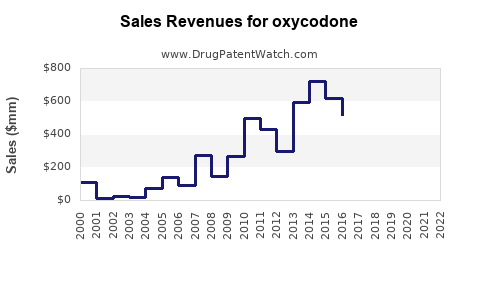
Drug Sales Revenue Trends for oxycodone
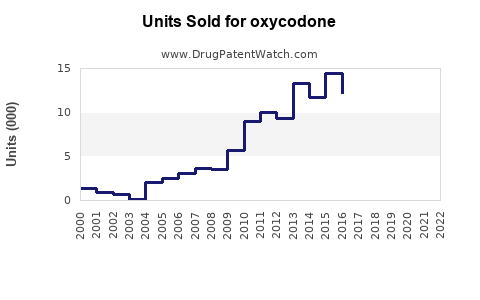
Drug Units Sold Trends for oxycodone

Annual Sales Revenues and Units Sold for oxycodone

These sales figures are drawn from a US national survey of drug expenditures

Market Analysis and Sales Projections for Oxycodone

Last updated: July 28, 2025

Introduction

Oxycodone, a potent opioid analgesic, is widely prescribed for the management of moderate to severe pain. Initially developed in the 1910s and introduced into clinical use in the 1930s, it has since become one of the most prescribed opioids globally. Its efficacy in pain relief has driven extensive medical adoption; however, the drug’s potential for misuse, dependence, and regulatory scrutiny has significantly shaped its market landscape. This report provides a comprehensive analysis of the current market environment for oxycodone and offers projections for its sales trajectory over the next five years.


Current Market Landscape

1. Market Size and Revenue

The global opioid analgesics market, including oxycodone, was valued at approximately USD 8.4 billion in 2022, with oxycodone accounting for a significant share due to its widespread prescription use. North America dominates this market, with the U.S. representing over 80% of global oxycodone sales owing to high prescription rates and prevalent pain management practices.[1]

2. Prescription Trends

Prescription volumes for oxycodone surged during the 2000s, driven by an emphasis on pain management. However, the opioid epidemic prompted stricter prescribing guidelines, led by the CDC’s 2016 guidelines, which aimed to curb over-prescription. Consequently, prescription rates declined marginally post-2016 but remain substantial, especially in specialized pain clinics and certain chronic pain patient populations.[2]

3. Key Players and Supply Chain Dynamics

Major pharmaceutical manufacturers include Purdue Pharma (notably its brand OxyContin), Teva Pharmaceuticals, and Mylan. Purdue Pharma’s bankruptcy and restructuring amid lawsuits have influenced supply and marketing practices. The supply chain maintains stability but faces pressure from regulatory agencies, law enforcement, and alternative pain management strategies.


Regulatory and Legal Environment

The regulatory landscape significantly impacts oxycodone sales. Post-2010, US authorities intensified oversight, fostering a decline in prescription volumes. Lawsuits targeting manufacturers have led to penalties and restructuring strategies encompassing marketing restrictions. Several countries, including Canada and parts of Europe, adhere to stricter opioid prescribing protocols, influencing local markets.[3]

The increasing focus on combating the opioid crisis has led to legislative measures that restrict opioid distribution, including prescription monitoring programs (PMPs) and prescription limits, which constrains market growth prospects.


Emerging Trends and Challenges

  • Shift Toward Abuse-Deterrent Formulations: The development and adoption of abuse-deterrent oxycodone formulations aim to minimize misuse and diversion. While these innovations may command premium pricing, their uptake may also reflect shifting reimbursement policies.

  • Alternative Pain Management Modalities: Non-opioid pain therapies, including gabapentinoids, nerve blocks, and non-pharmacological interventions, threaten oxycodone’s market share, especially in chronic pain management.

  • Regulatory Restrictions and Public Health Initiatives: Increasing restrictions and public health campaigns further dampen volume growth, emphasizing the importance of considering these factors in sales projections.


Market Segmentation and Geographic Analysis

  1. By Application

    • Acute Pain Management: Hospitals and emergency departments still utilize oxycodone extensively.
    • Chronic Pain Management: Represents the larger market share, though growth is hampered by regulatory restrictions.
    • Cancer Pain & Palliative Care: Continued reliance on oxycodone due to its efficacy.
  2. By Formulation

    • Immediate-Release (IR): Used for short-term or breakthrough pain.
    • Controlled-Release (CR/OxyContin): Preferred for long-term management but under scrutiny.
  3. Geographical Outlook

    • North America: Largest market, with sales driven by high prescription rates but facing regulatory headwinds.
    • Europe: Slower growth post-2010 due to strict prescribing policies.
    • Asia-Pacific: Emerging market with increasing demand attributed to expanding healthcare infrastructure.

Sales Projections (2023-2028)

Assumptions:

  • The global opioid market will witness modest growth driven by a focus on balanced pain management, despite regulatory challenges.
  • Revenue growth rates will be influenced by the degree of regulatory stringency, innovation adoption, and public health policies.
  • The decline in volume growth initially observed post-2016 will stabilize with new formulations and policy adaptations.

Forecasts:

Year Estimated Market Revenue (USD billion) Growth Rate (%) Notes
2023 USD 7.2 -2.5 Slight decline, stabilization post-2020s
2024 USD 7.4 2.8 Slow recovery with increased abuse-deterrent formulations
2025 USD 7.8 5.4 Market stabilization; innovation influence
2026 USD 8.2 5.1 Continued growth in emerging markets
2027 USD 8.6 4.9 Regulatory environment remains pivotal
2028 USD 9.0 4.7 Maturation phase; shifts toward non-opioid alternatives

Note: The projections assume that measures to address opioid misuse will keep prescription growth restrained but will gradually open opportunities for specialized formulations and safer delivery systems.


Key Drivers and Risks Affecting Sales

  • Drivers:

    • Persistent demand for effective pain relief.
    • Innovations in abuse-resistant formulations.
    • Expansion into emerging markets with increasing healthcare access.
    • Chronic pain prevalence epidemiology.
  • Risks:

    • Regulatory restrictions leading to decreased prescriptions.
    • Legal liabilities affecting manufacturers.
    • Alternative pain therapies under development.
    • Public health initiatives reducing opioid utilization.

Impact of COVID-19 Pandemic

The pandemic initially disrupted supply chains, labor availability, and healthcare access, resulting in short-term declines in prescriptions. However, telemedicine expansion and increased focus on pain management are likely to sustain demand levels in post-pandemic recovery phases.


Conclusion

Oxycodone’s market remains sizable but increasingly constrained by regulatory reforms, societal concerns, and the advent of alternative therapies. While current prescription volumes are stabilizing or declining in some jurisdictions, there remains a sustained, though cautious, demand, especially for formulations designed to mitigate abuse.


Key Takeaways

  • Market trajectory indicates modest growth over the next five years, with revenues projected to reach approximately USD 9 billion by 2028.
  • Regulatory landscape is the primary influence, with tightening controls tempering volume growth.
  • Innovation in formulations, particularly abuse-deterrent products, presents growth opportunities but may face reimbursement challenges.
  • Competitive dynamics shift as manufacturers adapt to legal and societal pressures, with emerging markets offering potential expansion.
  • Alternative therapies and public health initiatives pose long-term threats to traditional oxycodone sales, underscoring the importance of diversification strategies.

FAQs

1. How will regulatory changes impact oxycodone sales in the coming years?
Regulatory efforts, including stricter prescribing guidelines and monitoring programs, are likely to suppress prescription volumes initially but may foster innovation in abuse-resistant formulations, potentially offsetting declines to some extent.

2. Are there opportunities in emerging markets for oxycodone?
Yes, increasing healthcare infrastructure and rising prevalence of chronic pain conditions in Asia-Pacific and Latin America present growth opportunities, contingent upon local regulatory approvals and market penetration strategies.

3. How does the development of abuse-deterrent formulations influence sales?
Abuse-deterrent formulations may command premium prices and support continued market presence by addressing safety concerns, although their adoption depends on reimbursement policies and prescriber acceptance.

4. What role do alternative pain management strategies play?
Growing adoption of non-opioid modalities, such as nerve blocks, non-pharmacologic therapies, and new analgesics, can reduce reliance on oxycodone, potentially constraining future sales.

5. Will the opioid epidemic lead to the complete decline of oxycodone?
While the epidemic has led to significant regulatory and societal backlash, oxycodone remains vital for specific medical contexts like cancer pain and palliative care. It is unlikely to disappear entirely but will likely see a reshaped, more regulated market landscape.


References

[1] MarketWatch. "Global Opioid Analgesics Market." 2022.
[2] CDC. "Guideline for Prescribing Opioids for Chronic Pain." 2016.
[3] Drug Policy Alliance. "The Impact of Regulation on Opioid Market Dynamics." 2021.

More… ↓

⤷  Get Started Free

Make Better Decisions: Try a trial or see plans & pricing

Drugs may be covered by multiple patents or regulatory protections. All trademarks and applicant names are the property of their respective owners or licensors. Although great care is taken in the proper and correct provision of this service, thinkBiotech LLC does not accept any responsibility for possible consequences of errors or omissions in the provided data. The data presented herein is for information purposes only. There is no warranty that the data contained herein is error free. We do not provide individual investment advice. This service is not registered with any financial regulatory agency. The information we publish is educational only and based on our opinions plus our models. By using DrugPatentWatch you acknowledge that we do not provide personalized recommendations or advice. thinkBiotech performs no independent verification of facts as provided by public sources nor are attempts made to provide legal or investing advice. Any reliance on data provided herein is done solely at the discretion of the user. Users of this service are advised to seek professional advice and independent confirmation before considering acting on any of the provided information. thinkBiotech LLC reserves the right to amend, extend or withdraw any part or all of the offered service without notice.