Share This Page
Drug Sales Trends for ZYCLARA
✉ Email this page to a colleague
Payment Methods and Pharmacy Types for ZYCLARA (2018)
Revenues by Pharmacy Type
Units Sold by Pharmacy Type
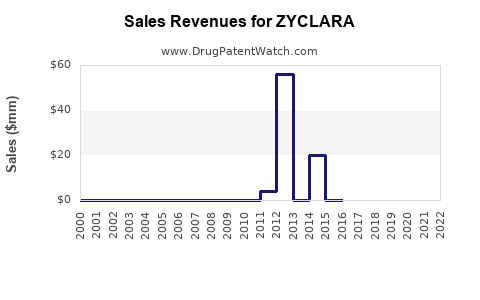
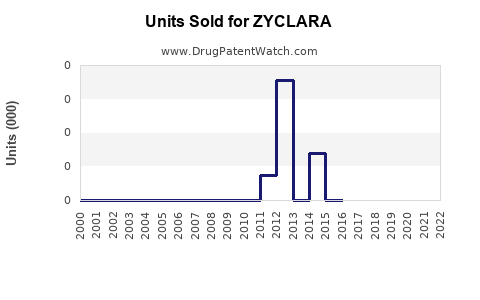
Annual Sales Revenues and Units Sold for ZYCLARA
| Drug Name | Revenues (USD) | Units | Year |
|---|---|---|---|
| ZYCLARA | ⤷ Start Trial | ⤷ Start Trial | 2022 |
| ZYCLARA | ⤷ Start Trial | ⤷ Start Trial | 2021 |
| ZYCLARA | ⤷ Start Trial | ⤷ Start Trial | 2020 |
| ZYCLARA | ⤷ Start Trial | ⤷ Start Trial | 2019 |
| ZYCLARA | ⤷ Start Trial | ⤷ Start Trial | 2018 |
| ZYCLARA | ⤷ Start Trial | ⤷ Start Trial | 2017 |
| >Drug Name | >Revenues (USD) | >Units | >Year |
Zyclara Market Analysis and Sales Projections
Zyclara, the branded imiquimod 3.75% cream for actinic keratosis, is a mature dermatology product with limited growth potential. Its commercial value is constrained by generic imiquimod competition, the availability of alternative actinic keratosis treatments, and the absence of meaningful exclusivity protection. Product-level Zyclara revenue is not separately disclosed by Bausch Health, so sales projections require scenario modeling rather than direct extrapolation from audited company data.
What is Zyclara and which patients does it treat?
Zyclara is a topical cream containing imiquimod 3.75%. The U.S. Food and Drug Administration approved it for the topical treatment of clinically typical, visible or palpable actinic keratoses on the full face or balding scalp in adults. The labeled regimen is two treatment cycles of once-daily application, separated by a two-week no-treatment period [1].
Zyclara differs from Aldara, the older imiquimod 5% product, in concentration, dosing schedule and labeled treatment area.
| Product | Active ingredient | Strength | Primary U.S. use | Typical treatment structure |
|---|---|---|---|---|
| Zyclara | Imiquimod | 3.75% | Actinic keratosis on full face or balding scalp | Two-week treatment, two-week break, two-week treatment |
| Aldara and generic equivalents | Imiquimod | 5% | Actinic keratosis, superficial basal cell carcinoma and external genital/perianal warts | Indication-specific schedules |
| Efudex and generics | Fluorouracil | 5% | Actinic keratosis and superficial skin lesions | Usually longer treatment courses |
| Picato | Ingenol mebutate | 0.015% or 0.05% | Actinic keratosis | Withdrawn from the U.S. market |
| Tirbanibulin | Tirbanibulin | 1% | Actinic keratosis | Five-day treatment course |
Zyclara’s commercial positioning is based on treatment of a broad facial or scalp field with a lower imiquimod concentration than Aldara. Its principal competitive advantage is convenience relative to some longer topical regimens, rather than a major difference in clinical mechanism.
What is the FDA regulatory status of Zyclara?
Zyclara was approved in the United States in 2010 under New Drug Application 022483. The FDA-approved label identifies imiquimod 3.75% cream as a prescription topical treatment for actinic keratosis in adults [1].
The product is not a biologic. Biosimilar competition is therefore irrelevant. Competitive entry occurs through the abbreviated new drug application, or ANDA, pathway for generic topical imiquimod.
The FDA regulatory profile is commercially mature:
| Regulatory factor | Zyclara assessment |
|---|---|
| FDA approval | Approved |
| Dosage form | Topical cream |
| Prescription status | Prescription |
| Biologic reference product | No |
| Biosimilar exposure | None |
| Generic pathway | ANDA |
| Primary market | United States |
| Regulatory growth driver | Limited |
| Regulatory risk | Generic substitution and labeling competition |
When does Zyclara lose exclusivity?
Zyclara’s meaningful market exclusivity has expired. The product was approved more than a decade ago, and any original regulatory exclusivity period has ended. Its commercial protection therefore depends on residual brand recognition, prescriber habits, distribution, payer positioning and any remaining formulation or method-of-use rights.
The relevant patent analysis is more complex than the FDA approval date. Imiquimod patents cover different compounds, formulations, concentrations and uses. A patent that covers imiquimod generally does not automatically block a generic 3.75% cream, while a formulation patent may be relevant only if its claims read on the generic product.
The practical conclusion is that Zyclara does not have a durable patent-based barrier comparable to a recently launched specialty drug.
What patents protect Zyclara?
Publicly available patent records associated with imiquimod and topical imiquimod products include patents covering imidazoquinoline compounds, pharmaceutical compositions and dermatological uses. Older foundational patents have largely reached or passed their natural expiration dates. Any later-listed patents would need to be assessed claim by claim against the generic formulation and proposed labeling.
The principal legal issues are:
- Whether a listed patent claims the 3.75% concentration or the vehicle used in Zyclara.
- Whether the generic applicant can certify that the patent is invalid, unenforceable or not infringed.
- Whether the generic label omits any protected indication or dosing instruction.
- Whether formulation differences create a non-infringement position.
A definitive current patent-expiration table cannot be established from company financial filings alone. The controlling source is the FDA Orange Book listing for NDA 022483 and any associated patent certifications [2].
How strong is the Zyclara patent estate?
Zyclara’s patent estate is commercially weak to moderate, with the main weakness arising from product age and the availability of alternative imiquimod products.
| Patent-strength factor | Assessment |
|---|---|
| Foundational active-ingredient protection | Expired or commercially exhausted |
| Product age | More than 14 years since approval |
| Formulation protection | Potentially relevant, but narrow |
| Method-of-use protection | Limited value against noninfringing generic labeling |
| Regulatory exclusivity | Expired |
| Generic substitution risk | High |
| Litigation leverage | Limited absent a live, claim-relevant patent |
| Manufacturing barrier | Low to moderate |
The most defensible commercial protections are likely to be formulation know-how, manufacturing consistency, packaging, supply reliability and brand familiarity. These protections can slow switching but do not prevent ANDA approval.
Which companies compete with Zyclara?
Zyclara competes in a crowded actinic keratosis market. Generic products are the largest structural threat because imiquimod is an established active ingredient with broad physician familiarity.
Direct competitors
- Generic imiquimod 3.75% cream, where available.
- Generic imiquimod 5% cream.
- Fluorouracil 5% cream and lower-strength fluorouracil products.
- Diclofenac sodium gel.
- Tirbanibulin ointment.
- Photodynamic therapy.
- Cryotherapy.
- Curettage and other office-based procedures.
Zyclara has a narrower competitive position than imiquimod as a molecule because many physicians can substitute another topical or procedural treatment based on lesion burden, tolerability, insurance coverage and patient adherence.
How does Zyclara compare with generic imiquimod?
| Commercial factor | Zyclara | Generic imiquimod |
|---|---|---|
| Brand | Branded | Generic |
| Active ingredient | Imiquimod | Imiquimod |
| Strength | 3.75% | Primarily 5%; 3.75% availability depends on market entrants |
| Price | Higher | Lower |
| Payer preference | Vulnerable to step therapy | Usually preferred |
| Patient familiarity | Established | Increasing |
| Promotional support | Limited | Limited |
| Substitution risk | High | N/A |
| Long-term growth | Negative to flat | Potentially positive through share capture |
The commercial distinction between branded and generic imiquimod is likely to narrow as payers prioritize lower-cost products.
What is the market size for Zyclara?
The addressable market is the U.S. actinic keratosis treatment market, not the entire dermatology market. Actinic keratosis is common among older adults and patients with cumulative ultraviolet exposure. The market includes prescription creams, office procedures and newer short-course topical products.
Zyclara’s realistic addressable segment is smaller than the total actinic keratosis market because:
- It is approved for the face and balding scalp.
- It is not interchangeable with every imiquimod indication.
- Many patients receive cryotherapy rather than field therapy.
- Generic and lower-cost topical alternatives are widely available.
- Payers can impose prior authorization or step therapy.
- Physicians may prefer fluorouracil or procedure-based treatment.
Zyclara is therefore a niche branded product within a large but highly competitive dermatology category.
What are Zyclara sales and revenue projections?
Bausch Health does not consistently report Zyclara as a standalone revenue line in its public financial disclosures. The product is generally included within broader dermatology or prescription-product reporting. As a result, product-level revenue cannot be verified from consolidated annual reports [3].
The following projections are scenario estimates for U.S. net sales, not reported company guidance.
Zyclara U.S. net-sales projection
| Year | Downside case | Base case | Upside case |
|---|---|---|---|
| 2024 | $1 million | $4 million | $7 million |
| 2025 | $0.7 million | $3.2 million | $6 million |
| 2026 | $0.4 million | $2.6 million | $5.2 million |
| 2027 | $0.2 million | $2.1 million | $4.5 million |
| 2028 | $0.1 million | $1.7 million | $3.9 million |
| 2029 | De minimis | $1.4 million | $3.4 million |
| 2030 | De minimis | $1.2 million | $3 million |
The base case assumes annual erosion of approximately 12% to 18%, driven by generic substitution and declining brand promotion. The upside case assumes continued availability, stable reimbursement and limited direct competition from generic 3.75% products. The downside case assumes broad payer exclusion, supply disruption or a generic entrant with comparable dosing and labeling.
These estimates imply that Zyclara is unlikely to become a material growth driver for Bausch Health. Its value is more likely to come from incremental dermatology revenue and portfolio completeness than from standalone sales expansion.
What drives Zyclara revenue?
The key sales variables are:
- Generic imiquimod 3.75% entry and launch timing.
- The wholesale acquisition price differential between Zyclara and generic products.
- Formulary placement and prior-authorization requirements.
- Physician preference for field therapy versus cryotherapy.
- Patient adherence to the two-cycle treatment schedule.
- Availability of samples, copay assistance and dermatology sales support.
- Bausch Health’s strategic decision to continue active promotion.
What generic launch risks exist for Zyclara?
Generic entry is the central commercial risk. A generic applicant could challenge an Orange Book-listed patent through a Paragraph IV certification, asserting that the patent is invalid, unenforceable or not infringed. If the brand owner brings patent litigation within the statutory period, FDA approval may be subject to a 30-month stay, subject to statutory exceptions and court developments [2].
The likely generic launch scenarios are:
| Scenario | Commercial effect |
|---|---|
| No direct 3.75% generic | Gradual erosion from 5% imiquimod and competing therapies |
| One 3.75% generic | Rapid payer-driven substitution |
| Multiple 3.75% generics | Price compression and sharp brand decline |
| Authorized generic | Faster erosion with limited market disruption |
| Patent litigation settlement | Delayed entry with a defined launch date |
| Formulation non-infringement | Potential early entry if FDA requirements are satisfied |
Because Zyclara is a topical cream, substitution dynamics may depend on vehicle, strength, application instructions and state-level pharmacy substitution rules. A generic with the same strength but a materially different vehicle may not produce a fully automatic substitution pattern in every commercial channel.
What patent litigation or settlement agreements affect Zyclara?
No major, currently disclosed Zyclara litigation outcome is reflected in the principal company financial disclosures cited here. The absence of a prominent public settlement does not eliminate the possibility of ANDA certifications, confidential commercial agreements or patent disputes in federal court.
The key litigation variables are:
- Whether any Orange Book patent remains listed.
- Whether an ANDA applicant files a Paragraph IV certification.
- Whether the brand owner sues within the statutory period.
- Whether the court grants a preliminary injunction.
- Whether a settlement establishes a future generic-entry date.
- Whether the generic applicant uses a different cream vehicle or label.
For valuation purposes, the most important event is not historical patent litigation but the first credible direct generic launch announcement.
What is the commercial outlook for Zyclara?
Zyclara has a defensive rather than growth-oriented profile. The product can retain revenue through brand familiarity, prescriber continuity and patients who prefer its established dosing regimen. Those advantages are insufficient to support sustained growth in a market with generic imiquimod and several non-imitative therapies.
The most probable outcome is a gradual decline in U.S. sales, followed by a low-revenue maintenance phase. A direct generic 3.75% launch would accelerate the decline and could reduce branded revenue by more than half within two to three years, depending on payer adoption and inventory conditions.
International revenue is unlikely to materially change the conclusion. Imiquimod is marketed in multiple countries, but regulatory approvals, reimbursement and brand ownership vary by jurisdiction. Geographic expansion is not a clear growth catalyst for a product with an aging U.S. commercial base.
Key Takeaways
- Zyclara is an FDA-approved imiquimod 3.75% cream for actinic keratosis on the full face or balding scalp.
- Its regulatory exclusivity has expired, and generic competition is the principal commercial risk.
- Bausch Health does not separately disclose audited Zyclara revenue.
- A reasonable base-case estimate places U.S. sales at roughly $4 million in 2024, declining to about $1 million to $2 million by 2030.
- The product’s patent estate is unlikely to provide durable protection unless a live formulation patent remains listed and survives an ANDA challenge.
- Biosimilar risk does not apply because Zyclara is a small-molecule topical drug.
- Zyclara is unlikely to be a material growth contributor to Bausch Health.
- A direct generic 3.75% launch would be the main catalyst for accelerated revenue erosion.
FAQs
Is Zyclara still available in the United States?
Zyclara has an FDA-approved product history and remains associated with Bausch Health’s dermatology portfolio. Commercial availability can vary by pharmacy, wholesaler and payer channel.
Is Zyclara stronger than Aldara?
No. Zyclara contains imiquimod 3.75%, while Aldara contains imiquimod 5%. Strength alone does not determine comparative clinical effectiveness because the products use different treatment schedules and labeled indications.
Can patients substitute generic imiquimod for Zyclara?
Substitution depends on the generic’s strength, formulation, FDA-approved labeling, state pharmacy law and payer rules. Generic imiquimod 5% is not automatically identical to Zyclara 3.75%.
Does Zyclara have orphan-drug or pediatric exclusivity?
Zyclara is not an orphan-drug product for its actinic keratosis indication. No continuing pediatric exclusivity is expected to provide material commercial protection for the mature product.
What would increase Zyclara’s valuation?
The most material positive factors would be continued absence of a direct 3.75% generic, stable payer coverage, reliable product supply and sustained physician use of its facial and scalp dosing regimen.
References
- U.S. Food and Drug Administration. (2010). Zyclara (imiquimod) cream, 3.75% prescribing information.
- U.S. Food and Drug Administration. (2024). Approved drug products with therapeutic equivalence evaluations: Orange Book.
- Bausch Health Companies Inc. (2024). Annual report on Form 10-K for the year ended December 31, 2023. U.S. Securities and Exchange Commission.
More… ↓
