Share This Page
Drug Sales Trends for VARENICLINE
✉ Email this page to a colleague
Payment Methods and Pharmacy Types for VARENICLINE (2018)
Revenues by Pharmacy Type
Units Sold by Pharmacy Type
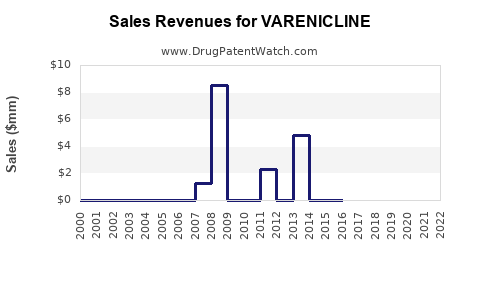
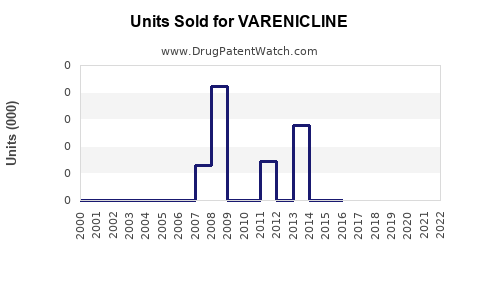
Annual Sales Revenues and Units Sold for VARENICLINE
| Drug Name | Revenues (USD) | Units | Year |
|---|---|---|---|
| VARENICLINE | ⤷ Start Trial | ⤷ Start Trial | 2022 |
| VARENICLINE | ⤷ Start Trial | ⤷ Start Trial | 2021 |
| VARENICLINE | ⤷ Start Trial | ⤷ Start Trial | 2020 |
| VARENICLINE | ⤷ Start Trial | ⤷ Start Trial | 2019 |
| VARENICLINE | ⤷ Start Trial | ⤷ Start Trial | 2018 |
| VARENICLINE | ⤷ Start Trial | ⤷ Start Trial | 2017 |
| >Drug Name | >Revenues (USD) | >Units | >Year |
Varenicline Market Analysis and Sales Projections Through 2030
Varenicline is a mature smoking-cessation drug with strong clinical efficacy, broad generic availability, and limited pricing power. The market shifted from Pfizer’s high-value Chantix franchise to a fragmented generic market after U.S. generic approvals and the 2021 nitrosamine-related recall. Global varenicline sales are likely to remain below the product’s pre-generic peak unless smoking-cessation policy, reimbursement, or obesity-drug-adjacent health programs materially expand prescription demand.
A base-case model estimates global varenicline product sales of approximately $180 million to $230 million in 2025, rising to $230 million to $320 million by 2030. The forecast reflects volume growth, generic price erosion, Pfizer’s reduced commercial role, and renewed availability of varenicline products.
What is varenicline and how is it used?
Varenicline is a prescription partial agonist at the alpha-4 beta-2 nicotinic acetylcholine receptor. It reduces nicotine craving and withdrawal symptoms while lowering the rewarding effects of smoking. Pfizer commercialized the product in the United States as Chantix and in some markets as Champix.
The U.S. Food and Drug Administration approved Chantix in 2006 for smoking cessation in adults. The treatment is generally initiated before a target quit date and titrated during the first week. Standard treatment lasts 12 weeks, with an additional 12 weeks used in some patients to reduce relapse risk.
Varenicline competes with:
- Nicotine replacement therapy, including patches, gum, lozenges, inhalers and nasal spray
- Bupropion, marketed in smoking cessation as Zyban
- Behavioral counseling and digital cessation programs
- Cytisine, where approved
- Over-the-counter and prescription combination cessation regimens
Varenicline is usually positioned as a premium prescription option relative to generic nicotine replacement products, but generic entry has sharply reduced the price differential.
How large is the varenicline market?
The commercially relevant market has three layers:
- Global smoking-cessation medicines
- Prescription smoking-cessation medicines
- Varenicline products, including branded and generic versions
Public market reports often combine nicotine replacement, prescription drugs, digital therapeutics and counseling. Those totals should not be treated as varenicline sales. Varenicline is a single-molecule segment inside a much larger smoking-cessation market.
Estimated 2025 market structure
| Segment | Estimated 2025 global sales | Market characteristics |
|---|---|---|
| Nicotine replacement therapy | $2.5 billion-$3.5 billion | Large OTC and retail pharmacy segment |
| Prescription cessation medicines | $350 million-$600 million | Concentrated in North America, Europe and selected Asian markets |
| Varenicline products | $180 million-$230 million | Generic-dominated, low-to-moderate growth |
| Pfizer Chantix/Champix | Less than $100 million | Regional availability and reduced commercial concentration |
| Other generic varenicline | $100 million-$160 million | Price competition and tender-driven sales |
These figures are analytical estimates rather than reported market totals. Product-level generic revenue is not disclosed consistently by manufacturers, distributors or national health systems.
What were Chantix sales before generic competition?
Pfizer reported Chantix global revenue of approximately $919 million in 2020, before the full impact of generic competition and the product recall. That level represented the commercial peak of the originator franchise in a relatively mature therapeutic category (Pfizer, 2021).
The franchise then faced two simultaneous pressures:
- FDA approval of generic varenicline products in 2021
- Pfizer’s 2021 recall and temporary distribution interruption related to nitrosamine contamination concerns
Pfizer reported substantial disruption to Chantix availability after the recall. The company later resumed distribution in selected markets after reformulation and testing. The interruption accelerated substitution toward generic varenicline and nicotine replacement therapy.
Historical commercial timeline
| Year | Event | Commercial effect |
|---|---|---|
| 2006 | FDA approves Chantix in the U.S. | Pfizer establishes a prescription smoking-cessation franchise |
| 2016 | European regulatory actions address neuropsychiatric labeling concerns | Prescribing restrictions ease relative to earlier warnings |
| 2020 | Pfizer reports approximately $919 million in Chantix revenue | Pre-generic commercial peak |
| 2021 | FDA approves first generic varenicline products; Pfizer recalls Chantix lots | Originator supply interruption and rapid substitution |
| 2022 | Generic supply expands; Pfizer resumes selected Chantix distribution | Price compression and lower branded share |
| 2023-2025 | Generic market becomes established | Volume depends on reimbursement, smoking prevalence and public-health programs |
What are the varenicline sales projections for 2025 to 2030?
The base case assumes continued generic substitution, stable or modestly declining smoking prevalence in developed markets, higher prescription use among smokers attempting to quit, and no major new branded formulation.
Global varenicline sales forecast
| Year | Bear case | Base case | Bull case |
|---|---|---|---|
| 2025 | $150 million | $205 million | $275 million |
| 2026 | $145 million | $215 million | $295 million |
| 2027 | $145 million | $230 million | $320 million |
| 2028 | $150 million | $245 million | $345 million |
| 2029 | $155 million | $265 million | $375 million |
| 2030 | $160 million | $285 million | $410 million |
The base case represents approximately 5.7% compound annual growth from 2025 to 2030. That growth is primarily volume-led. Average selling prices are expected to decline or remain flat because generic suppliers compete through pharmacy contracts, government tenders and health-system formularies.
Forecast assumptions
The base case assumes:
- Global adult smoking prevalence continues to decline gradually.
- Prescription cessation treatment expands in markets with stronger reimbursement.
- Varenicline retains a clinical advantage over bupropion for many patients.
- Generic manufacturers maintain adequate supply.
- Pfizer remains a secondary commercial participant rather than restoring the pre-2021 Chantix model.
- No major safety event causes a new class-wide withdrawal.
- Cytisine adoption remains regionally concentrated and does not displace varenicline globally.
The bull case requires broader use of pharmacologic cessation treatment, stronger reimbursement, increased quit attempts, and improved access through primary care and public-health programs. The bear case assumes continued preference for low-cost nicotine replacement therapy, limited physician prescribing and persistent generic price compression.
Which companies sell varenicline?
The commercial field is fragmented. Pfizer remains associated with Chantix, but generic suppliers determine much of the accessible market.
Originator and generic participants
| Company | Product or role | Commercial position |
|---|---|---|
| Pfizer | Chantix | Originator brand; reduced share after generic entry and recall |
| Teva Pharmaceuticals | Generic varenicline | Major U.S. generic supplier |
| Apotex | Generic varenicline | Generic supply in selected markets |
| Dr. Reddy’s Laboratories | Generic varenicline | Generic supply and regulated-market participation |
| Par Pharmaceutical/Endo | Generic varenicline | U.S. generic market participation |
| Other regional manufacturers | Generic varenicline | Important in Europe, Asia and tender markets |
The competitive landscape varies by country. A company can hold a meaningful share in one national market while having little presence elsewhere. Manufacturer revenue is difficult to compare because varenicline may be bundled into broader generic portfolios.
What is the FDA regulatory status of varenicline?
Varenicline is an FDA-approved prescription drug. The reference product is Chantix, approved under New Drug Application 021928. FDA-approved generic versions are available through abbreviated new drug applications.
The 2021 supply disruption followed detection of nitrosamine impurities in certain Chantix lots. Pfizer recalled affected lots and later resumed distribution after product testing and manufacturing adjustments. The episode created a temporary supply shock but did not remove varenicline from the FDA-approved treatment market.
The FDA has also communicated that the neuropsychiatric risk profile of varenicline was lower than initially indicated in earlier postmarketing reports. The agency removed the boxed warning from the Chantix label in 2016 while retaining other warnings and precautions (FDA, 2016).
What is the Orange Book status of Chantix and generic varenicline?
Chantix is listed in the FDA Orange Book as the reference drug for varenicline tartrate tablets. Generic applicants rely on the reference product’s safety and efficacy findings through the ANDA pathway.
The key commercial facts are:
- Varenicline is a small molecule, not a biologic.
- Biosimilar regulation does not apply.
- The principal competitive pathway is generic substitution under the ANDA framework.
- The original composition and formulation exclusivity period has expired.
- Current market protection depends more on manufacturing, supply reliability, regulatory compliance, contracting and distribution than on core molecule patents.
Orange Book patent listings and exclusivity entries can change through regulatory updates. Market participants should distinguish expired core patents from any later-listed patents covering specific formulations, manufacturing processes or approved uses.
When did varenicline lose exclusivity?
The practical loss of exclusivity occurred in 2021 when FDA-approved generic varenicline products entered the U.S. market. Any remaining commercial value in Chantix therefore depends on brand preference, supply reliability, payer coverage and geographic markets where generic substitution is weaker.
The originator’s earlier patent protection no longer provides a meaningful barrier to standard generic varenicline tablets. Later patents, where applicable, would need to cover a non-obvious formulation, manufacturing process or other differentiated product feature to create material exclusionary value.
What patent litigation and Paragraph IV risks affect varenicline?
Varenicline’s main patent risk is low for the standard tablet market because generic entry has already occurred. Earlier ANDA litigation and Paragraph IV certifications were relevant before launch, but they no longer create the same strategic uncertainty as they would for a pre-generic product.
Current legal risk profile
| Risk area | Assessment | Commercial implication |
|---|---|---|
| Core molecule patent | Low | Standard generic entry is established |
| Standard tablet formulation | Low to moderate | Limited ability to exclude approved generics |
| New salt or dosage form | Moderate | Could support a differentiated product if clinically meaningful |
| Manufacturing process | Moderate | Usually affects a specific supplier, not the full market |
| Method-of-use patent | Low to moderate | Narrow claims may face validity and infringement challenges |
| Supply-chain compliance | Moderate to high | Recalls or manufacturing failures can create temporary shortages |
| Brand infringement litigation | Low | Generic market is already active |
A new varenicline formulation could create greater protection if it improves tolerability, adherence, dosing convenience or stability. A formulation patent would not automatically block existing immediate-release generic tablets.
Are there formulation patents or method-of-use patents for varenicline?
The standard commercial product is an oral tablet containing varenicline tartrate. Potential follow-on intellectual-property strategies include:
- Extended-release tablets
- Orally disintegrating tablets
- Lower-dose titration products
- Combination products with nicotine replacement
- Improved stability or impurity-control processes
- Pediatric or adolescent cessation methods
- Digital adherence systems linked to prescription use
Method-of-use patents are commercially weaker when the underlying treatment method is already well established and physicians routinely use the drug for the claimed purpose. Enforceability depends on claim scope, written description, obviousness, induced infringement and the prescribing behavior associated with the patented method.
No formulation strategy should be valued as a durable market barrier without evidence of regulatory approval, issued claims and a commercially differentiated product.
How does varenicline compare with bupropion and nicotine replacement therapy?
| Attribute | Varenicline | Bupropion | Nicotine replacement |
|---|---|---|---|
| Regulatory status | Prescription | Prescription | Mostly OTC, with some prescription forms |
| Core mechanism | Partial nicotinic receptor agonist | Dopamine and norepinephrine reuptake inhibition | Replaces nicotine |
| Generic availability | Yes | Yes | Yes |
| Typical pricing power | Low after generic entry | Low | Very low to moderate |
| Physician involvement | Required in many markets | Required in many markets | Often limited |
| Main commercial strength | Efficacy and prescription positioning | Alternative for selected patients | Accessibility and consumer familiarity |
| Main weakness | Prescription access and prior supply disruption | Contraindications and lower demand | Adherence and lower treatment persistence |
Varenicline’s main commercial advantage is clinical positioning. Its main commercial disadvantage is that generic pricing has removed much of the economic premium historically attached to Chantix.
What geographic markets offer the strongest growth?
The United States remains commercially important because of prescription volume, payer infrastructure and historical Chantix adoption. It is also the most price-competitive market.
Europe offers a mixed outlook. Smoking prevalence varies substantially by country, and national reimbursement and tender systems can produce meaningful volume at low prices. The United Kingdom and selected Central and Eastern European markets may provide volume opportunities, but branded pricing is generally constrained.
Asia-Pacific has the largest long-term volume potential because of population size and smoking prevalence. Commercial conversion depends on regulatory approvals, physician awareness, reimbursement and out-of-pocket affordability. China and other large Asian markets are more likely to favor local generic manufacturers and lower price points.
Regional forecast, 2030 base case
| Region | Estimated 2030 sales | Growth profile |
|---|---|---|
| North America | $90 million-$115 million | Stable prescriptions, intense generic pricing |
| Europe | $70 million-$90 million | Public-health programs and tender volume |
| Asia-Pacific | $85 million-$115 million | Highest volume potential, lower unit prices |
| Latin America and other markets | $25 million-$40 million | Uneven regulatory and reimbursement access |
| Total | $270 million-$360 million | Volume growth offset by price erosion |
What licensing deals could affect varenicline sales?
No widely disclosed recent licensing transaction has restored a blockbuster commercial model for standard varenicline. Licensing activity is more likely to involve:
- Regional commercialization rights
- Generic supply and distribution agreements
- Contract manufacturing
- Combination products
- Digital cessation programs
- Public-health procurement contracts
The most valuable licensing opportunity would involve a differentiated delivery system or combination therapy with regulatory and reimbursement advantages. A license covering ordinary immediate-release generic varenicline would have limited economic value unless it includes scarce manufacturing capacity or access to a major tender channel.
What generic launch scenarios exist for varenicline?
Base scenario
Multiple generic manufacturers remain active. Prices decline gradually, supply remains adequate and total prescriptions grow modestly. Pfizer retains a small branded segment in selected markets.
Upside scenario
Governments expand funded smoking-cessation programs, primary-care prescribing increases and varenicline becomes more accessible through digital or pharmacy-based services. Volume grows faster than price declines.
Downside scenario
Nicotine replacement dominates low-cost cessation programs, generic suppliers reduce participation because of low margins, and varenicline prescriptions remain concentrated among specialist or highly motivated quitters.
The most important near-term variable is not patent expiry. It is the balance between prescription demand and generic manufacturing economics.
How strong is the varenicline patent estate?
The patent estate is weak for the unmodified molecule and standard tablet. Core exclusivity has expired, generic products are approved and substitution is established.
The estate could be stronger for:
- New controlled-release formulations
- Combination products
- Improved impurity-control manufacturing
- Novel delivery technologies
- Clinically supported dosing regimens
A follow-on patent estate would need regulatory differentiation and a clear reimbursement case. Without those elements, patent protection alone is unlikely to produce substantial sales.
What revenue exposure do manufacturers face?
Pfizer has the greatest historical exposure but not necessarily the greatest future exposure. Its pre-generic Chantix revenue demonstrates the product’s former commercial scale, while the current market is distributed among generic manufacturers with lower per-unit revenue.
For generic companies, varenicline is more likely to be a portfolio product than a standalone revenue driver. The principal risks are:
- Low prices
- Manufacturing interruptions
- Nitrosamine or other impurity findings
- Pharmacy benefit manager contracting
- National tender losses
- Declining smoking prevalence
- Competition from OTC nicotine replacement
A manufacturer with reliable supply and broad distribution can gain share during shortages, but shortage-driven revenue is usually temporary.
Key Takeaways
- Varenicline is a mature, generic-dominated smoking-cessation market.
- Pfizer’s Chantix reached approximately $919 million in global revenue in 2020 before generic entry and the recall-related disruption.
- Generic varenicline entered the U.S. market in 2021.
- Estimated global varenicline sales are approximately $180 million to $230 million in 2025.
- Base-case sales are projected at approximately $230 million to $320 million by 2030.
- Growth will depend on prescription volume, reimbursement and public-health programs, not on core patent protection.
- Biosimilar risk does not apply because varenicline is a small-molecule drug.
- Standard tablet patent risk is low; differentiated formulations and manufacturing technologies offer the main follow-on IP opportunities.
- The strongest commercial opportunity is higher treatment volume through primary care, pharmacies and government cessation programs.
- Generic price erosion will limit revenue growth even if prescription volume increases.
FAQs
Is varenicline still commercially attractive after generic entry?
Yes, but mainly as a volume product. Commercial attractiveness depends on manufacturing cost, supply reliability, reimbursement access and distribution scale rather than premium pricing.
Can a new varenicline formulation obtain market exclusivity?
A new formulation may obtain patent protection and, if sufficiently differentiated, regulatory exclusivity. The product would need a credible clinical, adherence or tolerability advantage to support pricing above standard generic tablets.
Does varenicline have biosimilar competition?
No. Varenicline is a chemically synthesized small molecule, so competition occurs through generic-drug regulation rather than the biosimilar pathway.
What caused the 2021 Chantix supply disruption?
Pfizer recalled certain Chantix lots after detection of nitrosamine impurities. The recall reduced branded supply and accelerated substitution toward generic varenicline and nicotine replacement therapy.
Will smoking prevalence decline reduce varenicline sales?
Not necessarily in the short term. Lower smoking prevalence reduces the addressable population, but greater treatment penetration, stronger cessation reimbursement and more quit attempts can offset part of that decline.
References
-
U.S. Food and Drug Administration. (2006). FDA approves Chantix to help adults quit smoking. FDA.
-
U.S. Food and Drug Administration. (2016). FDA removes boxed warning about serious mental health side effects from Chantix. FDA.
-
U.S. Food and Drug Administration. (2021). FDA approves first generic versions of Chantix to help adults quit smoking. FDA.
-
U.S. Food and Drug Administration. (2021). Pfizer expands voluntary recall of Chantix tablets due to presence of nitrosamine impurity. FDA.
-
Pfizer Inc. (2021). 2020 annual review. Pfizer.
-
Centers for Disease Control and Prevention. (2024). Current cigarette smoking among adults in the United States. CDC.
-
World Health Organization. (2023). WHO report on the global tobacco epidemic 2023. World Health Organization.
-
U.S. Food and Drug Administration. (2025). Approved drug products with therapeutic equivalence evaluations: Orange Book. FDA.
More… ↓
