Drug Sales Trends for ROCALTROL
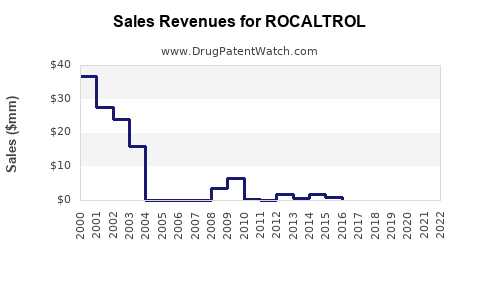
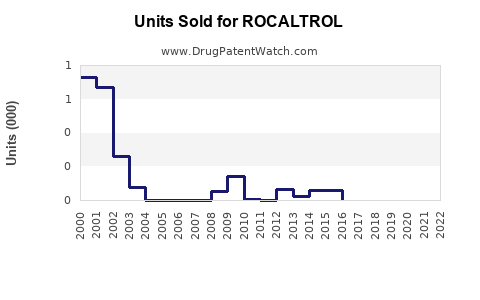
Annual Sales Revenues and Units Sold for ROCALTROL
| Drug Name | Revenues (USD) | Units | Year |
|---|---|---|---|
| ROCALTROL | ⤷ Start Trial | ⤷ Start Trial | 2022 |
| ROCALTROL | ⤷ Start Trial | ⤷ Start Trial | 2021 |
| ROCALTROL | ⤷ Start Trial | ⤷ Start Trial | 2020 |
| ROCALTROL | ⤷ Start Trial | ⤷ Start Trial | 2019 |
| ROCALTROL | ⤷ Start Trial | ⤷ Start Trial | 2018 |
| ROCALTROL | ⤷ Start Trial | ⤷ Start Trial | 2017 |
| ROCALTROL | ⤷ Start Trial | ⤷ Start Trial | 2016 |
| >Drug Name | >Revenues (USD) | >Units | >Year |
ROCALTROL Market Analysis, Sales Projections, Patent Status, and Competitive Outlook
ROCALTROL is an established calcitriol product with limited branded commercial upside. Its active ingredient, calcitriol, is a genericized small molecule with no meaningful remaining composition-of-matter exclusivity. Revenue is concentrated in niche uses such as dialysis-related mineral-bone disease and hypoparathyroidism. The main commercial risk is substitution by generic calcitriol, alternative vitamin D analogs, and newer treatment protocols that reduce routine calcitriol use in non-dialysis chronic kidney disease.
The base-case outlook is declining low-single-digit annual revenue for the branded product through 2030. Generic calcitriol demand should remain comparatively stable because of chronic use, low unit prices, and continued prescribing in dialysis and endocrine indications.
What is ROCALTROL and how is it used?
ROCALTROL is an oral formulation of calcitriol, the active hormonal form of vitamin D3. It increases intestinal calcium absorption and regulates calcium and phosphate metabolism.
The product has historically been marketed in:
| Product attribute | ROCALTROL profile |
|---|---|
| Active ingredient | Calcitriol |
| Drug class | Active vitamin D analog |
| Typical dosage forms | Oral capsules and oral solution |
| Common capsule strengths | 0.25 mcg and 0.5 mcg |
| Prescription status | Prescription medicine |
| Primary medical uses | Chronic kidney disease-related mineral and bone disorders, hypoparathyroidism, pseudohypoparathyroidism |
| Principal safety concern | Hypercalcemia and hyperphosphatemia |
| Commercial category | Mature, genericized specialty medicine |
Calcitriol is used in patients whose kidneys cannot adequately convert vitamin D into its active form or who have impaired calcium regulation. The product is especially relevant in dialysis populations and selected endocrine disorders.
Current clinical practice has narrowed its use in non-dialysis chronic kidney disease. KDIGO guidance discourages routine use of calcitriol and vitamin D analogs in adults with chronic kidney disease stages G3a to G5 who are not on dialysis, except in severe and progressive hyperparathyroidism.[1]
What is the FDA regulatory status of ROCALTROL?
ROCALTROL is an established FDA-approved calcitriol product, but commercial availability differs by market and dosage form. The U.S. market has generic calcitriol products that compete directly with the brand.
The principal regulatory characteristics are:
- FDA-approved active ingredient with long clinical history.
- No biologic license application and no biosimilar pathway.
- Generic competition through abbreviated new drug applications.
- Oral dosage forms that can be substituted at the pharmacy where state law and formulary rules permit.
- Safety monitoring focused on serum calcium, phosphate, and parathyroid hormone levels.
Calcitriol is not a biologic. Biosimilar risk is therefore irrelevant. The relevant substitution risk is generic-drug competition under the Hatch-Waxman framework.
The product's commercial status should be evaluated separately by country because legacy brand listings, authorized generics, local distributors, and temporary supply interruptions can change availability without changing the underlying regulatory status.
What patents protect ROCALTROL and when does calcitriol lose exclusivity?
No commercially meaningful U.S. composition-of-matter patent protection remains for calcitriol. The molecule was developed and commercialized decades ago, and any original compound or early formulation patents have expired.
| Exclusivity category | ROCALTROL status |
|---|---|
| Composition-of-matter patent | Expired |
| Original formulation protection | Expired or commercially immaterial |
| FDA new chemical entity exclusivity | Expired |
| Pediatric exclusivity | Not commercially relevant |
| Orphan exclusivity | No current product-level exclusivity identified |
| Active Orange Book patent barrier | No material current barrier expected |
| Generic entry | Established |
The Orange Book is the relevant U.S. source for listed patents and regulatory exclusivity. For a mature product such as ROCALTROL, the principal legal question is not whether a new generic can enter, but whether a specific manufacturer has current approval, supply capacity, and a commercially viable product.
No active patent estate is expected to protect ordinary calcitriol capsules from generic entry. Any later patents would need to cover a distinct formulation, delivery system, manufacturing process, or method of use. Such patents would not necessarily block standard generic calcitriol capsules.
What is the Orange Book status of ROCALTROL?
The commercial value of any historical Orange Book listing is limited because generic calcitriol products are already marketed. Orange Book records may contain legacy product entries, discontinued products, or historical patent information, but those records do not create present-day exclusivity by themselves.[2]
For diligence purposes, the relevant conclusions are:
- ROCALTROL is not protected by an unexpired basic-molecule patent.
- Generic calcitriol products have already entered the U.S. market.
- Any remaining listed patent would need to be tested against the specific dosage form and approved labeling.
- A Paragraph IV challenge is unlikely to be strategically important for the original brand because generic entry has already occurred.
Are there Paragraph IV challenges or patent litigation affecting ROCALTROL?
No major current Paragraph IV litigation is central to the ROCALTROL market. Paragraph IV litigation is most commercially relevant before first generic entry, when a patent holder can delay approval through the statutory stay. That stage has passed for ordinary calcitriol products.
The current legal environment is more likely to involve:
- Manufacturing and supply disputes.
- Product-liability claims related to hypercalcemia.
- Labeling or pharmacovigilance matters.
- Contract disputes among brand owners, distributors, and generic manufacturers.
- State substitution and reimbursement disputes.
There is no known settlement agreement that creates a material current barrier to generic calcitriol commercialization. Any historic Hatch-Waxman settlement would have limited impact because the market already includes generic products.
What formulations are protected by ROCALTROL patents?
The historical commercial formulations are conventional oral calcitriol capsules and oral solution. Those formulations have limited defensibility because they are technically established and can be reproduced through standard pharmaceutical manufacturing.
Potentially differentiated formulation areas could include:
- Modified-release calcitriol.
- Liquid formulations with improved stability.
- Unit-dose packaging.
- Pediatric liquid delivery.
- Combination products with calcium or phosphate-management agents.
- Long-acting injectable or implantable delivery systems.
These concepts could support new patents only if they satisfy novelty, non-obviousness, enablement, and other applicable legal standards. They would not automatically extend protection for standard ROCALTROL capsules.
The technical barrier to entry is moderate rather than high. Calcitriol is highly potent, so low-dose manufacturing requires accurate content uniformity, validated analytical methods, and careful contamination controls. These requirements raise quality-assurance demands but do not create a durable barrier comparable to complex biologics or sterile injectables.
How large is the ROCALTROL and calcitriol market?
The branded ROCALTROL market is small relative to major nephrology and endocrine products. Public company filings generally do not disclose standalone ROCALTROL revenue, which limits direct verification of brand sales. Commercial value is better assessed through prescription volume, generic share, reimbursement, and institutional use.
The broader calcitriol market has four principal demand pools:
| Demand segment | Commercial outlook |
|---|---|
| Dialysis-related mineral-bone disease | Durable but price-sensitive |
| Hypoparathyroidism | Smaller, specialty-driven market |
| Pseudohypoparathyroidism | Very small but clinically specialized |
| Non-dialysis CKD | Structurally constrained by treatment guidelines |
Dialysis demand provides the most stable base because patients require long-term management and nephrology practices use active vitamin D compounds in selected cases. The segment remains exposed to protocol changes and the use of paricalcitol, doxercalciferol, calcimimetics, or other approaches.
Hypoparathyroidism is a smaller but potentially higher-value segment. Competition includes calcium and conventional vitamin D, recombinant parathyroid hormone therapies where available, and other endocrine management strategies.
What are the ROCALTROL sales projections through 2030?
The following projection is an analyst scenario for branded ROCALTROL revenue, not reported company guidance. It assumes continued generic substitution, no successful reformulation, no new indication, and stable use in dialysis and hypoparathyroidism.
| Year | Base-case brand revenue index | Base-case annual change | Commercial interpretation |
|---|---|---|---|
| 2024 | 100 | -- | Mature genericized brand |
| 2025 | 96 | -4% | Ongoing substitution and formulary pressure |
| 2026 | 92 | -4% | Lower brand retention |
| 2027 | 88 | -4% | Stable clinical demand, declining brand share |
| 2028 | 84 | -5% | Generic and alternative analog competition |
| 2029 | 80 | -5% | Increasingly niche brand economics |
| 2030 | 76 | -5% | Residual specialty and continuity-of-care demand |
A dollar-based scenario can be expressed using a 2024 brand-sales starting range:
| Scenario | 2024 estimated brand sales | 2030 estimated brand sales | 2024-2030 CAGR |
|---|---|---|---|
| Downside | $5 million | $2.5 million | Approximately -11% |
| Base case | $10 million | $7.6 million | Approximately -4% |
| Upside | $20 million | $18 million | Approximately -2% |
These figures represent a valuation framework rather than audited ROCALTROL revenue. The upside case requires continued specialist prescribing, supply reliability, and limited active investment by the brand owner. The downside case assumes further delisting, loss of distributor support, or rapid conversion to generic products.
The broader generic calcitriol market should be more resilient than the brand. Generic revenue is supported by chronic therapy, but low prices and pharmacy purchasing concentration limit manufacturer margins.
How does ROCALTROL compare with competing vitamin D therapies?
| Therapy | Main role | Competitive position against ROCALTROL |
|---|---|---|
| Generic calcitriol | Direct substitute | Strongest competitive threat |
| Paricalcitol | Active vitamin D analog, especially nephrology | Competes where lower calcium/phosphate impact is preferred |
| Doxercalciferol | Vitamin D analog | Competes in CKD-related secondary hyperparathyroidism |
| Nutritional vitamin D | Vitamin D deficiency | Lower-cost alternative when active vitamin D is not required |
| Cinacalcet | Calcimimetic | Reduces parathyroid hormone through a different mechanism |
| Etelcalcetide | Injectable calcimimetic | Dialysis-focused alternative |
| Recombinant parathyroid hormone products | Hypoparathyroidism | Higher-cost option for selected patients |
ROCALTROL's main weakness is that its clinical effect is closely linked to hypercalcemia and hyperphosphatemia risk. Its main strengths are familiarity, low acquisition cost, oral administration, and broad generic availability.
Which companies are challenging ROCALTROL commercially?
The primary competitors are generic manufacturers rather than branded pharmaceutical companies. Competition can come from:
- Generic calcitriol capsule manufacturers.
- Regional suppliers of calcitriol oral solution.
- Manufacturers of paricalcitol and doxercalciferol.
- Dialysis providers using protocol-driven vitamin D and calcimimetic regimens.
- Manufacturers of endocrine therapies for hypoparathyroidism.
The competitive landscape is fragmented at the product level but concentrated at the purchasing level. Large wholesalers, group purchasing organizations, dialysis networks, and hospital systems can exert substantial price pressure.
What licensing deals and commercial partnerships affect ROCALTROL?
No major recent licensing transaction is known to materially alter the ROCALTROL market. The product is too mature for a conventional high-value licensing structure unless a transaction includes:
- Geographic rights in markets where the brand retains recognition.
- Manufacturing or distribution rights.
- An improved liquid or modified-release formulation.
- A bundled portfolio of nephrology products.
- Rights linked to a specialty pharmacy or dialysis channel.
Any acquisition would likely be driven by cash flow, manufacturing capacity, or regional distribution rather than patent exclusivity.
What generic launch risks exist for ROCALTROL?
Generic entry is already established, so the relevant risks are ongoing erosion rather than a single launch event.
The main risk factors are:
- Pharmacy-level substitution from brand to generic.
- Formulary exclusion of the branded product.
- Price compression from multiple suppliers.
- Contract manufacturing disruption.
- Loss of a national distributor.
- Shortages that shift demand between suppliers.
- Clinical movement away from routine calcitriol use in non-dialysis CKD.
- Increased use of alternative vitamin D analogs or calcimimetics.
A generic manufacturer would face moderate technical requirements but low patent risk. Regulatory approval, supply consistency, content uniformity, and reliable distribution are more important than freedom-to-operate analysis.
How strong is the ROCALTROL patent estate?
The patent estate is weak for standard oral calcitriol products.
| Patent-strength factor | Assessment |
|---|---|
| Basic molecule | Weak, expired |
| Standard capsules | Weak |
| Oral solution | Weak to moderate depending on formulation claims |
| Manufacturing know-how | Moderate operational value |
| Brand recognition | Limited and declining |
| Clinical differentiation | Limited |
| Barrier to generic approval | Low |
| Litigation leverage | Low |
| Geographic exclusivity | Limited and market-specific |
The remaining value is commercial and operational, not patent-driven. A buyer would need to underwrite manufacturing economics, supply contracts, regulatory status, and channel access rather than expect patent-protected pricing.
Key Takeaways
- ROCALTROL is a mature calcitriol product with limited branded growth potential.
- Generic calcitriol is the dominant commercial threat and has already entered the U.S. market.
- No meaningful active composition-of-matter or standard formulation exclusivity remains.
- Biosimilar risk does not apply because calcitriol is a small molecule.
- Dialysis and hypoparathyroidism provide the most durable demand.
- Non-dialysis CKD use is constrained by contemporary treatment guidance.
- Base-case branded revenue declines about 4% annually through 2030.
- The strongest investment case would involve manufacturing, distribution, or a differentiated reformulation rather than the legacy brand alone.
FAQs About ROCALTROL Market Exclusivity and Sales
Does ROCALTROL still have patent protection?
No material composition or standard capsule patent protection is expected to remain. Generic calcitriol products have already entered the market.
Is ROCALTROL interchangeable with generic calcitriol?
Generic calcitriol is the direct substitute, but substitution depends on product approval, dosage form, pharmacy rules, and local prescribing and reimbursement practices.
Can a company launch a new calcitriol product without licensing ROCALTROL?
A company can generally develop and seek approval for a generic calcitriol product without licensing the legacy brand, subject to regulatory requirements and freedom-to-operate review for any specific formulation or process.
Is calcitriol a biosimilar product?
No. Calcitriol is a chemically synthesized small molecule. Competing products are regulated as generic drugs, not biosimilars.
What would increase ROCALTROL sales?
A differentiated formulation, supply shortage among generic competitors, stronger specialist-channel distribution, or an approved indication with a clear clinical advantage could improve sales. Without such changes, the brand remains exposed to continued generic erosion.
References
-
Kidney Disease: Improving Global Outcomes. (2017). KDIGO 2017 clinical practice guideline update for the diagnosis, evaluation, prevention, and treatment of chronic kidney disease-mineral and bone disorder. Kidney International Supplements, 7(1), 1-59.
-
U.S. Food and Drug Administration. (2024). Approved drug products with therapeutic equivalence evaluations: Orange Book. https://www.accessdata.fda.gov/scripts/cder/ob/
-
U.S. National Library of Medicine. (2024). DailyMed: Calcitriol and ROCALTROL prescribing information. https://dailymed.nlm.nih.gov/
-
U.S. Food and Drug Administration. (2024). Drugs@FDA. https://www.accessdata.fda.gov/scripts/cder/daf/
More… ↓
