Share This Page
Drug Sales Trends for REMERON
✉ Email this page to a colleague
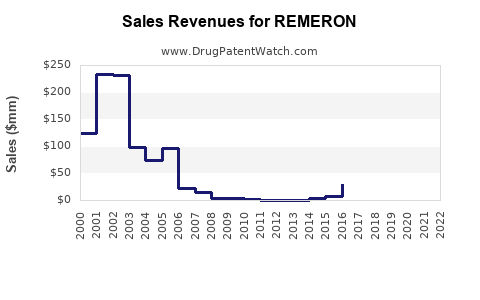
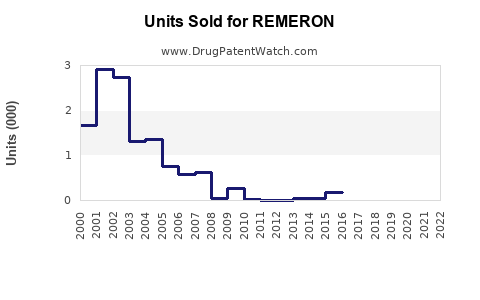
Annual Sales Revenues and Units Sold for REMERON
| Drug Name | Revenues (USD) | Units | Year |
|---|---|---|---|
| REMERON | ⤷ Start Trial | ⤷ Start Trial | 2022 |
| REMERON | ⤷ Start Trial | ⤷ Start Trial | 2021 |
| REMERON | ⤷ Start Trial | ⤷ Start Trial | 2020 |
| REMERON | ⤷ Start Trial | ⤷ Start Trial | 2019 |
| REMERON | ⤷ Start Trial | ⤷ Start Trial | 2018 |
| REMERON | ⤷ Start Trial | ⤷ Start Trial | 2017 |
| >Drug Name | >Revenues (USD) | >Units | >Year |
Remeron (Mirtazapine) Market Analysis, Sales Projections, and Patent Outlook
Remeron is the branded form of mirtazapine, an oral antidepressant approved by the U.S. Food and Drug Administration in 1996 for major depressive disorder. Its U.S. market has been generic for many years, leaving limited branded revenue and low barriers to entry. Commercial value now sits primarily in generic tablets, orally disintegrating tablets, hospital supply, international markets, and potential lifecycle products rather than in the Remeron brand.
A base-case market model indicates that global mirtazapine sales are likely to remain broadly stable through 2030 in volume terms but decline in nominal value as generic prices fall. A reasonable planning range for the worldwide mirtazapine market is approximately $350 million to $650 million in 2025, with value declining at roughly 2% to 5% annually unless new formulations, combination products, or expanded indications gain approval.
What is Remeron and how large is the mirtazapine market?
Remeron contains mirtazapine, a noradrenergic and specific serotonergic antidepressant. It is available in conventional oral tablets and orally disintegrating tablets marketed as Remeron SolTab in the United States. Generic mirtazapine is available in multiple strengths and dosage forms.
| Market attribute | Assessment |
|---|---|
| Active ingredient | Mirtazapine |
| Brand | Remeron; Remeron SolTab |
| Original sponsor | Organon |
| U.S. approval | 1996 |
| Primary indication | Major depressive disorder |
| U.S. status | Generic competition established |
| Dosage forms | Tablets and orally disintegrating tablets |
| Typical strengths | 7.5 mg, 15 mg, 30 mg, 45 mg |
| Primary competitors | Generic mirtazapine, SSRIs, SNRIs, trazodone, vortioxetine, bupropion |
| Biosimilar exposure | None |
| Current commercial position | Mature, low-cost generic market |
Mirtazapine retains demand because it is used when depression coexists with insomnia, poor appetite, weight loss, or anxiety. Its sedating and appetite-stimulating effects create a differentiated prescribing profile, although those same properties can limit use in patients at risk of weight gain or excessive somnolence.
U.S. revenue is concentrated in generic products. Remeron brand sales are no longer a material growth driver because prescribers, pharmacies, and payers generally substitute lower-cost generic mirtazapine.
What are the projected sales for Remeron and mirtazapine through 2030?
The following projection separates the commercial value of the total mirtazapine market from the much smaller Remeron-branded opportunity. It is a scenario model based on generic-market maturity, stable prescription demand, annual price erosion, and limited brand pull-through.
| Year | Global mirtazapine market: low case | Base case | High case | Remeron-branded revenue outlook |
|---|---|---|---|---|
| 2025 | $350 million | $500 million | $650 million | Less than $25 million |
| 2026 | $335 million | $485 million | $650 million | Less than $24 million |
| 2027 | $320 million | $470 million | $645 million | Less than $23 million |
| 2028 | $305 million | $455 million | $640 million | Less than $22 million |
| 2029 | $290 million | $440 million | $635 million | Less than $21 million |
| 2030 | $275 million | $425 million | $630 million | Less than $20 million |
The base case assumes prescription demand remains approximately flat, while net prices decline by 3% to 5% annually. The high case assumes increased use in geriatric psychiatry, sleep-associated depression, appetite-loss management, and international markets. The low case assumes continued substitution toward SSRIs and SNRIs, reduced reimbursement for branded products, and further generic price compression.
These figures are market-planning estimates, not reported company guidance. Public financial filings generally do not disclose a standalone current revenue line for Remeron because brand sales are immaterial relative to the owners' broader portfolios.
How does generic competition affect Remeron sales?
Generic competition is the primary factor limiting Remeron revenue. Mirtazapine has been available from numerous manufacturers, including major generic suppliers and regional pharmaceutical companies. The U.S. market has moved from brand-led pricing to commodity-like generic pricing.
Generic erosion affects Remeron in four ways:
- Pharmacy substitution reduces brand dispensing.
- Payers place generic mirtazapine on preferred formulary tiers.
- Retail prices decline as additional suppliers enter.
- Prescribers have little clinical reason to specify the Remeron brand for most patients.
The orally disintegrating tablet format can retain some differentiation because it may benefit patients with swallowing difficulty or adherence problems. That differentiation is limited because generic orally disintegrating mirtazapine products reduce the value of the branded formulation.
When did Remeron lose market exclusivity?
Remeron lost practical market exclusivity in the United States after generic mirtazapine approvals began. The product has been exposed to generic competition for more than two decades.
The FDA approved Remeron in 1996 and Remeron SolTab in 2001. Any original composition, formulation, or regulatory exclusivity associated with those approvals has expired. The product has no remaining new chemical entity exclusivity and no meaningful orphan-drug exclusivity.
| Exclusivity category | Current position |
|---|---|
| New chemical entity exclusivity | Expired |
| Orphan-drug exclusivity | None identified |
| Pediatric exclusivity | Expired, if granted |
| Original compound patents | Expired |
| Formulation patents | Expired or commercially ineffective |
| Data exclusivity | Expired |
| Generic competition | Established |
The relevant commercial question is no longer when Remeron loses exclusivity. It is whether any manufacturer can create a differentiated product with a new delivery system, combination, indication, or adherence benefit.
What is the Orange Book status of Remeron?
Remeron and Remeron SolTab are legacy FDA-approved products with an established generic pathway. The Orange Book historically listed patents and exclusivity information associated with the products, but those protections do not create a current barrier to generic entry.
An applicant seeking approval for mirtazapine tablets can generally rely on an abbreviated new drug application pathway. A Paragraph IV certification would have been relevant during the protected period. It is not a material current risk because the core patent estate has expired.
The current regulatory profile is:
- FDA-approved reference products exist.
- Generic ANDA approvals are established.
- No active brand exclusivity blocks ordinary generic substitution.
- No biosimilar pathway applies.
- Any future patent challenge would likely concern a newly developed formulation rather than the original product.
What patents protect Remeron and mirtazapine?
The original Remeron patent estate covered the mirtazapine compound and related pharmaceutical compositions. Those patents are expired. Later patents associated with orally disintegrating tablets or specific formulation technologies also no longer provide meaningful exclusivity for the original Remeron franchise.
| Patent category | Historic role | Current commercial impact |
|---|---|---|
| Compound patents | Protected mirtazapine molecule | Expired |
| Salt or stereochemical patents | Covered chemical forms or intermediates | Expired |
| Tablet formulation patents | Covered conventional dosage forms | Expired |
| Orally disintegrating formulation patents | Protected SolTab-type delivery | Expired or bypassed |
| Method-of-use patents | Covered depression treatment | No active barrier identified |
| Manufacturing patents | Covered process or intermediates | May affect cost, but not market entry broadly |
Patent strength is therefore low for the legacy Remeron product. A new patent estate could have greater value only if it protects a clinically meaningful feature, such as rapid onset, reduced sedation, improved tolerability, a long-acting formulation, or a combination product.
Are there current Paragraph IV challenges to Remeron?
No commercially significant current Paragraph IV dispute is expected for the original Remeron product because generic mirtazapine entry is already established and the relevant patent protections have expired.
Historical Paragraph IV activity may have occurred when generic applicants challenged listed patents. Those disputes no longer materially affect the market. The practical competitive issue is price competition among approved suppliers rather than patent litigation.
A new Paragraph IV risk could arise if a sponsor obtains approval for a novel mirtazapine formulation and lists new patents in the Orange Book. That scenario would involve a different product and a new patent estate rather than a challenge to legacy Remeron.
What formulations are protected by Remeron patents?
The main formulation distinction is between conventional mirtazapine tablets and orally disintegrating tablets.
Conventional tablets
Conventional tablets are widely available from generic manufacturers. Manufacturing requirements are routine for an established oral solid dose product. The segment has low technical and legal barriers.
Orally disintegrating tablets
Remeron SolTab was designed to dissolve in the mouth and assist patients who have difficulty swallowing. Orally disintegrating tablets can require tighter controls over taste masking, friability, disintegration time, packaging, and moisture sensitivity.
These requirements can create manufacturing and quality-control barriers, but they do not create durable market exclusivity once formulation patents expire. Generic manufacturers can enter by using different excipients, manufacturing processes, or packaging systems.
Potential lifecycle formulations
Potentially differentiated products include:
- Extended-release mirtazapine
- Transdermal or buccal delivery
- Lower-sedation formulations
- Fixed-dose combinations
- Pediatric or geriatric formulations
- Digital adherence or specialty packaging products
No such product currently changes the competitive position of legacy Remeron on a material scale.
What is the FDA regulatory status of Remeron?
The FDA approved Remeron for major depressive disorder in adults. Mirtazapine remains an approved active ingredient, but its regulatory status is mature rather than expansionary.
The principal regulatory risks are safety and labeling issues rather than approval risk. Label considerations include somnolence, increased appetite, weight gain, lipid changes, and the class-wide warning regarding suicidal thoughts and behaviors in younger patients taking antidepressants.
Mirtazapine is also used off-label for sleep disturbance and appetite stimulation. Those uses can support volume but do not automatically support additional reimbursed revenue or a proprietary product opportunity.
How does Remeron compare with competing antidepressants?
| Product class | Examples | Competitive position versus mirtazapine |
|---|---|---|
| SSRIs | Sertraline, escitalopram, fluoxetine | Usually first-line; less appetite and sedation effect |
| SNRIs | Venlafaxine, duloxetine | Strong anxiety and pain overlap; different tolerability profile |
| Atypical antidepressants | Bupropion, vortioxetine | Differentiated cognition, activation, or sexual-side-effect profiles |
| Sedating antidepressants | Trazodone | Competes in insomnia-associated prescribing |
| Mirtazapine | Remeron and generics | Useful where sleep or appetite effects are desirable |
Mirtazapine is unlikely to capture substantial share from first-line SSRIs without a clear clinical reason. Its durable niche is treatment selection based on patient characteristics rather than broad superiority across depression.
What licensing deals and commercial partnerships involve Remeron?
No current licensing deal is central to the Remeron commercial outlook. The product originated with Organon, but the brand's commercial value has declined after generic entry. Generic mirtazapine is supplied through ordinary manufacturing, distribution, and marketing agreements rather than high-value innovation partnerships.
A meaningful licensing opportunity would require a new proprietary delivery system, a combination product, or a validated additional indication. Licensing the legacy molecule alone would offer limited pricing power because active pharmaceutical ingredient supply and generic finished-dose manufacturing are widely available.
What litigation affects Remeron?
There is no known active litigation that materially threatens access to generic mirtazapine or creates a near-term change in the product's market structure. Historical patent disputes have limited current relevance because the protected period has ended.
The litigation risks for a future mirtazapine product would include:
- ANDA Paragraph IV litigation
- Formulation patent disputes
- Trade-secret claims involving manufacturing processes
- Hatch-Waxman litigation over listed patents
- Product-liability claims involving sedation, weight gain, or suicidality
For legacy Remeron, litigation exposure is low relative to commercially protected branded drugs.
What generic launch scenarios exist for mirtazapine?
Three scenarios define the current market.
Base scenario: stable demand and price erosion
Generic manufacturers maintain supply, prescriptions remain broadly stable, and net prices decline gradually. This is the most likely outcome through 2030.
Downside scenario: accelerated substitution
Payers increase preference for lower-cost SSRIs and SNRIs, while generic suppliers compete aggressively on price. Mirtazapine revenue declines faster than prescription volume.
Upside scenario: specialty-niche expansion
Use grows among older patients, patients with insomnia or appetite loss, and populations needing orally disintegrating dosage forms. Volume growth offsets some price erosion, but the market remains predominantly generic.
What geographic markets offer the strongest opportunity?
The United States is large in prescription volume but unattractive for branded expansion because generic substitution is entrenched. Europe has broad generic access and substantial price controls. Selected emerging markets may offer better unit growth, although regulatory registration, local manufacturing, tender pricing, and distribution requirements reduce margins.
The strongest commercial opportunities are likely to be:
- Markets with incomplete generic penetration
- Countries with growing psychiatric diagnosis and treatment
- Regions where orally disintegrating products have limited availability
- Hospital and institutional channels
- Private-label generic partnerships
Geographic growth is more likely to come from volume than from price.
Key Takeaways
- Remeron is the branded form of mirtazapine and was first approved in the United States in 1996.
- The U.S. product has long been exposed to generic competition.
- The legacy Remeron patent estate is expired and provides no meaningful current exclusivity.
- No biosimilar risk exists because mirtazapine is a small-molecule drug.
- Remeron-branded revenue is likely below $25 million annually in the United States and other mature markets combined.
- The worldwide mirtazapine market could be approximately $350 million to $650 million in 2025, with a base-case decline to about $425 million by 2030.
- Commercial value is concentrated in generic manufacturing, supply reliability, orally disintegrating tablets, and international distribution.
- A new proprietary formulation would be required to create material licensing or patent value.
- Current Paragraph IV, litigation, and settlement risks are low for legacy Remeron.
- The primary commercial risk is generic price erosion, not patent expiry.
FAQs About Remeron Sales, Patents, and Market Competition
Is Remeron still sold as a branded drug?
Remeron and Remeron SolTab have limited commercial availability compared with generic mirtazapine. Generic substitution is the dominant U.S. market pattern.
What is the annual revenue of Remeron?
Current standalone Remeron revenue is not generally disclosed in public financial filings. A reasonable planning estimate is less than $25 million annually across mature branded markets.
Does mirtazapine have patent protection?
The original compound and legacy formulation protections have expired. New patents could protect a future delivery system or combination product, but they would not restore exclusivity to ordinary mirtazapine tablets.
Can a generic company launch mirtazapine without Paragraph IV litigation?
Yes. Generic mirtazapine products have already entered the market, and the original patent barriers are no longer commercially operative.
Is mirtazapine a growth market for pharmaceutical investors?
Mirtazapine is primarily a defensive generic market. Growth prospects are limited unless an investor controls a differentiated formulation, a specialty indication, or a market with low generic penetration.
References
- U.S. Food and Drug Administration. (1996). Remeron (mirtazapine) prescribing information.
- U.S. Food and Drug Administration. (2001). Remeron SolTab (mirtazapine) prescribing information.
- U.S. Food and Drug Administration. (2024). Orange Book: Approved drug products with therapeutic equivalence evaluations.
- U.S. Food and Drug Administration. (2024). Drugs@FDA: FDA-approved drugs database.
- DailyMed. (2024). Mirtazapine tablet and orally disintegrating tablet labeling. National Library of Medicine.
More… ↓
