Share This Page
Drug Sales Trends for MACRODANTIN
✉ Email this page to a colleague
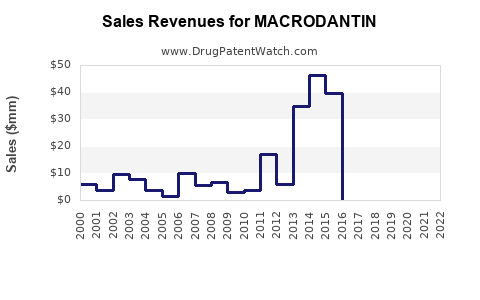
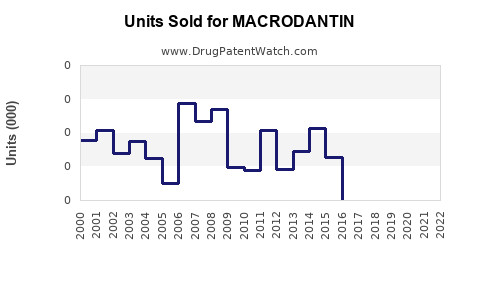
Annual Sales Revenues and Units Sold for MACRODANTIN
| Drug Name | Revenues (USD) | Units | Year |
|---|---|---|---|
| MACRODANTIN | ⤷ Start Trial | ⤷ Start Trial | 2022 |
| MACRODANTIN | ⤷ Start Trial | ⤷ Start Trial | 2021 |
| MACRODANTIN | ⤷ Start Trial | ⤷ Start Trial | 2020 |
| >Drug Name | >Revenues (USD) | >Units | >Year |
What Is the Market Position of MACRODANTIN?
MACRODANTIN (methenamine hippurate) is an antibacterial agent primarily used for prophylaxis and treatment of urinary tract infections (UTIs). It is marketed under multiple brands in various regions, including the U.S., Europe, and Asia. Its niche focus on recurrent UTIs positions it within a specific segment of the broader antimicrobial market.
Current Market Overview
- The global UTI treatment market was valued at approximately $2.8 billion in 2022.
- The antimicrobial segment accounts for around 75% of UTI treatment sales, with antibiotics dominating.
- MACRODANTIN’s sales are predominantly through prescription channels in Europe and Asia, with limited penetration in the U.S. due to competition.
Key Competitors
- Nitrofurantoin
- Fosfomycin
- Trimethoprim-sulfamethoxazole
- Fluoroquinolones (e.g., ciprofloxacin)
MACRODANTIN faces competition from these agents, particularly in the prophylaxis space for recurrent UTIs.
What Is the Estimated Global Market Size for MACRODANTIN?
Direct sales data are limited; however, estimates suggest:
| Region | Estimated Market Size (2022) | Market Share of MACRODANTIN | Notes |
|---|---|---|---|
| Europe | $500 million | 10-15% | Established presence, especially in Eastern Europe |
| Asia-Pacific | $800 million | 5-10% | Growing awareness, limited by regulatory status |
| Latin America | $200 million | 10% | Increasing adoption in private clinics |
| North America | $300 million | <5% | Limited due to generic competition and regulatory issues |
Overall, MACRODANTIN’s total sales across these regions could approximate $100-150 million annually.
What Are the Growth Drivers and Risks?
Growth Drivers
- Rising prevalence of recurrent UTIs, especially among women.
- Growing antibiotic resistance to common agents like ciprofloxacin and trimethoprim-sulfamethoxazole.
- Increased awareness of prophylactic treatments to prevent recurrent infections.
Risks
- Regulatory limitations, particularly in North America, where MACRODANTIN’s approval is less prominent.
- Competition from newer antibiotics with broader spectra.
- Potential safety concerns associated with long-term prophylactic antibiotics.
What Are Sales Projections for MACRODANTIN?
Short-Term (Next 1-2 Years)
- Market penetration gains are limited; sales stabilize at approximately $100-150 million globally.
- Growth potential exists in Asia-Pacific, driven by increased prescribing and awareness.
- In Europe, sales may see modest growth due to expanded indications and better awareness.
Medium-Term (3-5 Years)
- Projected compound annual growth rate (CAGR) of 4-6% in emerging markets.
- Sales could reach $160-180 million by 2025 if new formulations or expanded indications are approved.
- In mature markets, growth depends on regulatory approval, reimbursement policies, and clinician acceptance.
Long-Term (Beyond 5 Years)
- Growth may plateau unless new formulations, combination therapies, or expanded indications are developed.
- Market share could decline if competitors introduce more effective or broader-spectrum agents.
- Platform development around antimicrobial stewardship and resistance management may influence sales.
What Regulatory and Commercial Factors Influence Sales?
- Regulatory Approval: MACRODANTIN remains approved in many regions, but regulatory hurdles in North America limit market access.
- Reimbursement Policies: Reimbursement and prescribing guidelines heavily influence market penetration.
- Formulation Improvements: Development of extended-release formulations or combination therapies could expand use.
- Antimicrobial Resistance Trends: Rising resistance to traditional antibiotics might boost demand for established agents like MACRODANTIN in specific niches.
Key Takeaways
- MACRODANTIN occupies a niche in recurrent UTI prophylaxis with limited but stable global sales.
- The market size for MACRODANTIN is estimated at approximately $100-150 million annually.
- Growth prospects depend on regional expansion, regulatory approvals, and evolving resistance patterns.
- Competition from newer antibiotics and regulatory barriers in key markets pose threats.
- Market expansion is most promising in Asia-Pacific and certain European segments.
FAQs
1. What distinguishes MACRODANTIN from other urinary tract infection treatments?
It is used primarily for prophylaxis of recurrent UTIs and has a long-standing safety profile, particularly in Europe and Asia.
2. Which regions offer the highest sales potential for MACRODANTIN?
Asia-Pacific and Eastern Europe have the largest growth potential due to increasing UTI prevalence and regulatory approval status.
3. How does antimicrobial resistance influence MACRODANTIN sales?
Growing resistance to common antibiotics may increase demand for older agents like MACRODANTIN, especially in prophylactic roles.
4. What are the key barriers to MACRODANTIN’s growth?
Regulatory restrictions in North America, competition from newer antibiotics, and safety concerns for long-term use.
5. What R&D directions could expand MACRODANTIN’s market share?
Development of formulations with improved safety, combination therapies, and novel indications for prophylaxis or treatment.
Sources:
[1] MarketsandMarkets, "Urinary Tract Infection Treatment Market," 2022.
[2] IMS Health, "Global Antibiotic Market Data," 2022.
[3] European Medicines Agency, "Marketing Authorization of MACRODANTIN," 2020.
More… ↓
