Drug Sales Trends for CELEBREX
Payment Methods and Pharmacy Types for CELEBREX (2018)
Revenues by Pharmacy Type
Units Sold by Pharmacy Type
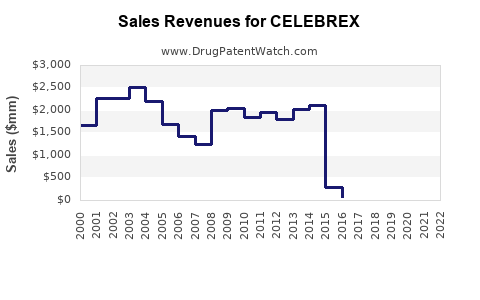
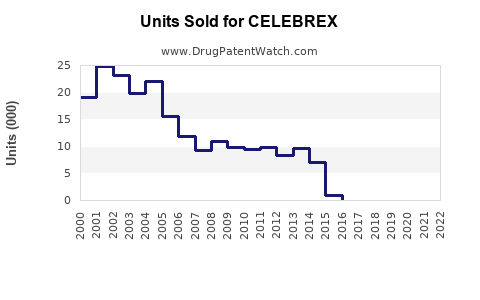
Annual Sales Revenues and Units Sold for CELEBREX
| Drug Name | Revenues (USD) | Units | Year |
|---|---|---|---|
| CELEBREX | ⤷ Start Trial | ⤷ Start Trial | 2022 |
| CELEBREX | ⤷ Start Trial | ⤷ Start Trial | 2021 |
| CELEBREX | ⤷ Start Trial | ⤷ Start Trial | 2020 |
| CELEBREX | ⤷ Start Trial | ⤷ Start Trial | 2019 |
| CELEBREX | ⤷ Start Trial | ⤷ Start Trial | 2018 |
| CELEBREX | ⤷ Start Trial | ⤷ Start Trial | 2017 |
| >Drug Name | >Revenues (USD) | >Units | >Year |
Celebrex Market Analysis, Sales Projections, Patent Status, and Generic Competition
Celebrex, Pfizer’s brand of celecoxib, is a mature oral nonsteroidal anti-inflammatory drug used primarily for osteoarthritis, rheumatoid arthritis, acute pain, and primary dysmenorrhea. Its commercial profile is defined by widespread generic competition, limited remaining exclusivity, and continuing demand for a selective COX-2 inhibitor with a lower gastrointestinal-ulcer risk than many traditional NSAIDs.
Pfizer’s Celebrex revenue is expected to remain near $1 billion annually in the near term but decline gradually as branded utilization shifts to generic celecoxib and price competition increases. The base-case forecast projects originator-associated revenue of approximately $1.0 billion in 2024, falling to about $850 million by 2029. Total celecoxib market value will be materially larger than Pfizer’s reported brand revenue because it includes generic manufacturers.
What is the current market position of Celebrex?
Celebrex is a mature prescription NSAID with strong physician familiarity, broad labeling, and a large installed patient base. The active ingredient, celecoxib, selectively inhibits cyclooxygenase-2, or COX-2, and is available primarily as oral capsules.
| Metric | Assessment |
|---|---|
| Brand | Celebrex |
| Active ingredient | Celecoxib |
| Originator | Pfizer |
| Therapeutic class | Selective COX-2 NSAID |
| U.S. approval | 1998 |
| Main indications | Osteoarthritis, rheumatoid arthritis, acute pain, primary dysmenorrhea |
| Dosage forms | Oral capsules, primarily 50 mg, 100 mg, 200 mg, and 400 mg |
| U.S. generic status | Multiple generic manufacturers |
| Biosimilar exposure | None; celecoxib is a small molecule |
| U.S. composition-patent protection | Expired |
| Current commercial phase | Mature, genericized product |
Celecoxib remains differentiated from nonselective NSAIDs through its COX-2 selectivity and established clinical record. Its limitations include cardiovascular warnings, renal risks, gastrointestinal risks, dose restrictions, and competition from inexpensive generic ibuprofen, naproxen, diclofenac, and meloxicam.
How much revenue does Celebrex generate?
Pfizer has reported Celebrex revenue at approximately the $1 billion level in recent years. Reported revenue includes Pfizer’s branded and market-specific sales and should not be interpreted as the total value of all celecoxib prescriptions.
| Year | Pfizer Celebrex revenue indication | Market interpretation |
|---|---|---|
| 2022 | Approximately $1.0 billion | Stable mature-brand revenue |
| 2023 | Approximately $1.0 billion | Resilient demand despite generic competition |
| 2024 estimate | Approximately $1.0 billion | Broadly stable before gradual erosion |
| 2025 base case | $950 million | Low-single-digit decline |
| 2026 base case | $920 million | Generic substitution continues |
| 2027 base case | $890 million | Brand price and volume pressure |
| 2028 base case | $870 million | Mature-market stabilization |
| 2029 base case | $850 million | Residual brand and international demand |
Pfizer’s 2023 annual report identified Celebrex as a significant established product. The product’s revenue resilience reflects several factors:
- Physician familiarity with celecoxib.
- Continued demand from chronic osteoarthritis and rheumatoid arthritis patients.
- Prescriber preference for selective COX-2 therapy in patients with gastrointestinal-risk concerns.
- Pfizer’s international commercial infrastructure.
- Brand retention among patients who remain on established therapy.
- Demand for the 200 mg capsule in chronic-use settings.
Revenue pressure comes from low-cost generic celecoxib, therapeutic substitution, payer formulary controls, and the availability of over-the-counter or low-cost prescription NSAIDs.
What are the Celebrex sales projections through 2029?
The following forecast covers Pfizer-associated Celebrex revenue, not total global sales of generic celecoxib.
| Scenario | 2024 base | 2025 | 2026 | 2027 | 2028 | 2029 |
|---|---|---|---|---|---|---|
| Downside | $1.0B | $900M | $820M | $760M | $710M | $670M |
| Base case | $1.0B | $950M | $920M | $890M | $870M | $850M |
| Upside | $1.0B | $1.02B | $1.03B | $1.04B | $1.04B | $1.03B |
Base-case assumptions
The base case assumes:
- No major new U.S. exclusivity.
- Continued generic price erosion.
- Stable or modestly declining prescription demand.
- No major safety-driven withdrawal.
- Continued use in chronic arthritis and acute-pain populations.
- Pfizer retains international commercial access.
- No major branded reformulation with materially superior clinical or reimbursement characteristics.
The downside case reflects accelerated generic substitution, increased payer restrictions, and broader use of low-cost alternatives. The upside case requires stronger brand retention, price stability in selected markets, or successful commercial expansion in regions where branded celecoxib remains less commoditized.
How large is the total celecoxib market?
The total celecoxib market includes Pfizer’s Celebrex, authorized generics, independent generic manufacturers, and country-specific branded versions. Because generic companies usually report celecoxib sales within broader portfolios, public market data do not provide a single consistent global revenue figure.
The market has three economic layers:
| Market layer | Competitive profile | Margin profile |
|---|---|---|
| Pfizer Celebrex | Brand-prescription demand and residual loyalty | Highest price and margin |
| Authorized or branded generic products | Limited differentiation | Moderate margin |
| Commodity generic celecoxib | Payer and pharmacy price competition | Low margin, volume-driven |
In the United States, generic substitution is the principal market force. In some international markets, brand recognition, physician prescribing habits, local reimbursement, and distribution structures allow branded celecoxib to retain a larger share.
When does Celebrex lose exclusivity?
Celebrex’s core U.S. composition-patent protection has expired. The key foundational patent is U.S. Patent No. 5,466,823, covering celecoxib-related chemical subject matter. Its term ended in 2014, subject to the applicable regulatory and pediatric-exclusivity calculations reflected in the historical generic-entry timeline.
Celecoxib therefore has no remaining U.S. composition-patent barrier comparable to a newly launched small-molecule medicine.
| Exclusivity element | Status |
|---|---|
| New chemical entity exclusivity | Expired |
| Core composition patent | Expired |
| Pediatric exclusivity | Historical, expired |
| U.S. generic entry | Established |
| Biosimilar exclusivity | Not applicable |
| Active U.S. market exclusivity strategy | Limited |
Some later patents and regulatory listings may have addressed methods of use, formulations, or other technical aspects. Those rights did not preserve broad molecule-level exclusivity.
What patents protect Celebrex and celecoxib?
The principal historical patent estate centered on the celecoxib chemical structure and related therapeutic use. The estate was commercially important before generic launch but is now primarily relevant to historical litigation analysis and foreign-country rights.
| Patent | Subject matter | Commercial relevance |
|---|---|---|
| U.S. Patent No. 5,466,823 | Celecoxib and related chemical compounds | Foundational patent; expired |
| U.S. Patent No. 5,760,068 | Related celecoxib patent rights | Historical litigation and term analysis |
| U.S. Patent No. 6,048,850 | Additional celecoxib-related protection | Historical estate; no longer a broad U.S. entry barrier |
Patent strength today is low from a U.S. market-exclusivity perspective. Pfizer’s strongest remaining advantages are brand recognition, regulatory history, manufacturing know-how, physician familiarity, and distribution rather than enforceable molecule-level patent rights.
What formulations are protected by Celebrex patents?
Celebrex is mainly an oral capsule product. Historical patent filings and regulatory listings may cover dosage forms, formulations, or pharmaceutical compositions. These rights are less commercially significant than the basic chemical patent because generic manufacturers have entered with approved capsule products.
A formulation patent could still matter if it covers a clinically differentiated delivery system, improved bioavailability, reduced dosing frequency, or a specific combination. Standard generic celecoxib capsules do not face a meaningful formulation barrier in the U.S. market.
What method-of-use patents cover celecoxib?
Celecoxib has been associated with patents and patent claims covering therapeutic uses, dosing regimens, and disease indications. Method-of-use rights can restrict a labeled indication if they remain enforceable, but they generally do not prevent approval of a generic product for non-protected uses.
For a mature product such as celecoxib, method-of-use patents have lower commercial leverage than the original composition patent. Physicians can prescribe generic celecoxib across non-patent-restricted indications, and generic manufacturers can use labeling strategies designed to avoid patented uses where legally required.
What is the FDA regulatory status of Celebrex?
The FDA approved Celebrex in 1998. Its approved uses include osteoarthritis, rheumatoid arthritis, acute pain in adults, and primary dysmenorrhea. The labeling includes class-wide NSAID warnings, including cardiovascular thrombotic risk, gastrointestinal bleeding, renal toxicity, and risks associated with use during pregnancy.
Celecoxib’s regulatory position is mature and stable:
- It has an established FDA safety and efficacy record.
- It is available through abbreviated new drug applications as a generic.
- It is subject to the NSAID boxed warning framework.
- It does not qualify for biosimilar competition because it is not a biologic.
- Its regulatory value is based on continued demand rather than new-exclusivity potential.
The FDA’s approval of generic celecoxib products confirms that manufacturers can rely on abbreviated regulatory pathways rather than repeating the full clinical development program required for the original brand.
Which companies are challenging Celebrex exclusivity?
Celebrex has faced generic competition from multiple manufacturers following expiration of its principal U.S. patent protection. Generic manufacturers that have participated in the celecoxib market include Teva Pharmaceuticals, Mylan, Apotex, Amneal, and other ANDA sponsors, depending on product strength and market period.
The relevant competitive activity has included:
- Paragraph IV patent challenges before core patent expiry.
- ANDA litigation involving Pfizer and generic sponsors.
- Settlements or launch arrangements governing generic entry timing.
- Post-expiry competition among several approved suppliers.
- Price reductions as additional manufacturers entered.
The commercial outcome was a conventional mature-brand transition: the originator retained brand sales while generic manufacturers captured prescription volume and reduced average selling prices.
What patent litigation affected Celebrex?
Historical Celebrex litigation focused on the validity, infringement, and enforceability of Pfizer’s composition and related patents. The primary legal questions included:
- Whether generic celecoxib products infringed Pfizer patents.
- Whether asserted patent claims were valid over prior art.
- Whether Paragraph IV certifications created an artificial act of infringement.
- When generic products could enter under settlement or court decisions.
- Whether patents covered the active ingredient, specific formulations, or particular uses.
Because the foundational patent estate has expired, current U.S. litigation risk is substantially lower than it was during the pre-generic period. New disputes could still involve manufacturing processes, trademarks, trade dress, supply arrangements, or narrow formulation claims, but those issues would not recreate the original market barrier.
What is the Orange Book status of Celebrex?
Celebrex has historically been listed in the FDA Orange Book with patents associated with the reference-listed drug. The practical importance of those listings has declined because the principal patent rights have expired and multiple generic products are approved.
Orange Book analysis should distinguish between:
- Expired patents listed for historical reference.
- Any later-listed formulation or method-of-use patent.
- The specific strength and dosage form covered by each listing.
- Whether a patent creates a remaining regulatory stay or launch restriction.
- Whether a generic applicant used Paragraph IV or Paragraph III certification.
For current commercial planning, the Orange Book does not indicate a broad U.S. barrier to generic celecoxib entry.
What generic entry risks exist for Celebrex?
Generic entry risk is already realized rather than prospective. The remaining risk is erosion of Pfizer’s residual branded revenue.
| Risk | Probability | Revenue effect |
|---|---|---|
| Continued generic price competition | High | Gradual decline |
| Additional generic entrants | Moderate to high | Faster price erosion |
| Brand-to-generic formulary conversion | High | Volume loss |
| New safety signal | Low to moderate | Potential sharp decline |
| Generic supply disruption | Low | Temporary brand-volume benefit |
| Successful branded reformulation | Low | Potential stabilization |
| International generic expansion | Moderate | Regional revenue pressure |
The most likely commercial scenario is gradual erosion rather than abrupt collapse. Celebrex has been genericized for years, and the remaining brand revenue is supported by persistent prescribing rather than patent protection.
How does Celebrex compare with competing NSAIDs?
Celebrex competes with both selective and nonselective NSAIDs.
| Product | Active ingredient | Main competitive advantage | Main limitation |
|---|---|---|---|
| Celebrex | Celecoxib | COX-2 selectivity and established use | Cardiovascular and renal warnings; higher brand price |
| Mobic | Meloxicam | Once-daily dosing and low generic price | Similar NSAID safety constraints |
| Voltaren | Diclofenac | Broad use and multiple formulations | Cardiovascular and hepatic concerns |
| Naprosyn | Naproxen | Low cost and long clinical history | Gastrointestinal toxicity |
| Advil/Motrin | Ibuprofen | OTC accessibility and low price | Shorter duration; GI and renal risks |
| Indocin | Indomethacin | Potent anti-inflammatory effect | Tolerability and central nervous system effects |
Celebrex’s most defensible clinical position is among patients who need chronic NSAID therapy and whose clinicians prioritize COX-2 selectivity or gastrointestinal considerations. Its weakest position is in price-sensitive markets where generic naproxen, ibuprofen, or meloxicam is adequate.
What licensing deals affect Celebrex?
Celebrex’s commercial history is primarily associated with Pfizer’s internal development, regulatory ownership, and commercialization rather than a current high-value licensing structure. Historical development rights and collaborations may be relevant to ownership analysis, but they do not materially change the present U.S. competitive profile.
Potential commercial value lies in regional distribution, authorized-generic arrangements, and supply agreements rather than licensing a new patent-protected celecoxib platform.
How strong is the Celebrex patent estate?
The estate is weak for current U.S. exclusivity and stronger as historical technical documentation.
| Dimension | Strength |
|---|---|
| U.S. molecule protection | Low; expired |
| U.S. formulation protection | Low to moderate, depending on claim scope |
| Method-of-use protection | Low to moderate for narrow claims |
| Manufacturing know-how | Moderate |
| Regulatory history | Strong |
| Brand recognition | Strong |
| International protection | Variable by country |
| Ability to block generic entry | Low |
Geographic coverage is uneven because patent expiry dates differ by country, supplementary protection regimes may apply differently, and generic entry depends on local regulatory approval. Most major markets now treat celecoxib as a mature generic product.
Key Takeaways
- Celebrex is a mature Pfizer brand with approximately $1 billion in annual revenue.
- Pfizer’s branded revenue is expected to decline gradually, with a base-case estimate of about $850 million by 2029.
- Total celecoxib market revenue includes generic sales and is larger than Pfizer’s reported Celebrex revenue.
- The core U.S. celecoxib patent estate has expired.
- Generic competition is established, and current commercial risk is revenue erosion rather than a future patent cliff.
- Celecoxib has no biosimilar risk because it is a small-molecule drug.
- The brand’s remaining value comes from physician familiarity, clinical positioning, international sales, and residual patient loyalty.
- The most likely launch scenario for additional generic entrants is incremental price and volume erosion, not a sudden market reset.
- Patent strength is low for blocking generic entry but historical formulation, method-of-use, and manufacturing rights may still matter in narrow disputes.
FAQs About Celebrex Market Size, Patents, and Sales
Is Celebrex still profitable for Pfizer?
Yes. Celebrex remains a significant established-product revenue source for Pfizer, although its profitability is lower than during the period of patent exclusivity because generic competition has reduced pricing power.
Will generic celecoxib eliminate Celebrex sales?
No. Generic substitution will continue to reduce brand volume, but brand sales can persist through physician preference, patient continuity, international markets, and formulary structures that preserve branded prescriptions.
Does Celebrex have any active U.S. patent protection?
The foundational U.S. composition patents have expired. Any current patent issue would likely involve a narrow formulation, method-of-use, manufacturing, or other technical claim rather than broad protection of celecoxib itself.
Is celecoxib a biosimilar product?
No. Celecoxib is a chemically synthesized small molecule. Generic approval proceeds through the ANDA pathway, not the FDA biosimilar pathway.
What could increase Celebrex sales after 2025?
Sales could outperform the base case if branded prescriptions remain stable, generic supply disruptions occur, international markets sustain brand pricing, or Pfizer develops a commercially differentiated formulation. Without such factors, gradual erosion remains the expected outcome.
References
-
Pfizer Inc. (2024). 2023 annual report. Pfizer Inc.
-
U.S. Food and Drug Administration. (1998). Celebrex (celecoxib) prescribing information. U.S. Department of Health and Human Services.
-
U.S. Food and Drug Administration. (2024). Orange Book: Approved drug products with therapeutic equivalence evaluations. U.S. Department of Health and Human Services.
-
U.S. Patent and Trademark Office. (1995). U.S. Patent No. 5,466,823: Diaryl substituted pyrazoles. U.S. Department of Commerce.
-
U.S. Patent and Trademark Office. (1998). U.S. Patent No. 5,760,068: Substituted pyrazoles as cyclooxygenase-2 inhibitors. U.S. Department of Commerce.
-
U.S. Patent and Trademark Office. (2000). U.S. Patent No. 6,048,850: Pharmaceutical compositions containing substituted pyrazoles. U.S. Department of Commerce.
More… ↓
