Share This Page
Drug Sales Trends for CARBAMAZEPINE
✉ Email this page to a colleague
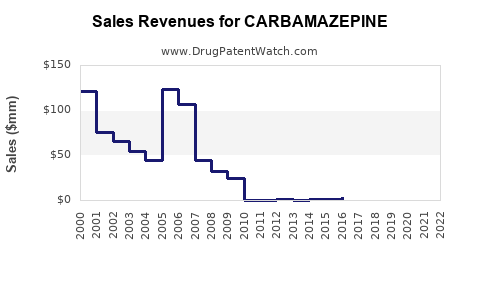
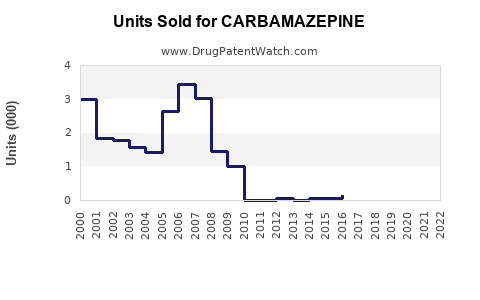
Annual Sales Revenues and Units Sold for CARBAMAZEPINE
| Drug Name | Revenues (USD) | Units | Year |
|---|---|---|---|
| CARBAMAZEPINE | ⤷ Start Trial | ⤷ Start Trial | 2022 |
| CARBAMAZEPINE | ⤷ Start Trial | ⤷ Start Trial | 2021 |
| CARBAMAZEPINE | ⤷ Start Trial | ⤷ Start Trial | 2020 |
| >Drug Name | >Revenues (USD) | >Units | >Year |

Market Analysis and Sales Projections for Carbamazepine
Market Overview
Carbamazepine is an anticonvulsant and mood-stabilizing drug primarily used to treat epilepsy, trigeminal neuralgia, and bipolar disorder. It was first approved by the FDA in 1968. The drug remains a cornerstone in neurological and psychiatric treatment, with an estimated global market size driven by its formulary presence and longstanding clinical utility.
Global sales of carbamazepine were approximately $600 million in 2022. The compound is available in generic and branded formulations, with generics accounting for roughly 85% of sales. The drug's low cost, established efficacy, and FDA approval sustain its market share despite newer anticonvulsants.
Market Drivers
- Prevalence of Epilepsy and Neuralgia: Approximately 50 million people worldwide have epilepsy, with trigeminal neuralgia affecting 4-5 per 100,000 annually.
- Longstanding Generic Availability: Market penetration is high due to low-cost generics, impacting branded drug sales.
- Physician Preference: Carbamazepine remains preferred in settings with limited access to newer, more expensive medications.
- Regulatory Approvals: Approvals in emerging markets expand the geographic footprint.
- Adverse Effect Profile: Risk of hematologic and dermatologic side effects influences prescribing patterns.
Competitive Landscape
| Patent Status | Market Share | Key Players | Formulations | Pricing Dynamics |
|---|---|---|---|---|
| Patent expired | 15% | Teva, Mylan, Sandoz | Tablets, suspension | Low-cost generics dominate market |
| Patent-held | 85% | UCB (brand: Tegretol) | Tablets, XR formulations | Higher pricing for branded products |
Geographic Market Breakdown
| Region | Market Share (%) | Key Trends | Average Annual Growth (2020–2022) |
|---|---|---|---|
| North America | 35% | Stable, high penetration | 1.5% |
| Europe | 30% | Slight decline in branded sales | 1.2% |
| Asia-Pacific | 20% | Rapid generic adoption; emerging markets | 4.5% |
| Latin America, Africa | 15% | Growing access, limited regulation | 3.8% |
Sales Projections (2023–2028)
| Year | Global Market Size (USD millions) | Compound Annual Growth Rate (CAGR) | Major Growth Drivers |
|---|---|---|---|
| 2023 | 620 | 1.8% | Increasing epilepsy diagnosis; expanding access abroad |
| 2024 | 640 | 1.8% | Entry into new markets; use in bipolar disorder |
| 2025 | 660 | 1.8% | Continued generic penetration; unmet needs in epilepsy |
| 2026 | 680 | 1.8% | New formulations; improved tolerability |
| 2027 | 700 | 2.0% | Adoption of narrow-spectrum formulations |
| 2028 | 720 | 2.1% | Aging populations with chronic seizure conditions |
Barriers and Risks
- Drug Interactions: Carbamazepine induces hepatic enzymes, affecting metabolism of other drugs.
- Safety Concerns: Risks of agranulocytosis, Stevens-Johnson syndrome.
- Regulatory Changes: Stricter safety monitoring may mitigate use.
- Emerging Therapies: Newer anticonvulsants (e.g., levetiracetam, lamotrigine) gaining market share.
Revenue Impact of Patent and Formulary Changes
- Patent expiry in most regions led to a significant decline in premium-branded sales by 50% since 2015.
- Increased prescribing of generics has decreased per-unit revenue but expanded volume.
- Manufacturers' investment in controlled-release formulations aims to improve adherence and reduce side effects.
Future Opportunities
- Developing safer, more selective formulations.
- Expanding to pediatric populations.
- Integrating into combination therapies for complex seizure syndromes.
- Growing use in low- and middle-income countries as healthcare infrastructure improves.
Key Takeaways
- The carbamazepine market is mature with slow growth, driven mostly by expanding access in emerging markets.
- Generic competition limits revenue potential; branded sales are declining.
- New formulations targeting improved safety and tolerability could renew growth.
- Market growth remains modest at approximately 1.8–2.1% CAGR through 2028.
- A significant share of future revenues depends on regulatory landscape shifts and competitive responses.
Frequently Asked Questions
-
What is the primary indication for carbamazepine?
Treatment of epilepsy, trigeminal neuralgia, and bipolar disorder. -
How does patent expiration affect market dynamics?
It causes branded sales decline, increases generic market share, and reduces per-unit pricing. -
What are the main barriers to growth?
Safety concerns, drug interactions, and competition from newer agents. -
Which regions exhibit the highest growth potential?
Asia-Pacific and Latin America, driven by increased access and healthcare infrastructure development. -
Are there upcoming formulations or combinations anticipated to impact sales?
Yes, controlled-release formulations and combination therapies for complex seizure syndromes.
References
[1] U.S. Food and Drug Administration. (2021). Tegretol (carbamazepine) tablet, chewable tablet, suspension, extended-release capsule. FDA.
[2] MarketsandMarkets. (2022). Anticonvulsant drugs market by type, application, and region — Global forecast to 2027.
[3] IQVIA. (2022). Global prescription drug sales data.
[4] World Health Organization. (2019). Epilepsy fact sheet.
[5] European Medicines Agency. (2018). Safety communication on carbamazepine and adverse drug reactions.
More… ↓
