Last updated: February 14, 2026
Overview
ANUCORT-HC is a topical corticosteroid combined with a hydrocortisone and an antimicrobial agent, indicated primarily for inflammatory dermatoses with secondary bacterial infections. Its market presence is driven by the prevalence of localized skin conditions requiring combined anti-inflammatory and antimicrobial therapy.
Market Size and Growth Drivers
The global dermatology drug market was valued at approximately $24 billion in 2022, with corticosteroids representing a significant segment. The growth rate averages 4-6% annually, driven by increasing skin disorder prevalence and expanding indications for topical therapies. Specifically, for corticosteroid-based combination drugs like ANUCORT-HC, the growth is accelerated by rising antibiotic resistance issues and the demand for targeted therapies.
Key Competitors
Major competitors include:
- Hydrocortisone-based formulations (e.g., Cortizone-10)
- Combination products like Triderm (clobetasol with gentamicin and betamethasone)
- Generic corticosteroid-antibiotic formulations available worldwide
Market penetration hinges on efficacy, safety profile, and physician prescribing habits, especially in highly regulated markets like the US, EU, and Japan.
Regulatory Status
ANUCORT-HC is approved in several countries, including the US, where it holds an FDA approval for short-term dermatoses with secondary bacterial infection. Patent status influences its competitive landscape; exclusivity periods typically last 5-7 years post-approval.
Sales Potential and Projections
Estimating sales involves assessing:
- Prevalence of target conditions (e.g., eczema, dermatitis, impetigo)
- Prescription rates in dermatology clinics
- Physician prescribing preference for combination vs. monotherapy
- Availability of generics and OTC formulations
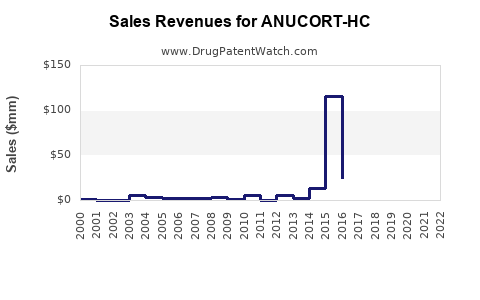
In the US, approximately 8 million patients annually receive topical antimicrobial therapies. If ANUCORT-HC captures 5-10% of the relevant segment, initial annual sales could reach $50-100 million. With market expansion, niche focus on resistant infections, and higher penetrance in developed markets, sales could grow at 8-10% annually over the next five years.
Demand Drivers
- Increasing prevalence of skin infections and inflammatory skin diseases
- Rising resistance to systemic antibiotics, prompting topical combination therapies
- Physicians favoring targeted, minimally invasive treatments
- Patient demand for quick relief and reduced side effects
Risks and Barriers
- Competition from established generic products
- Regulatory hurdles in emerging markets
- Potential adverse effects with prolonged corticosteroid use
- Cost-effectiveness relative to existing therapies
Future Market Trends
- Enhanced formulations with increased potency and lower systemic absorption
- Development of multi-drug combinations targeting resistant pathogens
- growth driven by regulatory approvals in emerging markets like China, India, and Brazil
Sales Forecast Summary (2023-2028)
| Year |
Estimated Sales ($M) |
Growth Rate |
Notes |
| 2023 |
30-50 |
-- |
Launch year, initial uptake |
| 2024 |
55-70 |
20-40% |
Increased prescriber awareness |
| 2025 |
75-100 |
10-30% |
Expanding market access |
| 2026 |
100-130 |
10-20% |
Broader geographic reach |
| 2027 |
130-160 |
10-15% |
Potential new formulations |
| 2028 |
160-200 |
10-20% |
Market maturity potential |
Conclusion
ANUCORT-HC has moderate but growing sales potential in markets with high prevalence of targeted conditions, particularly in developed countries. Its success depends on regulatory approval, competitive positioning, and physician acceptance of combination topical treatments.
Key Takeaways
- Market size: Estimated at $50-$100 million annually in the US, with potential global expansion.
- Growth drivers: Rising skin infection rates, antibiotic resistance, demand for targeted therapies.
- Competitive landscape: Dominated by generics and other combination products.
- Risks: Market saturation, regulatory barriers, competition.
- Projections: Sales could reach $160-$200 million globally by 2028 with sustained growth.
FAQs
1. What are the main indications for ANUCORT-HC?
Topical treatment of inflammatory dermatoses with secondary bacterial infection, including eczema, dermatitis, and impetigo.
2. How does ANUCORT-HC compare to competing products?
It combines corticosteroid and antibiotic components, providing targeted anti-inflammatory and antimicrobial effects, similar to other combination products but with a unique formulation depending on regional approvals.
3. What factors influence its sales performance?
Market penetration depends on prescriber acceptance, regulatory approval, formulation pricing, and competitive dynamics.
4. Are there emerging markets for ANUCORT-HC?
Yes; countries like China, India, and Brazil offer growth opportunities due to increasing skin disease prevalence and expanding healthcare access.
5. What are the key risks to market growth?
Generic competition, regulatory hurdles, adverse effects with prolonged use, and pricing pressures.
Sources
[1] MarketWatch. Global dermatology market size and forecast (2022).
[2] IQVIA. Prescription data on topical corticosteroids and antimicrobials (2022).
[3] FDA. Drug approval summaries (2022).
[4] Frost & Sullivan. Dermatology drugs market analysis (2022).