Share This Page
Drug Sales Trends for AMBIEN
✉ Email this page to a colleague
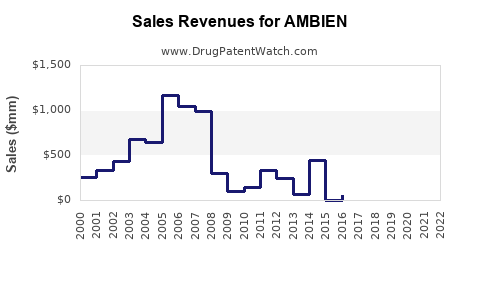
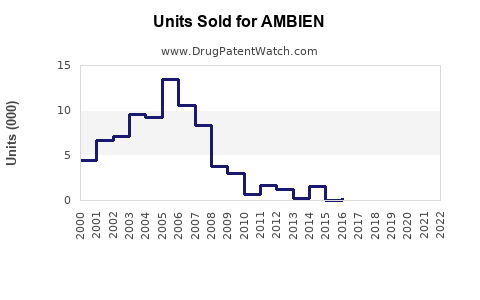
Annual Sales Revenues and Units Sold for AMBIEN
| Drug Name | Revenues (USD) | Units | Year |
|---|---|---|---|
| AMBIEN | ⤷ Start Trial | ⤷ Start Trial | 2022 |
| AMBIEN | ⤷ Start Trial | ⤷ Start Trial | 2021 |
| AMBIEN | ⤷ Start Trial | ⤷ Start Trial | 2020 |
| AMBIEN | ⤷ Start Trial | ⤷ Start Trial | 2019 |
| AMBIEN | ⤷ Start Trial | ⤷ Start Trial | 2018 |
| AMBIEN | ⤷ Start Trial | ⤷ Start Trial | 2017 |
| AMBIEN | ⤷ Start Trial | ⤷ Start Trial | 2016 |
| >Drug Name | >Revenues (USD) | >Units | >Year |
AMBIEN Market Analysis and Sales Projections: Zolpidem Market Outlook Through 2029
AMBIEN is a mature prescription sleep medicine based on zolpidem tartrate. Its U.S. composition-of-matter exclusivity ended in 2007, and generic zolpidem now accounts for most prescriptions. The branded franchise has limited growth potential, while the broader zolpidem market remains commercially relevant because of high prescribing volume, low treatment cost, and established physician familiarity.
The base-case outlook is for declining branded AMBIEN revenue and broadly stable-to-declining zolpidem molecule sales through 2029. Newer orexin receptor antagonists, tighter prescribing controls, safety concerns, and generic price compression will limit value growth.
What is the current market position of AMBIEN?
AMBIEN is the U.S. brand name for immediate-release zolpidem tablets. Related products include AMBIEN CR extended-release tablets and INTERMEZZO sublingual tablets. Zolpidem is a Schedule IV controlled substance indicated for short-term treatment of insomnia characterized by difficulty with sleep initiation or maintenance, depending on the formulation.[1]
| Product | Active ingredient | Dosage form | Primary use | Current commercial position |
|---|---|---|---|---|
| AMBIEN | Zolpidem tartrate | Immediate-release tablet | Sleep initiation | Mature branded product with extensive generic competition |
| AMBIEN CR | Zolpidem tartrate | Extended-release tablet | Sleep initiation and maintenance | Generic competition and declining brand leverage |
| INTERMEZZO | Zolpidem tartrate | Sublingual tablet | Middle-of-the-night awakening | Niche product with limited commercial scale |
| Generic zolpidem | Zolpidem tartrate | Tablets, extended-release tablets, sublingual products | Insomnia | Dominant volume segment |
The product’s main commercial advantage is cost. Generic zolpidem is usually available for a few dollars per prescription, while newer branded insomnia products often carry substantially higher monthly list prices.
How large is the zolpidem and AMBIEN market?
The U.S. market is volume-heavy but value-constrained. Zolpidem remains one of the most frequently prescribed prescription insomnia medicines, although utilization has declined from historical peaks and has shifted toward generic products.
The market can be divided into four segments:
- Immediate-release generic zolpidem.
- Extended-release zolpidem, including generic versions of AMBIEN CR.
- Sublingual zolpidem products, including generic INTERMEZZO equivalents.
- Branded AMBIEN products purchased by patients or insurers that retain brand coverage.
The branded AMBIEN market is now a small fraction of the historical franchise. Sanofi no longer reports AMBIEN as a major standalone growth product in its current financial disclosures. Historical U.S. sales reached blockbuster levels before generic entry, but the franchise lost substantial value after the core patent expired and generic manufacturers entered the market.
An appropriate market distinction is:
| Market definition | 2024 commercial profile | Five-year outlook |
|---|---|---|
| Branded AMBIEN | Small, mature, price-sensitive | Decline |
| U.S. generic zolpidem | High prescription volume, low unit economics | Stable to modest decline |
| Global zolpidem products | Fragmented by country and manufacturer | Low single-digit decline |
| Prescription insomnia market | Growing in value because of newer branded therapies | Low-to-mid single-digit growth |
| Orexin antagonist segment | Expanding from a small base | Strongest branded growth |
Public market reports produce materially different estimates for the global zolpidem market because they vary in geographic coverage, inclusion of hospital sales, and treatment of generic revenue. Prescription volume and manufacturer sales are more reliable indicators than syndicated market-size estimates.
What are AMBIEN sales projections through 2029?
The following projection separates branded AMBIEN revenue from total zolpidem molecule revenue. Figures are modeled estimates in U.S. dollars and represent worldwide manufacturer-level sales for the relevant product category, not retail prescription spending.
Base-case projection
| Year | Branded AMBIEN franchise | Total zolpidem molecule market | Key assumption |
|---|---|---|---|
| 2024 | $30 million-$50 million | $650 million-$850 million | Generic products dominate |
| 2025 | $27 million-$45 million | $635 million-$835 million | Brand erosion continues |
| 2026 | $24 million-$41 million | $620 million-$820 million | Price pressure offsets stable volume |
| 2027 | $21 million-$37 million | $605 million-$805 million | Orexin products take share |
| 2028 | $18 million-$34 million | $590 million-$790 million | Mature generic market |
| 2029 | $16 million-$31 million | $575 million-$775 million | Continued low-cost substitution |
The base case implies an annual branded AMBIEN revenue decline of approximately 7% to 10%. Total zolpidem revenue declines more slowly, at approximately 1% to 2% annually, because generic volume remains substantial and the medicine is widely recognized by prescribers.
Scenario analysis
| Scenario | 2029 branded AMBIEN sales | 2029 total zolpidem sales | Main drivers |
|---|---|---|---|
| Downside | $8 million-$16 million | $470 million-$600 million | Faster conversion to generics, safety-driven prescribing reductions |
| Base case | $16 million-$31 million | $575 million-$775 million | Stable volume and gradual branded erosion |
| Upside | $35 million-$55 million | $750 million-$950 million | Persistent demand, limited payer access to newer agents, stronger international sales |
The upside case is more plausible for the molecule than for the AMBIEN brand. Generic zolpidem can retain volume even as branded sales fall because of affordability and formulary access.
When did AMBIEN lose market exclusivity?
The core U.S. AMBIEN patent expired in the mid-2000s, with generic entry occurring in 2007 after patent and regulatory exclusivity effects were resolved. The loss of exclusivity changed the product from a branded blockbuster into a generic-volume medicine.
AMBIEN CR retained a longer period of formulation-related protection than immediate-release AMBIEN. Generic extended-release zolpidem products entered the U.S. market after separate patent litigation and regulatory review. The commercial effect was similar: once generic extended-release products became available, payer substitution reduced the value of the brand.
The relevant exclusivity profile is:
| Protection category | AMBIEN impact |
|---|---|
| Active pharmaceutical ingredient | No meaningful remaining U.S. exclusivity |
| Immediate-release formulation | Generic competition established |
| Extended-release formulation | Formulation patents delayed competition but did not preserve long-term exclusivity |
| Sublingual formulation | Niche formulation protection has limited current commercial effect |
| Regulatory exclusivity | Expired for the original products |
| Data exclusivity | No current barrier to generic approval |
The key commercial barrier is no longer patent protection. It is the ability to obtain favorable formulary placement, maintain physician use, and differentiate a branded product from low-cost generic zolpidem.
What patents protect AMBIEN and AMBIEN CR?
AMBIEN’s original patent estate covered zolpidem and pharmaceutical compositions containing the active ingredient. AMBIEN CR relied on extended-release formulation and delivery technology. INTERMEZZO relied on sublingual delivery and low-dose administration for middle-of-the-night awakening.
The current patent position does not provide a meaningful broad barrier to generic immediate-release zolpidem. Any remaining patent claims would be more likely to concern:
- Extended-release delivery mechanisms.
- Specific dosage strengths.
- Sublingual dosage forms.
- Manufacturing processes.
- Narrow method-of-use claims.
- Device or packaging elements.
FDA Orange Book listings historically provided the principal public record for AMBIEN-related patents and approved equivalents.[2] Patent protection for the original AMBIEN product is no longer a practical defense against standard generic substitution.
What is the FDA regulatory status of AMBIEN?
The FDA approved AMBIEN in 1993. AMBIEN CR was later approved as an extended-release formulation, and INTERMEZZO was approved for middle-of-the-night awakening in patients who had at least four hours remaining before planned awakening.[1]
The FDA has imposed important safety communications and labeling requirements for zolpidem products. Key issues include:
- Complex sleep behaviors such as sleep-walking, sleep-driving, and other activities performed while not fully awake.
- Next-morning impairment, particularly with higher doses and in women.
- Central nervous system depression when combined with alcohol, opioids, or other sedatives.
- Abuse, misuse, dependence, and withdrawal risks.
- Lower recommended starting doses for women and older or vulnerable patients.
In 2019, the FDA required a boxed warning for zolpidem and other commonly used insomnia medicines after reports of serious injuries and deaths associated with complex sleep behaviors.[3] The warning increases prescribing friction and may support gradual migration toward non-drug treatment or newer insomnia medicines.
Which drugs compete with AMBIEN?
AMBIEN competes with both low-cost generic medicines and newer branded products.
| Competitor | Company | Mechanism or category | Competitive effect |
|---|---|---|---|
| Generic zolpidem | Multiple manufacturers | GABA-A receptor modulator | Direct substitution and largest volume threat to brand |
| LUNESTA | Sunovion/other generic manufacturers | Eszopiclone | Established generic alternative |
| SONATA | Generic manufacturers | Zaleplon | Shorter-acting alternative |
| BELSOMRA | Merck | Orexin receptor antagonist | Branded alternative for sleep onset and maintenance |
| DAYVIGO | Eisai | Orexin receptor antagonist | Competes for chronic insomnia treatment |
| QUVIVIQ | Idorsia/Jazz Pharmaceuticals | Orexin receptor antagonist | Newer branded alternative |
| OTC melatonin | Multiple manufacturers | Circadian supplement | Consumer and self-care substitute |
| OTC antihistamines | Multiple manufacturers | Sedating antihistamines | Low-cost nonprescription substitute |
Orexin antagonists are the most important branded competitive category. Their commercial positioning emphasizes sleep maintenance, lower dependence liability relative to controlled sedative-hypnotics, and suitability for longer-term treatment. Their disadvantages include higher cost, payer restrictions, and slower formulary access.
How strong is the AMBIEN patent estate?
The AMBIEN patent estate is weak as a current commercial defense.
Strengths
- Long physician and patient familiarity.
- Broad generic manufacturing infrastructure.
- High prescription recognition.
- Multiple dosage forms.
- Established distribution and reimbursement pathways.
Weaknesses
- Core patents expired.
- Generic immediate-release products are widely available.
- Brand differentiation is limited.
- Safety labeling constrains expansion.
- No meaningful remaining composition-of-matter exclusivity.
- Newer therapies can target patients seeking alternatives to controlled sedatives.
The product has commercial durability but little remaining intellectual-property leverage. Its principal asset is market familiarity rather than patent exclusivity.
What generic entry risks exist for AMBIEN?
Generic entry risk is already realized for immediate-release AMBIEN and substantially realized for extended-release products. Future erosion will come from additional generic approvals, more aggressive pharmacy substitution, and payer exclusion of the brand.
The main risks are:
- Brand-to-generic substitution at the pharmacy.
- Lower reimbursement for branded prescriptions.
- Generic competition in extended-release and sublingual formats.
- New insomnia therapies gaining preferred formulary status.
- Reduced use of controlled sleep medicines because of safety monitoring.
- Declining physician willingness to prescribe long-term zolpidem.
The remaining market opportunity is primarily generic volume, authorized generic supply, international sales, and narrow formulation niches.
What litigation and settlement issues affect AMBIEN?
The most commercially important AMBIEN litigation occurred around generic entry and formulation patents. Those disputes focused on whether generic products infringed listed patents and whether the patents were valid or enforceable.
Current litigation risk is limited relative to the product’s historical lifecycle. Any new dispute would more likely involve:
- Extended-release formulation claims.
- Product-specific labeling.
- Patent listing disputes.
- Manufacturing process patents.
- ANDA Paragraph IV certifications.
- Narrow dosage-form claims.
A Paragraph IV certification could trigger Hatch-Waxman litigation and a potential 30-month stay for an affected generic application. That mechanism is relevant mainly to remaining formulation or sublingual products, not to ordinary immediate-release zolpidem, where generic competition is already established.[4]
No current broad patent dispute is required to explain AMBIEN’s sales outlook. The primary drivers are generic pricing, prescription volume, safety labeling, and competition from orexin antagonists.
How does AMBIEN compare with newer insomnia drugs?
| Metric | AMBIEN/generic zolpidem | Orexin antagonists |
|---|---|---|
| Price | Low after generic entry | High relative to generic zolpidem |
| Prescriber familiarity | Very high | Increasing |
| Patent protection | Expired or commercially weak | Active for newer products |
| Controlled-substance status | Schedule IV | Varies by product and jurisdiction |
| Sleep-onset efficacy | Established | Established |
| Sleep-maintenance efficacy | Formulation-dependent | Often central to positioning |
| Payer access | Broad for generics | Frequently restricted |
| Long-term commercial growth | Low | Higher |
| Dependence and complex-behavior concerns | Important label risks | Different safety and tolerability profile |
AMBIEN remains difficult to displace in cost-sensitive prescribing. Newer products are more likely to take share from branded and chronic-use segments than from all zolpidem prescriptions.
What is the revenue exposure for manufacturers?
For the original innovator, AMBIEN is unlikely to represent a material growth asset. Sanofi’s current portfolio is not dependent on AMBIEN revenue, and the company does not identify the product as a major standalone growth driver in its recent reporting.[5]
For generic manufacturers, zolpidem is a low-margin, high-volume product. Revenue exposure depends on:
- Contract pricing.
- Manufacturing scale.
- Active pharmaceutical ingredient costs.
- Number of approved competitors.
- Pharmacy benefit manager negotiations.
- Shortages or supply interruptions.
- Product mix between immediate-release and extended-release forms.
The product can generate meaningful aggregate revenue across the generic industry while producing limited profit for any single manufacturer.
What are the likely AMBIEN launch scenarios?
A new branded AMBIEN launch is unlikely to achieve historical blockbuster economics. The most credible commercial scenarios are:
Generic expansion
A manufacturer adds or expands generic zolpidem capacity. Success depends on cost leadership, supply reliability, and regulatory compliance rather than clinical differentiation.
Formulation lifecycle management
An improved-release, lower-dose, or alternative-delivery zolpidem product seeks protection through formulation patents. The opportunity is limited by the need to justify a premium over inexpensive generic tablets.
International growth
Zolpidem retains potential in markets where branded products, local generics, or different reimbursement systems support higher pricing. Geographic expansion would be fragmented and unlikely to recreate U.S. peak sales.
Branded insomnia repositioning
A branded zolpidem product could target controlled distribution, lower-dose use, or specific sleep-maintenance populations. Safety warnings and generic substitution would constrain uptake.
Key Takeaways
- AMBIEN is a mature zolpidem brand with no meaningful remaining U.S. composition-of-matter exclusivity.
- Generic zolpidem controls the U.S. market by prescription volume and reimbursement.
- Branded AMBIEN sales are projected to decline from approximately $30 million-$50 million in 2024 to $16 million-$31 million by 2029.
- Total zolpidem molecule sales are projected to decline gradually, remaining approximately $575 million-$775 million worldwide in 2029 under the base case.
- AMBIEN’s commercial strength is physician familiarity and low-cost generic infrastructure, not patent protection.
- Orexin antagonists, including BELSOMRA, DAYVIGO, and QUVIVIQ, are the main branded growth competitors.
- FDA boxed-warning requirements for complex sleep behaviors create a continuing prescribing constraint.
- Generic entry risk is fully realized for immediate-release AMBIEN and substantial for extended-release products.
- The best commercial opportunities are generic manufacturing, supply reliability, niche formulations, and selected international markets.
FAQs About AMBIEN Sales, Patents, and Market Competition
Is AMBIEN still a blockbuster drug?
No. AMBIEN was a blockbuster before generic entry, but current branded sales are small relative to historical levels. Most commercial activity now occurs in generic zolpidem.
Does AMBIEN still have patent protection?
Broad protection for immediate-release zolpidem has expired. Any remaining protection is likely to be limited to specific formulations, dosage forms, methods of use, or manufacturing claims.
Can a generic manufacturer still launch a new AMBIEN product?
Yes. A manufacturer can seek FDA approval through an ANDA for an eligible generic product. The product must satisfy applicable bioequivalence, labeling, manufacturing, and patent-certification requirements.
Will orexin drugs eliminate zolpidem sales?
No. Orexin antagonists will take share in selected patients, particularly those seeking branded or longer-term insomnia treatment. Low-cost generic zolpidem will remain important because of price and prescribing familiarity.
Is AMBIEN approved for long-term chronic insomnia treatment?
The FDA labeling recommends short-term use and states that treatment should generally be limited to short periods. Persistent insomnia requires evaluation of underlying causes and treatment strategy.[1]
References
- U.S. Food and Drug Administration. (2023). AMBIEN (zolpidem tartrate) tablets prescribing information.
- U.S. Food and Drug Administration. (2024). Approved drug products with therapeutic equivalence evaluations: Orange Book.
- U.S. Food and Drug Administration. (2019). FDA adds boxed warning for risk of serious injuries caused by sleepwalking with certain prescription insomnia medicines.
- U.S. Food and Drug Administration. (2024). ANDA submissions: Content and format of abbreviated new drug applications.
- Sanofi. (2024). Universal registration document and annual financial report.
More… ↓
