Share This Page
Drug Sales Trends for ALBUTEROL
✉ Email this page to a colleague
Payment Methods and Pharmacy Types for ALBUTEROL (2018)
Revenues by Pharmacy Type
Units Sold by Pharmacy Type
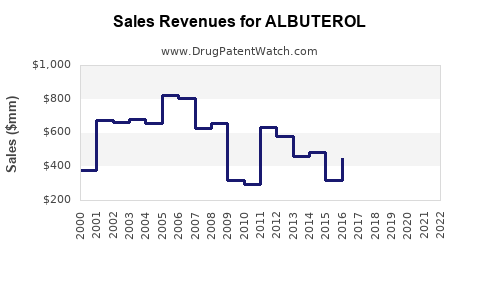
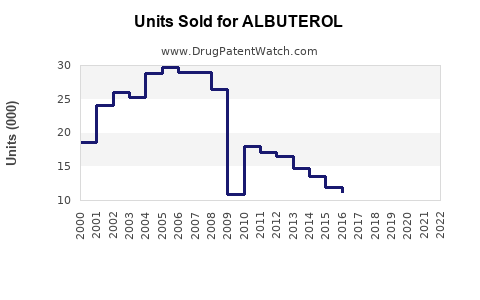
Annual Sales Revenues and Units Sold for ALBUTEROL
| Drug Name | Revenues (USD) | Units | Year |
|---|---|---|---|
| ALBUTEROL | ⤷ Start Trial | ⤷ Start Trial | 2022 |
| ALBUTEROL | ⤷ Start Trial | ⤷ Start Trial | 2021 |
| ALBUTEROL | ⤷ Start Trial | ⤷ Start Trial | 2020 |
| ALBUTEROL | ⤷ Start Trial | ⤷ Start Trial | 2019 |
| >Drug Name | >Revenues (USD) | >Units | >Year |
Albuterol Market Analysis, Sales Projections, Competition, and Patent Outlook
Albuterol is a mature, high-volume respiratory medicine with stable demand and limited pricing power. The market is driven by asthma and COPD prevalence, rescue-inhaler use, emergency-care utilization, and nebulizer demand. Generic competition has reduced branded pricing, while manufacturing complexity in metered-dose inhalers limits complete commoditization.
The estimated global manufacturer market for pure albuterol products was approximately $2.0 billion to $2.6 billion in 2024. A base-case model projects market value of about $2.7 billion by 2029, representing a compound annual growth rate of roughly 3.3%. Unit demand should grow faster than revenue because generic price erosion will offset part of volume growth.
How large is the global albuterol market?
Albuterol, also known as salbutamol outside the United States, is sold primarily as inhalation aerosol, dry-powder inhaler, nebulizer solution, and oral solution. In the United States, the dominant products are albuterol sulfate inhalation aerosols and nebulizer solutions.
| Segment | Estimated 2024 manufacturer sales | 2024-2029 outlook |
|---|---|---|
| United States | $1.2 billion-$1.5 billion | Low-single-digit growth |
| Europe | $300 million-$450 million | Flat to low growth |
| Asia-Pacific | $350 million-$500 million | Mid-single-digit growth |
| Latin America, Middle East and Africa | $150 million-$250 million | Mid- to high-single-digit growth |
| Global total | $2.0 billion-$2.6 billion | Approximately 2%-5% annual growth |
These figures cover pure albuterol or salbutamol products and exclude most combination products such as albuterol-budesonide. They represent modeled manufacturer-market value rather than a single audited industry total. Public company filings generally report respiratory portfolios rather than albuterol sales separately.
The United States remains the largest value market because of higher unit prices, extensive commercial insurance coverage, and substantial use of branded or authorized-generic inhalers. Emerging markets account for a greater share of volume but generate lower revenue per inhaler.
What are the main albuterol products and manufacturers?
United States products
The principal U.S. dosage forms are:
- Albuterol sulfate inhalation aerosol, generally 90 micrograms per actuation
- Albuterol sulfate inhalation powder
- Albuterol sulfate inhalation solution for nebulization
- Concentrated or unit-dose nebulizer solutions
- Oral syrup and tablets, which have a small and declining role
Key commercial products and suppliers include:
| Product or supplier | Product status | Commercial position |
|---|---|---|
| Ventolin HFA | Branded albuterol inhaler | GSK’s principal U.S. albuterol brand |
| ProAir HFA | Brand and authorized-generic history | Teva’s former major U.S. albuterol franchise |
| Proventil HFA | Legacy branded product | Limited current commercial relevance |
| Generic albuterol HFA | Multiple ANDA suppliers | Main source of unit growth and price pressure |
| Albuterol nebulizer solution | Multiple generic manufacturers | Large institutional and home-nebulizer segment |
| RespiClick-type products | Device-specific inhaled powder products | Smaller niche relative to HFA aerosol |
Teva launched an authorized generic version of ProAir HFA in 2019 and received FDA approval for generic ProAir HFA in 2020. The availability of equivalent products increased substitution and reduced the market share of branded rescue inhalers.[1]
GSK continues to commercialize Ventolin HFA in the United States. The company’s respiratory portfolio includes Trelegy Ellipta, Anoro Ellipta, and other products, but reported financial results do not isolate Ventolin revenue in a consistent public series.[2]
What is driving albuterol demand?
Asthma prevalence and rescue-medication use
Asthma remains the primary chronic demand driver. The CDC estimates that more than 25 million people in the United States have asthma, including millions of children.[3] Albuterol is used for acute bronchospasm and symptom relief, so prescriptions remain high even when maintenance-therapy guidelines shift toward inhaled corticosteroid-containing regimens.
COPD adds a second demand pool. Albuterol is commonly used as a short-acting bronchodilator in COPD, either alone or alongside long-acting bronchodilators and inhaled corticosteroids.
Emergency and acute-care demand
Emergency departments, urgent-care centers, hospitals, and outpatient clinics use albuterol nebulizer solution for acute respiratory symptoms. Respiratory-virus seasons can produce temporary volume spikes, particularly for nebulizer products.
Pediatric use
Children’s asthma care supports recurring inhaler and nebulizer demand. Spacer devices and nebulizer equipment increase the value of the broader delivery-system market but do not materially expand active pharmaceutical ingredient revenue.
Global access
Albuterol is included in the World Health Organization’s Model List of Essential Medicines for respiratory disease treatment.[4] In lower-income markets, salbutamol is often supplied through public procurement programs, hospital formularies, and low-cost multidose inhalers. Volume growth is stronger in these markets than revenue growth.
What are the 2025-2029 albuterol sales projections?
The base-case projection assumes stable U.S. prescription volume, modest international volume growth, continuing generic price erosion, and no major supply interruption.
| Year | Bear case | Base case | Bull case |
|---|---|---|---|
| 2024 | $2.0 billion | $2.3 billion | $2.6 billion |
| 2025 | $1.9 billion | $2.4 billion | $2.8 billion |
| 2026 | $1.9 billion | $2.4 billion | $2.9 billion |
| 2027 | $1.8 billion | $2.5 billion | $3.0 billion |
| 2028 | $1.8 billion | $2.6 billion | $3.1 billion |
| 2029 | $1.8 billion | $2.7 billion | $3.2 billion |
| 2024-2029 CAGR | -2.1% | 3.3% | 4.2% |
The base case implies approximately $400 million of incremental annual manufacturer revenue by 2029. Growth comes primarily from population expansion, greater diagnosis and treatment access in emerging markets, and continued nebulizer utilization. U.S. revenue growth is constrained by generic substitution.
Base-case revenue composition in 2029
| Segment | Estimated 2029 share |
|---|---|
| U.S. albuterol inhalers | 35%-40% |
| U.S. nebulizer solutions | 15%-20% |
| European inhalers and nebulizers | 15%-18% |
| Asia-Pacific | 18%-22% |
| Other markets | 8%-12% |
The largest downside risk is faster price erosion in U.S. generic inhalers and nebulizer solutions. The largest upside risk is greater international access combined with manufacturing expansion that resolves chronic shortages.
How does generic competition affect albuterol sales?
Generic competition is the primary commercial constraint. Albuterol sulfate is a small molecule with a long clinical history, and numerous abbreviated new drug applications have been approved. The active ingredient itself provides little differentiation. Competitive advantage instead depends on:
- Metered-dose inhaler manufacturing capacity
- Hydrofluoroalkane propellant sourcing
- Device-engineering reliability
- FDA inspection history
- Hospital and group-purchasing contracts
- Product availability during shortages
- Commercial reimbursement and pharmacy distribution
The HFA inhaler market is harder to enter than the nebulizer-solution market because it requires validated formulation, canister, valve, actuator, dose-uniformity, extractables, leachables, and aerodynamic-performance controls.
Nebulizer solution products have lower device complexity, but the segment remains exposed to sterile-manufacturing capacity, container availability, and hospital procurement concentration.
What is the FDA regulatory status of albuterol?
FDA-approved albuterol products are regulated as prescription drugs. The principal U.S. regulatory pathways are:
- New drug applications for branded products
- Abbreviated new drug applications for generic inhalers and nebulizer solutions
- Supplemental applications for formulation, device, labeling, or manufacturing changes
Albuterol HFA products are subject to FDA requirements for dose delivery, product performance, device compatibility, microbial quality, and stability. FDA’s Orange Book lists approved albuterol products and their therapeutic-equivalence codes, but it does not present one consolidated “albuterol patent expiration date.” Patent and exclusivity status is product-specific.[5]
Albuterol is also used in combination products. Airsupra, an albuterol-budesonide product approved by FDA in 2023, competes for some rescue-medication use but is not a pure-albuterol product.[6] Its commercial adoption could reduce the long-term growth rate of standalone rescue albuterol in selected asthma patients, although its higher price places it in a separate market segment.
What patents protect albuterol products?
Pure albuterol has limited composition-of-matter patent protection remaining in the United States. The commercial patent barriers are concentrated in product-specific technologies rather than the albuterol molecule.
Formulation and device patents
Potentially relevant protection can cover:
- HFA propellant formulations
- Canister and valve assemblies
- Dose-counting mechanisms
- Actuator geometry
- Dry-powder inhaler components
- Suspension stability
- Particle-size distribution
- Manufacturing and filling processes
- Combination products containing albuterol
For a generic applicant, the key legal analysis is product-specific. A patent search must identify the reference listed drug, current Orange Book listings, active ingredients, dosage form, strength, device configuration, and any Paragraph IV certifications.
Method-of-use patents
Method-of-use patents can cover treatment of asthma, bronchospasm, exercise-induced bronchoconstriction, or specific patient populations. Their commercial impact is generally weaker for a mature rescue medicine because physicians prescribe albuterol across broad, established indications and generic labels often reflect long-standing uses.
Paragraph IV challenges
Generic albuterol applicants may submit Paragraph IV certifications against listed patents when they assert that patents are invalid, unenforceable, or not infringed. The economic value of a challenge depends on:
- Whether the patent covers the inhaler device or only an ancillary feature.
- Whether the patent is listed for the reference product.
- Whether a 30-month stay is triggered.
- Whether the product can launch with a carve-out label.
- Whether the challenger can supply sufficient commercial volume.
Pure albuterol has less Paragraph IV value than newer respiratory products because multiple generic products already compete and the remaining patents are generally narrower.
When does albuterol lose exclusivity?
There is no single future loss-of-exclusivity date for albuterol. The active ingredient lost practical exclusivity many years ago. Current exclusivity depends on each branded product, formulation, device, and patent listing.
| Protection category | Current commercial significance |
|---|---|
| Albuterol molecule | No meaningful U.S. composition exclusivity |
| Conventional inhalation aerosol | Generic competition established |
| Nebulizer solution | Broad generic competition |
| Legacy brand patents | Mostly expired or commercially weak |
| Device-specific patents | Can delay or complicate individual products |
| Albuterol combination products | Potentially stronger, product-specific protection |
The most important commercial event is therefore not a single expiration date. It is the entry, withdrawal, shortage, or capacity expansion of individual suppliers.
What is the competitive landscape for albuterol?
The market has four competitive layers:
Branded inhalers
Ventolin retains brand recognition and physician familiarity. Its price premium is vulnerable where payers mandate generic substitution.
Authorized generics
Authorized generics can preserve manufacturer participation while reducing the incentive for independent generic entrants. They are particularly relevant when a brand owner or licensee controls a large pharmacy channel.
Independent generics
Generic manufacturers compete primarily on price, supply reliability, contract access, and regulatory compliance. Large suppliers include companies with established respiratory and sterile-manufacturing operations, such as Viatris, Teva, Cipla, Lupin, and other regional manufacturers.
Combination and maintenance therapies
Albuterol competes indirectly with long-acting bronchodilators, inhaled corticosteroids, and fixed-dose combinations. Clinical guidelines increasingly emphasize anti-inflammatory treatment for asthma rather than frequent short-acting bronchodilator use alone.[7] That trend affects utilization intensity but does not eliminate the need for rescue medication.
What generic entry risks exist for albuterol?
The generic-entry risk is high for standard albuterol products and moderate for technically complex inhalers.
| Product type | Generic-entry risk | Price-pressure risk |
|---|---|---|
| Nebulizer solution | High | High |
| Standard albuterol HFA aerosol | High | High |
| Device-specific inhaler | Moderate | Moderate |
| Dry-powder albuterol | Moderate | Moderate |
| Albuterol combination product | Lower initially | Lower initially |
| Hospital-dose presentations | High | Moderate |
For originators, the principal risk is share loss rather than complete market disappearance. Brand loyalty, formulary placement, shortages, and pharmacy substitution can preserve a portion of branded volume.
What manufacturing and supply risks affect albuterol?
Albuterol supply depends on several specialized inputs:
- Albuterol sulfate active pharmaceutical ingredient
- HFA propellant
- Aluminum canisters
- Metering valves
- Actuators and dose counters
- Sterile plastic unit-dose containers
- Contract filling and assembly capacity
The HFA transition eliminated chlorofluorocarbon propellants from modern U.S. albuterol inhalers, but it increased dependence on specialized formulation and device production. Supply interruptions can temporarily increase pricing and improve the position of suppliers with redundant manufacturing.
FDA’s drug-shortage database has listed albuterol-related supply issues at various times, particularly for nebulizer solutions during periods of acute respiratory demand.[8] These disruptions can create short-term revenue increases for available suppliers but do not change the long-term generic structure.
How does albuterol compare with newer respiratory drugs?
| Product class | Market maturity | Pricing power | Growth outlook |
|---|---|---|---|
| Pure albuterol | Mature generic market | Low | Low-single-digit |
| Long-acting bronchodilators | Branded and generic mix | Moderate | Moderate |
| Inhaled corticosteroid combinations | Mixed patent status | Moderate to high | Moderate |
| Biologic asthma therapies | Patent-protected | High | High |
| Albuterol-budesonide combinations | Early commercial phase | Higher than albuterol alone | Potentially high |
Albuterol remains a volume product. Newer respiratory therapies generate greater revenue per patient but address different treatment objectives and have higher acquisition costs.
What is the investment and licensing outlook for albuterol?
Standalone albuterol is generally a low-value licensing asset unless it includes a differentiated inhaler platform, proprietary propellant technology, or a major distribution contract. The strongest commercial opportunities are:
- Low-cost inhalers for emerging markets
- Reliable sterile nebulizer production
- Device platforms with broad respiratory applications
- Authorized-generic arrangements
- Combination products with clinical or reimbursement differentiation
- Contract manufacturing for firms facing supply constraints
Licensing economics are weak for an undifferentiated albuterol formulation because multiple suppliers can compete on price. Device intellectual property and reliable regulatory execution have greater value than the active ingredient.
Key Takeaways
- The estimated global pure-albuterol manufacturer market was $2.0 billion-$2.6 billion in 2024.
- Base-case sales are projected to reach approximately $2.7 billion by 2029.
- The United States is the largest value market, while Asia-Pacific is the strongest volume-growth region.
- Generic competition is established and will continue to limit U.S. pricing.
- Nebulizer solutions offer volume but remain exposed to sterile-manufacturing disruptions.
- HFA inhalers have higher technical entry barriers than standard nebulizer products.
- Albuterol has no meaningful remaining composition-of-matter exclusivity.
- Future patent value is concentrated in devices, formulations, manufacturing processes, and combination products.
- Airsupra and other anti-inflammatory rescue approaches may moderate standalone albuterol growth in asthma.
- The most attractive commercial opportunities involve supply reliability, device technology, emerging-market access, and combination products.
FAQs
Is albuterol still a profitable drug?
Yes, but profitability depends on manufacturing scale, supply reliability, channel access, and production cost. Standard generic albuterol has limited pricing power.
Which albuterol product has the strongest commercial position?
Ventolin has the strongest global brand recognition, while generic albuterol products control much of U.S. prescription volume. The strongest supplier position can change during shortages.
Is albuterol a biologic drug?
No. Albuterol is a small-molecule bronchodilator. Biosimilar competition does not apply. Competition occurs through generic-drug pathways.
Does albuterol have a new patent expiration date?
No single date applies. The molecule is long off patent. Any remaining protection is tied to a specific device, formulation, manufacturing process, or combination product.
Will albuterol sales decline because of newer asthma therapies?
Standalone albuterol use may decline in some well-controlled asthma populations, but population growth, COPD use, pediatric demand, acute-care utilization, and emerging-market access should support a broadly stable global market.
References
- U.S. Food and Drug Administration. (2020). FDA approves first generic of ProAir HFA albuterol sulfate inhalation aerosol.
- GSK plc. (2024). Annual report 2023.
- Centers for Disease Control and Prevention. (2024). Most recent national asthma data.
- World Health Organization. (2023). WHO model list of essential medicines: 23rd list.
- U.S. Food and Drug Administration. (2024). Approved drug products with therapeutic equivalence evaluations.
- U.S. Food and Drug Administration. (2023). FDA approves first-ever rescue medication for asthma attacks.
- Global Initiative for Asthma. (2024). Global strategy for asthma management and prevention.
- U.S. Food and Drug Administration. (2024). FDA drug shortages database.
More… ↓
