Share This Page
Drug Sales Trends for miconazole
✉ Email this page to a colleague
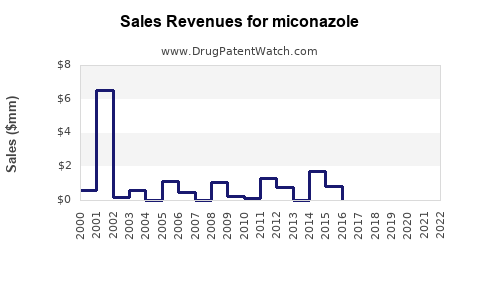
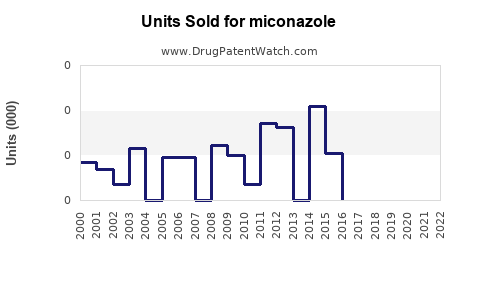
Annual Sales Revenues and Units Sold for miconazole
| Drug Name | Revenues (USD) | Units | Year |
|---|---|---|---|
| MICONAZOLE | ⤷ Start Trial | ⤷ Start Trial | 2022 |
| MICONAZOLE | ⤷ Start Trial | ⤷ Start Trial | 2021 |
| MICONAZOLE | ⤷ Start Trial | ⤷ Start Trial | 2020 |
| MICONAZOLE | ⤷ Start Trial | ⤷ Start Trial | 2019 |
| MICONAZOLE | ⤷ Start Trial | ⤷ Start Trial | 2018 |
| MICONAZOLE | ⤷ Start Trial | ⤷ Start Trial | 2017 |
| MICONAZOLE | ⤷ Start Trial | ⤷ Start Trial | 2016 |
| >Drug Name | >Revenues (USD) | >Units | >Year |
Miconazole Market Analysis, Sales Projections, Patent Status, and Competitive Landscape
Miconazole is a mature antifungal active ingredient with broad global use in vaginal, topical, oral-gel, dermatological, and veterinary products. Its commercial market is fragmented across branded OTC products, private-label generics, pharmacy brands, and prescription formulations. The strongest demand is in vaginal candidiasis and topical skin infections. Patent barriers are generally low because the active ingredient has been marketed for decades; commercial performance depends more on brand recognition, retail distribution, formulation convenience, pricing, and regulatory access than on exclusivity.
Public sources do not provide a single audited global revenue figure for all miconazole products. The following projections use a market model based on mature OTC and generic pharmaceutical categories, rather than reported consolidated sales from one manufacturer.
What is miconazole and how is it used?
Miconazole is an imidazole antifungal that inhibits fungal ergosterol biosynthesis by interfering with lanosterol 14-alpha-demethylase. It has activity against Candida species and dermatophytes and is used in several dosage forms.
| Product category | Common dosage forms | Main indications | Market position |
|---|---|---|---|
| Vaginal miconazole | Cream, suppository, ovule, capsule | Vulvovaginal candidiasis | Largest branded OTC segment in the U.S. |
| Dermatological miconazole | Cream, powder, spray, lotion | Tinea pedis, tinea cruris, tinea corporis, cutaneous candidiasis | Highly genericized |
| Oral miconazole | Oral gel or buccal preparations | Oral candidiasis | Important in selected non-U.S. markets |
| Veterinary miconazole | Creams, drops, shampoos, otic products | Skin, ear, and fungal infections in animals | Smaller but recurring specialty segment |
| Combination products | Miconazole with corticosteroids or antibacterial agents | Inflammatory or mixed skin infections | Country-specific prescription and OTC demand |
In the United States, miconazole nitrate vaginal products are marketed primarily under the Monistat brand and as store-brand generics. Topical products are marketed under multiple private-label and pharmacy brands.
How large is the global miconazole market?
The global miconazole market is best treated as a mature, low-growth pharmaceutical category rather than a single branded drug market. Published commercial estimates differ materially because some reports include only prescription products, while others include OTC vaginal products, dermatology products, veterinary products, and combination formulations.
A reasonable addressable-market range for human miconazole products is approximately $500 million to $1.0 billion in annual retail and institutional value globally. The range reflects differences in geographic coverage, inclusion of private-label products, and whether sales are measured at manufacturer, wholesale, or retail level.
A base-case market model is shown below.
| Market segment | Estimated 2025 global value | Expected 2025-2030 CAGR | 2030 base-case value |
|---|---|---|---|
| Vaginal products | $250 million-$450 million | 1%-3% | $265 million-$520 million |
| Dermatological products | $180 million-$350 million | 1%-3% | $190 million-$405 million |
| Oral and buccal products | $40 million-$100 million | 0%-2% | $40 million-$110 million |
| Veterinary and other uses | $50 million-$120 million | 2%-4% | $55 million-$145 million |
| Total human and adjacent market | $520 million-$1.02 billion | 1%-3% | $550 million-$1.18 billion |
These figures are analytical estimates, not reported manufacturer revenue. They should not be treated as a substitute for IQVIA, Circana, national pharmacy audits, or company-specific sales disclosures.
What are the miconazole sales projections through 2030?
Miconazole is unlikely to produce high growth through new mechanism or exclusivity. The base case assumes stable demand, modest population growth, continued self-care use, and gradual substitution toward lower-priced generic and private-label products.
| Scenario | 2025 estimated market | Annual growth | 2030 estimated market | Main assumptions |
|---|---|---|---|---|
| Downside | $520 million | -1% to 0% | $495 million-$520 million | Price erosion, substitution by fluconazole or newer OTC products |
| Base case | $750 million | 2% | $829 million | Stable category demand and moderate emerging-market expansion |
| Upside | $1.02 billion | 4% | $1.24 billion | Stronger self-care growth, wider access, and higher retail pricing |
The most defensible forecast is low-single-digit nominal growth. Unit volumes may be flat or decline while revenue rises modestly through inflation and premium branded products.
U.S. sales outlook
The U.S. market is mature and concentrated in OTC vaginal products. Monistat retains high consumer awareness, but private-label products create substantial price pressure. Growth is likely to remain limited because:
- The underlying condition is common but episodic.
- The treatment course is short.
- Consumers can choose branded, generic, and alternative antifungal products.
- Oral fluconazole remains a competing treatment where clinically appropriate.
- Retailers can substitute private-label products quickly.
A reasonable U.S. miconazole forecast is flat to low-single-digit annual value growth through 2030, with branded share declining faster than total category value.
Europe and other developed markets
European demand is distributed among Daktarin, generic miconazole, clotrimazole, terbinafine, and country-specific prescription products. Reimbursement policies and pharmacy dispensing rules affect sales more than patent rights. Miconazole oral gel remains relevant in selected markets, but usage varies because of local prescribing practices and safety restrictions.
Emerging markets
Emerging markets offer the strongest volume opportunity. Growth drivers include increased diagnosis of fungal infections, pharmacy-led treatment, wider retail access, and expansion of domestic generic manufacturing. Pricing is substantially lower than in the U.S. and Western Europe, so volume growth does not translate proportionally into revenue growth.
Which companies sell miconazole products?
Miconazole is supplied by a large group of consumer-health companies, generic manufacturers, distributors, and regional pharmaceutical businesses.
| Company or brand group | Relevant products or role |
|---|---|
| Prestige Consumer Healthcare | Monistat vaginal antifungal franchise in the U.S. |
| Bayer and regional consumer-health businesses | Daktarin and related miconazole products in several markets, subject to country-specific ownership and distribution |
| Perrigo | Private-label and store-brand OTC products in multiple markets |
| Haleon and other consumer-health companies | Distribution and retail competition in antifungal self-care categories |
| Generic manufacturers | Miconazole creams, powders, vaginal products, and combination products |
| Veterinary manufacturers | Miconazole-containing dermatology, otic, and shampoo products |
Brand ownership and distribution arrangements vary by country. A company may own the trademark in one market while a licensee or distributor controls commercialization elsewhere.
How does miconazole compare with clotrimazole, terbinafine, and fluconazole?
Miconazole competes across different clinical categories, not through a single head-to-head market.
| Drug | Principal use | Relative commercial strength | Main competitive issue |
|---|---|---|---|
| Miconazole | Vaginal and topical fungal infections | Strong OTC presence | Mature category and price competition |
| Clotrimazole | Vaginal and dermatological infections | Broad global generic use | Often lower-priced and widely available |
| Terbinafine | Dermatophyte skin and nail infections | Strong topical brand recognition | Particularly competitive in athlete's foot |
| Fluconazole | Systemic and vaginal candidiasis | Strong prescription position | Oral convenience and physician preference |
| Ketoconazole | Dermatology, shampoo, veterinary use | Narrower human role than in the past | Safety and formulation-specific limitations |
| Nystatin | Candida infections | Strong in certain regional and clinical uses | Different spectrum and dosage-form economics |
Miconazole's commercial advantage is formulation breadth and long-established consumer recognition. Its disadvantage is the absence of meaningful exclusivity and the availability of clinically familiar substitutes.
What FDA regulatory status applies to miconazole?
Miconazole products are regulated under several pathways depending on dosage form and indication.
U.S. OTC vaginal products
Miconazole nitrate vaginal products are eligible for marketing under the FDA OTC antifungal framework when they comply with applicable conditions, including active ingredient concentration, dosage form, labeling, and indications. The relevant regulatory framework is found in 21 C.F.R. Part 333, Subpart C, covering OTC external analgesic, antifungal, and related products, together with FDA OTC monograph requirements.
Monistat products are generally marketed as nonprescription products for vaginal yeast infection treatment. Products may be sold in one-day, three-day, or seven-day regimens, depending on strength and formulation.
U.S. topical products
Miconazole nitrate cream and related topical products are marketed for conditions such as athlete's foot, jock itch, and ringworm when they meet applicable OTC antifungal requirements. Product-specific labeling must address age, application frequency, duration, warnings, and when to seek medical attention.
Prescription products
Some formulations, combinations, concentrations, or indications may remain prescription products depending on jurisdiction. Prescription status is product-specific and cannot be inferred solely from the active ingredient.
FDA Orange Book status
The Orange Book is not the principal source of exclusivity for ordinary OTC monograph-compliant miconazole products. FDA-approved prescription products may have Orange Book entries, but the commercial market is dominated by nonprescription and generic products that do not rely on a new-drug patent monopoly.
What patents protect miconazole products?
The original miconazole compound is long off patent. Current commercial protection is more likely to involve formulation, delivery system, combination therapy, packaging, or manufacturing claims than the active ingredient itself.
| Protection type | Current relevance |
|---|---|
| Original composition-of-matter patent | No meaningful current exclusivity |
| Vaginal dosage-form patent | Potentially relevant only for specific newer delivery systems |
| Cream, gel, or emulsion formulation | Usually narrow and vulnerable to design-around |
| Combination product patent | May cover a specific active combination or ratio |
| Manufacturing process patent | Can create supply-chain advantages but rarely blocks all generic production |
| Trademark protection | Important for Monistat, Daktarin, and regional brands |
| Trade dress and consumer branding | Commercially meaningful in OTC retail channels |
No broad, current composition-of-matter barrier should be assumed for miconazole. Patent clearance requires a country-specific search of active claims covering the exact product, formulation, concentration, and manufacturing process.
When does miconazole lose exclusivity?
Miconazole lost meaningful active-ingredient exclusivity decades ago. The current market is already genericized in most jurisdictions. Any remaining exclusivity is product-specific and may arise from:
- A newly approved dosage form.
- A novel delivery system.
- A combination product.
- A jurisdiction-specific data or market exclusivity period.
- A trademark or brand position.
- A private licensing arrangement.
For a conventional miconazole nitrate cream, powder, or vaginal suppository, the principal commercial barriers are regulatory compliance, manufacturing scale, retailer access, and brand investment rather than patent expiry.
Are there Paragraph IV challenges involving miconazole?
Paragraph IV litigation is not a central feature of the conventional miconazole market. Paragraph IV certifications are relevant to abbreviated new drug applications that reference an approved drug with listed patents. Many miconazole products are OTC monograph products or mature generic products without a commercially significant Orange Book patent estate.
A Paragraph IV challenge could arise for a specific prescription formulation or a newly approved delivery system, but it would not normally affect the broader miconazole category. Generic entrants are more likely to rely on ANDA pathways, OTC monograph compliance, or country-specific generic registration routes.
What formulation patents and manufacturing barriers matter?
The most defensible IP opportunities are formulation-specific.
Vaginal delivery
Potentially protectable features include:
- Mucoadhesive delivery.
- Extended residence time.
- Reduced leakage.
- Lower irritation.
- Single-dose delivery.
- Controlled release.
- Improved compatibility with vaginal pH.
- Applicator design and dose uniformity.
These claims may improve differentiation but generally do not prevent competition from conventional creams, suppositories, or alternative antifungals.
Dermatological formulations
Relevant formulation claims can involve improved spreadability, drying time, skin penetration, emulsion stability, reduced residue, and combination therapy. Generic competitors can often design around narrow excipient or process claims.
Manufacturing and supply
Manufacturing barriers include reliable supply of miconazole nitrate, control of particle size, assay uniformity, microbiological quality, preservative performance, and stability of semisolid or vaginal products. These are execution barriers rather than durable exclusivity barriers.
What licensing deals affect the miconazole market?
Miconazole has historically been commercialized through brand licensing, regional distribution, manufacturing agreements, and private-label supply arrangements. The active ingredient itself is not generally associated with a current high-value platform license.
Commercial agreements are more likely to cover:
- Regional rights to a consumer brand.
- Contract manufacturing.
- Retailer private-label supply.
- Veterinary distribution.
- Combination formulations.
- Regulatory sponsorship in a local market.
Deal value is difficult to isolate because companies usually report consumer-health portfolios in aggregate rather than disclose miconazole-specific royalties or product-level margins.
What litigation and settlement risks affect miconazole?
The main litigation risks are product liability, advertising claims, trademark disputes, manufacturing quality, and regulatory compliance. Patent litigation is a secondary risk for mature conventional products.
Potential disputes may involve:
- Alleged failure to treat infection.
- Misdiagnosis or delayed medical treatment.
- Irritation or hypersensitivity.
- Comparative advertising.
- Trademark ownership or brand licensing.
- Generic equivalence and labeling.
- Quality recalls or contamination.
- Combination-product claims.
Settlement agreements are more likely to concern branding, distribution, or generic entry for a particular product than broad market exclusion.
What generic launch scenarios exist for miconazole?
A conventional generic launch can occur through several routes:
| Launch route | Expected market effect |
|---|---|
| OTC monograph product | Rapid entry if formulation and labeling comply |
| ANDA generic | Lower price and pharmacy substitution |
| Private-label retail product | Immediate pressure on branded share |
| Regional prescription generic | Increased hospital and pharmacy competition |
| New delivery system | Potential premium pricing but limited exclusion |
| Combination product | Differentiation based on indication or convenience |
The most likely outcome is gradual erosion of branded share rather than a single abrupt generic event. Retailers often maintain a branded option while expanding lower-priced store brands.
What is the commercial outlook for miconazole?
Miconazole remains commercially durable because fungal infections are common, treatment is inexpensive, and the active ingredient is familiar to pharmacists and consumers. The category lacks the characteristics of a high-growth innovative medicine.
Key commercial drivers are:
- OTC self-care demand.
- Brand recognition in vaginal antifungal products.
- Retail shelf placement.
- Private-label pricing.
- Pharmacy access in emerging markets.
- Product convenience, particularly shorter treatment regimens.
- Formulation stability and manufacturing reliability.
Revenue exposure is concentrated in consumer-health businesses rather than biotechnology companies. A manufacturer with a leading brand may generate attractive cash flow despite limited volume growth, while an unbranded generic manufacturer faces price competition and low switching costs.
How strong is the miconazole patent estate?
The patent estate is weak for the active ingredient and conventional formulations. It can be rated as follows:
| Estate component | Strength |
|---|---|
| Active ingredient | Very weak or expired |
| Conventional cream | Weak |
| Conventional vaginal suppository | Weak |
| Branded OTC formulation | Moderate commercial protection through trademark |
| Novel delivery system | Potentially moderate, claim-dependent |
| Manufacturing process | Narrow to moderate |
| Retail distribution | Commercially important but not patent-based |
| Regulatory exclusivity | Limited for mature products |
The strongest defensible assets are trademarks, consumer recognition, retailer relationships, regulatory files, and supply capabilities.
Key Takeaways
- Miconazole is a mature, globally distributed antifungal active ingredient.
- Estimated global human and adjacent market value is approximately $520 million to $1.02 billion in 2025.
- A base-case forecast places the market near $829 million by 2030, assuming roughly 2% annual growth.
- Vaginal OTC products represent the largest branded opportunity, while topical products are highly genericized.
- Monistat and Daktarin are important regional brands, but ownership and distribution differ by country.
- The original active ingredient has no meaningful current composition-of-matter exclusivity.
- Conventional products face low patent barriers and high price competition.
- Formulation, delivery, trademark, manufacturing, and distribution rights are more commercially relevant than active-ingredient patents.
- Paragraph IV litigation is not a central risk for the mature OTC market.
- Growth is likely to come from emerging-market volume, self-care access, and formulation upgrades rather than innovation-led pricing.
FAQs About Miconazole Market Size and Drug Patents
Is miconazole still profitable for pharmaceutical companies?
Yes, particularly for branded OTC products, private-label supply, and efficient generic manufacturing. Profitability depends on scale, retailer access, and brand pricing rather than patent exclusivity.
Which miconazole product has the strongest commercial position?
Monistat has a strong U.S. vaginal-antifungal position because of consumer recognition and retail availability. Daktarin has substantial regional strength outside the United States.
Can a company patent a new miconazole cream?
A company may obtain patents for a novel formulation, delivery system, combination, or manufacturing process if the claims satisfy patentability requirements. It generally cannot obtain a new composition-of-matter patent on miconazole itself.
Is miconazole threatened by fluconazole?
Yes, fluconazole competes particularly in vaginal candidiasis and prescription channels. Miconazole retains an OTC advantage where consumers prefer local treatment or where oral therapy is unsuitable.
Is miconazole a high-growth pharmaceutical market?
No. It is a stable, mature market with expected low-single-digit nominal growth and continuing generic and private-label price pressure.
References
-
Code of Federal Regulations. (2024). 21 C.F.R. Part 333: Topical antimicrobial drug products for over-the-counter human use. U.S. Government Publishing Office.
-
U.S. Food and Drug Administration. (2024). Over-the-counter monograph M020: Vaginal antifungal drug products. U.S. Department of Health and Human Services.
-
U.S. Food and Drug Administration. (2024). Orange Book: Approved drug products with therapeutic equivalence evaluations. U.S. Department of Health and Human Services.
-
DailyMed. (2024). Miconazole nitrate vaginal and topical product labeling. National Library of Medicine.
-
World Health Organization. (2023). WHO model list of essential medicines. World Health Organization.
-
British National Formulary. (2024). Miconazole: Drug monograph. BMJ Group and Pharmaceutical Press.
More… ↓
