Drug Sales Trends for jardiance
Payment Methods and Pharmacy Types for jardiance (2017)
Revenues by Pharmacy Type
Units Sold by Pharmacy Type
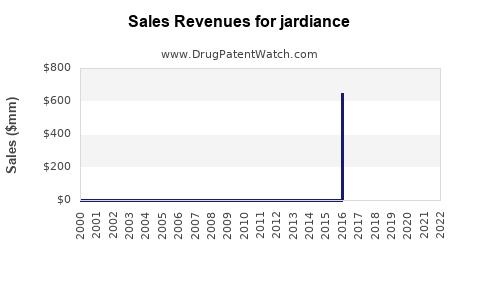
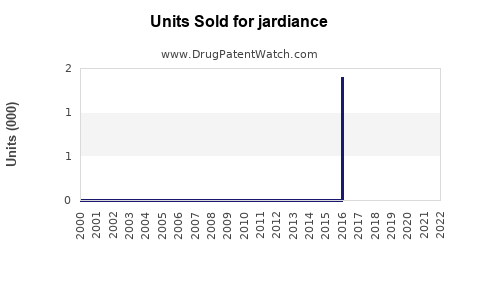
Annual Sales Revenues and Units Sold for jardiance
| Drug Name | Revenues (USD) | Units | Year |
|---|---|---|---|
| JARDIANCE | ⤷ Start Trial | ⤷ Start Trial | 2022 |
| JARDIANCE | ⤷ Start Trial | ⤷ Start Trial | 2021 |
| JARDIANCE | ⤷ Start Trial | ⤷ Start Trial | 2020 |
| JARDIANCE | ⤷ Start Trial | ⤷ Start Trial | 2019 |
| >Drug Name | >Revenues (USD) | >Units | >Year |
Jardiance Market Analysis, Sales Projections, Patent Expiry, and Generic Entry Risk
Jardiance, the empagliflozin product marketed by Boehringer Ingelheim and Eli Lilly, is one of the leading SGLT2 inhibitors globally. Its market has expanded from type 2 diabetes into heart failure and chronic kidney disease, materially extending demand beyond the original diabetes franchise. Global Jardiance sales are estimated at approximately $8 billion in 2024, with peak sales likely in the $8.5 billion to $9.5 billion range before U.S. generic competition and international price erosion reduce revenue.
The primary commercial risk is no longer clinical adoption. It is loss of U.S. exclusivity. The core U.S. compound patent has expired or reached its pediatric-extension endpoint, while later method-of-use and formulation patents may delay or constrain generic launches. Jardiance is a small-molecule drug, so biosimilar risk does not apply. The relevant pathway is an abbreviated new drug application, or ANDA, with Paragraph IV patent challenges.
What is Jardiance and who markets it?
Jardiance is the brand name for empagliflozin, an oral sodium-glucose cotransporter 2, or SGLT2, inhibitor. Boehringer Ingelheim and Eli Lilly jointly develop and commercialize the product through their diabetes alliance.
| Item | Detail |
|---|---|
| Active ingredient | Empagliflozin |
| Brand | Jardiance |
| Drug class | SGLT2 inhibitor |
| Primary developers | Boehringer Ingelheim and Eli Lilly |
| U.S. approval | August 2014 |
| Initial indication | Glycemic control in adults with type 2 diabetes |
| Major later indications | Cardiovascular-risk reduction, heart failure, and chronic kidney disease |
| Dosage form | Oral tablets, 10 mg and 25 mg |
| U.S. regulatory pathway | New drug application |
| Generic pathway | ANDA |
| Biosimilar exposure | None |
The FDA approved Jardiance in 2014 for adults with type 2 diabetes as an adjunct to diet and exercise. The label later expanded after cardiovascular, heart-failure, and renal-outcome data. FDA approvals for heart failure and chronic kidney disease significantly increased the addressable population beyond patients requiring additional glucose control.[1]
How large is the Jardiance market?
Jardiance has become a broad cardiorenal-metabolic product rather than a diabetes-only drug. Its commercial market includes four overlapping populations:
- Adults with type 2 diabetes.
- Patients with type 2 diabetes and elevated cardiovascular risk.
- Patients with heart failure, including patients without diabetes.
- Patients with chronic kidney disease who are at risk of disease progression.
Eli Lilly reported Jardiance revenue of approximately $3.25 billion in 2024, compared with approximately $2.87 billion in 2023 and $2.37 billion in 2022.[2] Lilly’s figure does not represent total global Jardiance sales because Boehringer Ingelheim reports its share separately and the companies use alliance accounting.
Estimated global Jardiance sales
| Year | Estimated global sales | Growth profile | Primary driver |
|---|---|---|---|
| 2022 | $6.5B-$7.0B | High | Heart-failure adoption |
| 2023 | $7.2B-$7.8B | High single digit to low double digit | Chronic kidney disease uptake |
| 2024 | $7.8B-$8.5B | Mid-to-high single digit | Cardiorenal expansion |
| 2025 | $8.3B-$9.1B | Low-to-mid single digit | Continued guideline adoption |
| 2026 | $8.0B-$9.0B | Flat to modest decline | Early generic pressure in selected markets |
| 2027 | $7.0B-$8.2B | Decline | U.S. and European price erosion |
| 2030 | $4.5B-$6.5B | Structural decline | Broad generic substitution |
These are market estimates rather than a single company-reported figure. The range reflects different assumptions about Boehringer’s reported revenue, currency conversion, international pricing, and the timing of generic launches.
What are the Jardiance sales projections through 2030?
The central forecast is for global sales to peak around 2025 or 2026 and then decline as generic empagliflozin becomes commercially available.
Base-case projection
| Year | Base-case sales | Change from prior year |
|---|---|---|
| 2024 | $8.1B | 8% |
| 2025 | $8.7B | 7% |
| 2026 | $8.5B | -2% |
| 2027 | $7.6B | -11% |
| 2028 | $6.7B | -12% |
| 2029 | $5.9B | -12% |
| 2030 | $5.2B | -12% |
The forecast assumes:
- Continued SGLT2 class growth in heart failure and chronic kidney disease.
- Jardiance retaining a leading position against Farxiga and Invokana.
- U.S. generic availability beginning between late 2025 and 2027, depending on patent litigation and settlement terms.
- Faster erosion in the United States than in markets with delayed generic launches or stronger reimbursement controls.
- No major safety signal that materially changes the label or prescribing guidelines.
Bull-case scenario
Under a bull case, Jardiance reaches $9.5 billion to $10 billion in global sales by 2026. This would require durable guideline preference, continued use in patients without diabetes, slower generic entry, and stable net pricing.
Bear-case scenario
Under a bear case, sales fall below $7 billion by 2027. The main triggers would be an early multi-generic launch, aggressive payer switching to lower-cost empagliflozin, faster price cuts in Europe, or stronger-than-expected competition from dapagliflozin and newer cardiorenal therapies.
How does Jardiance compare with Farxiga and other SGLT2 inhibitors?
Jardiance and Farxiga are the two principal global SGLT2 products. Farxiga contains dapagliflozin and is marketed by AstraZeneca.
| Product | Active ingredient | Company | Commercial strengths | Main risk |
|---|---|---|---|---|
| Jardiance | Empagliflozin | Boehringer Ingelheim, Eli Lilly | Cardiovascular outcomes, heart failure, CKD, diabetes | Generic entry and core patent expiry |
| Farxiga | Dapagliflozin | AstraZeneca | Heart failure, CKD, diabetes, broad clinical adoption | Similar class competition and patent expiry |
| Invokana | Canagliflozin | Johnson & Johnson | Early SGLT2 presence, diabetes outcomes | Reduced share after safety and competitive issues |
| Steglatro | Ertugliflozin | Merck, Pfizer | Diabetes franchise access | Smaller outcome-data and commercial position |
Jardiance’s principal competitive advantage is the breadth of its outcome evidence and its strong position in patients with cardiovascular disease and heart failure. Farxiga is a close competitor in chronic kidney disease and heart failure. Because both drugs are guideline-supported, physician switching may be limited before generic substitution becomes economically compelling.
What FDA regulatory approvals support Jardiance sales?
Jardiance’s commercial expansion followed a sequence of FDA label developments.
| FDA milestone | Commercial effect |
|---|---|
| 2014 initial approval for type 2 diabetes | Established the diabetes franchise |
| 2016 cardiovascular-risk reduction approval | Added high-risk cardiovascular patients |
| 2021 heart-failure approval | Expanded use beyond glycemic control |
| 2022 broader heart-failure labeling | Increased use in reduced and preserved ejection fraction |
| 2023 chronic kidney disease approval | Opened a large renal-care market |
| Pediatric type 2 diabetes expansion | Added a smaller incremental population |
The heart-failure and chronic-kidney-disease indications are more important to revenue durability than the pediatric expansion. They allow Jardiance to be prescribed to some patients without diabetes, reducing dependence on endocrinology and primary-care diabetes treatment.
What patents protect Jardiance?
Jardiance is protected by a combination of compound, formulation, and method-of-use patents. The relevant rights differ by jurisdiction and indication.
Core U.S. patent
U.S. Patent No. 7,579,449 covers empagliflozin-related C-glucoside compounds and is widely identified as a principal Jardiance patent. Its listed expiration date was March 28, 2025, before any applicable pediatric extension. A six-month pediatric extension could move the effective date to September 28, 2025, subject to the applicable FDA listing and statutory requirements.[3]
The expiration of the core compound patent does not automatically eliminate all patent barriers. Orange Book-listed patents can cover particular indications, combinations, formulations, or dosing methods.
Patent categories affecting generic entry
| Patent category | Commercial relevance |
|---|---|
| Compound patent | Broadest protection for empagliflozin |
| Crystalline-form or solid-state patent | May limit manufacture or use of a specific active form |
| Tablet formulation patent | Can affect the reference formulation used in an ANDA |
| Heart-failure method patent | May delay approval or require a carve-out for the protected indication |
| Chronic-kidney-disease method patent | Can create indication-specific litigation risk |
| Combination-product patent | Relevant to empagliflozin combinations with metformin or other agents |
The practical value of a later patent depends on its claim scope, validity, enforceability, Orange Book listing, and ability to support an injunction. Method-of-use patents often protect only a labeled indication. A generic applicant may seek approval with a Section VIII statement or a label carve-out that omits the patented use.
What is the Orange Book status of Jardiance?
Jardiance is listed in the FDA Orange Book as a prescription small-molecule product with patents and exclusivity information tied to its approved strengths and indications.[4]
The commercial assessment is:
- The core compound protection is at or near its U.S. endpoint.
- Later-listed patents may remain relevant to heart failure, chronic kidney disease, formulations, or dosing.
- An ANDA applicant can challenge listed patents through Paragraph IV certification.
- A successful Paragraph IV notice generally creates a 30-month stay if the patent holder files suit within the statutory period.
- The stay does not guarantee that the patent holder will win or that launch will be barred after the stay expires.
The Orange Book should be evaluated at the product-strength and indication level. A patent that affects a 10 mg tablet may not create identical risk for a 25 mg product, and a method patent may not block a generic label covering only diabetes.
Which companies are challenging Jardiance patents?
Public ANDA litigation and Paragraph IV activity have involved generic-drug companies seeking empagliflozin approval. Companies associated with SGLT2 generic development or patent challenges have included major U.S. and international manufacturers such as Mylan or Viatris, Teva, Sun Pharmaceutical, Zydus, Lupin, and related generic applicants.
The litigation landscape changes as applicants amend ANDAs, settle cases, or receive tentative approvals. The important business issue is the number of independent generic applicants. Multiple applicants increase the probability of rapid price erosion after the first commercial launch.
What does a Paragraph IV challenge mean for Jardiance?
A Paragraph IV certification asserts that a listed patent is invalid, unenforceable, or will not be infringed by the proposed generic. The patent owner can sue within 45 days of receiving notice. A timely lawsuit generally triggers the 30-month stay under the Hatch-Waxman framework.[5]
Possible outcomes include:
- Patent-holder victory and delayed generic entry.
- Generic victory and early launch.
- Settlement with a defined entry date.
- License permitting launch before patent expiry.
- Label carve-out for a patented indication.
- At-risk launch followed by damages exposure if the patent is later upheld.
The existence of a Paragraph IV challenge is therefore a probability signal, not proof of imminent market entry.
What generic entry risks exist for Jardiance?
The largest risk is a rapid multi-generic launch after the core patent barrier ends. Jardiance could experience a revenue pattern similar to other high-value oral medicines:
| Period after first generic launch | Expected U.S. branded erosion |
|---|---|
| First 6 months | 15%-35% |
| 12 months | 35%-60% |
| 24 months | 60%-85% |
| 36 months | 75%-95% |
The decline could be slower if only one generic launches, if key indications remain protected, or if payers preserve branded coverage. It could be faster if several ANDA holders launch simultaneously and pharmacy benefit managers favor generic substitution.
Jardiance’s low manufacturing complexity increases generic feasibility. The product is an oral tablet with a chemically defined active ingredient, and it does not require biologic manufacturing, cold-chain distribution, or complex device assembly.
Does Jardiance face biosimilar risk?
No. Jardiance is a small-molecule drug, so it is not subject to the biosimilar pathway under the Public Health Service Act. Generic manufacturers will use the ANDA pathway under the Federal Food, Drug, and Cosmetic Act.
This distinction matters commercially. An ANDA-approved empagliflozin product can receive automatic pharmacy substitution under state law where applicable, subject to payer and formulary rules. A biosimilar would involve a different approval and interchangeability framework.
What formulation and manufacturing barriers protect Jardiance?
Jardiance has modest manufacturing barriers compared with biologics and complex drug-device products.
Manufacturing profile
- Synthetic small-molecule active ingredient.
- Conventional oral solid dosage form.
- Standard tablet manufacturing technology.
- No sterile manufacturing requirement.
- No injection-device dependence.
- Limited formulation complexity relative to modified-release products.
Potential barriers include control of polymorphic form, particle size, impurity profile, tablet dissolution, stability, and bioequivalence. These barriers can delay approval but are unlikely to provide durable exclusivity after the core patent estate expires.
Combination products such as empagliflozin/metformin may have separate formulation and patent considerations. They can preserve some franchise revenue but do not fully replace Jardiance monotherapy sales.
What licensing deals affect Jardiance?
Jardiance is governed primarily by the long-standing Boehringer Ingelheim-Eli Lilly diabetes alliance rather than a conventional single-asset licensing transaction. The companies share development and commercialization responsibilities, with regional economics and reporting structures that differ by market.[2][6]
The alliance has strategic value because it supports:
- Global commercialization.
- Large cardiovascular and renal-outcomes programs.
- Expansion into primary care, cardiology, and nephrology.
- Coordinated regulatory submissions.
- Shared defense of the patent portfolio.
No publicly reported transaction changes the basic ownership or commercial-control structure of Jardiance. Any sales analysis must avoid adding Lilly and Boehringer revenue figures without adjusting for alliance accounting and geographic reporting.
What patent litigation and settlements affect Jardiance?
The key litigation issue is the timing of ANDA approvals and the terms of any settlement between the brand owners and generic applicants. Hatch-Waxman settlements can establish a future launch date that is earlier than full patent expiry but later than the generic applicant’s requested date.
A settlement can materially change the forecast by:
- Removing litigation uncertainty.
- Preserving part of the remaining branded market.
- Allowing an authorized generic or license-based launch.
- Creating a staggered launch schedule.
- Limiting generic use of protected indications.
The most important diligence point is whether a settlement permits an earlier launch than September 2025 and whether it covers all strengths and indications. A settlement covering diabetes alone may leave heart-failure or chronic-kidney-disease methods in dispute.
What is the geographic coverage and international exclusivity outlook?
Jardiance is sold across North America, Europe, Japan, China, and other major pharmaceutical markets. Patent expiry is jurisdiction-specific, and European and Asian generic entry will not necessarily occur at the same time as U.S. entry.
| Region | Commercial outlook |
|---|---|
| United States | Highest near-term generic risk; large price impact |
| Europe | Earlier price pressure can occur through national reimbursement systems |
| Japan | Regulatory and reimbursement timing can delay substitution |
| China | Local generic competition and centralized procurement can accelerate price erosion |
| Emerging markets | Volume growth may continue despite lower net pricing |
The U.S. remains the most important market for profit exposure because of high branded pricing and the size of the cardiorenal patient population. Europe may show lower revenue per patient but faster reimbursement-driven price compression.
How strong is the Jardiance patent estate?
Jardiance has a strong commercial franchise but a weaker long-term exclusivity position than products protected by a late-expiring composition-of-matter patent or a complex biologic manufacturing process.
| Dimension | Assessment |
|---|---|
| Clinical differentiation | Strong |
| Guideline support | Strong |
| Market access | Strong but payer-sensitive |
| Core compound protection | Expired or at endpoint |
| Later method patents | Potentially meaningful but narrower |
| Formulation barriers | Moderate to low |
| Generic manufacturing difficulty | Low |
| Biosimilar risk | None |
| Post-expiry revenue durability | Moderate because of cardiorenal demand |
The patent estate can delay or shape generic entry, but it is unlikely to prevent eventual substitution across the full product market.
What is the revenue exposure for Boehringer Ingelheim and Eli Lilly?
Jardiance is a major product for both alliance partners. Lilly’s reported 2024 revenue of roughly $3.25 billion shows substantial direct exposure. Boehringer’s total global economics are higher than Lilly’s reported figure because the companies report their shares through separate accounting channels.
The franchise also carries indirect value. Jardiance supports sales of combination products, reinforces cardiology and nephrology relationships, and contributes to the companies’ broader diabetes and obesity portfolios. Revenue loss may therefore affect promotional efficiency and portfolio positioning even where the direct product decline is partially offset by newer therapies.
Key Takeaways
- Jardiance global sales likely reached approximately $7.8 billion to $8.5 billion in 2024.
- Base-case peak sales are approximately $8.7 billion in 2025, with a possible range of $8.5 billion to $9.5 billion.
- Eli Lilly reported approximately $3.25 billion in Jardiance revenue in 2024.
- The product’s major growth drivers are heart failure and chronic kidney disease, not only type 2 diabetes.
- U.S. Patent No. 7,579,449 is a principal compound patent, with a listed endpoint of March 28, 2025 and a potential six-month pediatric extension.
- Later method-of-use and formulation patents may affect launch timing but are narrower than compound protection.
- Generic competition will proceed through ANDA Paragraph IV litigation, not the biosimilar pathway.
- U.S. revenue could decline 60% to 85% within two years of a multi-generic launch.
- Jardiance is likely to remain a high-volume cardiorenal product after patent expiry, but at materially lower net prices.
- The most probable commercial pattern is peak sales in 2025-2026 followed by a global decline to approximately $4.5 billion to $6.5 billion by 2030.
FAQs About Jardiance Market Size, Patents, and Generic Entry
When will generic Jardiance become available in the United States?
Generic empagliflozin entry is most likely after resolution of Paragraph IV litigation and expiration or settlement of the relevant listed patents. A launch in the late-2025-to-2027 period is the central commercial range.
Will generic Jardiance be automatically substitutable at pharmacies?
An FDA-approved ANDA product may be therapeutically substitutable under applicable state pharmacy laws and payer rules. Actual substitution will depend on the product’s Orange Book rating, formulary status, and contracting.
Is Jardiance more commercially durable than Farxiga?
Jardiance has strong durability because of its cardiovascular, heart-failure, renal, and diabetes indications. Farxiga is a close competitor, so relative durability will depend on patent timing, net price, payer preference, and comparative guideline positioning.
Can a generic company launch Jardiance for diabetes while avoiding heart-failure patents?
Potentially. An ANDA applicant may use a Section VIII statement or label carve-out for a patented method of use. The feasibility depends on the exact Orange Book listing, claim scope, FDA labeling requirements, and the court’s infringement analysis.
What will happen to Jardiance sales after U.S. generic entry?
Branded sales will likely decline rapidly in the United States, with a potential 35% to 60% reduction within 12 months and 60% to 85% reduction within 24 months of a multi-generic launch. Global revenue should decline more gradually because international patent and reimbursement timing will differ.
References
- U.S. Food and Drug Administration. (2023). Jardiance prescribing information. https://www.accessdata.fda.gov
- Eli Lilly and Company. (2025). 2024 annual report.
- U.S. Patent and Trademark Office. (2009). U.S. Patent No. 7,579,449: C-glucoside derivatives.
- U.S. Food and Drug Administration. (2025). Approved drug products with therapeutic equivalence evaluations: Orange Book. https://www.fda.gov
- U.S. Food and Drug Administration. (2017). ANDA submissions: Amendments and inspections. https://www.fda.gov
- Boehringer Ingelheim. (2025). Annual report 2024.
More… ↓
