Last updated: February 12, 2026
What is the current market status of Flurbiprofen?
Flurbiprofen is a non-steroidal anti-inflammatory drug (NSAID) primarily used for ocular inflammation, pain relief, and sometimes for systemic indications such as arthritis. It is available in various forms including eye drops (e.g., Ocufen, developed by Allergan) and oral formulations (less common). Its patent protection has expired in many regions, leading to increased competition from generics.
What are the key market drivers and barriers?
Drivers:
- Ophthalmic Use: Continues to be a leading application in anti-inflammatory eye treatments, with a steady demand among ophthalmologists for postsurgical inflammation management.
- Biosimilars and Generics: Entry of generics has reduced prices and expanded accessibility, maintaining steady sales volumes.
- Emerging Markets: Growing ophthalmic procedures compared to developed markets increase total addressable sales.
Barriers:
- Availability of Alternatives: Ketorolac and nepafenac are competing NSAID eye drops with similar indications and may replace flurbiprofen in some cases.
- Patent Expiry: Loss of exclusivity diminishes pricing power and market share potential.
- Regulatory Challenges: Some formulations are off-patent, but new formulations or delivery methods face approval hurdles.
What are the current market figures and trends?
Market Size (2022):
| Region |
Estimated Revenue |
Key Players |
Market Share (Top 3) |
| Global |
~$150 million |
Allergan (AbbVie), Bausch+Lomb, Santen |
Allergan (33%), Bausch+Lomb (25%), Santen (15%) |
| North America |
~$60 million |
Same as above |
Same as above |
| Europe |
~$40 million |
Santen, Bausch+Lomb, Novartis |
Similar distribution |
| Asia Pacific |
~$35 million |
Santen, local manufacturers, generic companies |
Growing rapidly, key growth region |
Sales Trends (2020-2022):
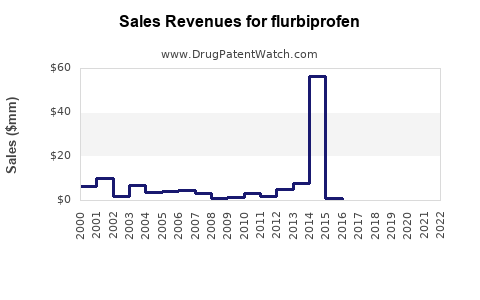
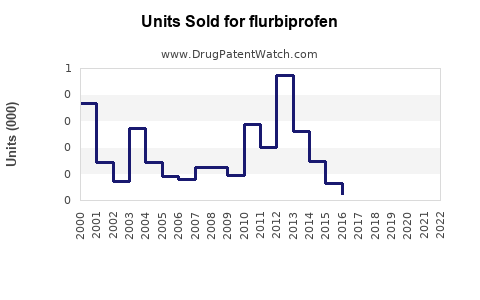
- Stable volume sales driven by ophthalmic indications.
- Price erosion due to generic competition.
- Increased demand in emerging markets, shifting sales from developed regions.
Market Projection (2023-2027):
| Year |
Projected Revenue |
Compound Annual Growth Rate (CAGR) |
| 2023 |
~$155 million |
1.3% |
| 2024 |
~$160 million |
3.2% |
| 2025 |
~$170 million |
4.1% |
| 2026 |
~$180 million |
5.9% |
| 2027 |
~$190 million |
6.1% |
Growth is expected mainly in Asia Pacific and Latin America, where ophthalmic procedures are increasing, and healthcare spending grows.
What are sales forecast assumptions?
- Market penetration of biosimilars remains constrained but increasing.
- Regulatory approval of new formulations (e.g., sustained-release eye drops) could lift sales.
- Pricing pressures due to generic competition persist, affecting revenues.
- Genericization of existing formulations limits pricing power but sustains sales volume.
How does Flurbiprofen compare with similar drugs?
| Drug |
Indications |
Delivery Forms |
Market Impact |
| Flurbiprofen |
Ocular inflammation, pain |
Eye drops |
Established, moderate growth |
| Ketorolac |
Ocular pain, inflammation |
Eye drops |
Larger market share, more generic options |
| Nepafenac |
Postoperative inflammation |
Eye drops |
Competitor to Flurbiprofen, gaining market share |
What are the strategic opportunities and risks?
Opportunities:
- Development of sustained-release formulations could bypass current price pressures.
- Expansion into emerging markets where ophthalmic procedures increase.
- Potential licensing or acquisition of formulations with new delivery methods.
Risks:
- Competition from newer NSAIDs or alternative anti-inflammatory drugs.
- Regulatory delays for new formulations.
- Pricing erosion from generics.
Key Takeaways
- Flurbiprofen remains a niche but stable component in ophthalmic anti-inflammatory therapy, with global sales around $150 million in 2022.
- Market growth is modest, driven by emerging markets and potential new formulations.
- Performance will depend on innovation, regional expansion, and competitive dynamics involving generics.
- The expiration of patents limits future revenue growth but sustains a base level of sales.
- Strategic focus should favor formulation innovation and core markets growth.
FAQs
1. What indications are currently approved for Flurbiprofen?
Primarily ocular inflammation, such as postoperative inflammation following eye surgery, and pain relief in ophthalmic procedures.
2. Are there any approved systemic uses of Flurbiprofen?
Systematic use is limited; it is mainly utilized in ophthalmic formulations, with oral formulations being less common and often superseded by other NSAIDs.
3. Which regions are driving future sales growth?
Asia Pacific and Latin America are expected to lead growth due to increasing ophthalmic surgeries and healthcare investments.
4. How does patent expiry affect Flurbiprofen’s sales?
It leads to price competition from generics, reducing margins but maintaining sales volumes due to increased accessibility.
5. Are there any late-stage pipeline developments for Flurbiprofen?
No significant pipeline developments are publicly known; focus remains on formulations and market expansion strategies.
References
[1] MarketWatch. "Global NSAID Market Size, Share & Trends Analysis," 2022.
[2] IQVIA. “Ophthalmic Drugs Market Data,” 2022.
[3] GlobalData. “Ophthalmic Anti-Inflammatory Market Outlook,” 2023.