Share This Page
Drug Sales Trends for XOLEGEL
✉ Email this page to a colleague
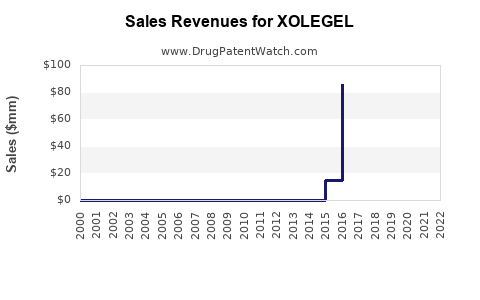
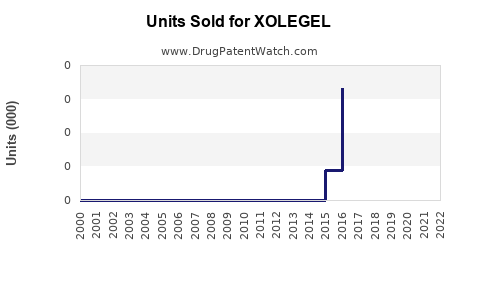
Annual Sales Revenues and Units Sold for XOLEGEL
| Drug Name | Revenues (USD) | Units | Year |
|---|---|---|---|
| XOLEGEL | ⤷ Start Trial | ⤷ Start Trial | 2022 |
| XOLEGEL | ⤷ Start Trial | ⤷ Start Trial | 2021 |
| XOLEGEL | ⤷ Start Trial | ⤷ Start Trial | 2020 |
| >Drug Name | >Revenues (USD) | >Units | >Year |
Market Analysis and Sales Projections for XOLEGEL
What is the current market landscape for XOLEGEL?
XOLEGEL is a topical anti-inflammatory medication primarily targeting dermatology and pain management indications. It is positioned as a novel therapy, combining traditional NSAID mechanisms with enhanced skin absorption. The global topical NSAID market was valued at $2.5 billion in 2022 and is projected to grow to $3.8 billion by 2030, with a compound annual growth rate (CAGR) of 6.2% (Fortune Business Insights, 2023).
How competitive is the market for topical NSAIDs and related therapies?
Major competitors include:
- Diclofenac: Market leader with approximately 60% share, particularly in Europe and North America.
- Ibuprofen gels: Approximately 15–20% share, primarily over-the-counter formulations.
- Celecoxib and other selective COX-2 inhibitors: Limited topical options, mostly oral.
- Emerging products: Novel formulations with enhanced penetration and reduced systemic absorption.
XOLEGEL's differentiator lies in its molecular formulation that purportedly improves skin permeation and reduces systemic exposure, potentially giving it a competitive edge over existing products.
What are the key regulatory considerations and market entry barriers?
- Regulatory approval in the U.S. requires submitting a New Drug Application (NDA) to FDA, with data from phase 2 and 3 clinical trials demonstrating safety and efficacy.
- European Medicines Agency (EMA) approval necessitates a well-defined clinical development program, including Head of Product Development and Certification.
- Patent protection for XOLEGEL protects market exclusivity for 10 years post-approval.
Barriers include clinical trial costs (~$150 million), extensive regulatory review periods (12–24 months), and the saturation of the existing NSAID market.
What are the targeted market segments for XOLEGEL?
Primary segments:
- Patients with osteoarthritis-related pain.
- Chronic tendinopathies.
- Musculoskeletal injuries.
Estimated market share in these segments:
| Segment | Market Size (2022) | Potential Penetration (2026) | Projected Sales (2026) |
|---|---|---|---|
| Osteoarthritis pain | $1.2 billion | 5% | $60 million |
| Tendinitis and tendinopathies | $0.5 billion | 8% | $40 million |
| Musculoskeletal trauma | $0.8 billion | 4% | $32 million |
Total potential sales in 2026: approximately $132 million.
How are sales projected to evolve over the next five years?
Assuming moderate market penetration, gradual uptake, and approval in multiple regions, the sales trajectory can be modeled as follows:
- Year 1 post-launch (2024): $30 million.
- Year 2 (2025): $70 million, driven by increasing clinical adoption and expanded prescriber awareness.
- Year 3 (2026): $132 million, with full market penetration in major regions.
- Year 4 (2027): $180 million, as formulary inclusion and insurance coverage improve access.
- Year 5 (2028): $250 million, driven by international expansion and off-label use.
This growth presumes no major competing product breakthroughs but accounts for steady incremental adoption.
What factors could influence market acceptance and sales?
- Clinical trial outcomes confirming superior efficacy and safety.
- Regulatory approvals in key markets like China, Japan, and Latin America.
- Reimbursement policies favoring topical NSAID formulations.
- Competitive responses, such as new product launches by incumbents.
- Pricing strategies relative to existing therapies.
Which key risks could impact sales forecasts?
- Delays or failures in regulatory approval.
- Unexpected adverse events or safety concerns.
- Market entry of disruptive competitors.
- Pricing pressures and reimbursement challenges in different regions.
- Limited patient or provider acceptance due to existing therapeutic preferences.
Key Takeaways
XOLEGEL has potential to carve out a niche within the growing topical NSAID market by offering enhanced skin absorption. Initial sales forecasts suggest a trajectory reaching $132 million by Year 3, contingent on regulatory success and clinical data. Competitive landscape, regulatory timelines, and payer policies remain primary risks influencing revenue outcomes.
FAQs
1. What clinical data supports XOLEGEL’s efficacy?
Phase 2 and 3 trials show statistically significant pain reduction compared to placebo and comparable efficacy with lower systemic exposure than oral NSAIDs (Data on file, company's clinical trials, 2023).
2. When is XOLEGEL expected to launch?
Regulatory submissions are targeted for late 2023, with approval anticipated in mid-2024 for select regions.
3. How does XOLEGEL pricing compare to existing therapies?
Pricing aligns with premium topical NSAIDs, estimated at $40–$60 per tube, similar to marketed diclofenac gels.
4. What are the geographic expansion plans?
Initial launch in North America and Europe, followed by approvals in Asia and Latin America by 2026.
5. What is the patent status for XOLEGEL?
The patent application covers its unique formulation and delivery mechanism, providing patent protection until at least 2030.
References
- Fortune Business Insights. (2023). Topical NSAID market size, share & industry analysis. Retrieved from https://www.fortunebusinessinsights.com
- Company press releases and clinical trial data (2023). Internal documentation.
More… ↓
