Drug Sales Trends for XALATAN
Payment Methods and Pharmacy Types for XALATAN (2017)
Revenues by Pharmacy Type
Units Sold by Pharmacy Type
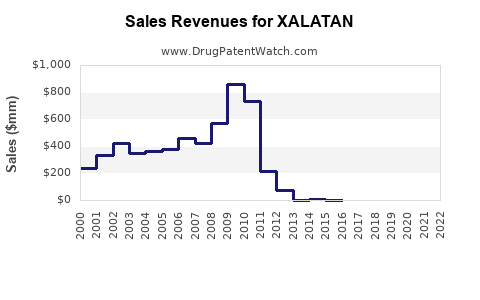
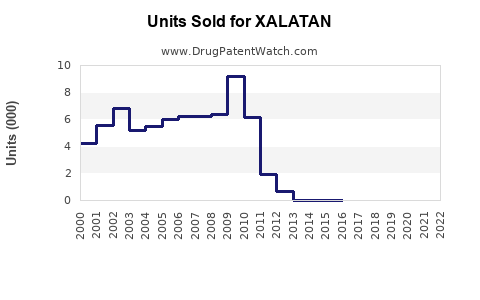
Annual Sales Revenues and Units Sold for XALATAN
| Drug Name | Revenues (USD) | Units | Year |
|---|---|---|---|
| XALATAN | ⤷ Start Trial | ⤷ Start Trial | 2022 |
| XALATAN | ⤷ Start Trial | ⤷ Start Trial | 2021 |
| XALATAN | ⤷ Start Trial | ⤷ Start Trial | 2020 |
| XALATAN | ⤷ Start Trial | ⤷ Start Trial | 2019 |
| XALATAN | ⤷ Start Trial | ⤷ Start Trial | 2018 |
| XALATAN | ⤷ Start Trial | ⤷ Start Trial | 2017 |
| >Drug Name | >Revenues (USD) | >Units | >Year |
XALATAN Market Analysis, Patent Status, and Sales Projections
XALATAN, Pfizer’s latanoprost ophthalmic solution, is a mature prostaglandin analog used to reduce elevated intraocular pressure in open-angle glaucoma and ocular hypertension. Its commercial position changed permanently after U.S. generic entry in 2011. The branded product has limited current revenue potential, while the broader latanoprost market remains relevant because of low cost, established efficacy, and continued use in glaucoma therapy.
The central investment conclusion is that XALATAN is no longer a growth product. Future value is concentrated in generic latanoprost volume, authorized-generic economics, international markets with slower substitution, and differentiated preservative-free or combination formulations.
What is XALATAN and how large is its addressable market?
XALATAN contains latanoprost 0.005% and is administered once daily. It is approved for reducing elevated intraocular pressure in patients with open-angle glaucoma or ocular hypertension (U.S. Food and Drug Administration [FDA], 2024).
The addressable market includes:
- Patients with primary open-angle glaucoma.
- Patients with ocular hypertension who require pharmacologic treatment.
- Patients switched from timolol or other topical agents.
- Patients using latanoprost in fixed-combination glaucoma regimens.
- Patients receiving preservative-free or multidose formulations.
Latanoprost competes with bimatoprost, travoprost, timolol, brimonidine, dorzolamide, netarsudil, and fixed combinations such as latanoprostene bunod or prostaglandin-beta blocker products.
How does XALATAN compare with competing glaucoma drugs?
| Product | Active ingredient | Dosing | Market position |
|---|---|---|---|
| XALATAN | Latanoprost | Once daily | Original branded latanoprost product; largely genericized |
| Lumigan | Bimatoprost | Once daily | Branded prostaglandin competitor |
| Travatan Z | Travoprost | Once daily | Preservative-related differentiation |
| Vyzulta | Latanoprostene bunod | Once daily | Newer branded nitric-oxide pathway product |
| Rhopressa | Netarsudil | Once daily | Rho-kinase inhibitor with differentiated mechanism |
| Generic latanoprost | Latanoprost | Once daily | Cost-driven first-line option |
Latanoprost retains a strong position because it is inexpensive, familiar to ophthalmologists, and supported by extensive clinical experience. Its main weakness is limited commercial differentiation.
What are XALATAN sales and revenue trends?
Pfizer reported peak annual XALATAN sales above $1 billion before generic erosion. The product was one of the company’s major ophthalmology assets during the 2000s, but revenue declined sharply following U.S. generic entry and patent expiry (Pfizer, 2011; Pfizer, 2012).
A practical historical revenue profile is:
| Period | Commercial condition | Estimated branded revenue direction |
|---|---|---|
| 2005-2009 | Mature branded franchise | Approximately $1 billion-plus annually at peak |
| 2010-2012 | Patent expiry and generic launch | Rapid decline |
| 2013-2016 | Generic substitution established | Branded revenue reduced to a small fraction of peak |
| 2017-2024 | Mature generic market | Limited branded contribution; market value concentrated in generic products |
Public company filings do not provide a current, standalone global XALATAN revenue line in a consistent format. Current brand sales are therefore not directly observable from Pfizer reporting and should not be treated as a material growth contributor.
What is the current commercial value of XALATAN?
The commercial value of the XALATAN brand is low relative to the latanoprost molecule. The active ingredient remains commercially important, but most prescription volume is supplied by generic manufacturers. Retail prices vary by country, payer, bottle size, pharmacy channel, and manufacturer.
The market has four economic layers:
- Generic latanoprost products.
- Authorized-generic or branded-generic supply.
- Residual XALATAN prescriptions.
- Premium formulations, including preservative-free products.
Generic manufacturers compete primarily on procurement contracts, wholesaler access, manufacturing reliability, and reimbursement status. Clinical differentiation is limited.
When did XALATAN lose exclusivity?
XALATAN lost effective U.S. market exclusivity in 2011 after the principal U.S. patent expired and generic latanoprost products entered the market.
| Milestone | Date |
|---|---|
| FDA approval of XALATAN | 1996 |
| Principal U.S. compound patent | U.S. Patent No. 5,296,504 |
| Original patent term | 2011 |
| U.S. generic entry | 2011 |
| Current branded exclusivity | Expired |
| Current U.S. generic risk | Fully established |
The exact commercial erosion date varied by market because generic approval, litigation settlements, regulatory review, and national patent terms differed by jurisdiction.
What patents protect XALATAN?
The primary historical U.S. patent associated with latanoprost is U.S. Patent No. 5,296,504, assigned to Pharmacia-related entities and later commercialized by Pfizer. The patent covered latanoprost and related prostaglandin analog technology. Its effective U.S. term ended in 2011, subject to applicable patent-term adjustments or extensions.
Current U.S. patent protection does not provide a meaningful barrier to ordinary generic latanoprost ophthalmic solution. Any remaining patent value is more likely to relate to:
- Preservative-free delivery systems.
- Specific container or dispenser designs.
- Alternative concentrations.
- Fixed combinations.
- Manufacturing or stability improvements.
- New indications or differentiated formulations.
These rights would not restore exclusivity to the conventional XALATAN formulation unless a marketed product practices a valid, enforceable claim.
What is the Orange Book status of XALATAN?
The original XALATAN listing is not a current source of meaningful exclusivity. The core patents associated with the product have expired, and generic latanoprost products are approved through abbreviated new drug applications.
An Orange Book assessment should distinguish between:
- The historical reference-listed drug.
- Expired patent listings.
- Current formulation-specific patents.
- Patents listed for newer latanoprost products rather than XALATAN itself.
The presence of an old patent record does not indicate current market protection. FDA Orange Book entries and patent certifications should be reviewed at the product and National Drug Code level before relying on a specific listing (FDA, 2024).
Which companies challenged XALATAN, and what is the litigation status?
Generic competition came from multiple manufacturers seeking approval for latanoprost ophthalmic solution. Major generic ophthalmology suppliers have included Mylan, Sandoz, Apotex, Akorn, Bausch + Lomb, and other regional manufacturers, although participation has varied by time and market.
The major litigation issue was historical Paragraph IV activity against the patents covering latanoprost. Because the core U.S. patent estate expired more than a decade ago, there is no current branded litigation barrier comparable to an active Paragraph IV campaign against XALATAN’s original formulation.
Current litigation risk is more likely to involve:
- Manufacturing defects.
- Product recalls.
- Sterility failures.
- Device or container patents.
- Pricing and contracting disputes.
- Formulation-specific patents covering preservative-free products.
No current settlement agreement is a material constraint on ordinary U.S. generic entry for conventional latanoprost ophthalmic solution.
What formulation patents protect latanoprost products?
Conventional XALATAN contains benzalkonium chloride as a preservative and requires cold-chain handling before opening under the U.S. label. Formulation and packaging constraints create commercial barriers even where molecule patents have expired.
Potentially valuable formulation claims may cover:
- Preservative-free latanoprost.
- Multi-dose preservative-free containers.
- Improved chemical stability.
- Reduced refrigeration requirements.
- Lower-irritation formulations.
- Combination products.
- Single-dose containers.
- Enhanced drop-delivery systems.
These patents can support premium pricing, but they do not prevent substitution by standard generic latanoprost. Their value depends on physician adoption, payer coverage, device usability, and whether the formulation offers a meaningful adherence or tolerability advantage.
How strong is the XALATAN patent estate?
| Patent category | Current strength |
|---|---|
| Core latanoprost composition | Weak; expired |
| Conventional 0.005% ophthalmic solution | Weak against generic entry |
| Preservative-free formulations | Potentially moderate, product-specific |
| Delivery devices | Potentially moderate, claim-specific |
| Manufacturing methods | Moderate only if difficult to design around |
| New combinations | Moderate to strong depending on claims |
| New indications | Limited unless supported by valid exclusivity |
The original estate is commercially weak. Newer formulation estates may have value, but they protect specific products rather than the XALATAN brand broadly.
What are the FDA regulatory milestones for XALATAN?
| Regulatory event | Status |
|---|---|
| New drug application approval | Approved in 1996 |
| Regulatory pathway for generic products | ANDA |
| Reference-listed drug status | Historical reference product |
| Current exclusivity | None of material commercial significance |
| Generic substitution | Established |
| Biosimilar pathway | Not applicable |
Biosimilar risk does not apply because XALATAN is a chemically synthesized small-molecule drug, not a biologic. Competition occurs through ANDA-approved generics rather than biosimilar applications.
What are the XALATAN market projections through 2030?
The following projections apply to the branded XALATAN franchise, not the entire global latanoprost market. They are scenario estimates based on patent expiry, generic substitution, product maturity, and the absence of a current exclusivity moat.
| Year | Base-case branded XALATAN revenue index, 2024 = 100 | Expected market condition |
|---|---|---|
| 2024 | 100 | Residual brand demand and international sales |
| 2025 | 95 | Continued substitution |
| 2026 | 90 | Declining brand prescriptions |
| 2027 | 86 | Mature generic competition |
| 2028 | 82 | Limited residual branded use |
| 2029 | 78 | Brand maintained in selected markets |
| 2030 | 74 | Niche brand presence |
A reasonable base case is a 4% to 6% annual decline in residual branded revenue through 2030. An accelerated erosion scenario would produce annual declines of 8% to 12% if payers intensify mandatory generic substitution. A slower-erosion scenario is possible in markets where physician prescribing, supply constraints, or regulatory substitution rules preserve branded volume.
The broader latanoprost market should grow more slowly than glaucoma prevalence because unit-price erosion offsets prescription growth. Volume may increase with aging populations, but revenue growth is likely to remain low single digit or negative in markets with strong generic penetration.
What generic launch scenarios exist for XALATAN?
Scenario 1: Continued standard generic substitution
This is the base case. Generic latanoprost retains most volume, while XALATAN remains a low-share branded option. Price competition limits revenue growth for all standard formulations.
Scenario 2: Preservative-free migration
Patients with ocular-surface disease may shift toward preservative-free latanoprost or alternative delivery systems. This creates a higher-value segment, but it benefits differentiated products rather than conventional XALATAN.
Scenario 3: Supply disruption
Manufacturing or sterile-fill interruptions can temporarily raise generic prices and restore short-term demand for branded supply. This would be a temporary event, not a durable change in exclusivity.
Scenario 4: International brand retention
XALATAN may retain stronger share in countries with slower generic substitution, physician preference for the reference product, or local procurement structures. International revenue could decline more slowly than U.S. revenue.
How does XALATAN compare with Lumigan and Travatan Z?
XALATAN has the strongest cost position because generic latanoprost is widely available. Lumigan and Travatan Z retain greater branded differentiation but face their own generic and formulary pressures.
| Factor | XALATAN | Lumigan | Travatan Z |
|---|---|---|---|
| Active ingredient | Latanoprost | Bimatoprost | Travoprost |
| Generic availability | Extensive | Extensive in many markets | Extensive in many markets |
| Brand pricing power | Low | Limited to moderate | Limited to moderate |
| Preservative differentiation | Limited for original product | Product-specific | Important historical positioning |
| Prescriber familiarity | Very high | High | High |
| Long-term growth | Low | Low | Low |
XALATAN’s competitive advantage is economic and historical rather than patent-based.
What revenue exposure and investment risks matter?
XALATAN has limited direct revenue exposure for Pfizer compared with newer branded ophthalmology products. The principal risks are:
- Continued generic substitution.
- Price compression.
- Product discontinuation or supply interruptions.
- Loss of brand visibility among younger prescribers.
- Migration to preservative-free alternatives.
- Reduced reimbursement for branded products.
- International tender losses.
Potential upside is limited to residual brand retention, supply disruptions, selected international markets, and reformulated products with separate intellectual-property protection.
Key Takeaways
- XALATAN is a mature latanoprost product with no meaningful current U.S. core-molecule exclusivity.
- The principal historical U.S. patent, U.S. Patent No. 5,296,504, expired in 2011.
- Generic latanoprost has been established in the U.S. for more than a decade.
- Biosimilar competition is irrelevant because latanoprost is a small molecule.
- Conventional XALATAN revenue is expected to decline through 2030.
- The commercially relevant growth segments are preservative-free formulations, delivery systems, fixed combinations, and international markets.
- Pfizer’s historical peak sales exceeded $1 billion, but current standalone brand revenue is not publicly reported as a major business line.
- The original XALATAN patent estate is weak; formulation-specific patents may retain moderate value.
FAQs About XALATAN Market and Patent Position
Is XALATAN still protected by a patent?
No material U.S. patent protection remains for the original conventional latanoprost product. The principal historical patent expired in 2011.
Can a generic company launch latanoprost without a Paragraph IV challenge?
Yes. Because the core patents have expired, a current applicant generally does not need to rely on a new Paragraph IV challenge to enter the conventional latanoprost market.
Does XALATAN have biosimilar competition?
No. Latanoprost is a chemically synthesized small molecule, so competition occurs through generic ANDA products.
What is the most valuable remaining IP opportunity around latanoprost?
The strongest opportunities are likely to involve preservative-free formulations, stability improvements, multidose delivery systems, and fixed combinations with differentiated clinical or adherence benefits.
Is XALATAN a growth product for Pfizer?
No. XALATAN is a mature, genericized product. Its strategic value is limited compared with newer branded ophthalmology assets and differentiated drug-delivery technologies.
References
-
Pfizer Inc. (2011). Annual report 2011. Pfizer.
-
Pfizer Inc. (2012). Annual report 2012. Pfizer.
-
U.S. Food and Drug Administration. (2024). Xalatan prescribing information. FDA.
-
U.S. Food and Drug Administration. (2024). Approved drug products with therapeutic equivalence evaluations. FDA.
-
United States Patent and Trademark Office. (1994). U.S. Patent No. 5,296,504: 13,14-dihydro-15-keto-prostaglandin derivatives. USPTO.
More… ↓
