Drug Sales Trends for TRADJENTA
Payment Methods and Pharmacy Types for TRADJENTA (2017)
Revenues by Pharmacy Type
Units Sold by Pharmacy Type
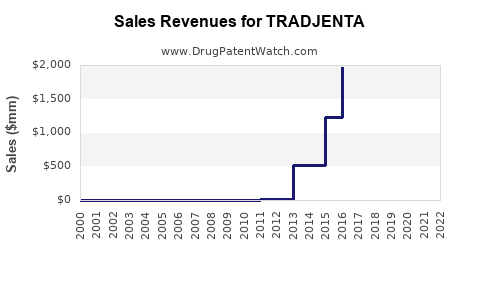
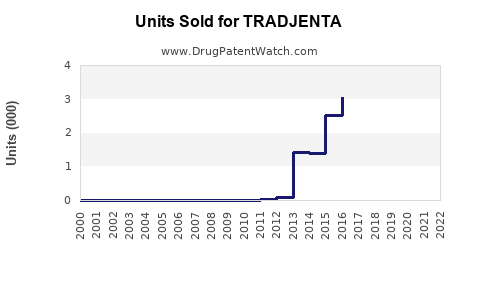
Annual Sales Revenues and Units Sold for TRADJENTA
| Drug Name | Revenues (USD) | Units | Year |
|---|---|---|---|
| TRADJENTA | ⤷ Start Trial | ⤷ Start Trial | 2022 |
| TRADJENTA | ⤷ Start Trial | ⤷ Start Trial | 2021 |
| TRADJENTA | ⤷ Start Trial | ⤷ Start Trial | 2020 |
| >Drug Name | >Revenues (USD) | >Units | >Year |
Tradjenta Market Analysis, Sales Projections, Patent Protection, and Generic Entry Risk
Tradjenta, the brand name for linagliptin, is a mature DPP-4 inhibitor marketed by Boehringer Ingelheim and Eli Lilly. Its commercial base is declining as physicians shift toward GLP-1 receptor agonists and SGLT2 inhibitors, but linagliptin retains demand among patients requiring a once-daily oral therapy with low hypoglycemia risk and no renal dose adjustment. Global annual sales are approximately €1 billion to €1.3 billion, with the largest exposure in established diabetes markets.
The central commercial risk is class substitution rather than an immediate loss of all demand at patent expiry. Generic competition against Januvia, the leading sitagliptin product, is expected to pressure the DPP-4 category before the full Tradjenta patent estate expires. A reasonable base case is for Tradjenta sales to decline at a mid-single-digit annual rate through 2028, followed by a sharper decline after meaningful generic linagliptin entry.
What is Tradjenta and how large is its market?
Tradjenta contains linagliptin, an oral dipeptidyl peptidase-4 inhibitor approved for adults with type 2 diabetes mellitus. The product is administered once daily at a 5 mg dose and does not require renal dose adjustment, a differentiating point versus several other DPP-4 inhibitors.
The FDA approved Tradjenta in May 2011. The product is marketed in the United States by Boehringer Ingelheim and Eli Lilly under a long-standing diabetes alliance. It is marketed as Trajenta in many countries outside the United States.[1]
Tradjenta product profile
| Attribute | Tradjenta |
|---|---|
| Active ingredient | Linagliptin |
| Drug class | DPP-4 inhibitor |
| Dosage form | 5 mg oral tablet |
| U.S. approval | May 2, 2011 |
| U.S. sponsor | Boehringer Ingelheim Pharmaceuticals |
| Commercial partners | Boehringer Ingelheim and Eli Lilly |
| Main indication | Type 2 diabetes |
| Renal dose adjustment | Not required |
| Biosimilar risk | None |
| Primary competitive classes | GLP-1 receptor agonists, SGLT2 inhibitors, other DPP-4 inhibitors |
| Key competitors | Januvia, Janumet, Onglyza, Nesina, Jardiance, Trulicity, Ozempic, Rybelsus |
The addressable market is the global type 2 diabetes oral-treatment market, but Tradjenta competes within a narrower DPP-4 segment. DPP-4 inhibitors remain relevant for older patients, patients seeking oral treatment, and patients for whom weight loss or cardiovascular and renal outcomes are not the primary treatment objective.
How much revenue does Tradjenta generate?
Boehringer Ingelheim reports Trajenta within its Human Pharma portfolio. Public company disclosures indicate that annual global sales have remained near the €1 billion level but have trended downward from earlier peak levels.[2]
Historical sales range
| Year | Estimated global net sales | Direction |
|---|---|---|
| 2020 | Approximately €1.5 billion | Declining |
| 2021 | Approximately €1.4 billion | Declining |
| 2022 | Approximately €1.3 billion | Declining |
| 2023 | Approximately €1.2 billion | Declining |
| 2024 | Approximately €1.1 billion to €1.2 billion | Declining |
The figures above reflect publicly reported company-level product information and rounded estimates where companies report currencies, regional sales, or alliance economics differently. Eli Lilly does not report Tradjenta as a major standalone revenue line in the same way as its largest internally owned diabetes products.[3]
Revenue quality is weaker than headline sales suggest. The product is mature, faces substantial payer pressure, and competes against medicines that have stronger clinical positioning for weight loss, cardiovascular risk reduction, or chronic kidney disease.
What are the Tradjenta sales projections through 2030?
The base-case forecast assumes continued erosion from therapeutic substitution, increasing DPP-4 price pressure, and generic linagliptin entry in major markets after core patent protection expires.
Global Tradjenta sales forecast
| Year | Base case | Downside case | Upside case |
|---|---|---|---|
| 2024 | €1.15 billion | €1.10 billion | €1.20 billion |
| 2025 | €1.08 billion | €0.98 billion | €1.16 billion |
| 2026 | €1.01 billion | €0.86 billion | €1.12 billion |
| 2027 | €0.94 billion | €0.73 billion | €1.08 billion |
| 2028 | €0.84 billion | €0.58 billion | €1.02 billion |
| 2029 | €0.65 billion | €0.39 billion | €0.92 billion |
| 2030 | €0.49 billion | €0.27 billion | €0.82 billion |
The base case represents an approximate compound annual decline of 10% from 2024 through 2030. The model assumes that generic entry is staggered by jurisdiction rather than simultaneous worldwide competition.
Forecast assumptions
The base case assumes:
- DPP-4 inhibitors remain an established but shrinking oral treatment segment.
- GLP-1 receptor agonists and SGLT2 inhibitors continue to capture treatment additions and switches.
- Tradjenta preserves a portion of demand because of once-daily dosing and no renal dose adjustment.
- Generic linagliptin enters selected markets after the strongest composition and formulation protections expire.
- Boehringer and Lilly use contracting and discounts to defend volume, causing net price erosion before generic entry.
- No new cardiovascular or renal indication materially expands linagliptin demand.
The upside case requires slower adoption of injectable and oral GLP-1 therapies, continued use in elderly patients, and delayed generic penetration. The downside case assumes rapid DPP-4 substitution, aggressive generic pricing, and loss of formulary preference.
When does Tradjenta lose exclusivity?
Tradjenta's commercial exclusivity is based on a group of patents covering linagliptin, pharmaceutical compositions, solid forms, and selected manufacturing or use-related claims. The core U.S. composition patent has been publicly associated with U.S. Patent No. 7,951,400.[4]
Key exclusivity considerations
| Protection type | Commercial relevance |
|---|---|
| New chemical entity exclusivity | Expired |
| Core compound patents | Primary basis for early generic delay |
| Solid-form patents | May delay or complicate generic launch |
| Formulation patents | Potentially relevant to specific dosage forms |
| Method-of-use patents | Potentially relevant to labeled indications |
| Pediatric exclusivity | Does not materially define current market protection |
| Biosimilar exclusivity | Not applicable |
The core patent term is generally understood to extend into the late 2020s in the United States, subject to patent-term adjustment, patent-term extension, claim scope, and Orange Book listing status. Commercial generic entry can occur before every listed patent expires if an applicant wins litigation, obtains a settlement, or launches at risk.
Patent expiration alone does not establish the precise generic launch date. A generic applicant may file an abbreviated new drug application with a Paragraph IV certification before expiration and challenge the listed patents in federal court.
What is the Orange Book status of Tradjenta?
Tradjenta is an FDA-approved small-molecule drug listed under NDA 201280. Unlike biologics, it is regulated through the abbreviated new drug application pathway for generic competition. The Orange Book is the controlling public source for patents listed by the NDA holder and for FDA-recognized expiration and exclusivity information.[5]
The relevant Orange Book analysis should distinguish between:
- patents listed against the 5 mg tablet;
- patents covering the active ingredient;
- patents covering crystalline or solid forms;
- patents covering combinations such as linagliptin and metformin;
- method-of-use patents;
- patents that remain enforceable but may not block every generic formulation.
Generic applicants can challenge listed patents through Paragraph IV certifications. A Paragraph IV filing normally creates litigation risk for the patent owner and may trigger a 30-month stay of FDA approval under the Hatch-Waxman framework, subject to statutory exceptions and litigation developments.[6]
Which companies are challenging Tradjenta?
Generic-drug manufacturers that target linagliptin may include large Indian and U.S. manufacturers, contract manufacturers, and diversified generic companies. Publicly visible ANDA activity does not always identify the commercial entrant early, and an ANDA filing does not guarantee launch.
The most important competitive event is likely to be the progression of generic sitagliptin. Januvia and Tradjenta compete in the same DPP-4 class, and generic sitagliptin can lower the reference price used by payers when evaluating linagliptin. This indirect pressure may reduce Tradjenta sales before a generic linagliptin product reaches the market.[7]
No biosimilar pathway applies because linagliptin is a chemically synthesized small molecule. The relevant risk is generic substitution, not biosimilar interchangeability.
What formulations and indications are protected by Tradjenta patents?
Tradjenta is sold primarily as a conventional immediate-release 5 mg tablet. The broader linagliptin patent estate may cover:
- the linagliptin compound;
- pharmaceutical compositions containing linagliptin;
- crystalline or polymorphic forms;
- tablet formulations;
- processes for preparing linagliptin;
- combinations with metformin;
- treatment of type 2 diabetes;
- dosing in patients with renal impairment.
The most commercially important distinction is between the plain Tradjenta tablet and combination products such as Jentadueto, which combines linagliptin with metformin. A generic applicant may be able to enter with one formulation while remaining exposed to separate patents covering another product or indication.
Combination-product patents can preserve some revenue after generic entry into the standalone tablet market, but they rarely maintain the original brand price once the active ingredient becomes widely available.
How strong is the Tradjenta patent estate?
The Tradjenta patent estate is moderately strong before core patent expiry and materially weaker after the core compound claims expire.
Strength assessment
| Factor | Assessment |
|---|---|
| Core compound protection | Strong until expiration |
| Solid-form protection | Potentially useful but vulnerable to design-around |
| Method-of-use protection | Narrower practical value for diabetes products |
| Formulation protection | Limited if the dosage form is conventional |
| Manufacturing patents | Can raise development cost but rarely block all entry |
| Small-molecule litigation risk | High under Hatch-Waxman |
| Post-expiry durability | Limited |
| Biosimilar barrier | Not applicable |
The estate's strongest asset is the compound protection. Formulation and process patents can increase litigation complexity but may not prevent a non-infringing generic from launching once the core compound claims expire.
What patent litigation affects Tradjenta?
Tradjenta faces the standard litigation pattern for a mature small-molecule product: patent challenges may be filed years before commercial entry, followed by settlements, licensing arrangements, or at-risk launches. The existence of an ANDA or Paragraph IV challenge does not necessarily indicate that a generic will launch on the earliest statutory date.
Publicly disclosed litigation must be evaluated by:
- the specific patent challenged;
- the ANDA number and dosage form;
- whether the patent covers linagliptin or a combination product;
- whether the case was dismissed, settled, or adjudicated;
- whether the settlement includes a licensed entry date;
- whether the settlement includes a restriction on authorized generic supply.
A settlement can preserve brand revenue for several years while allowing the generic applicant to avoid the cost and uncertainty of trial. Without a disclosed settlement date or final judgment, the most defensible commercial assumption is a range of possible launch dates rather than a single date.
What FDA regulatory status does Tradjenta have?
The FDA approved Tradjenta in 2011 for type 2 diabetes as an adjunct to diet and exercise. The label includes warnings relating to pancreatitis, heart failure risk considerations for the DPP-4 class, hypoglycemia when used with insulin or insulin secretagogues, hypersensitivity, and bullous pemphigoid.[1]
The product does not have the regulatory profile of an innovative cardiometabolic therapy such as semaglutide or empagliflozin. Its label and mechanism support continued use, but they do not provide a strong basis for premium growth.
How does Tradjenta compare with Januvia, Jardiance, and GLP-1 drugs?
| Product or class | Main advantage | Main weakness versus Tradjenta |
|---|---|---|
| Januvia | Established DPP-4 brand and broad physician familiarity | Generic entry pressure |
| Jardiance | Cardiovascular and kidney outcome positioning | Higher clinical and reimbursement competition |
| Ozempic | Strong glucose and weight-loss efficacy | Injectable administration and supply constraints |
| Rybelsus | Oral GLP-1 option | Higher cost and more complex administration |
| Trulicity | Cardiovascular outcomes and weekly dosing | Injectable therapy |
| Tradjenta | Oral, once daily, no renal dose adjustment | Limited weight and outcomes differentiation |
Tradjenta's best defense is convenience and tolerability. Its weakest point is the absence of a compelling weight-loss or cardiovascular-outcomes advantage against newer therapies.
What revenue exposure do Boehringer Ingelheim and Eli Lilly have?
Boehringer Ingelheim has greater direct exposure because Tradjenta is part of its Human Pharma portfolio. Eli Lilly benefits from alliance economics and commercial participation but has a much broader diabetes portfolio, reducing the impact of Tradjenta erosion on consolidated revenue.
A €100 million decline in global Tradjenta sales would not translate directly into €100 million of lost revenue for either company because reported sales, royalties, co-promotion income, rebates, and regional profit-sharing arrangements differ.
The more important strategic issue is portfolio migration. Boehringer's Jardiance franchise has substantially stronger growth and outcomes positioning. Lilly's diabetes revenue is concentrated in newer products, including Trulicity and insulin products, rather than Tradjenta.
What generic launch scenarios exist for Tradjenta?
Early launch scenario
A generic applicant challenges key patents, obtains a favorable court outcome, or reaches a settlement with an early licensed entry date. U.S. sales decline 50% to 80% within two years, with net prices falling rapidly.
At-risk launch scenario
A generic launches before final resolution of patent litigation. The launch creates immediate price erosion but exposes the applicant to damages if the patent owner prevails.
Scheduled expiry scenario
Generic entry occurs after the core patent estate expires, with several entrants launching within 6 to 12 months. This is the base-case assumption for the late 2020s.
Delayed-entry scenario
Secondary patents, litigation, regulatory deficiencies, or manufacturing problems delay broad entry. Brand sales decline gradually but remain above €800 million globally through 2028.
What geographic markets remain attractive for Tradjenta?
The United States is the highest-value market but also has the greatest generic and payer pressure. Europe has lower net prices and stronger health-technology assessment controls. Japan and selected Asian markets may preserve demand because of aging populations and continued use of oral diabetes therapies. Emerging markets provide volume but lower revenue per prescription.
The commercial opportunity is therefore concentrated in markets where:
- oral treatment remains preferred;
- physicians value the absence of renal dose adjustment;
- generic substitution is slower;
- reimbursement favors established diabetes products;
- injectable therapies have lower patient acceptance.
Key Takeaways
- Tradjenta is a mature linagliptin product with global sales near €1 billion to €1.3 billion.
- Sales are expected to decline before patent expiry because GLP-1 and SGLT2 therapies are taking share from DPP-4 inhibitors.
- A base-case forecast places global sales at approximately €490 million in 2030.
- The core patent estate is more valuable than secondary formulation and manufacturing patents.
- Generic linagliptin presents the principal direct exclusivity risk.
- Generic sitagliptin creates indirect pricing pressure before Tradjenta loses full protection.
- No biosimilar risk applies because linagliptin is a small-molecule drug.
- The product's main commercial defenses are oral dosing, once-daily administration, and no renal dose adjustment.
- Boehringer Ingelheim has greater direct exposure than Eli Lilly, but neither company depends on Tradjenta for growth.
- The most likely long-term outcome is gradual erosion followed by accelerated decline after multi-source generic entry.
FAQs
Is Tradjenta still a profitable drug?
Yes. Tradjenta remains commercially profitable because it has an established global prescriber base and relatively low manufacturing complexity. Profitability is likely to decline faster than sales after generic entry because payer discounts and rebate demands will increase.
Can a generic substitute directly for Tradjenta?
Yes. An FDA-approved generic linagliptin tablet can generally be therapeutically substituted subject to state pharmacy laws, formulary rules, and the specific product's approved labeling.
Does Tradjenta have cardiovascular outcome superiority?
No. Tradjenta has cardiovascular safety data, but it is not positioned as a cardiovascular risk-reduction therapy with the same commercial differentiation as certain SGLT2 inhibitors or GLP-1 receptor agonists.
Is Jentadueto protected separately from Tradjenta?
Yes. Jentadueto contains linagliptin and metformin and may have separate listed patents, regulatory exclusivities, or formulation claims. Entry into generic Tradjenta does not automatically establish identical entry rights for every linagliptin-metformin product.
What is the biggest threat to Tradjenta sales before generic entry?
The biggest near-term threat is therapeutic substitution into GLP-1 receptor agonists and SGLT2 inhibitors, followed by lower-priced generic sitagliptin. These products can reduce Tradjenta demand even while linagliptin remains patent-protected.
References
- U.S. Food and Drug Administration. (2011). Tradjenta prescribing information.
- Boehringer Ingelheim. (2023). Annual report 2023.
- Eli Lilly and Company. (2023). Annual report 2023.
- U.S. Patent and Trademark Office. (2009). U.S. Patent No. 7,951,400, Xanthine derivatives.
- U.S. Food and Drug Administration. (2024). Approved drug products with therapeutic equivalence evaluations: Orange Book.
- U.S. Congress. (1984). Drug Price Competition and Patent Term Restoration Act of 1984.
- IQVIA. (2024). The global use of medicines 2024: Outlook to 2028.
More… ↓
