Drug Sales Trends for TAYTULLA
Payment Methods and Pharmacy Types for TAYTULLA (2017)
Revenues by Pharmacy Type
Units Sold by Pharmacy Type
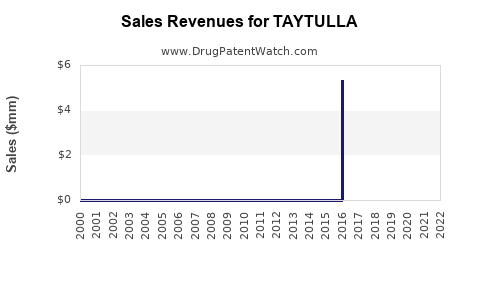
Annual Sales Revenues and Units Sold for TAYTULLA
| Drug Name | Revenues (USD) | Units | Year |
|---|---|---|---|
| TAYTULLA | ⤷ Start Trial | ⤷ Start Trial | 2022 |
| TAYTULLA | ⤷ Start Trial | ⤷ Start Trial | 2021 |
| TAYTULLA | ⤷ Start Trial | ⤷ Start Trial | 2020 |
| >Drug Name | >Revenues (USD) | >Units | >Year |
TAYTULLA Market Analysis and Sales Projections, Patent Position, and Generic Risk
Taytulla is a low-dose combined oral contraceptive containing norethindrone acetate 1 mg and ethinyl estradiol 20 mcg, supplied as 24 active capsules followed by four ferrous fumarate capsules. Its commercial opportunity is limited by a mature contraceptive market, multiple generic substitutes, and the expiration of regulatory exclusivity. The principal remaining differentiator is the capsule-based delivery format and established brand recognition.
Standalone Taytulla sales are not reported separately by AbbVie, its current owner through the Allergan acquisition. The projections below are analyst estimates based on residual branded demand, generic erosion, estimated prescription volume, and net price assumptions. The base case forecasts U.S. net sales declining from approximately $35 million in 2025 to $13 million in 2029.
What is Taytulla and how is it positioned in the contraceptive market?
Taytulla is an oral hormonal contraceptive indicated for the prevention of pregnancy in females of reproductive potential. Each 28-day pack contains:
| Component | Dosage |
|---|---|
| Norethindrone acetate | 1 mg |
| Ethinyl estradiol | 20 mcg |
| Active capsules | 24 |
| Ferrous fumarate capsules | 4 |
| Dosage form | Capsule |
The product was approved by the U.S. Food and Drug Administration in 2017 under NDA 208757. It is pharmacologically aligned with low-dose norethindrone acetate and ethinyl estradiol products, but its capsule presentation differentiates it from several tablet-based competitors.[1]
Taytulla competes in a large but highly price-sensitive market. U.S. patients have access to branded and generic oral contraceptives containing:
- Norethindrone acetate and ethinyl estradiol
- Norethindrone and ethinyl estradiol
- Levonorgestrel and ethinyl estradiol
- Drospirenone and ethinyl estradiol
- Desogestrel and ethinyl estradiol
The commercial value of the Taytulla brand depends less on category growth than on maintaining prescriptions among patients who prefer the capsule format, require a low-estrogen formulation, or remain on therapy through a branded insurance benefit.
How large is the U.S. oral contraceptive market?
The U.S. oral contraceptive market is mature, with demand supported by a large addressable population and recurring monthly use. Market growth is constrained by substitution from long-acting reversible contraceptives, intrauterine devices, implants, emergency contraception, and generic oral products.
Oral contraceptives remain a major method of pregnancy prevention in the United States. The Centers for Disease Control and Prevention has reported that oral contraceptive pills are among the most commonly used reversible contraceptive methods among women of reproductive age.[2]
For Taytulla, the relevant market is narrower than the total oral contraceptive market. The commercial segment consists primarily of:
- Low-dose combined oral contraceptive users.
- Patients receiving norethindrone acetate and ethinyl estradiol.
- Patients who prefer capsules over tablets.
- Patients whose plans continue to reimburse a branded product.
- Patients receiving samples or manufacturer-supported access.
The market has limited structural growth. Revenue performance depends on share capture, reimbursement, generic conversion, and retention of existing users.
What are the current FDA and Orange Book positions for Taytulla?
FDA regulatory exclusivity is no longer a meaningful barrier to generic competition.
| Regulatory item | Taytulla status |
|---|---|
| FDA approval | 2017 |
| NDA | 208757 |
| Dosage form | Oral capsule |
| Regulatory pathway | New drug application |
| NCE exclusivity | Expired |
| Pediatric exclusivity | No commercially material remaining period identified |
| Generic competition | Present |
| Orange Book relevance | Product and patent-listing database for approved equivalents |
The five-year new chemical entity exclusivity period associated with a 2017 approval would have ended no later than 2022, subject to any applicable statutory adjustment. Generic applicants therefore have had access to an abbreviated new drug application pathway after the exclusivity period.
The FDA Orange Book remains the controlling source for current product listings, therapeutic equivalence codes, and any listed patents.[3] Because Taytulla’s commercial erosion is already driven by generic availability, the existence of a residual formulation or method-of-use patent would have limited practical impact unless it could support enforceable injunction relief or a commercially meaningful settlement.
What patents protect Taytulla?
Taytulla’s commercial protection is weaker than that of a newly launched small-molecule product because the active ingredients are long-established contraceptive compounds and the product has passed its regulatory exclusivity period.
The potentially relevant protection categories are:
| Protection category | Commercial relevance |
|---|---|
| Active ingredients | Low; norethindrone acetate and ethinyl estradiol are established compounds |
| Capsule formulation | Moderate if narrowly claimed and valid |
| 24/4 dosing regimen | Limited because similar regimens are widely used |
| Ferrous fumarate placebo capsules | Low barrier to substitution |
| Manufacturing process | Potentially relevant but difficult to use as a broad market barrier |
| Method of contraception | Low; broad method claims would face substantial validity and obviousness risks |
| Brand trademark | Protects the name, not the active product |
No broad composition-of-matter patent can provide meaningful exclusivity for Taytulla’s active ingredients. Any remaining patent value would therefore depend on narrow claims covering the capsule formulation, dosage regimen, packaging, or manufacturing process.
How strong is the Taytulla patent estate?
The estate should be assessed as commercially weak to moderate.
Its strengths are the product-specific capsule presentation, the possibility of formulation or process claims, and the practical cost of switching patients who are stable on therapy. Its weaknesses are generic availability, the long commercial history of the active ingredients, a mature therapeutic class, and the limited difficulty of producing an equivalent oral contraceptive.
A generic applicant can also challenge a listed patent through a Paragraph IV certification. The commercial outcome would depend on the scope of any listed claims, the timing of the applicant’s ANDA, and whether the brand owner initiates litigation within the statutory 45-day period.
When does Taytulla lose exclusivity?
Taytulla’s principal regulatory exclusivity ended after the 2017 approval cycle. The product is therefore in the post-exclusivity phase.
| Milestone | Approximate timing |
|---|---|
| FDA approval | 2017 |
| Five-year NCE exclusivity expiration | 2022 |
| Generic filing opportunity | After applicable exclusivity ended |
| Generic commercial erosion | Began after generic approvals and launches |
| Current commercial phase | Mature branded product with generic competition |
Patent expiration dates should be taken from the live Orange Book record and relevant patent documents. A single effective loss-of-exclusivity date is less useful for Taytulla than for a product protected by one dominant composition-of-matter patent. Generic competition can proceed around narrow patents, and authorized-generic supply can reduce the economic value of residual brand protection.
Which companies are challenging or competing with Taytulla?
The competitive threat comes primarily from generic manufacturers and established contraceptive brands rather than from one direct branded challenger.
Generic competitors
Generic products based on norethindrone acetate and ethinyl estradiol can compete on price, formulary placement, and pharmacy substitution. Mayne Pharma has been associated with generic norethindrone acetate and ethinyl estradiol capsules corresponding to the Taytulla dosage form.[4]
Other generic manufacturers can enter if they obtain FDA approval for the same or therapeutically equivalent product. The number of active suppliers will determine the severity of price erosion. Oral contraceptive products typically experience substantial price compression once multiple generic suppliers are available.
Branded competitors
The principal branded comparators include:
| Product | Key distinction |
|---|---|
| Taytulla | Norethindrone acetate, ethinyl estradiol, capsule, 24/4 regimen |
| Loestrin 24 Fe | Similar hormonal concept, tablet presentation |
| Lo Loestrin Fe | Lower estrogen exposure and different dosing profile |
| Junel Fe | Generic and branded-equivalent tablet products |
| Microgestin Fe | Generic norethindrone acetate and ethinyl estradiol tablet product |
| Yaz | Drospirenone and ethinyl estradiol |
| Ortho-Cyclen and equivalents | Norgestimate and ethinyl estradiol |
Taytulla’s strongest direct competition comes from low-cost tablet products with similar hormonal components. Its capsule format provides differentiation but does not create a substantial clinical barrier.
What is the Taytulla sales outlook from 2025 to 2029?
AbbVie does not separately disclose Taytulla revenue in its public financial reporting. Sales are aggregated within broader pharmaceutical categories or are not material enough to receive separate reporting.[5]
The following model estimates U.S. net sales. It assumes that branded volume contracts as generic substitution increases, while net price declines more slowly because remaining patients are concentrated in commercial insurance, cash-pay, and brand-preference segments.
Base-case projection
| Year | Estimated branded packs | Estimated net price per pack | Estimated U.S. net sales |
|---|---|---|---|
| 2025 | 0.90 million | $39 | $35 million |
| 2026 | 0.75 million | $36 | $27 million |
| 2027 | 0.62 million | $34 | $21 million |
| 2028 | 0.51 million | $31 | $16 million |
| 2029 | 0.42 million | $30 | $13 million |
The base case implies a compound annual sales decline of approximately 22% from 2025 to 2029.
Scenario analysis
| Scenario | 2025 sales | 2029 sales | 2025-2029 trend |
|---|---|---|---|
| Upside | $55 million | $27 million | Slower generic conversion |
| Base | $35 million | $13 million | Continued erosion |
| Downside | $20 million | $4 million | Rapid formulary exclusion and substitution |
The upside case requires sustained brand reimbursement, limited generic supply, and continued physician prescribing of the capsule product. The downside case assumes several generic suppliers, aggressive payer substitution, lower patient out-of-pocket support, and reduced promotional investment.
These are model-derived estimates rather than company guidance or reported product revenue.
What drives Taytulla revenue exposure?
Taytulla revenue is exposed to five principal variables.
Generic substitution
Generic dispensing is the most important driver. Pharmacy-level substitution can reduce branded volume without requiring a new physician visit. The impact is greatest when the generic has an identical active ingredient, strength, regimen, and dosage form.
Payer coverage
Commercial plans can place Taytulla on a non-preferred tier or require prior authorization. Coverage changes can produce a rapid decline in branded prescriptions. The contraceptive benefit requirements under the Affordable Care Act can support access but do not guarantee preferred placement for a specific brand.[6]
Patient retention
Patients who tolerate Taytulla and prefer its capsule presentation may remain on the brand despite generic availability. Retention is more likely when the patient has experienced side effects or dissatisfaction with other contraceptive products.
Promotional activity
Taytulla’s revenue depends on physician education, samples, copay support, and field promotion. Reduced promotional spending would accelerate conversion to generic products.
Category substitution
Patients can switch from oral contraception to IUDs, implants, injections, transdermal systems, vaginal rings, or nonhormonal methods. This limits the ability of Taytulla to recover lost share through category expansion.
What generic launch scenarios exist for Taytulla?
Scenario one: one generic supplier
A single approved generic may initially produce moderate price erosion. The brand can retain a meaningful share through contracts, patient support, and physician preference. Net brand sales could remain in the $30 million to $50 million range in the near term.
Scenario two: multiple generic suppliers
Two or more suppliers generally increase pharmacy substitution and payer pressure. The brand may retain patients with high switching costs, but new starts would increasingly flow to generics. Brand sales could fall below $20 million annually.
Scenario three: authorized generic or private-label distribution
An authorized generic can preserve some manufacturer economics while weakening the independent generic opportunity. It can also reduce the brand’s average selling price because the same company participates in both branded and generic channels.
Scenario four: formulation-specific challenge
A generic applicant may challenge a formulation or process patent while relying on the underlying active ingredients and regimen. A Paragraph IV filing could lead to litigation, a settlement, or an at-risk launch. No major publicly documented Taytulla Paragraph IV litigation is identified in the public record reviewed for this analysis.
What patent litigation and settlement risks affect Taytulla?
The litigation risk is lower than for a high-value product with a single dominant patent. Potential disputes could involve:
- Capsule composition.
- Dissolution or release characteristics.
- Packaging and regimen configuration.
- Manufacturing methods.
- Patent-listing accuracy.
- Therapeutic equivalence or bioequivalence.
A settlement could provide a generic with a defined entry date, an authorized-generic arrangement, or a license to use specific intellectual property. No material public settlement agreement associated with Taytulla has been identified in the reviewed sources.
Because the product is a contraceptive, regulatory and commercial disputes are more likely to concern approval, substitution, reimbursement, or product supply than high-value patent damages.
How does Taytulla compare with Lo Loestrin Fe and generic norethindrone products?
| Factor | Taytulla | Lo Loestrin Fe | Generic norethindrone products |
|---|---|---|---|
| Main hormones | Norethindrone acetate and ethinyl estradiol | Norethindrone acetate and very-low-dose ethinyl estradiol | Varies by product |
| Dosage form | Capsule | Tablet | Usually tablet |
| Brand differentiation | Capsule and 24/4 schedule | Lower estrogen positioning | Price |
| Generic pressure | High | High, depending on product | N/A |
| Reimbursement leverage | Limited | Brand-dependent | Strong |
| Clinical switching barrier | Moderate | Moderate | Low to moderate |
| Long-term sales outlook | Declining | Dependent on brand retention | Stable category demand |
Taytulla has a more direct generic substitute than products differentiated by a novel delivery system, implant, device, or biologic mechanism. Its commercial position is therefore more vulnerable to pharmacy substitution.
Does Taytulla face biosimilar risk?
No. Biosimilar risk is not applicable because Taytulla is a chemically synthesized small-molecule oral contraceptive, not a biologic. Its competitive risk comes from abbreviated new drug applications, therapeutic equivalents, authorized generics, and branded contraceptive alternatives.
What geographic markets are relevant to Taytulla?
The United States is the primary commercial market associated with the Taytulla brand and its FDA approval. International opportunities are limited by:
- Country-specific regulatory approvals.
- Different contraceptive prescribing practices.
- Local generic competitors.
- National reimbursement systems.
- Trademark and formulation rights.
- Variations in allowable estrogen and progestin products.
A material international revenue contribution should not be assumed without evidence of country-specific approvals, distributors, or licensing arrangements.
No major public licensing transaction specifically expanding Taytulla into international markets has been identified. The Allergan acquisition by AbbVie transferred the broader Allergan portfolio, but it did not create a new product-specific growth catalyst for Taytulla.[5]
What manufacturing and intellectual-property barriers remain?
Manufacturing barriers are modest. The product requires reliable production of hormone-containing capsules, consistent low-dose content uniformity, validated dissolution performance, packaging compliance, and stability control.
Potential barriers include:
- Low-dose active pharmaceutical ingredient handling.
- Capsule fill-weight control.
- Separation of active and ferrous fumarate units.
- Stability and moisture protection.
- Bioequivalence testing.
- Consistent 28-day packaging.
- Compliance with current good manufacturing practices.
These requirements can delay entry but do not prevent competition from established generic manufacturers. The manufacturing barrier is materially lower than for sterile injectables, complex biologics, controlled-release systems, or drug-device combinations.
Key Takeaways
- Taytulla is a mature branded oral contraceptive with no remaining meaningful NCE exclusivity.
- Its active ingredients are established, and generic substitution is the central commercial risk.
- The capsule presentation and patient familiarity provide moderate retention value but limited defensible protection.
- U.S. standalone revenue is not disclosed by AbbVie.
- The base-case model estimates U.S. net sales of $35 million in 2025, declining to $13 million in 2029.
- Multiple generic suppliers could reduce sales below $10 million by 2029.
- Biosimilar risk is not applicable.
- The most relevant legal questions concern formulation, manufacturing, and product-specific patents rather than composition-of-matter rights.
- Taytulla is unlikely to become a significant growth product without a new formulation, expanded indication, or materially improved reimbursement position.
FAQs About Taytulla Sales, Patents, and Market Competition
Is Taytulla still commercially available?
Taytulla has had U.S. commercial availability, but distribution and reimbursement can vary by pharmacy, payer, and manufacturer supply arrangements. Generic equivalents create an important alternative.
Is there a generic version of Taytulla?
Yes. Generic norethindrone acetate and ethinyl estradiol capsule products have been approved or associated with the Taytulla reference product. Availability can vary by supplier and market channel.
What is Taytulla’s peak sales potential?
Because standalone historical sales are not publicly reported, a precise peak cannot be verified. A reasonable commercial estimate is that the product’s U.S. peak was materially below the leading billion-dollar contraceptive brands and likely depended on branded reimbursement before generic entry.
Can a generic company launch Taytulla without infringing patents?
A generic company must address any listed patents through an ANDA certification and must satisfy FDA approval requirements. Patent risk depends on the current Orange Book listing and the claims of each relevant patent.
Is Taytulla a high-value licensing opportunity?
Taytulla is more likely to have value as part of a contraceptive portfolio, authorized-generic strategy, or patient-retention platform than as a standalone growth asset. Its declining brand sales and generic exposure limit its licensing attractiveness.
References
- U.S. Food and Drug Administration. (2017). Taytulla prescribing information. FDA.
- Centers for Disease Control and Prevention. (2023). Use of contraception and use of family planning services in the United States. CDC.
- U.S. Food and Drug Administration. (2024). Approved drug products with therapeutic equivalence evaluations: Orange Book. FDA.
- Mayne Pharma. (2020). Mayne Pharma receives U.S. FDA approval for norethindrone acetate and ethinyl estradiol capsules. Mayne Pharma.
- AbbVie Inc. (2024). 2023 annual report. AbbVie.
- U.S. Department of Health and Human Services. (2024). Women’s preventive services guidelines. HHS.
More… ↓
