Share This Page
Drug Sales Trends for TAMOXIFEN
✉ Email this page to a colleague
Payment Methods and Pharmacy Types for TAMOXIFEN (2017)
Revenues by Pharmacy Type
Units Sold by Pharmacy Type
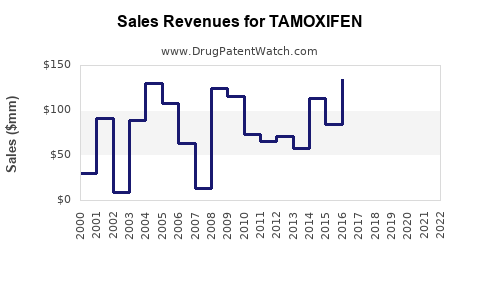
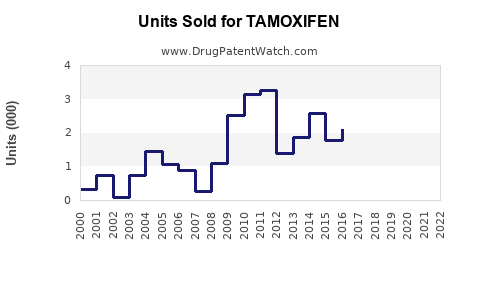
Annual Sales Revenues and Units Sold for TAMOXIFEN
| Drug Name | Revenues (USD) | Units | Year |
|---|---|---|---|
| TAMOXIFEN | ⤷ Start Trial | ⤷ Start Trial | 2022 |
| TAMOXIFEN | ⤷ Start Trial | ⤷ Start Trial | 2021 |
| TAMOXIFEN | ⤷ Start Trial | ⤷ Start Trial | 2020 |
| TAMOXIFEN | ⤷ Start Trial | ⤷ Start Trial | 2019 |
| TAMOXIFEN | ⤷ Start Trial | ⤷ Start Trial | 2018 |
| >Drug Name | >Revenues (USD) | >Units | >Year |
Tamoxifen Market Analysis and Sales Projections Through 2030
Tamoxifen is a mature, low-cost generic endocrine therapy with broad global availability and minimal remaining patent risk. Its commercial market is stable rather than high-growth. Global annual sales are estimated at approximately $150 million to $300 million in 2025 across finished tablets, hospital procurement, retail prescriptions, and selected prevention uses. A reasonable base-case forecast is $165 million to $330 million by 2030, driven by treatment-duration expansion, breast-cancer incidence, and demand in emerging markets rather than price increases.
What is the current market size for tamoxifen?
Public companies generally do not report tamoxifen revenue separately because the product is sold as a generic portfolio item. Market estimates therefore require a bottom-up assessment of treated patients, dosage volumes, geographic pricing, and channel mix.
| Metric | 2025 estimate |
|---|---|
| Global tamoxifen finished-product sales | $150 million-$300 million |
| U.S. finished-product sales | $20 million-$60 million |
| Global treated patients using tamoxifen annually | 1.5 million-3.0 million |
| Standard tablet strengths | 10 mg and 20 mg |
| Typical daily dose | 20 mg |
| Approximate annual treatment volume per patient | 365 tablets |
| Core product form | Generic oral tablets |
| Global market status | Mature, fragmented, price-sensitive |
These figures exclude the wider breast-cancer endocrine-therapy market, which includes anastrozole, letrozole, exemestane, fulvestrant, and branded selective estrogen receptor degraders.
Tamoxifen remains clinically relevant because it is used for estrogen receptor-positive breast cancer in premenopausal patients, some postmenopausal patients, metastatic disease, male breast cancer, and breast-cancer risk reduction. The National Cancer Institute identifies tamoxifen as an established option for reducing breast-cancer risk in selected high-risk women and for treating hormone receptor-positive disease (National Cancer Institute, 2024).
What is driving tamoxifen demand?
Breast-cancer incidence
Global breast-cancer incidence supports a durable underlying treatment pool. The International Agency for Research on Cancer estimated approximately 2.3 million new breast-cancer cases worldwide in 2022 (International Agency for Research on Cancer, 2024). A substantial proportion of tumors are hormone receptor-positive, creating continuing demand for endocrine therapy.
Incidence alone does not translate directly into tamoxifen sales. Treatment selection depends on menopausal status, recurrence risk, guideline preference, tolerability, access to aromatase inhibitors, and local reimbursement.
Treatment duration
Tamoxifen is commonly prescribed for five years and may be extended to 10 years in selected patients. The FDA label identifies adjuvant treatment and prevention-related uses, while clinical guidelines support longer endocrine-therapy courses for certain recurrence-risk profiles (FDA, 2024; Burstein et al., 2019).
Longer treatment duration increases prescription volume even where new-patient growth is limited. Persistence is reduced by adverse effects, including hot flashes, thromboembolic events, endometrial abnormalities, and sexual or mood-related symptoms.
Access in lower-income markets
Tamoxifen is included in the World Health Organization Model List of Essential Medicines. Its low price and oral administration make it important in markets where aromatase inhibitors or newer endocrine therapies are less accessible (World Health Organization, 2023).
Demand growth is strongest in markets with:
- Expanding oncology screening and diagnosis.
- Greater availability of pathology testing for estrogen receptor status.
- Public procurement programs.
- Increasing breast-cancer treatment capacity.
- Limited access to higher-cost aromatase inhibitors.
India, China, Latin America, the Middle East, and parts of Africa are commercially more important for volume than for per-tablet pricing.
How much will tamoxifen sales grow through 2030?
Base-case sales projection
| Year | Low case | Base case | High case |
|---|---|---|---|
| 2025 | $150 million | $225 million | $300 million |
| 2026 | $151 million | $231 million | $309 million |
| 2027 | $153 million | $238 million | $318 million |
| 2028 | $156 million | $245 million | $328 million |
| 2029 | $159 million | $252 million | $338 million |
| 2030 | $162 million | $260 million | $348 million |
| 2025-2030 CAGR | 1.5% | 3.0% | 3.0% |
The base case assumes nominal market growth of about 3% annually. Unit demand rises modestly, while generic price competition limits revenue expansion. The high case assumes faster diagnosis, longer treatment duration, and stronger procurement demand in developing markets. The low case assumes continued substitution by aromatase inhibitors in postmenopausal patients and sustained generic price erosion.
These are analyst scenario estimates, not reported manufacturer sales. No single public source provides a complete global tamoxifen revenue series across all manufacturers and countries.
Which companies sell tamoxifen?
Tamoxifen is supplied by multiple generic manufacturers and distributors. Availability changes by country and procurement contract. Major or historically significant suppliers include:
| Company | Commercial role |
|---|---|
| Teva Pharmaceuticals | Generic tamoxifen tablets in selected markets |
| Mylan/Viatris | Generic oncology portfolio and tamoxifen supply in selected jurisdictions |
| Sandoz | Generic pharmaceutical supplier |
| Dr. Reddy's Laboratories | Generic oncology products in selected markets |
| Cipla | Oncology and essential-medicine supplier |
| Sun Pharmaceutical Industries | Generic and specialty pharmaceutical supplier |
| Hikma Pharmaceuticals | Generic medicines and hospital products |
| Accord Healthcare | Generic oncology supplier |
| Wockhardt | Generic pharmaceutical supplier |
| Regional manufacturers | Public-sector and tender-based supply |
The original Nolvadex product was associated with AstraZeneca. The branded product has largely been displaced by generic tamoxifen citrate. Commercial leadership is fragmented, and supplier rankings differ by country.
What patents protect tamoxifen?
Tamoxifen has no meaningful remaining composition-of-matter patent barrier in the United States or other major markets. The original compound and early formulation rights expired decades ago.
| IP category | Current commercial relevance |
|---|---|
| Active-ingredient patent | Expired |
| Original breast-cancer treatment patents | Expired |
| Original prevention patents | Expired |
| Basic tablet formulation patents | Expired or commercially immaterial |
| Generic manufacturing patents | Potentially relevant at the supplier level |
| New combinations or delivery systems | Possible but limited market impact |
| Method-of-use patents | No broad blocking position apparent for standard treatment |
Tamoxifen citrate is a small-molecule generic active ingredient. It is not a biologic and does not create biosimilar exposure. Generic approval proceeds through abbreviated pathways, including ANDA procedures in the United States, rather than through biosimilar applications.
What is the Orange Book status of tamoxifen?
Tamoxifen tablets are listed in the FDA’s Approved Drug Products with Therapeutic Equivalence Evaluations, commonly called the Orange Book. The reference product is associated with tamoxifen citrate tablets, including 10 mg and 20 mg strengths. Generic products are approved based on pharmaceutical equivalence and bioequivalence requirements (FDA, 2024).
The commercially important Orange Book issues are:
- Multiple approved generic products.
- No durable exclusivity period supporting premium pricing.
- No current composition patent supporting delayed generic entry.
- Limited value in Paragraph IV litigation.
- Product availability determined mainly by manufacturing economics and procurement contracts.
Generic applicants may file Paragraph IV certifications against listed patents when applicable. For tamoxifen, the practical importance of Paragraph IV litigation is low because the principal product patents expired long ago and the market is already genericized.
When did tamoxifen lose exclusivity?
Tamoxifen lost meaningful exclusivity in the United States many years ago. The original branded product was approved in 1977. Generic competition developed after the relevant patent and regulatory exclusivity periods ended.
The 1998 FDA approval of tamoxifen for reducing breast-cancer incidence in high-risk women expanded the label but did not create a new long-term commercial monopoly. Label expansion supported broader clinical use while generic suppliers remained able to compete (FDA, 1998).
Tamoxifen therefore has:
- No remaining new-drug exclusivity.
- No meaningful orphan-drug exclusivity.
- No biologic exclusivity.
- No commercially significant pediatric exclusivity.
- No expected patent-driven loss of market access through 2030.
How does tamoxifen compare with competing endocrine therapies?
Tamoxifen competes primarily with aromatase inhibitors and newer endocrine agents.
| Drug class | Examples | Main commercial position |
|---|---|---|
| Selective estrogen receptor modulator | Tamoxifen | Low-cost, established, important for premenopausal patients |
| Aromatase inhibitors | Anastrozole, letrozole, exemestane | Often preferred in postmenopausal adjuvant treatment |
| Selective estrogen receptor degrader | Fulvestrant | Injectable, mainly advanced or metastatic disease |
| Oral SERDs | Elacestrant and emerging agents | Higher-cost targeted use in advanced disease |
| Ovarian suppression combinations | Goserelin plus endocrine therapy | Used in selected higher-risk premenopausal patients |
Tamoxifen has an advantage in price, availability, and long clinical experience. Aromatase inhibitors have greater use in many postmenopausal adjuvant settings because of efficacy and guideline preferences. Tamoxifen remains important where patients are premenopausal, aromatase inhibitors are poorly tolerated, bone-health concerns affect treatment choice, or access to newer therapies is limited.
What generic entry risks exist for tamoxifen manufacturers?
Generic entry risk is already fully realized. The principal commercial risks are price compression, supply disruption, regulatory observations, and procurement loss rather than a new entrant suddenly displacing a protected brand.
Main risks
- Price erosion: Multiple suppliers can reduce tender and wholesale prices.
- Low-margin manufacturing: Small-volume oncology products may become unattractive if prices fall below sustainable production economics.
- Shortages: API concentration, plant inspections, packaging problems, or contract-manufacturing failures can interrupt supply.
- Substitution: Postmenopausal patients may move to anastrozole, letrozole, or exemestane.
- Adherence attrition: Adverse effects can reduce persistence and refill volume.
- Procurement concentration: A supplier may lose substantial volume when a government or hospital contract changes.
Manufacturing IP is not a broad barrier, but process patents, polymorph claims, impurity-control methods, and proprietary supply agreements can affect individual manufacturers. These rights generally do not prevent generic competition across the market.
What litigation and settlement activity affects tamoxifen?
No current, market-shaping patent litigation is expected to determine tamoxifen access in the United States. Historical litigation related to tamoxifen involved generic entry, patent validity, and regulatory approval, but the product is now a mature generic.
Settlement agreements have limited commercial relevance because:
- Original exclusivity periods have expired.
- Multiple suppliers are already active.
- No single defendant controls market access.
- Generic pricing, not litigation timing, determines commercial performance.
Product-liability litigation concerning tamoxifen-associated risks may continue separately from patent litigation. The FDA label includes warnings relating to uterine malignancies, thromboembolic events, and other serious adverse reactions (FDA, 2024).
What is tamoxifen’s revenue exposure for pharmaceutical companies?
Tamoxifen is unlikely to represent a material revenue driver for large diversified pharmaceutical companies. For generic manufacturers, it can be strategically useful as part of an oncology portfolio, hospital formulary offering, or government-tender business.
| Stakeholder | Revenue exposure |
|---|---|
| Large diversified originator | Minimal |
| Global generic company | Low per product, meaningful in aggregate portfolio |
| Regional oncology supplier | Potentially material if tender access is strong |
| API manufacturer | Volume-driven, low-margin opportunity |
| Hospital distributor | Stable but price-sensitive |
| Public-sector procurement agency | Budget-efficient essential therapy |
The highest commercial value is usually captured through manufacturing scale, distribution reach, and tender execution rather than intellectual-property exclusivity.
What is the commercial outlook for tamoxifen through 2030?
Tamoxifen should remain a stable essential oncology medicine through 2030. Volume growth is likely to outpace price growth, particularly in emerging markets. Revenue will remain constrained by generic pricing and competition from aromatase inhibitors.
The most attractive opportunities are:
- Reliable supply for public-sector tenders.
- Low-cost production in high-volume markets.
- 20 mg tablet manufacturing with strong quality compliance.
- Contract manufacturing and regional distribution.
- Combination packaging with oncology-support products.
- Supply agreements in countries with limited access to aromatase inhibitors.
The least attractive strategy is attempting to build a premium brand around standard tamoxifen tablets without a differentiated delivery system, adherence program, or regulatory market-access advantage.
Key Takeaways
- Global tamoxifen sales are estimated at $150 million to $300 million in 2025.
- Base-case sales could reach approximately $260 million by 2030.
- Growth is expected to be low, with a modeled base-case CAGR of about 3%.
- The market is genericized, fragmented, and highly price-sensitive.
- No meaningful composition-of-matter or regulatory exclusivity remains.
- Paragraph IV and patent-litigation risk is low.
- Tamoxifen remains commercially important in premenopausal breast cancer, prevention, resource-limited markets, and patients unable to use aromatase inhibitors.
- Aromatase inhibitors are the principal competitive threat in postmenopausal treatment.
- Manufacturing reliability, tender access, and supply economics matter more than patent protection.
FAQs
Is tamoxifen still a profitable drug?
Tamoxifen can be profitable at scale, but standard tablets generally produce low margins because multiple generic suppliers compete on price. Profitability depends on manufacturing cost, tender volume, API sourcing, and distribution efficiency.
Will tamoxifen sales decline after 2025?
A sharp decline is unlikely. Sales may remain stable or grow slowly because global breast-cancer incidence and treatment access are increasing. Substitution by aromatase inhibitors will limit growth in postmenopausal markets.
Does tamoxifen have biosimilar competition?
No. Tamoxifen is a small-molecule drug, not a biologic. It faces conventional generic competition rather than biosimilar competition.
Which tamoxifen strength has the greatest commercial demand?
The 20 mg tablet is generally the principal commercial strength because standard adult dosing is commonly 20 mg daily. The 10 mg strength remains relevant for dose adjustments and selected clinical uses.
Can a new tamoxifen formulation obtain market exclusivity?
A genuinely novel formulation, delivery system, or validated method of use could support patent protection. A new formulation would need meaningful clinical or pharmaceutical differentiation to justify development costs in a low-price generic market.
References
-
Burstein, H. J., Lacchetti, C., Anderson, H., Buchholz, T. A., Davidson, N. E., Gelmon, K. A., Giordano, S. H., Hudis, C. A., Liu, M. C., Mayer, E. L., Prowell, T. M., Winer, E. P., & Griggs, J. J. (2019). Adjuvant endocrine therapy for women with hormone receptor-positive breast cancer: ASCO clinical practice guideline focused update. Journal of Clinical Oncology, 37(5), 423-438.
-
Food and Drug Administration. (1998). FDA approves Nolvadex for reducing breast cancer incidence in high-risk women. U.S. Department of Health and Human Services.
-
Food and Drug Administration. (2024). Tamoxifen citrate tablets prescribing information. U.S. Department of Health and Human Services.
-
International Agency for Research on Cancer. (2024). Global Cancer Observatory: Breast cancer fact sheet. World Health Organization.
-
National Cancer Institute. (2024). Tamoxifen: Drug information and breast cancer prevention. U.S. Department of Health and Human Services.
-
World Health Organization. (2023). WHO model list of essential medicines, 23rd list. World Health Organization.
More… ↓
