Drug Sales Trends for SAXENDA
Payment Methods and Pharmacy Types for SAXENDA (2017)
Revenues by Pharmacy Type
Units Sold by Pharmacy Type
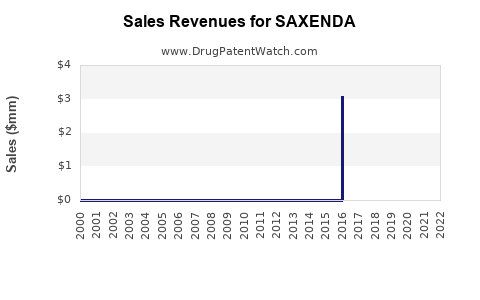
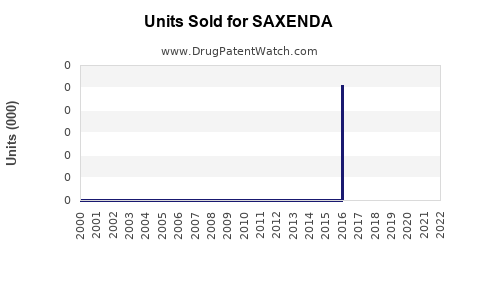
Annual Sales Revenues and Units Sold for SAXENDA
| Drug Name | Revenues (USD) | Units | Year |
|---|---|---|---|
| SAXENDA | ⤷ Start Trial | ⤷ Start Trial | 2022 |
| SAXENDA | ⤷ Start Trial | ⤷ Start Trial | 2021 |
| SAXENDA | ⤷ Start Trial | ⤷ Start Trial | 2020 |
| SAXENDA | ⤷ Start Trial | ⤷ Start Trial | 2019 |
| >Drug Name | >Revenues (USD) | >Units | >Year |
Saxenda Market Analysis, Sales Projections, Patent Expiry, and Generic Risk
Saxenda, Novo Nordisk’s liraglutide 3.0 mg obesity product, is in a late-life-cycle decline. Its commercial position has weakened sharply against Wegovy, Zepbound, and other once-weekly incretin therapies. Global Saxenda sales were approximately DKK 3.2 billion in 2024, down from roughly DKK 6.3 billion in 2023 and DKK 9.7 billion in 2022. Base-case sales are projected to fall below DKK 2 billion in 2026 and below DKK 1 billion by 2029 as patients and prescribers migrate to higher-efficacy weekly products.
The principal commercial risks are competitive substitution, daily injection burden, supply prioritization for newer products, and liraglutide patent expiry. Saxenda retains value in pediatric obesity, markets where newer GLP-1 products are unavailable, and lower-price treatment segments, but these uses are unlikely to offset the structural decline.
What is Saxenda and how does it compete in the obesity drug market?
Saxenda is a once-daily injectable formulation of liraglutide, a glucagon-like peptide-1 receptor agonist. It is approved for chronic weight management in adults with obesity or overweight and weight-related comorbidities, and in adolescents aged 12 to 17 years with obesity. Treatment is administered by subcutaneous injection and titrated to a 3.0 mg maintenance dose.
| Product | Active ingredient | Dose frequency | Primary company | Approximate weight-loss positioning |
|---|---|---|---|---|
| Saxenda | Liraglutide | Daily | Novo Nordisk | Lower than newer weekly incretin products |
| Wegovy | Semaglutide | Weekly | Novo Nordisk | Higher than Saxenda in pivotal obesity trials |
| Zepbound | Tirzepatide | Weekly | Eli Lilly | Generally higher than Saxenda and Wegovy |
| Contrave | Naltrexone/bupropion | Oral daily | Currax Pharmaceuticals | Non-GLP-1 oral alternative |
| Qsymia | Phentermine/topiramate | Oral daily | Vivus/Metuchen | Oral alternative with different safety profile |
| Xenical/Alli | Orlistat | Oral | Roche/OTC manufacturers | Older, lower-efficacy option |
Saxenda’s key disadvantage is efficacy relative to newer therapies. In the SCALE obesity trial, liraglutide produced mean weight loss of approximately 8% after 56 weeks, compared with higher average reductions reported for semaglutide and tirzepatide in their respective obesity programs. Trial populations and designs differ, so cross-trial comparisons are directional rather than definitive.
How much revenue does Saxenda generate?
Novo Nordisk reports Saxenda within its obesity-care portfolio. Public company disclosures show a steep decline in reported sales.
| Fiscal year | Estimated Saxenda sales | Approximate change | Commercial interpretation |
|---|---|---|---|
| 2022 | DKK 9.7 billion | Base year | Strong residual demand before widespread Wegovy availability |
| 2023 | DKK 6.3 billion | Approximately -35% | Substitution by Wegovy and supply constraints |
| 2024 | DKK 3.2 billion | Approximately -49% | Accelerated migration to weekly incretin products |
| 2025E | DKK 2.3-2.6 billion | Approximately -20% to -30% | Continued erosion, partly offset by price and geographic mix |
| 2026E | DKK 1.5-1.9 billion | Approximately -25% to -35% | Patent and generic-entry risk increases |
| 2027E | DKK 1.0-1.3 billion | Approximately -25% to -35% | Mature branded and generic competition |
| 2028E | DKK 0.7-1.0 billion | Approximately -20% to -30% | Residual pediatric, access-driven, and lower-price demand |
| 2029E | DKK 0.5-0.8 billion | Approximately -15% to -25% | Niche product status |
| 2030E | DKK 0.4-0.7 billion | Approximately -10% to -20% | Low-level maintenance revenue |
The 2025-2030 figures are an analytical projection rather than company guidance. The base case assumes continued annual volume contraction, no material clinical repositioning, and increasing generic or lower-cost liraglutide availability.
At an indicative exchange rate of DKK 6.8 to the U.S. dollar, 2024 sales of DKK 3.2 billion equal approximately $470 million. Under the base case, Saxenda revenue falls to roughly $220 million to $280 million in 2026 and $60 million to $120 million by 2030.
What are the main drivers of Saxenda sales decline?
Weekly GLP-1 and dual incretin substitution
Wegovy has displaced Saxenda within Novo Nordisk’s own obesity portfolio. Wegovy provides weekly administration and substantially higher average weight loss in clinical trials. Zepbound has intensified competitive pressure since its U.S. launch.
Saxenda’s daily injection schedule creates a persistent adherence disadvantage. Patients who start on liraglutide may also switch to weekly products when insurance coverage, supply, or prescribing access improves.
Supply allocation within Novo Nordisk
Novo Nordisk has prioritized manufacturing capacity for Wegovy and diabetes products with larger growth opportunities. Saxenda has lower strategic priority because its sales are declining and its manufacturing platform overlaps with newer products.
Lower reimbursement priority
Payers increasingly use formulary management to control obesity-drug spending. Saxenda may receive preference where it is cheaper than Wegovy or Zepbound, but reimbursement decisions increasingly favor products with stronger weight-loss outcomes, cardiovascular data, or negotiated net pricing.
Patient persistence and tolerability
Liraglutide’s gastrointestinal adverse effects are broadly consistent with the GLP-1 class. Daily dosing can reduce persistence. Saxenda may retain patients who do not tolerate higher-potency agents, but that segment is unlikely to support former revenue levels.
What is the FDA and Orange Book status of Saxenda?
Saxenda received FDA approval in December 2014 for chronic weight management. The product is regulated as a prescription drug, not a biologic, so biosimilar substitution rules do not apply.
The active ingredient is liraglutide. Victoza, another Novo Nordisk product containing liraglutide, was approved earlier for type 2 diabetes. Saxenda therefore entered a product family with an established active ingredient and prior liraglutide regulatory history.
| Regulatory issue | Saxenda position |
|---|---|
| FDA approval | December 2014 |
| Dosage form | Prefilled multidose injection pen |
| Active ingredient | Liraglutide |
| Drug class | GLP-1 receptor agonist |
| Biosimilar pathway | Not applicable |
| Generic pathway | Abbreviated New Drug Application, subject to applicable patents and regulatory requirements |
| Orange Book relevance | Listed patents and exclusivity determine ANDA certification and litigation exposure |
| Pediatric use | Approved for adolescents aged 12 to 17 years with obesity |
Orange Book listings and patent status can change through corrections, patent-listing updates, litigation outcomes, and regulatory decisions. Commercial entry analysis should therefore distinguish the underlying liraglutide compound patent from formulation, device, manufacturing, and method-of-use claims.
When does Saxenda lose exclusivity and when can generics launch?
The central U.S. compound patent covering liraglutide has been associated with expiration in the 2026 period. Novo Nordisk has also held patents and patent-family claims relating to formulations, dosing, use, and injection devices. The exact earliest lawful generic-entry date depends on:
- The patents listed for the specific Saxenda reference product.
- The ANDA applicant’s Paragraph IV certifications.
- Whether Novo Nordisk files patent litigation within the statutory period.
- Any 30-month stay, settlement, injunction, or court decision.
- Regulatory exclusivity and pediatric extensions, if applicable.
- Whether the generic applicant seeks approval for all or only part of the reference product’s labeling.
Paragraph IV challenge risk
A generic applicant can file a Paragraph IV certification asserting that a listed patent is invalid, unenforceable, or not infringed. If Novo Nordisk sues within the statutory window, FDA approval may be stayed for up to 30 months, subject to court and regulatory developments.
The commercial probability of entry is higher for liraglutide than for semaglutide because liraglutide is an older molecule with a more mature patent estate. Entry may still be delayed by device, formulation, manufacturing, or labeling issues.
Patent and exclusivity outlook
| Protection category | Expected commercial effect |
|---|---|
| Liraglutide compound claims | Core protection reaches the mid-2020s |
| Saxenda formulation claims | May delay some products, depending on claim scope and validity |
| Pen-device claims | Can create design-around or device-substitution issues |
| Method-of-use claims | May affect obesity labeling but generally offer narrower protection than compound claims |
| Pediatric exclusivity | Could affect timing for claims covering pediatric use, but does not necessarily block all adult generic entry |
| Regulatory exclusivity | Limited relative to the patent period because liraglutide had prior FDA approval in Victoza |
What formulations and manufacturing technologies protect Saxenda?
Saxenda is supplied in a multidose prefilled injection pen containing a sterile liraglutide solution. The relevant intellectual-property barriers may include:
- Liraglutide sequence and peptide-related claims.
- Stabilized aqueous formulations.
- Concentration and dosing claims.
- Pen injector architecture.
- Cartridge, needle, and dose-delivery systems.
- Manufacturing and purification processes.
- Impurity-control and peptide-production methods.
- Obesity-treatment and weight-maintenance methods.
Manufacturing is a meaningful barrier because liraglutide is a peptide rather than a conventional small molecule. Generic companies must demonstrate pharmaceutical equivalence, establish suitable device performance, and maintain consistent peptide purity and potency. These requirements raise development costs but do not create the same regulatory barrier as a biologic biosimilar program.
Device patents are more likely to influence product design than to prevent all competition. A generic company may use a different injector, obtain separate device clearance, or market a product with a delivery system that avoids selected claims.
Which companies are challenging Saxenda and what is the competitive landscape?
Novo Nordisk faces competition from three groups.
Direct incretin competitors
Eli Lilly’s Zepbound is the strongest commercial challenger. Its tirzepatide mechanism combines GLP-1 and glucose-dependent insulinotropic polypeptide activity. Zepbound’s higher efficacy and weekly dosing place direct pressure on Saxenda.
Novo Nordisk’s own Wegovy is also a major source of Saxenda substitution. This internal cannibalization is commercially rational because Wegovy has a substantially larger growth profile.
Potential liraglutide generic manufacturers
Potential entrants include established generic manufacturers with peptide capabilities, injection-device expertise, and experience with ANDA litigation. Teva, Sandoz, Viatris, Amneal, Hikma, and regional manufacturers are logical competitive candidates, although a company’s technical capability does not establish that it has filed or received approval for a specific Saxenda ANDA.
Generic Victoza activity may provide a pathway for companies to develop liraglutide products, but approval for diabetes labeling does not automatically establish approval for the Saxenda obesity indication.
Non-GLP-1 obesity products
Oral therapies remain commercially relevant because they avoid injections and may be cheaper. Contrave, Qsymia, and orlistat have lower efficacy but can serve patients who lack coverage for injectable incretin drugs or who cannot tolerate them.
What is the revenue exposure from Saxenda?
Saxenda is strategically important to Novo Nordisk’s obesity franchise but is no longer a principal growth driver. The revenue exposure is concentrated in:
- Markets where Wegovy supply is constrained.
- Countries with lower reimbursement thresholds.
- Pediatric obesity treatment.
- Patients who need a lower-potency GLP-1 option.
- Payers seeking lower-cost liraglutide alternatives.
- Patients who cannot tolerate semaglutide or tirzepatide.
A decline from DKK 3.2 billion in 2024 to DKK 0.5 billion by 2029 would remove approximately DKK 2.7 billion in annual sales. That loss is modest relative to Novo Nordisk’s total obesity and diabetes revenue, but the margin impact could be greater if branded Saxenda is replaced by lower-priced generic products.
How strong is Saxenda’s patent estate?
Saxenda’s patent estate is moderate but weakening.
| Strength factor | Assessment |
|---|---|
| Active-ingredient protection | Limited by age and expected mid-2020s expiry |
| Formulation protection | Potentially meaningful, but claim scope and validity are critical |
| Device protection | Can complicate launch but is generally design-aroundable |
| Method-of-use protection | Useful for labeled indications, with narrower enforcement leverage |
| Manufacturing protection | May raise technical barriers and protect process know-how |
| Regulatory exclusivity | Less powerful because liraglutide was previously approved as Victoza |
| Overall estate | Stronger before 2026; materially weaker after core compound expiry |
The estate is more effective at delaying low-cost entry than at preserving long-term exclusivity. Novo Nordisk’s commercial defense is likely to rely on product differentiation, supply scale, brand recognition, and portfolio conversion to Wegovy rather than on Saxenda alone.
What generic launch scenarios exist for Saxenda?
Base case
A first meaningful generic or follow-on liraglutide launch occurs around 2026 or 2027 after patent litigation, regulatory review, or settlement. Saxenda sales decline 25% to 35% annually through 2027.
Early-entry case
A successful Paragraph IV challenge or settlement permits entry near compound-patent expiry. Sales fall more than 40% in the first year after entry, with rapid payer substitution toward lower-cost liraglutide.
Delayed-entry case
Formulation, device, manufacturing, or litigation issues delay broad entry until 2028 or later. Saxenda retains higher revenue for another one to two years but continues losing volume to Wegovy and Zepbound.
Limited-indication case
Generic products enter with diabetes-focused labeling first, while obesity labeling remains restricted by method-of-use patents or regulatory strategy. This would create partial pricing pressure without immediate full substitution in obesity treatment.
How does Saxenda compare with Wegovy and Zepbound?
| Metric | Saxenda | Wegovy | Zepbound |
|---|---|---|---|
| Company | Novo Nordisk | Novo Nordisk | Eli Lilly |
| Active ingredient | Liraglutide | Semaglutide | Tirzepatide |
| Dosing | Daily | Weekly | Weekly |
| Relative efficacy | Lowest of the three | Higher | Generally highest in current obesity comparisons |
| Patent maturity | Mature, approaching expiry | Newer estate | Newer estate |
| Generic risk | High in the mid-to-late 2020s | Low near term | Low near term |
| Commercial outlook | Declining | Growth product | Growth product |
| Main advantage | Established safety, lower-cost potential, pediatric use | Strong efficacy and weekly dosing | Strong efficacy and weekly dosing |
Key Takeaways
- Saxenda sales fell from approximately DKK 9.7 billion in 2022 to DKK 3.2 billion in 2024.
- Base-case revenue is projected at DKK 1.5 billion to DKK 1.9 billion in 2026 and DKK 0.5 billion to DKK 0.8 billion in 2029.
- Wegovy and Zepbound are the primary commercial threats.
- Liraglutide compound protection is expected to reach the 2026 period, creating substantial generic-entry risk.
- Formulation, injector, method-of-use, and manufacturing patents may delay or narrow competition but are unlikely to preserve long-term exclusivity.
- Saxenda is not exposed to biosimilar competition because it is a chemically defined peptide drug regulated through the small-molecule framework.
- The product’s residual value is concentrated in pediatric obesity, lower-price markets, supply-constrained regions, and patients who do not tolerate newer incretin therapies.
- Novo Nordisk’s most likely strategy is to convert demand from Saxenda to Wegovy rather than defend Saxenda as a long-term growth asset.
FAQs About Saxenda Sales, Patents, and Market Outlook
How much did Saxenda sales decline from 2022 to 2024?
Reported sales declined from approximately DKK 9.7 billion in 2022 to DKK 3.2 billion in 2024, a reduction of roughly 67%. The decline reflects Wegovy substitution, competitive pressure, supply allocation, and lower demand for daily liraglutide.
Will generic liraglutide reduce Saxenda’s price?
Yes. Generic or follow-on liraglutide products would likely produce substantial net-price reductions, particularly in payer-controlled markets. The magnitude would depend on the number of entrants and whether products receive obesity-specific labeling.
Can a generic Victoza product automatically substitute for Saxenda?
No. Victoza and Saxenda contain liraglutide but have different indications, doses, labels, and commercial uses. Substitution depends on FDA approval, state substitution rules, payer policy, device equivalence, and the approved labeling of the competing product.
Is Saxenda still approved for adolescents?
Yes. FDA-approved Saxenda labeling includes chronic weight management for adolescents aged 12 to 17 years with obesity, subject to the product label’s eligibility and dosing requirements.
What is the biggest long-term risk to Saxenda revenue?
The largest risk is combined competitive and patent pressure: patients move to weekly Wegovy or Zepbound while generic liraglutide reduces price and market share after core patent protection weakens.
References
- Novo Nordisk A/S. (2023). Annual report 2023. Novo Nordisk.
- Novo Nordisk A/S. (2025). Annual report 2024. Novo Nordisk.
- U.S. Food and Drug Administration. (2014). Saxenda (liraglutide) prescribing information.
- U.S. Food and Drug Administration. (2024). Approved drug products with therapeutic equivalence evaluations: Orange Book.
- U.S. Food and Drug Administration. (2023). Wegovy (semaglutide) prescribing information.
- U.S. Food and Drug Administration. (2023). Zepbound (tirzepatide) prescribing information.
- Pi-Sunyer, X., Astrup, A., Fujioka, K., Greenway, F., Halpern, A., Krempf, M., Lau, D. C. W., le Roux, C. W., Violante Ortiz, R., Jensen, C. B., & Wilding, J. P. H. (2015). A randomized, controlled trial of 3.0 mg of liraglutide in weight management. New England Journal of Medicine, 373(1), 11-22.
More… ↓
