Drug Sales Trends for LATUDA
Payment Methods and Pharmacy Types for LATUDA (2017)
Revenues by Pharmacy Type
Units Sold by Pharmacy Type
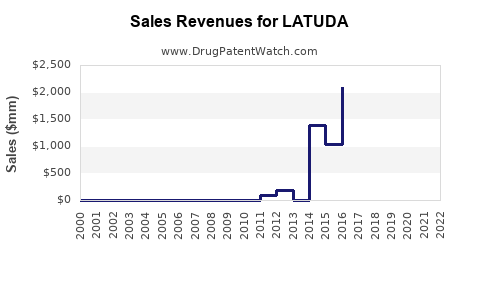
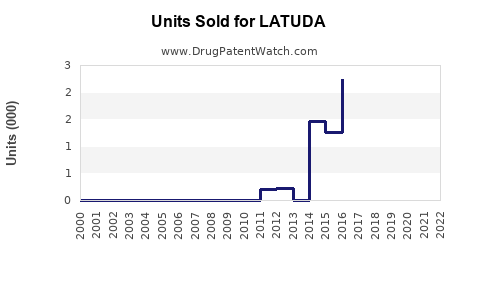
Annual Sales Revenues and Units Sold for LATUDA
| Drug Name | Revenues (USD) | Units | Year |
|---|---|---|---|
| LATUDA | ⤷ Start Trial | ⤷ Start Trial | 2022 |
| LATUDA | ⤷ Start Trial | ⤷ Start Trial | 2021 |
| LATUDA | ⤷ Start Trial | ⤷ Start Trial | 2020 |
| LATUDA | ⤷ Start Trial | ⤷ Start Trial | 2019 |
| LATUDA | ⤷ Start Trial | ⤷ Start Trial | 2018 |
| LATUDA | ⤷ Start Trial | ⤷ Start Trial | 2017 |
| >Drug Name | >Revenues (USD) | >Units | >Year |
Latuda Market Analysis, Sales Forecast, Patent Expiry and Generic Competition
Latuda (lurasidone hydrochloride) is a mature atypical antipsychotic whose U.S. branded market entered rapid decline after generic launches in 2023. The drug generated more than $1 billion in annual U.S. sales before loss of exclusivity, driven by schizophrenia and bipolar depression. Base-case U.S. branded sales are projected to fall below $200 million in 2024 and below $50 million by 2026. The commercial opportunity has shifted from Sunovion’s branded product to generic lurasidone manufacturers.
What is Latuda and what markets does it address?
Latuda is an oral atypical antipsychotic marketed by Sunovion Pharmaceuticals, a subsidiary of Sumitomo Pharma. Its active ingredient is lurasidone hydrochloride.
The FDA approved Latuda in 2010 for adults with schizophrenia. The agency expanded the label in 2013 to include depressive episodes associated with bipolar I disorder, either as monotherapy or with lithium or valproate. FDA later approved pediatric indications for schizophrenia and bipolar depression in adolescents and children, respectively. [1]
| Product attribute | Detail |
|---|---|
| Brand name | Latuda |
| Active ingredient | Lurasidone hydrochloride |
| Drug class | Atypical antipsychotic |
| Initial U.S. approval | October 28, 2010 |
| Main indications | Schizophrenia; bipolar depression |
| Dosage form | Immediate-release oral tablets |
| Strengths | 20, 40, 60, 80, 120, and 160 mg |
| Primary U.S. marketer | Sunovion Pharmaceuticals |
| Parent company | Sumitomo Pharma |
| Generic status | Multiple FDA-approved generic products |
| Core commercial markets | United States, Japan, Europe and selected international markets |
Latuda competes with quetiapine, aripiprazole, cariprazine, brexpiprazole, olanzapine, risperidone and other antipsychotics. Its commercial positioning has relied on bipolar depression efficacy, a relatively favorable metabolic profile compared with some older atypical antipsychotics, and broad payer access before generic entry.
How large were Latuda sales before generic competition?
Latuda became one of Sumitomo Pharma’s largest products. U.S. net sales reached approximately $1.3 billion in fiscal 2022, according to company disclosures and industry reporting. The United States represented the majority of the product’s commercial value because of its higher pricing and larger branded market than other jurisdictions. [2]
| Period | Estimated U.S. branded sales | Market condition |
|---|---|---|
| 2018 | Approximately $900 million | Continued branded growth |
| 2019 | Approximately $1.0 billion | Expansion in bipolar depression |
| 2020 | Approximately $1.1 billion | Stable demand despite pandemic disruption |
| 2021 | Approximately $1.2 billion | Mature branded product |
| 2022 | Approximately $1.3 billion | Final full year before generic erosion |
| 2023 | Approximately $500 million-$700 million | Partial-year generic impact |
| 2024E | $100 million-$200 million | Broad generic substitution |
| 2025E | $50 million-$100 million | Residual brand and protected prescriptions |
| 2026E | Below $50 million | Mature post-exclusivity market |
Reported figures differ depending on whether they include gross sales, net sales, geographic markets or fiscal-year periods. The 2021-2022 period represents Latuda’s commercial peak.
When did Latuda lose U.S. exclusivity?
Latuda lost effective U.S. market exclusivity in 2023 when generic lurasidone products entered the market. The launch followed patent litigation and settlement arrangements involving Sunovion and generic applicants.
The commercial loss-of-exclusivity date was more important than the nominal expiration of any single patent because the product was protected by a combination of composition, formulation, dosing and regulatory barriers. Once multiple ANDA applicants obtained approval or launch rights, pharmacy substitution accelerated.
Latuda exclusivity timeline
| Date | Event |
|---|---|
| 2010 | FDA approves Latuda for adult schizophrenia |
| 2013 | FDA approves bipolar depression indication |
| 2017 | Pediatric schizophrenia and bipolar depression approvals expand the label |
| 2020-2022 | Patent litigation and settlements with generic applicants |
| January 2023 | First broad U.S. generic lurasidone launches |
| 2023-2024 | Rapid erosion in branded prescriptions and pricing |
| 2025 onward | Mature generic market with low branded revenue |
The relevant exclusivity protections included FDA regulatory exclusivity, Orange Book-listed patents and settlement-based launch restrictions. FDA pediatric exclusivity added six months to applicable patent and exclusivity protections, but it did not preserve a long post-2023 commercial window.
What patents protected Latuda?
Latuda’s U.S. patent estate covered the lurasidone compound, pharmaceutical compositions, solid-state or formulation characteristics, and methods of treatment. The main commercial protection came from Orange Book-listed patents and associated Paragraph IV litigation.
Patent protection for a small-molecule product such as lurasidone differs from biologic protection. No biosimilar pathway applies. Generic applicants file abbreviated new drug applications, or ANDAs, and may challenge listed patents through Paragraph IV certifications.
The most commercially important protections were:
- Compound and composition-of-matter claims covering lurasidone.
- Pharmaceutical-composition claims covering oral tablets.
- Method-of-use claims for schizophrenia and bipolar depression.
- Pediatric and dosing-related protections.
- Regulatory exclusivity associated with expanded indications.
The Orange Book must be read together with FDA approval records and federal court dockets because listed patents do not always determine the earliest practical generic launch date. Settlement terms, pediatric exclusivity, manufacturing readiness and court outcomes also affect timing. [3]
Which companies challenged Latuda patents?
Several generic manufacturers pursued lurasidone ANDAs and challenged Sunovion’s patent position. Publicly reported participants included major generic companies such as Teva, Zydus, Apotex, Dr. Reddy’s Laboratories, Lupin and other ANDA sponsors.
The litigation pattern followed the standard Hatch-Waxman framework:
- An ANDA applicant filed a Paragraph IV certification against one or more Orange Book patents.
- Sunovion filed patent-infringement litigation.
- FDA approval was stayed for up to 30 months unless the litigation was resolved earlier.
- Settlements established permitted launch dates or other commercial terms.
- Multiple generic products entered after the first authorized or settlement-permitted launch.
Because settlement agreements may contain confidential commercial terms, public records do not always disclose royalties, supply arrangements or precise launch economics. The market outcome shows that the settlements did not preserve long-term branded exclusivity after 2023.
What is the FDA and Orange Book status of Latuda?
Latuda remains an FDA-approved prescription drug, but the product is no longer protected by a meaningful period of U.S. market exclusivity. FDA-approved generic lurasidone products are therapeutically equivalent to the reference listed drug when rated AB in the Orange Book.
The key regulatory facts are:
| Regulatory issue | Status |
|---|---|
| Reference listed drug | Latuda |
| FDA approval status | Approved |
| Generic pathway | ANDA |
| Biosimilar pathway | Not applicable |
| Orange Book relevance | Listed patents and therapeutic-equivalence ratings |
| Paragraph IV risk | Material historical driver of generic entry |
| Current commercial barrier | Low relative to pre-2023 levels |
Generic lurasidone tablets use the same active ingredient and dosage strengths as Latuda, subject to FDA bioequivalence and quality requirements. Generic substitution is strongest in Medicaid, Medicare Part D and commercial plans that apply mandatory substitution or step-edit policies.
How fast will Latuda sales decline after generic entry?
Latuda is experiencing the standard small-molecule post-exclusivity pattern: rapid prescription substitution, payer-driven formulary migration and severe price compression.
A reasonable market model assumes:
- 70%-85% branded prescription erosion during the first year after broad generic availability.
- 85%-95% erosion by the second full year.
- Continued residual branded demand from patients stabilized on Latuda, prescribers reluctant to switch therapy, and plans with delayed substitution.
- Net price reductions that compound the prescription decline.
- Generic manufacturers capturing volume but competing aggressively on price.
U.S. branded-sales forecast
| Year | Base case | Downside case | Upside case |
|---|---|---|---|
| 2023A | $500m-$700m | $400m-$500m | $700m-$800m |
| 2024E | $125m | $75m | $225m |
| 2025E | $70m | $25m | $150m |
| 2026E | $35m | $10m | $90m |
| 2027E | $20m | $5m | $60m |
| 2028E | $15m | $3m | $45m |
These figures are an analyst projection for branded Latuda sales, not company guidance. The base case assumes no new patent-based restriction, no material relaunch strategy and continued generic availability across major U.S. payers.
How large is the generic lurasidone opportunity?
The generic market should retain substantial prescription volume even as value migrates away from Sunovion. Lurasidone has established clinical use in schizophrenia and bipolar depression, and many patients will remain on therapy after substitution.
The U.S. generic opportunity is likely to divide into three stages:
First stage: launch and rapid substitution
Manufacturers compete for pharmacy and payer contracts. Prices decline quickly, while volume remains close to the branded baseline.
Second stage: price compression
Additional suppliers enter. Wholesale acquisition cost and net realized pricing fall as payers adopt preferred generic vendors.
Third stage: mature generic market
A smaller number of manufacturers retain meaningful share. Profits depend on manufacturing cost, supply reliability, contract access and product breadth across strengths.
A reasonable estimate for aggregate U.S. generic lurasidone manufacturer revenue is $400 million-$800 million annually during the early post-launch period, declining toward $250 million-$500 million as unit prices compress. This range is substantially different from pharmacy spending or total market value, which may include wholesaler and pharmacy margins.
What formulations are protected by Latuda patents?
Latuda is an immediate-release oral tablet. The main formulation value lies in maintaining bioequivalence, content uniformity, dissolution performance and reliable manufacturing across six dosage strengths.
The formulation estate is less commercially durable than the pre-launch composition patent because generic manufacturers can often design around narrower formulation claims while meeting the reference product’s bioequivalence requirements. Formulation patents can delay or complicate entry, but they rarely preserve the original branded price after the core product is exposed to multiple ANDA competitors.
There is no major long-acting injectable Latuda franchise comparable to long-acting formulations of aripiprazole or risperidone. That limits opportunities to shift patients into a protected delivery system.
How does Latuda compare with competing antipsychotics?
| Drug | Active ingredient | Main commercial position | Generic status | Key competitive issue |
|---|---|---|---|---|
| Latuda | Lurasidone | Schizophrenia and bipolar depression | Generic available | Rapid post-2023 erosion |
| Vraylar | Cariprazine | Bipolar depression and schizophrenia | Branded | Later-life-cycle patent protection |
| Rexulti | Brexpiprazole | Depression adjunct and schizophrenia | Branded | Broader commercial positioning |
| Abilify Maintena | Aripiprazole | Long-acting injectable | Branded injectable | Administration and adherence advantage |
| Seroquel XR | Quetiapine | Bipolar disorder and schizophrenia | Generic | Low-cost competition |
| Caplyta | Lumateperone | Bipolar depression and schizophrenia | Branded | Growth-stage differentiation |
| Invega Sustenna | Paliperidone | Long-acting schizophrenia treatment | Branded injectable | Long-acting delivery and adherence |
Latuda’s strongest direct commercial competitor is Vraylar in bipolar depression. Vraylar has benefited from a later patent timetable and continued branded pricing. Caplyta competes for bipolar depression prescriptions and has used clinical differentiation and promotional investment to expand its market.
Latuda’s generic price collapse reduces its ability to fund promotion, but the product remains relevant as a low-cost oral alternative.
What generic launch risks remain?
The principal risks are commercial rather than patent-based.
- Additional generic entrants can accelerate price erosion.
- Manufacturing interruptions can shift market share between suppliers.
- FDA inspection findings or recalls can reduce supply.
- Payers can favor one or two suppliers, excluding smaller manufacturers.
- Brand retention may exceed expectations in psychiatric patients with stable symptom control.
- Generic adoption can vary by dosage strength and indication.
- International patent and reimbursement conditions differ from the United States.
Manufacturing barriers are moderate. Lurasidone is a small-molecule active ingredient with established tablet manufacturing methods. The most important operational barriers are API sourcing, quality controls, bioequivalence across strengths and reliable supply to large pharmacy benefit managers.
What is the revenue exposure for Sumitomo Pharma?
Latuda’s loss of exclusivity removes one of Sumitomo Pharma’s most important cash-generating products. The impact is amplified because branded antipsychotic revenue has high contribution margins relative to mature generic products.
The company’s offsetting strategies include growth products, geographic expansion, licensing, restructuring and development of pipeline assets. The financial impact depends on whether new products replace Latuda’s gross profit or only its revenue.
For investors and potential partners, the key metrics are:
- U.S. Latuda net sales by fiscal quarter.
- Prescription volume versus net price.
- Generic share by strength.
- Sumitomo’s consolidated operating income.
- Development and launch timing for replacement products.
- Licensing income and milestone receipts.
- Manufacturing and restructuring costs after exclusivity loss.
How strong is the Latuda patent estate after 2023?
The estate was commercially strong before generic entry but is weak as a barrier to U.S. branded pricing after entry. It protected a large revenue stream through the settlement and litigation period, but it does not support a credible return to pre-2023 sales absent a new product, new formulation or regulatory change.
The remaining value is concentrated in:
- Residual brand prescriptions.
- International markets with later generic timing.
- Authorized-generic economics, if applicable.
- Licensing or supply arrangements.
- Technical know-how related to lurasidone manufacturing.
There is no biosimilar risk because Latuda is a chemically synthesized small molecule. The relevant competitive threat is ANDA-based generic substitution.
Key Takeaways
- Latuda is an FDA-approved lurasidone product for schizophrenia and bipolar depression.
- U.S. branded sales peaked at approximately $1.3 billion in 2022.
- Broad generic entry began in 2023 after Paragraph IV litigation and settlements.
- Base-case branded U.S. sales are projected below $200 million in 2024 and below $50 million by 2026.
- Aggregate generic lurasidone revenue may reach $400 million-$800 million annually before mature-market price compression.
- The product has no biosimilar pathway and no major long-acting formulation franchise.
- Vraylar and Caplyta are the most relevant branded competitors in bipolar depression.
- The remaining patent estate has limited ability to preserve branded pricing after generic entry.
- Revenue replacement, rather than additional Latuda patent enforcement, is the central commercial issue for Sumitomo Pharma.
FAQs
What is the generic name for Latuda?
The generic name is lurasidone hydrochloride.
Is Latuda still commercially available?
Yes. Brand Latuda remains FDA-approved, and generic lurasidone is also available in the United States.
Is lurasidone a controlled substance?
No. Lurasidone is not federally scheduled as a controlled substance under the U.S. Controlled Substances Act.
Does Latuda have a long-acting injectable version?
No major FDA-approved long-acting injectable version of lurasidone is marketed in the United States.
Which drug is most likely to replace Latuda in bipolar depression?
Vraylar and Caplyta are the closest branded competitors, while generic quetiapine and generic lurasidone compete on cost.
References
- U.S. Food and Drug Administration. (2024). Latuda prescribing information. FDA.
- Sumitomo Pharma Co., Ltd. (2023). Annual securities report and financial results. Sumitomo Pharma.
- U.S. Food and Drug Administration. (2024). Approved drug products with therapeutic equivalence evaluations. FDA Orange Book.
More… ↓
