Share This Page
Drug Sales Trends for FLAREX
✉ Email this page to a colleague
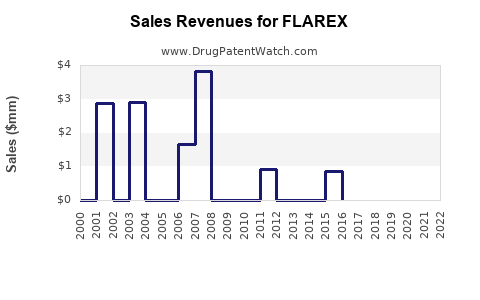
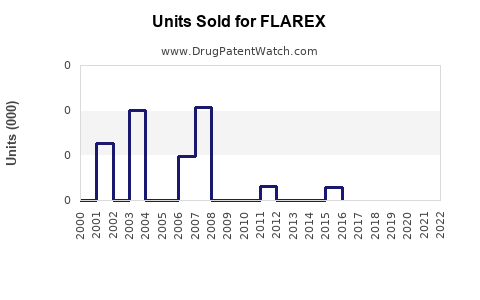
Annual Sales Revenues and Units Sold for FLAREX
| Drug Name | Revenues (USD) | Units | Year |
|---|---|---|---|
| FLAREX | ⤷ Start Trial | ⤷ Start Trial | 2022 |
| FLAREX | ⤷ Start Trial | ⤷ Start Trial | 2021 |
| FLAREX | ⤷ Start Trial | ⤷ Start Trial | 2020 |
| >Drug Name | >Revenues (USD) | >Units | >Year |
FLAREX Market Analysis, Sales Projections, Patent Status, and Competitive Outlook
FLAREX is a branded ophthalmic corticosteroid containing fluorometholone acetate 0.1%. Its commercial opportunity is limited by mature generic competition, short treatment durations, low clinical differentiation, and the absence of meaningful remaining market exclusivity. A reasonable U.S. base case is annual branded demand of approximately 50,000 to 100,000 units if distribution remains available, with net sales of roughly $5 million to $15 million. Generic fluorometholone products capture most price-sensitive demand.
What is FLAREX and what is its FDA status?
FLAREX is a topical ophthalmic suspension indicated for steroid-responsive inflammation of the palpebral and bulbar conjunctiva, cornea, and anterior segment of the eye. Its active ingredient is fluorometholone acetate 0.1%, a corticosteroid designed for ocular administration.
| Attribute | FLAREX profile |
|---|---|
| Brand name | FLAREX |
| Active ingredient | Fluorometholone acetate |
| Strength | 0.1% ophthalmic suspension |
| Dosage form | Sterile ophthalmic suspension |
| Primary use | Steroid-responsive ocular inflammation |
| Route | Topical ophthalmic |
| Original sponsor | Alcon Laboratories, Inc. |
| FDA application | NDA 017129 |
| Prescription status | Prescription-only ophthalmic product |
| Product class | Ophthalmic corticosteroid |
| U.S. market position | Mature, niche, generic-exposed |
FDA labeling states that FLAREX is intended for short-term treatment of inflammatory ocular conditions responsive to corticosteroids. The label warns of elevated intraocular pressure, glaucoma, delayed wound healing, and secondary ocular infections, which limit long-duration use and require physician monitoring. [1]
The commercial market is therefore driven by prescriptions for acute or intermittent treatment rather than chronic maintenance therapy.
What is the FDA regulatory and Orange Book status of FLAREX?
FLAREX was approved in the United States decades ago, and its original regulatory exclusivity has expired. The product does not have the profile of a recently approved ophthalmic medicine with remaining new chemical entity, orphan, pediatric, or other meaningful market exclusivity.
The Orange Book remains the principal source for current patent and exclusivity listings for approved prescription drugs. For a mature product such as FLAREX, the commercial issue is not regulatory exclusivity but whether an active marketed brand remains available and whether generic manufacturers maintain abbreviated new drug application approvals. [2]
Does FLAREX have active Orange Book patents?
No material active patent estate is generally associated with FLAREX’s current U.S. commercial position. Any original composition, formulation, or product patents would have expired after the product’s initial development period.
The principal implications are:
- No effective composition-of-matter exclusivity remains.
- No meaningful patent barrier prevents generic fluorometholone acetate competition.
- Any current protection would more likely involve manufacturing know-how, supplier controls, trademarks, or product-specific formulation execution.
- A Paragraph IV litigation strategy is unlikely to be commercially relevant against the original FLAREX product because the historic patent term has expired.
The absence of a current patent barrier does not guarantee uninterrupted generic supply. Ophthalmic suspensions can face manufacturing, sterility, particle-size, preservative, filling, and supply-chain constraints. Those barriers are operational rather than exclusionary.
When does FLAREX lose exclusivity?
FLAREX lost practical market exclusivity many years ago. Its current commercial status is consistent with a legacy ophthalmic corticosteroid that competes in a genericized market.
| Exclusivity category | FLAREX status |
|---|---|
| New chemical entity exclusivity | Expired |
| Orphan-drug exclusivity | Not applicable |
| Pediatric exclusivity | No current commercial impact |
| Reference-product exclusivity | Expired |
| Composition patent protection | Expired or no longer commercially relevant |
| Formulation patent protection | No material current barrier identified |
| Method-of-use protection | No material current barrier identified |
| Generic competition | Established or available by therapeutic class |
| Brand pricing power | Low to moderate, depending on supply availability |
The product’s commercial life is therefore determined by prescribing familiarity, formulary treatment, distributor availability, and the relative prices of competing ocular steroids.
What patents protect FLAREX?
The historical patent estate for FLAREX is not a current commercial defense. The relevant protection categories would have included:
- Fluorometholone acetate composition protection.
- Ophthalmic suspension formulation claims.
- Manufacturing methods for sterile ophthalmic suspensions.
- Container and dispensing-system claims.
- Method-of-use claims covering treatment of ocular inflammation.
Those categories have limited present value because generic competition can rely on an approved active ingredient and established ophthalmic dosage form. A generic applicant does not need to reproduce the brand’s trade dress or proprietary manufacturing process.
What formulation barriers affect generic FLAREX products?
The principal technical barriers are:
- Maintaining uniform suspension concentration.
- Controlling particle size and sedimentation.
- Achieving consistent redispersibility.
- Preserving sterility throughout shelf life.
- Managing preservative compatibility.
- Producing a drop size that supports accurate dosing.
- Establishing bioequivalence or therapeutic equivalence under FDA requirements.
These requirements can reduce the number of reliable suppliers, but they do not provide FLAREX with long-term exclusivity.
How large is the market for ophthalmic corticosteroids?
The relevant market is the U.S. prescription ophthalmic corticosteroid segment, including suspensions, solutions, ointments, combination antibiotics, and newer branded products.
FLAREX competes against:
- Generic fluorometholone acetate.
- Fluorometholone alcohol products.
- Prednisolone acetate ophthalmic suspension.
- Loteprednol etabonate products.
- Dexamethasone ophthalmic products.
- Difluprednate ophthalmic emulsion.
- Antibiotic-corticosteroid combinations.
- Postoperative and specialty anti-inflammatory products.
The segment is clinically important but commercially fragmented. Prescribers select products based on potency, intraocular-pressure risk, postoperative protocols, formulation performance, payer restrictions, and physician familiarity.
FLAREX has limited ability to expand the total market because it is a mature product with an established indication. Growth would primarily come from share capture, temporary competitor shortages, restored distribution, or targeted promotion to ophthalmologists and optometrists.
How does FLAREX compare with competing ophthalmic steroids?
| Product | Active ingredient | Relative commercial position | Main competitive issue |
|---|---|---|---|
| FLAREX | Fluorometholone acetate 0.1% | Mature branded niche | Generic substitution and limited differentiation |
| Generic fluorometholone | Fluorometholone or acetate | Lowest-price alternative | Supply continuity and formulary access |
| Pred Forte/generic prednisolone acetate | Prednisolone acetate | Established high-volume steroid | Strong generic competition |
| Lotemax/generic loteprednol | Loteprednol etabonate | Premium branded and generic segment | Lower perceived steroid-risk profile |
| Durezol/generic difluprednate | Difluprednate | Higher-potency specialty product | Price and safety monitoring |
| Maxidex/generic dexamethasone | Dexamethasone | Broad legacy use | Generic pricing |
| Tobradex and equivalents | Tobramycin/dexamethasone | Combination anti-infective segment | Used where infection risk is a concern |
FLAREX may benefit from clinician familiarity and perceived tolerability relative to stronger steroids. Its commercial weakness is the lack of a clear economic or clinical advantage over generic alternatives.
What are FLAREX sales and revenue projections?
No current public company disclosure provides audited FLAREX sales. The following projections are an analyst scenario model based on estimated unit demand, net realized price, and continued availability. They are not reported historical sales.
U.S. branded FLAREX projection
| Scenario | Annual units | Net price per unit | Estimated annual net sales |
|---|---|---|---|
| Downside | 25,000 | $75 | $1.9 million |
| Low base | 50,000 | $100 | $5.0 million |
| Base | 75,000 | $125 | $9.4 million |
| High base | 100,000 | $150 | $15.0 million |
| Upside | 150,000 | $175 | $26.3 million |
The base case assumes a small but active branded market, limited promotional investment, continued physician recognition, and intermittent substitution pressure from generic products.
Three-year projection
| Year | Downside | Base case | Upside |
|---|---|---|---|
| Year 1 | $1.9M | $9.4M | $26.3M |
| Year 2 | $1.7M | $8.9M | $25.0M |
| Year 3 | $1.5M | $8.5M | $23.8M |
The base case applies an annual decline of approximately 5% as generic utilization increases and the product ages further. The upside case assumes temporary supply shortages among competing ophthalmic steroids or successful reactivation of specialty distribution.
Global sales outlook
Global demand is likely to be modest relative to major ophthalmology brands. Market access differs by country because of:
- National reimbursement controls.
- Local generic manufacturers.
- Product-registration requirements.
- Preservation standards.
- Physician substitution rules.
- Availability of ophthalmic corticosteroid alternatives.
A reasonable global branded-sales range is $10 million to $30 million annually if FLAREX is broadly distributed. The product would require active country-level registration and reliable sterile manufacturing to reach the upper end of that range.
What generic entry risks exist for FLAREX?
Generic entry risk is high because FLAREX is a mature, off-patent ophthalmic corticosteroid. The most likely competitive outcomes are:
Immediate generic substitution
Pharmacies and payers may substitute an approved generic fluorometholone product where state law, payer rules, and the prescription allow substitution. This places direct pressure on brand volume and net pricing.
Therapeutic substitution
Physicians may select generic prednisolone acetate, dexamethasone, or fluorometholone products based on cost or formulary position. Therapeutic substitution is broader than direct generic substitution and can reduce demand even where no exact generic equivalent is dispensed.
Supply-driven brand retention
A brand can retain volume if generic suppliers experience shortages, manufacturing interruptions, or wholesaler backorders. This effect is usually temporary and difficult to forecast.
Payer exclusion
Commercial insurers and pharmacy benefit managers may place FLAREX on a nonpreferred tier or require prior authorization. A high cash price can accelerate movement to generic alternatives.
Which companies are challenging FLAREX commercially?
The principal competitors are generic ophthalmic manufacturers rather than branded patent challengers. Potential participants include companies that manufacture or distribute generic fluorometholone, prednisolone, dexamethasone, loteprednol, and combination steroid products.
The relevant competitive set includes:
- Generic manufacturers with ophthalmic suspension capacity.
- Specialty ophthalmology companies selling premium steroid products.
- Contract manufacturers with sterile filling capability.
- Distributors controlling access to ophthalmology practices and pharmacies.
A specific Paragraph IV challenger is unlikely to drive the market because FLAREX does not depend on a live patent barrier. Competition is more likely to occur through ANDA approval, pricing, distribution, and formulary contracting.
What patent litigation affects FLAREX?
No major current patent litigation is expected to determine FLAREX’s commercial outlook. The product’s key risks are commercial and operational:
- Generic price erosion.
- Product discontinuation or intermittent availability.
- FDA manufacturing observations.
- Sterility-related recalls.
- Contract manufacturing changes.
- Distributor delisting.
- Trademark or labeling disputes.
Any litigation involving generic fluorometholone products would more likely concern manufacturing, labeling, supply contracts, or regulatory approval than infringement of an active FLAREX patent estate.
What licensing deals could affect FLAREX sales?
A licensing or commercialization agreement could improve FLAREX’s market access if it transfers rights to:
- A specialty ophthalmology sales force.
- A regional distributor.
- A sterile ophthalmic manufacturer.
- A company with payer-contracting infrastructure.
- A partner with established international registrations.
The economics would be constrained by the product’s mature status. A potential licensee would likely seek low upfront consideration, a supply-based arrangement, or milestone payments tied to product reintroduction and geographic approvals. Royalty rates would likely be lower than for a protected or recently approved ophthalmic asset.
The most commercially logical structure would be a supply and distribution agreement rather than a high-value strategic license.
How strong is the FLAREX patent estate?
The patent estate is weak from a market-exclusivity perspective.
| Patent-strength factor | Assessment |
|---|---|
| Active composition patent | Weak or absent |
| Active formulation patent | Weak or absent |
| Method-of-use exclusivity | Weak or absent |
| Generic blocking position | Low |
| Manufacturing know-how | Moderate operational value |
| Trademark recognition | Moderate |
| Regulatory differentiation | Low |
| Supply-chain defensibility | Potentially moderate |
| Long-term pricing power | Low |
The most defensible assets are likely the FLAREX trademark, historical physician familiarity, approved labeling, manufacturing know-how, and distribution relationships. Those assets can support a niche business but cannot prevent generic entry.
What is the most likely generic launch scenario?
The most likely scenario is continued generic erosion with occasional periods of brand resilience caused by supply interruptions or physician preference.
Base launch scenario
- Generic products remain available.
- Payers favor lower-cost alternatives.
- FLAREX retains a minority of prescriptions.
- Brand net price remains above generic pricing but requires rebates or discounts.
- Annual branded revenue declines gradually.
Bull scenario
- Generic supply becomes unreliable.
- FLAREX returns to stable wholesale distribution.
- Ophthalmology practices prefer the branded suspension for consistency.
- The brand achieves $15 million to $25 million in annual sales.
Bear scenario
- The product becomes commercially unavailable or difficult to source.
- Generic fluorometholone and other steroids replace most demand.
- Annual branded sales fall below $2 million.
- The product is discontinued, licensed, or maintained only for limited accounts.
What are the key commercial risks and opportunities?
Risks
- No meaningful patent exclusivity.
- Generic substitution.
- Limited treatment duration.
- Low switching costs for prescribers.
- Payer pressure.
- Sterile manufacturing complexity.
- Potential product discontinuation.
- Competition from loteprednol and newer ophthalmic steroids.
- Limited ability to justify premium pricing.
Opportunities
- Supply reliability during generic shortages.
- Specialty distribution to ophthalmology practices.
- International licensing.
- Reformulation into a preservative-free or improved delivery system, subject to regulatory requirements.
- Institutional contracts.
- Education focused on suspension performance and clinical familiarity.
- Combination-product development, if supported by clinical and regulatory strategy.
A reformulation strategy would offer more commercial upside than relying on the legacy FLAREX product alone. It would also create development costs, regulatory risk, and potential new patent requirements.
Key Takeaways
- FLAREX is a mature fluorometholone acetate 0.1% ophthalmic suspension marketed for steroid-responsive ocular inflammation.
- Its FDA exclusivity and any original patent protection have expired.
- The commercial market is dominated by generic and therapeutic alternatives.
- No active Orange Book patent estate is expected to block generic competition.
- A reasonable U.S. branded-sales base case is approximately $5 million to $15 million annually.
- Upside to $20 million or more would require supply disruption, renewed distribution, or effective specialty promotion.
- The strongest remaining assets are brand recognition, manufacturing know-how, physician familiarity, and distribution access.
- Long-term value depends more on reliable sterile supply and commercial execution than on patent enforcement.
- A differentiated reformulation or regional licensing strategy would provide greater upside than the legacy product alone.
FAQs
Is FLAREX still available in the United States?
Availability can vary by wholesaler, pharmacy, and manufacturer status. FLAREX is a mature product, so commercial continuity depends on active manufacturing and distribution rather than patent protection.
Is fluorometholone acetate the same as prednisolone acetate?
No. Both are ophthalmic corticosteroids, but they contain different active ingredients and have different formulation, potency, labeling, and prescribing profiles.
Can FLAREX be replaced by a generic?
A generic equivalent may be substituted where an approved equivalent is available and applicable substitution rules permit it. Physicians may also select a different ophthalmic steroid based on clinical judgment.
Does FLAREX have biosimilar risk?
No. Biosimilars apply to biologic products. FLAREX is a small-molecule ophthalmic corticosteroid and faces ordinary generic-drug competition instead.
Could a new FLAREX formulation receive patent protection?
Potentially. A genuinely novel formulation, delivery system, preservative-free presentation, or manufacturing method could support new intellectual-property claims, but any protection would require separate development and regulatory support and would not automatically extend protection to the legacy product.
References
-
U.S. Food and Drug Administration. (n.d.). FLAREX (fluorometholone acetate ophthalmic suspension) prescribing information. FDA.
-
U.S. Food and Drug Administration. (2024). Approved drug products with therapeutic equivalence evaluations: The Orange Book. FDA.
-
National Library of Medicine. (n.d.). DailyMed: FLAREX, fluorometholone acetate ophthalmic suspension. U.S. National Library of Medicine.
-
U.S. Food and Drug Administration. (n.d.). Drugs@FDA: FDA-approved drugs database. FDA.
-
American Academy of Ophthalmology. (2023). Preferred practice pattern: Cataract in the adult eye and postoperative ocular inflammation resources. American Academy of Ophthalmology.
More… ↓
