Share This Page
Drug Sales Trends for FAMOTIDINE
✉ Email this page to a colleague
Payment Methods and Pharmacy Types for FAMOTIDINE (2017)
Revenues by Pharmacy Type
Units Sold by Pharmacy Type
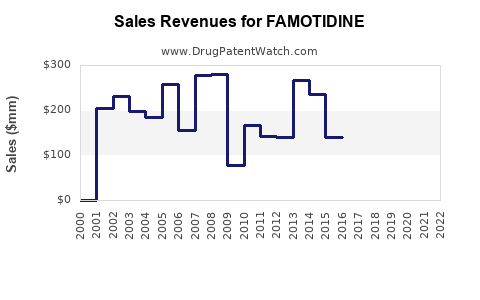
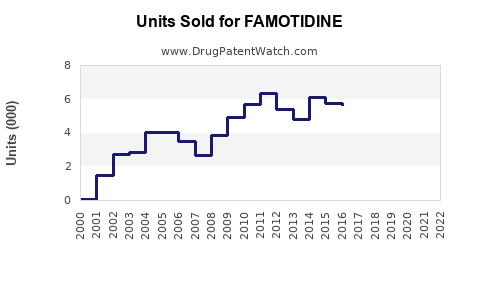
Annual Sales Revenues and Units Sold for FAMOTIDINE
| Drug Name | Revenues (USD) | Units | Year |
|---|---|---|---|
| FAMOTIDINE | ⤷ Start Trial | ⤷ Start Trial | 2022 |
| FAMOTIDINE | ⤷ Start Trial | ⤷ Start Trial | 2021 |
| FAMOTIDINE | ⤷ Start Trial | ⤷ Start Trial | 2020 |
| FAMOTIDINE | ⤷ Start Trial | ⤷ Start Trial | 2019 |
| FAMOTIDINE | ⤷ Start Trial | ⤷ Start Trial | 2018 |
| FAMOTIDINE | ⤷ Start Trial | ⤷ Start Trial | 2017 |
| >Drug Name | >Revenues (USD) | >Units | >Year |
Famotidine Market Analysis, Sales Forecast, Patent Position, and Competitive Outlook
Famotidine is a mature, low-cost H2-receptor antagonist sold in prescription, over-the-counter, generic, and combination products. The market is structurally defensive but offers limited pricing power. Global famotidine sales are estimated at approximately $0.9 billion to $1.2 billion in 2024, including branded OTC products, prescription products, generics, combination products, and hospital use. A base-case forecast places the market at $1.0 billion to $1.3 billion by 2028, implying annual growth of roughly 2% to 4%.
The principal commercial brand is Pepcid, marketed in the United States by Kenvue. Generic famotidine accounts for most prescription volume. The molecule has no meaningful remaining U.S. compound-patent protection, no biosimilar exposure, and limited opportunity for premium pricing outside consumer branding, convenient dosage forms, and combination products.
What is the current famotidine market size?
The famotidine market is fragmented across OTC retail, prescription dispensing, hospitals, online pharmacies, and international markets. No single public company reports global famotidine revenue separately from broader consumer-health or prescription portfolios.
Estimated 2024 market composition
| Segment | Estimated share of global sales | Commercial characteristics |
|---|---|---|
| Branded OTC famotidine | 35%-45% | Led by Pepcid and regional brands |
| Generic prescription famotidine | 30%-40% | High volume, low unit pricing |
| OTC private-label products | 10%-15% | Retailer and pharmacy brands |
| Combination products | 5%-10% | Famotidine with antacids or other active ingredients |
| Hospital and institutional use | 5%-10% | Injectable and oral formulations |
The United States is the largest commercial market because famotidine has strong consumer recognition, broad pharmacy distribution, and established use as an OTC heartburn treatment. Europe, Japan, China, Latin America, and parts of the Middle East contribute significant generic and local-brand volume.
Famotidine benefits from continued demand for treatment of occasional heartburn, gastroesophageal reflux disease, dyspepsia, peptic-ulcer disease, and stress-ulcer prophylaxis in institutional settings. Prescription demand is more mature and price-sensitive than OTC demand.
What are the sales projections for famotidine through 2028?
The following forecast is an analyst estimate based on the product’s mature market status, inflation-adjusted OTC demand, generic erosion, ongoing use in hospitals, and modest substitution from proton-pump inhibitors.
Global famotidine sales forecast
| Year | Bear case | Base case | Bull case |
|---|---|---|---|
| 2024E | $0.85B | $1.05B | $1.20B |
| 2025E | $0.84B | $1.07B | $1.24B |
| 2026E | $0.84B | $1.10B | $1.29B |
| 2027E | $0.85B | $1.14B | $1.35B |
| 2028E | $0.86B | $1.18B | $1.42B |
| 2024-2028 CAGR | 0.3% | 2.9% | 4.3% |
These figures represent total market sales rather than revenue attributable to one manufacturer. They include branded and generic products but exclude unrelated H2 blockers and proton-pump inhibitors.
What drives the base-case forecast?
The base case assumes:
- Stable global prevalence of reflux and dyspepsia.
- Continued use of famotidine for intermittent heartburn.
- Modest growth in OTC self-care.
- Continued generic price erosion in prescription channels.
- No major safety withdrawal or manufacturing disruption.
- Persistent use in hospitals where injectable and oral products remain available.
- Limited but durable demand from consumers seeking alternatives to proton-pump inhibitors.
The market is unlikely to achieve high-single-digit growth without a new delivery system, clinically differentiated combination product, or major shift in treatment guidelines.
Which companies sell famotidine?
Kenvue is the most visible branded consumer-health participant in the U.S. market through Pepcid. Generic manufacturers supply prescription and OTC famotidine under multiple labels.
Key commercial participants
| Company type | Examples | Primary role |
|---|---|---|
| Branded consumer health | Kenvue | Pepcid tablets, chewables, liquids, and combination products |
| Generic manufacturers | Viatris, Hikma, Teva, Dr. Reddy’s, Sandoz and regional suppliers | Prescription and institutional products |
| Private-label retailers | National pharmacy and grocery chains | OTC tablets, chewables, and equivalent products |
| Contract manufacturers | Regional pharmaceutical manufacturers | API, finished-dose, and private-label supply |
Manufacturer participation varies by country and dosage form. Generic supply is usually awarded through pharmacy benefit managers, wholesalers, hospital purchasing groups, and government tenders.
Kenvue does not generally report Pepcid revenue as a standalone line item. The brand is included within its broader self-care portfolio, which limits external visibility into product-level sales and margins. [1]
How does famotidine compare with proton-pump inhibitors?
Famotidine competes primarily with omeprazole, esomeprazole, lansoprazole, pantoprazole, and other proton-pump inhibitors. It also competes with antacid products such as calcium carbonate and combination products containing alginate or magnesium and aluminum salts.
| Attribute | Famotidine | Proton-pump inhibitors | Antacids |
|---|---|---|---|
| Onset | Generally faster than PPIs for episodic symptoms | Slower onset for immediate relief | Fastest symptom neutralization |
| Duration | Moderate | Longer acid suppression | Short |
| Typical consumer use | Occasional and nocturnal heartburn | Frequent reflux and maintenance treatment | Immediate, short-term relief |
| Generic competition | Very high | Very high | Very high |
| Brand pricing power | Moderate in OTC | Moderate in selected brands | Low to moderate |
| Clinical differentiation | H2 blockade | Stronger acid suppression | Neutralization of existing acid |
Famotidine has a commercial position between antacids and PPIs. It is attractive to consumers seeking longer relief than an antacid without daily PPI use. This positioning supports repeat OTC purchases but does not create substantial barriers to substitution.
The withdrawal of ranitidine from the U.S. market removed the primary direct branded H2-blocker competitor. FDA requested market withdrawal of ranitidine products in 2020 because of concerns about increasing levels of NDMA during storage. [2] The event increased visibility for famotidine but did not permanently transform the market because many consumers shifted to PPIs or non-drug options.
What is the FDA regulatory status of famotidine?
Famotidine is an FDA-approved small-molecule drug available in oral, chewable, liquid, and injectable dosage forms. Prescription products are approved for conditions including duodenal ulcer, gastric ulcer, gastroesophageal reflux disease, and pathological hypersecretory conditions. [3]
Pepcid products are sold over the counter for relief and prevention of heartburn associated with acid indigestion. The FDA approved nonprescription famotidine products after the drug had an established prescription safety and efficacy record. [4]
Major FDA milestones
| Milestone | Approximate timing |
|---|---|
| Original U.S. prescription approval | 1986 |
| Prescription generic competition | Early 2000s |
| OTC switch for Pepcid | 1995 |
| Ranitidine U.S. withdrawal | 2020 |
| Current regulatory status | Approved prescription and OTC products |
Famotidine is not a biologic and does not qualify for biosimilar competition. Generic products use the abbreviated new drug application pathway and must demonstrate pharmaceutical equivalence and bioequivalence rather than repeat the full clinical development program.
What patents protect famotidine and Pepcid?
The original U.S. famotidine compound patent has expired. The early Pepcid patent estate protected the active ingredient and related pharmaceutical technology, but those rights no longer prevent generic entry.
Core patent position
| Patent category | Current commercial significance |
|---|---|
| Original compound patent | Expired |
| Original formulation patents | Expired or commercially weak |
| Method-of-use patents | Generally expired for established indications |
| Later combination-product patents | Potentially relevant to specific products |
| Manufacturing patents | May protect individual processes but rarely block the market |
| Trademarks | Important for Pepcid brand recognition |
| Trade dress and packaging | Relevant to OTC differentiation |
The original famotidine patent was U.S. Patent No. 4,496,737, assigned to Merck-related interests and filed during the early development of the molecule. Its term expired before the current commercial period. The product’s economic protection now comes primarily from the Pepcid trademark, consumer awareness, retail placement, formulation convenience, and marketing rather than from exclusivity over famotidine itself.
When did famotidine lose exclusivity?
Famotidine lost meaningful U.S. molecule-level exclusivity in the early 2000s. Generic prescription products entered after expiration of the principal patent and regulatory exclusivity period.
The market has therefore operated for more than two decades under generic competition. There is no current new chemical entity exclusivity period, pediatric exclusivity period, or orphan-drug exclusivity associated with standard famotidine products.
Exclusivity timeline
| Protection | Status |
|---|---|
| New chemical entity exclusivity | Expired |
| Original compound patent | Expired |
| Prescription formulation exclusivity | Expired for legacy products |
| OTC exclusivity | Not a current barrier to generic entry |
| Pepcid trademark | Active, subject to renewal and use |
| Product-specific combination rights | May remain relevant for individual products |
How many patents cover famotidine today?
The number of active patents that mention famotidine is not equivalent to the number of patents that block commercial entry. Patent databases may contain later filings involving combinations, dosage forms, manufacturing processes, or therapeutic applications.
For the standard famotidine molecule and conventional tablets, the blocking patent estate is weak. Product-specific patents may matter for:
- Chewable tablets.
- Rapid-dissolve formulations.
- Antacid-famotidine combinations.
- Liquid or pediatric formulations.
- Controlled-release delivery systems.
- Manufacturing and crystallization processes.
- Packaging or dispensing systems.
These rights generally have narrower commercial scope than the original compound patent. A generic manufacturer can often avoid them by selling a conventional tablet or using a non-infringing process.
What is the Orange Book status of famotidine?
The FDA Orange Book historically lists approved prescription famotidine products and associated patent information where applicable. Standard generic famotidine products are generally exposed to abbreviated new drug application competition because the core active-ingredient protection has expired.
Orange Book analysis should distinguish among:
- The approved drug product.
- Listed patents for a specific reference product.
- Paragraph IV certifications by an ANDA applicant.
- Actual litigation filed by the patent owner.
- The ability of a generic to launch a non-infringing alternative.
For a mature famotidine product, an Orange Book listing does not automatically create a meaningful market barrier. A patent covering a narrow combination or formulation may leave conventional famotidine tablets unaffected.
Which companies are challenging famotidine patents?
No major current U.S. Paragraph IV campaign against the original famotidine molecule is commercially significant because the principal compound patent has expired. Generic manufacturers have competed in the market for many years.
Potential challenges are more likely to involve later product-specific patents covering combinations, delivery systems, or manufacturing methods. Those disputes would affect a particular branded formulation rather than the entire famotidine market.
What patent litigation affects famotidine?
The principal market risk is generic price competition, not a live patent dispute over the molecule. Legacy litigation associated with original Pepcid patents no longer determines current market access.
Current disputes, if filed, would most likely concern:
- A branded OTC combination product.
- A reformulated dosage form.
- A manufacturing process.
- Trade dress or trademark rights.
- Product distribution and labeling.
Trademark litigation can protect brand presentation but cannot prevent sale of an FDA-approved generic using the established name “famotidine.”
How strong is the famotidine patent estate?
The patent estate is weak for the active ingredient and conventional dosage forms, moderate for selected formulations, and stronger as a brand asset than as a technology asset.
| Estate component | Strength | Rationale |
|---|---|---|
| Molecule | Weak | Core patents expired |
| Conventional tablets | Weak | Numerous generic alternatives |
| Injectable product | Weak to moderate | Regulatory and manufacturing execution matter more than patents |
| Combination products | Moderate | Narrow formulation claims may apply |
| Novel delivery systems | Moderate | Scope depends on claim drafting and clinical differentiation |
| Pepcid brand | Moderate to strong commercially | Consumer recognition and retail presence |
| Manufacturing know-how | Moderate | Can affect cost and supply reliability |
The brand can maintain a price premium over generic products, but that premium depends on consumer demand and retailer support. It is not protected by exclusivity over the molecule.
What generic entry risks exist for famotidine?
Generic entry risk is already realized rather than pending. The key risks are continuing price compression, retailer substitution, formulary pressure, and loss of prescription volume to low-cost suppliers.
Generic launch scenarios
| Scenario | Market impact |
|---|---|
| Conventional tablet supply expands | Lower generic prices and reduced branded prescription share |
| Retailer private labels gain shelf space | Lower OTC share for branded products |
| New combination product launches | Potential premium segment growth |
| Manufacturing disruption | Temporary price increases and branded restocking |
| Safety signal or impurity finding | Rapid demand migration and regulatory action |
Because famotidine is inexpensive and widely manufactured, a single generic launch is unlikely to create a major market event. Supply concentration, API quality, and manufacturing compliance are more important than patent expiration.
What formulations are protected by famotidine patents?
Legacy conventional tablets have limited patent protection. Commercial differentiation is more likely in:
- Pepcid Complete-style combinations that pair famotidine with antacids.
- Chewable products.
- Flavored oral suspensions.
- Fast-dissolving tablets.
- Pediatric dosage forms.
- Injectable hospital formulations.
- Extended-release or controlled-release systems.
Combination products can command higher prices because they provide immediate antacid relief together with longer H2-blockade. Their protection depends on the exact active ingredients, dose ratios, manufacturing method, labeling, and patent claims.
What licensing deals involve famotidine?
Famotidine is a mature generic drug and does not have a major publicly visible licensing market comparable with newer branded therapies. Commercial arrangements generally involve:
- Private-label supply contracts.
- Generic distribution agreements.
- API manufacturing and sourcing.
- Contract manufacturing.
- Regional brand licensing.
- Retailer exclusivity arrangements.
The most important economic relationships are supply and distribution agreements rather than molecule-level licenses. Kenvue’s commercial position derives from brand ownership and consumer-health distribution, while generic manufacturers compete through cost, regulatory compliance, and supply reliability.
What is the revenue exposure for manufacturers?
Pepcid is strategically relevant to Kenvue because it is a recognized OTC brand, but product-level revenue is not separately disclosed in public filings. The brand’s value is likely concentrated in the U.S. and other developed consumer-health markets.
Generic manufacturers have lower revenue per unit but can generate stable volume through:
- Retail pharmacy contracts.
- Hospital tenders.
- Medicaid and commercial formularies.
- Wholesaler distribution.
- International government procurement.
The principal profitability risk is deflation. A manufacturer with a low-cost API source and efficient packaging operation can remain profitable at low prices. A manufacturer dependent on expensive third-party API or small production runs faces greater margin pressure.
What is the competitive outlook for famotidine?
Famotidine has a stable but mature outlook. Its strongest commercial attributes are consumer familiarity, broad approval, low safety complexity relative to newer therapies, and practical use for intermittent heartburn. Its weaknesses are generic commoditization, limited clinical differentiation, and competition from PPIs and antacids.
Growth is most plausible in:
- OTC heartburn prevention.
- Nighttime symptom relief.
- Combination products.
- E-commerce and private-label channels.
- Emerging markets with expanding pharmacy access.
- Hospital formulations where supply contracts are stable.
The largest downside risks are further OTC price competition, consumer migration to PPIs, retailer substitution, and a new quality or impurity event affecting a major supplier.
Key Takeaways
- Global famotidine sales are estimated at $0.9 billion to $1.2 billion in 2024.
- Base-case sales are projected to reach about $1.18 billion by 2028.
- Kenvue’s Pepcid is the leading branded U.S. consumer-health franchise, but standalone revenue is not publicly reported.
- Generic prescription famotidine accounts for most prescription volume and faces ongoing price erosion.
- The original compound and principal formulation patents have expired.
- No meaningful biosimilar risk exists because famotidine is a small molecule.
- Current commercial protection comes from the Pepcid trademark, retail placement, formulation convenience, and consumer recognition.
- Combination products and novel delivery systems have the strongest remaining product-level IP potential.
- The main market risk is generic and private-label substitution rather than patent litigation.
- Famotidine is likely to remain a stable, low-growth OTC and generic product through 2028.
FAQs
Is famotidine still a profitable drug?
Yes, but profitability depends on the channel. Branded OTC products can maintain higher margins, while prescription generics rely on volume, manufacturing efficiency, and supply contracts.
Does Pepcid have patent protection today?
Pepcid may have product-specific patents or regulatory listings for certain formulations, but the original famotidine compound protection has expired. The principal commercial asset is the Pepcid trademark and brand franchise.
Will famotidine sales grow faster than proton-pump inhibitor sales?
Famotidine is unlikely to outgrow the broader PPI market in absolute terms. It can gain share in intermittent-use and consumer-preference segments, while PPIs remain stronger in chronic acid-suppression treatment.
Can a generic company launch famotidine without a Paragraph IV challenge?
Yes. A generic applicant can avoid a Paragraph IV certification where no relevant unexpired patent is listed or can certify that applicable patents will not be infringed, are invalid, or are unenforceable. The launch strategy depends on the specific reference product and listed patents.
Is famotidine exposed to future FDA exclusivity loss?
Standard famotidine products have already lost their core exclusivity. Future commercial erosion will come mainly from generic pricing, retailer substitution, and competition among OTC brands rather than from a new loss of regulatory exclusivity.
References
-
Kenvue Inc. (2024). Annual report for the fiscal year ended December 31, 2023. Kenvue Inc.
-
U.S. Food and Drug Administration. (2020, April 1). FDA requests removal of all ranitidine products from the market. https://www.fda.gov
-
U.S. Food and Drug Administration. (2024). Famotidine prescribing information and approved drug products. Drugs@FDA. https://www.accessdata.fda.gov/scripts/cder/daf/
-
U.S. Food and Drug Administration. (1995). Pepcid AC nonprescription labeling and approval materials. Drugs@FDA. https://www.accessdata.fda.gov/scripts/cder/daf/
-
United States Patent and Trademark Office. (1985). U.S. Patent No. 4,496,737, famotidine. USPTO Patent Center. https://patentcenter.uspto.gov/
More… ↓
