Drug Sales Trends for AMITIZA
Payment Methods and Pharmacy Types for AMITIZA (2017)
Revenues by Pharmacy Type
Units Sold by Pharmacy Type
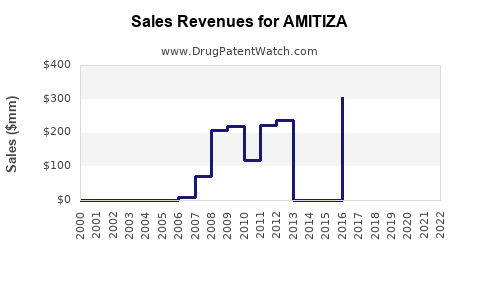
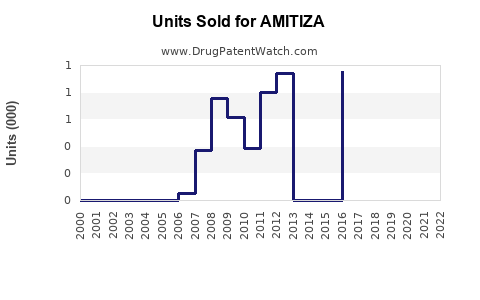
Annual Sales Revenues and Units Sold for AMITIZA
| Drug Name | Revenues (USD) | Units | Year |
|---|---|---|---|
| AMITIZA | ⤷ Start Trial | ⤷ Start Trial | 2022 |
| AMITIZA | ⤷ Start Trial | ⤷ Start Trial | 2021 |
| AMITIZA | ⤷ Start Trial | ⤷ Start Trial | 2020 |
| >Drug Name | >Revenues (USD) | >Units | >Year |
Amitiza Market Analysis, Sales Projections, Patent Status, and Generic Risk
Amitiza, the brand name for lubiprostone, is a mature gastrointestinal drug with established generic competition and declining commercial value. Its remaining market is concentrated in chronic idiopathic constipation, opioid-induced constipation, and irritable bowel syndrome with constipation. U.S. sales are exposed to generic substitution, payer preference for lower-cost alternatives, and competition from Linzess, Trulance, Motegrity, Movantik, and Relistor.
Amitiza should be valued as a declining specialty-branded product rather than a protected growth asset. A base-case forecast places global branded and authorized-generic revenue at approximately $45 million to $65 million in 2024, declining to $20 million to $35 million by 2028. The range depends on the treatment of U.S. generic sales, contract arrangements, and remaining international commercialization rights.
What is Amitiza and which gastrointestinal indications does it treat?
Amitiza contains lubiprostone, a locally acting chloride-channel activator. It increases intestinal fluid secretion and supports stool passage without functioning as a systemic opioid antagonist or serotonergic prokinetic agent.
The FDA-approved indications are:
| Indication | Approved population |
|---|---|
| Chronic idiopathic constipation | Adults |
| Irritable bowel syndrome with constipation | Women aged 18 and older |
| Opioid-induced constipation | Adults with chronic non-cancer pain, including patients receiving methadone |
The standard adult dose is generally 24 micrograms twice daily for chronic idiopathic constipation and opioid-induced constipation. The IBS-C dose is generally 8 micrograms twice daily. Amitiza is available as soft gelatin capsules in 8-microgram and 24-microgram strengths.[1]
The product’s principal commercial limitation is tolerability. Nausea and diarrhea can affect persistence, while competing drugs offer different mechanisms and dosing profiles. Payers also have several lower-cost generic laxative options before approving branded prescription therapies.
Who owns Amitiza and who commercializes it?
Amitiza’s commercial history involves Sucampo Pharmaceuticals, Takeda Pharmaceutical Company, and Mallinckrodt.
| Period | Commercial development |
|---|---|
| 2006 | FDA approval for chronic idiopathic constipation |
| 2008 | FDA approval for IBS-C in women |
| 2013 | FDA approval for opioid-induced constipation |
| 2017 | Mallinckrodt agreed to acquire U.S. and Canadian Amitiza rights from Takeda |
| 2018 | Mallinckrodt completed the transaction and assumed North American commercialization |
| Current structure | Mallinckrodt has been the principal U.S. commercial company; rights outside North America have been subject to separate arrangements |
Mallinckrodt acquired the U.S. and Canadian rights after Takeda’s broader acquisition of ARIAD and related portfolio rationalization. The deal reduced Takeda’s direct exposure to the product while giving Mallinckrodt a marketed gastrointestinal asset with recurring prescription demand.[2]
Amitiza is not a biologic, so biosimilar competition does not apply. The relevant competitive threat is generic lubiprostone and therapeutic substitution by other prescription and nonprescription constipation treatments.
How large is the Amitiza market?
The addressable patient population is large, but the branded prescription segment is narrower.
Chronic idiopathic constipation affects a substantial adult population, while IBS-C represents a smaller subgroup with high treatment switching. Opioid-induced constipation remains clinically relevant, but the market is tied to chronic opioid prescribing and competes with peripherally acting mu-opioid receptor antagonists, including Movantik, Relistor, and Symproic.
Amitiza’s commercial market has four layers:
- Chronic idiopathic constipation.
- IBS-C in women.
- Opioid-induced constipation.
- International lubiprostone markets and non-U.S. licensing revenue.
The product is strongest where prescribers seek a non-opioid-secretagogue mechanism, where patients have failed over-the-counter laxatives, or where payer policies permit branded prescription treatment. It is weaker in formularies that prioritize generic polyethylene glycol, lactulose, stimulant laxatives, linaclotide, or newer branded agents.
How does Amitiza compare with Linzess and Trulance?
| Product | Active ingredient | Main mechanism | Principal company exposure | Commercial position |
|---|---|---|---|---|
| Amitiza | Lubiprostone | Chloride-channel activation | Mallinckrodt in the U.S. | Mature product with generic competition |
| Linzess | Linaclotide | Guanylate cyclase-C agonist | AbbVie and Ironwood | Larger branded franchise |
| Trulance | Plecanatide | Guanylate cyclase-C agonist | Bausch Health | Branded competitor |
| Motegrity | Prucalopride | 5-HT4 agonist | Shire/Takeda lineage | Chronic constipation competitor |
| Movantik | Naloxegol | Peripheral opioid receptor antagonist | RedHill-related commercial history | OIC-specific competitor |
| Relistor | Methylnaltrexone | Peripheral opioid receptor antagonist | Salix/Valeant lineage | OIC-specific competitor |
Linzess has the strongest commercial position among the prescription secretagogues. AbbVie reported Linzess net revenue of approximately $1 billion in 2023, including U.S. and international sales, reflecting broader use, higher promotional investment, and a stronger branded market position.[3] Trulance is smaller but competes directly in CIC and IBS-C. Amitiza’s differentiation is therefore clinical and formulary-based rather than patent-based.
What are Amitiza sales and revenue trends?
Amitiza sales peaked before generic erosion and have declined as the product matured and competitive alternatives expanded. Mallinckrodt reports Amitiza within its Specialty Brands portfolio, where revenue has been affected by generic entry, price pressure, and portfolio restructuring.[4]
Public reporting does not always present Amitiza revenue on a directly comparable basis across years. Mallinckrodt has changed portfolio classifications and has operated through financial restructuring, which complicates trend analysis. The appropriate valuation method is to use reported historical revenue as a base, then apply a generic-erosion curve rather than extrapolating prior growth.
What is the projected Amitiza revenue from 2024 to 2028?
The following forecast is a scenario estimate for branded and directly controlled lubiprostone revenue, not company guidance.
| Year | Bear case | Base case | Upside case |
|---|---|---|---|
| 2024 | $40 million | $55 million | $70 million |
| 2025 | $30 million | $45 million | $60 million |
| 2026 | $23 million | $37 million | $52 million |
| 2027 | $18 million | $30 million | $45 million |
| 2028 | $14 million | $25 million | $39 million |
| 2024-2028 cumulative | $125 million | $192 million | $266 million |
The base case assumes:
- Continued generic availability in the U.S.
- Annual branded price erosion of roughly 5% to 8%.
- Unit decline of roughly 8% to 12% annually.
- Stable demand in OIC and CIC.
- No material new indication.
- Limited promotional investment compared with Linzess or Trulance.
- Continued reimbursement for patients who remain on lubiprostone.
The upside case assumes that the branded product retains a larger share of older patients, that generic supply remains inconsistent, and that international revenue offsets U.S. erosion. The bear case assumes rapid conversion to generic lubiprostone and greater substitution by linaclotide, plecanatide, and low-cost laxatives.
When does Amitiza lose exclusivity?
Amitiza’s principal U.S. market exclusivity has already expired. The product does not have a credible remaining period of branded exclusivity comparable to a newly approved small molecule.
The relevant U.S. patent position consists of composition, formulation, dosing, and use claims associated with lubiprostone. Patent protection for the core product has expired or reached the end of its commercial relevance, allowing FDA-approved generic competition. The FDA Orange Book should be used to confirm the current listing and any remaining patent codes for a specific litigation or launch-date analysis.[5]
What is the Amitiza Orange Book status?
Amitiza is listed in the FDA Orange Book under NDA 021908. Its current commercial position is consistent with a product that has faced generic approval and substitution. Any remaining Orange Book-listed patents would need to be evaluated claim by claim because a listed method-of-use patent may not prevent approval or launch for all indications.
For commercial forecasting, the key point is that the Orange Book does not provide Amitiza with a meaningful remaining barrier against generic lubiprostone across its principal indications.
Which companies are challenging Amitiza with generics?
Generic lubiprostone has been approved by multiple manufacturers, including companies active in the abbreviated new drug application market. Market participants have included large generic manufacturers and specialty generics companies such as Amneal, Dr. Reddy’s Laboratories, and Par Pharmaceutical-related entities, subject to product-specific approval and commercialization status.
Generic entry risk is higher for Amitiza than for products protected by unexpired composition patents because:
- The active ingredient is a small molecule.
- The product is available in conventional capsule dosage forms.
- The clinical indications are well established.
- Prescribers can substitute within the same therapeutic class.
- Pharmacy benefit managers can apply mandatory generic substitution.
- New formulation barriers are limited.
Paragraph IV litigation may affect the timing of an individual generic launch, but it does not restore long-term market exclusivity to the branded product. The commercial question is the number of approved generic suppliers and their ability to maintain supply, not whether the original brand retains a broad enforceable patent moat.
What formulation patents and manufacturing barriers protect Amitiza?
Amitiza has limited manufacturing complexity compared with injectable drugs, biologics, controlled-release systems, or products requiring device-specific delivery technology.
The product’s main technical requirements include:
- Lubiprostone synthesis and impurity control.
- Soft gelatin capsule manufacture.
- Dose-specific content uniformity.
- Stability control for the active ingredient and capsule shell.
- Packaging that protects the product through its shelf life.
These requirements create operational barriers but do not create a durable intellectual-property barrier. A generic manufacturer must demonstrate pharmaceutical equivalence and bioequivalence under the FDA ANDA pathway, but it does not need to reproduce every aspect of the brand’s manufacturing process.
Formulation and method-of-use patents may narrow generic labeling or create litigation leverage, but they are less valuable after core composition protection expires. The practical barrier is manufacturing validation and regulatory approval, not exclusivity.
What patent litigation and settlement issues affect Amitiza?
Amitiza’s major commercial risk is generic substitution rather than active high-value patent litigation. The relevant litigation history has centered on generic applications, Orange Book-listed patents, and the timing of approval or launch.
For investors and licensing parties, the material diligence points are:
| Issue | Commercial effect |
|---|---|
| Paragraph IV certification | Can accelerate patent litigation and create an at-risk launch |
| First-filer status | May create limited generic exclusivity if statutory conditions are met |
| Authorized generic supply | Can reduce the value of a first-filer period |
| Skinny labeling | May permit generic launch for non-patented indications |
| Patent settlement | Can delay or permit a negotiated generic entry date |
| Multiple ANDA approvals | Usually accelerates price erosion |
| Supply disruption | Can temporarily support branded volume |
Amitiza’s patent litigation exposure should therefore be modeled as a launch-timing variable, not as a basis for long-term revenue protection.
What is Amitiza’s FDA regulatory status?
Amitiza is an FDA-approved prescription drug marketed under NDA 021908. It is approved in capsule strengths of 8 micrograms and 24 micrograms for specified constipation-related indications.[1]
Regulatory risks are moderate. The drug has a mature safety database, but labeling remains important for nausea, diarrhea, bowel obstruction, pregnancy-related considerations, and opioid-induced constipation. A new indication or materially differentiated formulation would be required to change the product’s growth trajectory.
The FDA regulatory pathway for generic lubiprostone is the ANDA route. Generic manufacturers must demonstrate pharmaceutical equivalence and bioequivalence, while labeling generally tracks the reference product subject to permitted exclusions.
What generic launch scenarios exist for Amitiza?
Fast erosion scenario
Multiple generic manufacturers secure approval and pharmacy substitution begins rapidly. Branded unit volume falls 15% to 25% in the first full year, with net price reductions following. Revenue could fall below $30 million by 2026.
Moderate erosion scenario
Generic supply expands gradually. Mallinckrodt preserves a smaller branded segment through contracting, patient familiarity, and prescriber inertia. Revenue declines approximately 10% annually and reaches $25 million to $35 million by 2028.
Delayed-competition scenario
Only a limited number of generic suppliers remain active, or supply interruptions affect generic availability. The brand retains a larger share for several years. Revenue remains near $50 million to $70 million in the near term before declining.
The delayed-competition case is the strongest commercial outcome available without a new indication, new formulation, or substantial licensing arrangement.
What licensing deals and commercial agreements affect Amitiza?
The most important transaction was the transfer of North American Amitiza rights from Takeda to Mallinckrodt. That transaction changed the product’s value from a large pharmaceutical company asset into a portfolio product managed by a company focused on specialty and hospital medicines.[2]
Future licensing value is likely to be limited. A potential partner would need to justify acquisition or commercialization costs against:
- Declining U.S. branded sales.
- Generic competition.
- Limited patent life.
- Established therapeutic substitutes.
- Low probability of a major new indication.
- Potential pricing pressure from government and commercial payers.
The asset could still have value in selected international markets, in a cash-generative specialty portfolio, or as part of a broader gastrointestinal product package. A standalone transaction would likely be priced on cash flow rather than strategic growth.
How strong is the Amitiza patent estate?
Amitiza’s patent estate is weak for long-term commercial protection and moderate for short-term litigation or launch management.
| Patent-estate factor | Assessment |
|---|---|
| Core composition protection | Expired or commercially exhausted |
| Formulation protection | Limited practical value |
| Method-of-use protection | May restrict selected labels but not the full market |
| Manufacturing know-how | Moderate operational value |
| Regulatory exclusivity | Expired |
| Generic substitution risk | High |
| Biosimilar risk | Not applicable |
| Long-term licensing value | Low to moderate |
The product can generate residual cash flow, but its patent estate does not support premium valuation based on future exclusivity.
What is the competitive outlook for Amitiza?
Amitiza remains commercially relevant because constipation is chronic, prevalent, and often undertreated. Its market position is constrained by the availability of multiple treatment classes.
The strongest competitive threats are:
- Linzess in CIC and IBS-C.
- Trulance in CIC and IBS-C.
- Motegrity in chronic constipation.
- Movantik, Relistor, and Symproic in OIC.
- Generic lubiprostone.
- Polyethylene glycol and other over-the-counter laxatives.
Linzess has the clearest scale advantage. Amitiza’s remaining strength is its long clinical history, established physician familiarity, and use in patients who need an alternative secretagogue or who cannot tolerate another agent.
Key Takeaways
- Amitiza is a mature lubiprostone product with high generic-substitution risk.
- Its principal U.S. indications are chronic idiopathic constipation, IBS-C in women, and opioid-induced constipation.
- Mallinckrodt is the principal U.S. commercial company following the transfer of North American rights from Takeda.
- Core patent and regulatory exclusivity have expired or are commercially exhausted.
- The product faces direct competition from Linzess, Trulance, Motegrity, and OIC therapies.
- A reasonable base-case forecast is $55 million in 2024 revenue declining to approximately $25 million by 2028.
- The product’s value is primarily residual cash flow, not long-term patent protection.
- Biosimilar risk does not apply because Amitiza is a small-molecule drug.
- The principal upside is temporary generic supply disruption or stronger-than-expected branded retention.
- The principal downside is rapid generic conversion and payer-driven substitution.
Frequently Asked Questions
Is Amitiza still commercially protected?
No. Amitiza no longer has a meaningful period of broad market exclusivity. Generic lubiprostone competition is the central commercial issue.
Is lubiprostone the same as Amitiza?
Yes. Amitiza is the branded product, and lubiprostone is its active pharmaceutical ingredient.
Can a generic company launch lubiprostone for every Amitiza indication?
Not necessarily. A generic applicant may use a full label or a permitted skinny label that omits a patented method of use. Actual launch scope depends on FDA approval and patent status.
Is Amitiza more valuable than Trulance?
Generally no. Trulance retains a stronger branded positioning in some markets, while Amitiza is older and more exposed to generic competition. Relative value depends on net price, payer coverage, and the number of active generic suppliers.
Does Amitiza have biosimilar competition?
No. Amitiza is a chemically synthesized small molecule. Its competitors are generic lubiprostone products and therapeutically substitutable constipation drugs.
References
- U.S. Food and Drug Administration. (2023). Amitiza (lubiprostone) prescribing information.
- Mallinckrodt plc. (2018). Annual report and filings describing the acquisition of North American Amitiza rights from Takeda Pharmaceutical Company.
- AbbVie Inc. (2023). 2023 annual report.
- Mallinckrodt plc. (2023). 2023 annual report.
- U.S. Food and Drug Administration. (2024). Approved drug products with therapeutic equivalence evaluations: Orange Book.
More… ↓
