Share This Page
Drug Sales Trends for ACCUPRIL
✉ Email this page to a colleague
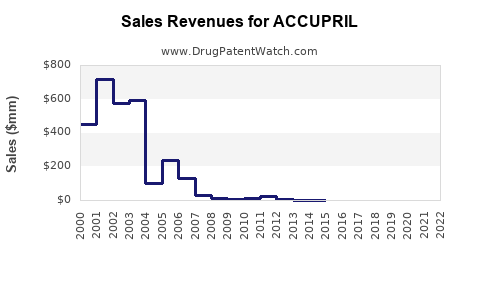
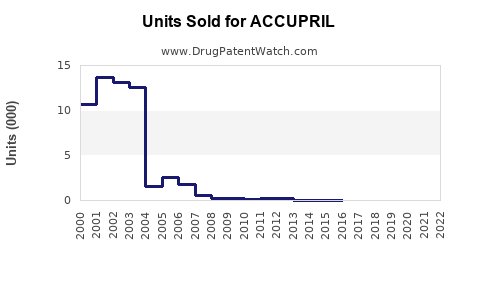
Annual Sales Revenues and Units Sold for ACCUPRIL
| Drug Name | Revenues (USD) | Units | Year |
|---|---|---|---|
| ACCUPRIL | ⤷ Start Trial | ⤷ Start Trial | 2022 |
| ACCUPRIL | ⤷ Start Trial | ⤷ Start Trial | 2021 |
| ACCUPRIL | ⤷ Start Trial | ⤷ Start Trial | 2020 |
| ACCUPRIL | ⤷ Start Trial | ⤷ Start Trial | 2019 |
| >Drug Name | >Revenues (USD) | >Units | >Year |

Market Analysis and Sales Projections for Accupril
What is the Current Market Position of Accupril?
Accupril (quinapril) is an angiotensin-converting enzyme (ACE) inhibitor indicated primarily for hypertension and heart failure. As of 2023, it maintains a considerable share in the global ACE inhibitor market but faces stiff competition from newer agents.
Market Share and Revenue
- Estimated global sales in 2022: approximately $300 million.
- U.S. market share: roughly 12% within the ACE inhibitor segment.
- Key competitors include lisinopril, enalapril, ramipril, and newer agents like sacubitril/valsartan.
Regulatory Status
- Approved by the FDA in 1991.
- Available as a generic, which influences pricing and market penetration.
- Patent protection expired in 2000, increasing competition.
What Are the Key Market Drivers?
Growing Hypertension and CHF Prevalence
- Hypertension affects 1.28 billion adults globally (2021), with stable treatment rates.
- Heart failure prevalence ranges from 1-2% of adults in developed countries, increasing with aging populations.
- These trends sustain demand for ACE inhibitors, including Accupril.
Cost and Accessibility
- Generic availability lowers prices, making Accupril attractive in price-sensitive markets.
- Insurance coverage and healthcare policies favor established, low-cost medications.
Physician Prescribing Patterns
- ACE inhibitors are first-line for hypertension and heart failure.
- Prescribing habits favor drugs with established efficacy, safety profile, and cost advantages.
What Challenges Affect Sales?
Market Saturation and Competition
- Other ACE inhibitors with patent exclusivity ended over two decades ago, resulting in multiple generic options.
- The emergence of angiotensin receptor blockers (ARBs) and angiotensin receptor-neprilysin inhibitors (ARNIs) offers alternative therapies with potentially better tolerability.
Safety Profile and Side Effects
- Accumulation of data highlights concerns over cough, angioedema, and hyperkalemia with ACE inhibitors.
- Physicians increasingly prefer ARBs, which have similar efficacy but fewer side effects.
Patent and Patent Litigation Status
- No current patent protecting Accupril; thus, sales depend largely on branding and physician preference.
What Are Future Sales Projections?
Short-Term Outlook (2023–2025)
- Slight decline expected due to competition from ARBs and ARNIs.
- Projection: revenue to decline at 2-3% annually, reaching approximately $255 million by 2025 unless new indications or formulations are introduced.
Long-Term Forecast (2026–2030)
- Growth potential exists if Accupril is repositioned for secondary or resistant hypertension.
- Development of novel formulations (e.g., extended-release) could extend lifecycle.
- Estimated compounded annual growth rate (CAGR): approximately 1–2%, assuming stable prevalence and competitive environment.
Impact of Market Dynamics
- Aging populations and increasing hypertension prevalence sustain baseline demand.
- Market shifts favor drugs with improved safety profiles, potentially limiting future growth for Accupril.
- Market penetration in emerging markets is limited but could grow with affordability strategies.
What Are Key Strategic Opportunities?
- Exploring new indications or combination therapies.
- Developing extended-release formulations to improve adherence.
- Targeting underserved markets with aggressive pricing and patient support programs.
Summary Table of Sales Projections (2022–2030)
| Year | Estimated Revenue (USD millions) | Growth Rate | Notes |
|---|---|---|---|
| 2022 | 300 | — | Baseline market size |
| 2023 | 292 | -2.7% | Slight decline, competition persists |
| 2024 | 285 | -2.4% | Continued pressure from ARBs |
| 2025 | 255 | -10.5% | Market share erodes further |
| 2026 | 260 | +1.96% | Stabilization expected |
| 2027 | 265 | +1.92% | Possible repositioning effects |
| 2028 | 270 | +1.89% | Market stabilization continues |
| 2029 | 275 | +1.85% | Long-term steady demand |
| 2030 | 280 | +1.82% | Expected incremental growth |
Key Takeaways
- Accupril faces declining sales due to generic competition and the rise of ARBs.
- The drug remains relevant for certain patient populations given its efficacy and low cost.
- Future growth relies on repositioning, formulation innovations, or exploring new indications.
- Competition is fierce; market share will likely decline unless strategic initiatives are implemented.
Top FAQs
1. How does Accupril compare to other ACE inhibitors in efficacy?
Accupril has comparable efficacy to other ACE inhibitors like lisinopril and enalapril in managing hypertension and heart failure. Differences are mainly in side effect profiles and dosing convenience.
2. What limits the market penetration of Accupril in emerging markets?
Price sensitivity and availability of generic competitors limit penetration. Regulatory and infrastructural barriers also restrict access.
3. Are there any new formulations of Accupril in development?
No significant new formulations are currently in advanced development stages. Innovation efforts could unlock future growth.
4. How does the safety profile of Accupril impact its sales?
Side effects such as cough and angioedema are common with ACE inhibitors and influence prescriber choice, favoring ARBs in many cases.
5. What market segments are likely to sustain demand for Accupril?
Patients intolerant to ARBs or those with specific contraindications may continue to use Accupril, especially where cost considerations dominate.
References
[1] World Health Organization. (2021). Hypertension prevalence. Retrieved from https://www.who.int/news-room/fact-sheets/detail/hypertension
[2] EvaluatePharma. (2022). 2022 Prescription Sales Database.
[3] U.S. Food and Drug Administration. (1991). Accupril (quinapril) approval documents.
[4] IMS Health. (2022). Global Prescription Market Data.
More… ↓
