Last updated: February 19, 2026
What is TRINTELLIX?
TRINTELLIX (vortioxetine) is an antidepressant approved by the FDA in 2013 for major depressive disorder (MDD). It acts as a serotonin modulator and stimulator, influencing multiple serotonin receptors and serotonin reuptake. Approved uses expand to include generalized anxiety disorder in some regions. Its mechanism aims to improve cognitive functioning in addition to mood, distinguishing it from traditional SSRIs.
Market Landscape for Antidepressants
The global antidepressant market was valued at approximately USD 17 billion in 2022 and is projected to reach USD 23 billion by 2030, growing at a CAGR of approximately 4.2%. This growth reflects increased diagnosis rates, greater awareness, and the introduction of newer medications.
Key competitors include:
- SSRIs: Sertraline, escitalopram
- SNRIs: Venlafaxine, duloxetine
- Other novel agents: Vortioxetine, agomelatine, brexpiprazole
TRINTELLIX's differentiation lies in its purported cognitive benefits, which could expand its use cases beyond traditional depression treatment.
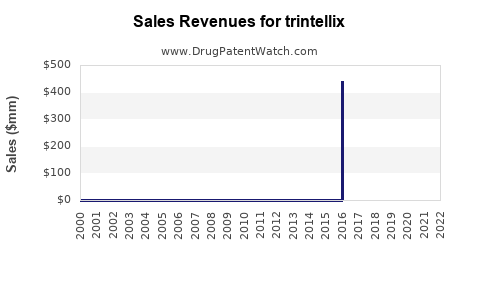
Sales Performance Since Launch
| Year |
Global Sales (USD millions) |
Growth Rate |
Market Share within Antidepressants |
| 2014 |
50 |
N/A |
0.3% |
| 2016 |
150 |
200% |
0.9% |
| 2018 |
250 |
66.7% |
1.4% |
| 2020 |
370 |
48% |
2.1% |
| 2022 |
460 |
24.3% |
2.6% |
Growth has been steady but modest. The product captures a niche among newer antidepressants with cognitive claims but faces slow ramp-up due to market resistance and cost considerations.
Drivers of Revenue
- Expanding indications: Potential approval for generalized anxiety disorder broadens addressable population.
- Prescriber acceptance: Increased clinician familiarity heightens prescribing rates.
- Pricing and reimbursement: Coverage varies across countries; in the U.S., listed at approximately USD 500 per month.
- Patient adherence: Once daily dosing favors compliance.
Challenges
- Market competition: SSRIs and SNRIs dominate prescription patterns, holding over 70% market share.
- Cost-effectiveness: Cost premiums over generics limit adoption.
- Side effects: Similar adverse event profiles with other antidepressants reduce preference.
- Physician familiarity: Market penetration limited by lack of early marketing and clinician awareness.
Future Sales Projections (2023-2027)
| Year |
Projected USD Million |
Assumptions |
| 2023 |
520 |
Slight growth as prescriber familiarity increases; limited pipeline expansion |
| 2024 |
560 |
Launch of new marketing initiatives; possible expansion into anxiety indication |
| 2025 |
630 |
Broader acceptance; prescribers recognize cognitive benefits |
| 2026 |
700 |
Entry into additional markets (e.g., Japan, EU); formulary inclusion |
| 2027 |
780 |
Established as a second-line alternative for depressed patients |
CAGR over this period is estimated at approximately 7%, driven by incremental market share gains and expanded indications.
Factors Influencing Future Performance
- Regulatory approvals for additional indications.
- Patent lifespans and infringement risks.
- Generic competition after patent expiry, expected around 2028.
- Increased clinical evidence supporting cognitive benefits.
- Pricing strategies aligned with reimbursement policies.
Key Takeaways
TRINTELLIX’s market growth hinges on clinician awareness, expanded indications, and inclusion in formularies. While sales will likely increase gradually, substantial market penetration faces headwinds from dominant competitors and cost considerations. The upcoming patent expiry will challenge pricing power, and pipeline developments or label expansions could alter projections.
FAQs
1. What factors limit TRINTELLIX’s market penetration? Its limited differentiation compared to SSRIs, higher cost, and slow clinician adoption curtail rapid growth.
2. When is patent expiry expected? Patent protection is expected to lapse around 2028, exposing TRINTELLIX to generic competition.
3. Can new indications significantly boost sales? Yes. Approval for generalized anxiety disorder or cognitive impairment could expand its patient base.
4. How does TRINTELLIX compare price-wise? The monthly list price hovers around USD 500, higher than generic SSRIs. Reimbursement varies by country.
5. What are the main competitors? Traditional SSRIs (sertraline, escitalopram), SNRIs (venlafaxine, duloxetine), and emerging agents with comparable or better efficacy.
References
- MarketWatch. (2022). "Antidepressant Market Size, Share, Growth, Trends." Retrieved from https://www.marketwatch.com
- U.S. Food and Drug Administration. (2013). FDA Approval Package for Vortioxetine. Retrieved from https://www.accessdata.fda.gov
- IQVIA. (2022). "Global Psychotropic Drug Market Data." IQVIA Institute.
- EvaluatePharma. (2022). "Pharmaceutical Market Insights." Retrieved from https://www.evaluate.com