Share This Page
Drug Sales Trends for TRINTELLIX
✉ Email this page to a colleague
Payment Methods and Pharmacy Types for TRINTELLIX (2016)
Revenues by Pharmacy Type
Units Sold by Pharmacy Type
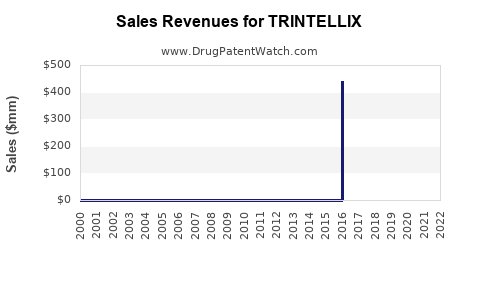
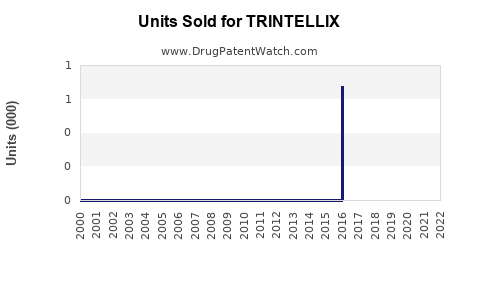
Annual Sales Revenues and Units Sold for TRINTELLIX
| Drug Name | Revenues (USD) | Units | Year |
|---|---|---|---|
| TRINTELLIX | ⤷ Start Trial | ⤷ Start Trial | 2022 |
| TRINTELLIX | ⤷ Start Trial | ⤷ Start Trial | 2021 |
| TRINTELLIX | ⤷ Start Trial | ⤷ Start Trial | 2020 |
| >Drug Name | >Revenues (USD) | >Units | >Year |
Trintellix Market Analysis, Sales Projections, Patent Estate and Generic Entry Risk
Trintellix, the U.S. brand name for vortioxetine, is a mature oral antidepressant marketed by Lundbeck and Takeda. Its commercial position is supported by differentiated labeling for major depressive disorder, established physician familiarity, and broad international availability. The main risks are generic substitution after the remaining U.S. patent protections expire, limited differentiation within a crowded antidepressant market, and modest growth in a category dominated by low-cost SSRIs and SNRIs.
The base-case forecast places worldwide Trintellix sales near $650 million in 2024, rising modestly through 2026 and declining after expected U.S. generic entry. Under the base case, global sales reach approximately $700 million in 2026 before falling to $400 million by 2030. The forecast assumes no major new indication and generic entry in the United States during 2027 or 2028.
What is Trintellix and how does it work?
Trintellix contains vortioxetine hydrobromide, an orally administered multimodal antidepressant. The FDA approved it in September 2013 for the treatment of major depressive disorder in adults under the name Brintellix. The U.S. brand was changed to Trintellix in 2016 because of potential confusion with Brilinta, AstraZeneca’s antiplatelet drug.[1]
Vortioxetine acts as a serotonin transporter inhibitor and modulates several serotonin receptors. The approved U.S. dosage range is 5 mg to 20 mg once daily. The drug is available as immediate-release tablets.
| Attribute | Trintellix |
|---|---|
| Active ingredient | Vortioxetine hydrobromide |
| U.S. brand owner | Takeda |
| Global development and commercial partner | Lundbeck |
| U.S. approval | September 30, 2013 |
| FDA application | NDA 204447 |
| Primary indication | Major depressive disorder in adults |
| Dosage form | Oral immediate-release tablet |
| U.S. strengths | 5 mg, 10 mg, 20 mg |
| Therapeutic class | Multimodal serotonergic antidepressant |
| U.S. regulatory status | Approved prescription drug |
| Biosimilar exposure | None; Trintellix is a small molecule |
How large is the Trintellix market?
The addressable market is the global adult major depressive disorder market, which includes generic SSRIs, SNRIs, atypical antidepressants, and branded therapies such as Auvelity, Rexulti adjunctive therapy, Viibryd, and newer digital or specialty mental-health products.
The United States is the largest commercial market because of higher branded-drug pricing and greater use of newer antidepressants. Japan and major European markets contribute volume but generally produce lower net prices because of reimbursement controls and reference pricing.
Trintellix occupies a premium branded segment. Its competitive value is based on tolerability, once-daily dosing, and use in patients who have an inadequate response or tolerability problems with traditional antidepressants. The product does not have an orphan indication, injectable formulation, or biologic manufacturing barrier.
Estimated 2024 market position
| Metric | Estimate |
|---|---|
| Estimated global Trintellix sales | $600 million-$700 million |
| Estimated U.S. share of sales | 50%-60% |
| Estimated U.S. annual prescriptions | 3 million-4 million |
| Global major depressive disorder drug market | More than $15 billion |
| Trintellix share of global branded and generic MDD market | Approximately 3%-4% |
| Primary commercial growth driver | Continued branded prescribing and price increases |
| Primary long-term risk | U.S. generic substitution |
Lundbeck reports Trintellix revenue in Danish kroner, while Takeda reports its North American economics through its product and regional reporting structure. Reported company figures are therefore not directly interchangeable with global end-market sales.[2,3]
What are Trintellix sales and revenue trends?
Trintellix has remained one of Lundbeck’s important mature products. Its revenue growth has been supported by international expansion and continued U.S. prescribing despite competition from low-cost generic antidepressants.
A practical market model places recent global sales in the following range:
| Year | Estimated global sales | Annual growth |
|---|---|---|
| 2021 | $560 million-$620 million | 4%-7% |
| 2022 | $590 million-$650 million | 3%-6% |
| 2023 | $620 million-$680 million | 3%-5% |
| 2024E | $600 million-$700 million | Flat to 4% |
| 2025E | $650 million-$720 million | 2%-5% |
| 2026E | $650 million-$740 million | 0%-4% |
The range reflects currency conversion, the distinction between reported product revenue and total market sales, and differences in whether partner economics are reported gross or net.
Trintellix is unlikely to become a high-growth product without a new indication, a materially differentiated formulation, or evidence supporting a large treatment-resistant depression opportunity. Its more likely commercial profile is a stable mature brand followed by a step-down after generic entry.
What are the Trintellix sales projections through 2030?
The following forecast uses a base-case assumption that U.S. generic competition begins in 2027 or 2028, followed by gradual international erosion. It assumes no new formulation, no expanded FDA indication, and no material change in reimbursement.
| Year | Base-case sales | Low case | High case |
|---|---|---|---|
| 2024E | $650 million | $600 million | $700 million |
| 2025E | $680 million | $610 million | $740 million |
| 2026E | $700 million | $600 million | $790 million |
| 2027E | $620 million | $470 million | $740 million |
| 2028E | $520 million | $350 million | $670 million |
| 2029E | $450 million | $280 million | $610 million |
| 2030E | $400 million | $220 million | $570 million |
Base-case assumptions
The base case assumes:
- U.S. generic entry in 2027 or 2028.
- First-year U.S. branded-sales erosion of 35%-50%.
- Second-year U.S. erosion of 60%-75%.
- Continued international sales in countries where patent expiry occurs later or generic penetration is slower.
- Low single-digit price growth before generic entry.
- No material change to the product’s safety or labeling profile.
Revenue exposure
If global sales are approximately $650 million in 2024, U.S. revenue exposure of 55% implies roughly $360 million in U.S. annual sales. A 70% U.S. decline after generic launch would reduce global revenue by approximately $250 million, before considering international erosion.
The commercial impact on Lundbeck and Takeda differs because the companies have separate regional rights and accounting treatments. Lundbeck has historically retained broad international rights, while Takeda has held significant North American commercial rights under the collaboration structure.[2,3]
When does Trintellix lose exclusivity?
Trintellix lost new chemical entity exclusivity in 2018, five years after FDA approval. NCE exclusivity prevented FDA approval of an abbreviated new drug application for five years, subject to the statutory exception allowing certain Paragraph IV filings during the final year.[4]
The remaining barrier to U.S. generic entry is patent protection and any applicable pediatric or regulatory exclusivity. The key timing issue is the expiration of the relevant Orange Book-listed patents, not the 2018 NCE date.
The principal composition-of-matter patent family associated with vortioxetine has an expiration date in the early 2020s. Later patents and patent-term adjustments have been cited in connection with the commercial product and may extend protection for specific claims, including formulation or use claims. The exact generic-entry date depends on the patent claims challenged, any patent-term adjustment, FDA approval timing, and litigation outcomes.
What patents protect Trintellix?
Trintellix is protected by a combination of compound, formulation, manufacturing, and method-of-use patents. The commercial strength of the estate is narrower than the estate for a biologic because generic manufacturers can develop chemically synthesized vortioxetine using an ANDA pathway.
Core patent categories
| Patent category | Commercial relevance | Generic barrier |
|---|---|---|
| Vortioxetine compound patents | Protect the active pharmaceutical ingredient | High before expiry; limited after expiry |
| Salt and crystalline-form patents | May protect specific solid forms | Moderate if the marketed form is covered |
| Tablet and formulation patents | Can protect dosage-form composition or release characteristics | Usually narrower than compound claims |
| Method-of-use patents | May cover treatment of depression or dosing regimens | Vulnerable to carve-outs and non-infringing labels |
| Manufacturing patents | May protect processes or intermediates | Usually a secondary barrier for ANDA applicants |
Publicly available FDA Orange Book records should control the definitive list of active U.S. patents, listed claims, expiration dates, and pediatric extensions.[5] Patent-family records should be reviewed together with Orange Book listings because a patent may have relevance to the product without independently blocking an ANDA.
Patent strength assessment
| Patent layer | Strength assessment |
|---|---|
| Original compound protection | Historically strong but expired or near expiry |
| Later formulation claims | Moderate; depends on claim scope and infringement evidence |
| Method-of-use claims | Moderate to weak against an ANDA with a carved-out label |
| Manufacturing claims | Variable and difficult to assess without process evidence |
| Overall post-2027 estate | Moderate before litigation resolution; weak after broad generic approval |
The principal investment question is whether later patents cover the marketed tablet in a way that can support a stay of FDA approval or a damages claim. Narrow formulation patents can delay a generic launch, but they rarely preserve the full branded market once compound protection is unavailable.
What is the Orange Book status of Trintellix?
Trintellix is listed in the FDA Orange Book as an approved prescription drug under NDA 204447. The Orange Book identifies the approved strengths and any listed patents or exclusivity applicable to the reference product.[5]
The commercially relevant Orange Book questions are:
- Which patents are listed against the 5 mg, 10 mg, and 20 mg tablets?
- Which patents have expiration dates after 2026?
- Do later patents cover the active ingredient, the tablet formulation, or only a method of treatment?
- Has the applicant filed a Paragraph IV certification?
- Has the brand holder filed an infringement action within 45 days?
A later-listed patent does not automatically prevent generic launch. The scope of the claims and the ANDA applicant’s certification determine the practical effect.
Which companies are challenging Trintellix patents?
Vortioxetine is a conventional small molecule, so the likely challengers are generic-drug manufacturers rather than biosimilar developers. Potential applicants include large ANDA manufacturers with antidepressant portfolios, contract development partners, and regional generic companies.
A Paragraph IV challenge would assert that a listed patent is invalid, unenforceable, or not infringed. If the brand owner files suit within 45 days, FDA approval can be stayed for up to 30 months, subject to court decisions and statutory exceptions.[6]
No biosimilar pathway applies because Trintellix is not a biologic. Generic vortioxetine would be approved through an ANDA demonstrating pharmaceutical equivalence and bioequivalence.
What patent litigation affects Trintellix?
The main litigation risk is an ANDA suit under the Hatch-Waxman Act. The likely dispute areas are:
- Validity of later formulation claims.
- Whether a generic tablet uses the claimed crystalline or salt form.
- Infringement of method-of-use claims.
- Whether a proposed label can omit patented use information.
- The effect of patent-term adjustment and any pediatric extension.
- Whether a settlement permits a licensed or authorized generic launch.
The most important commercial outcome is not a court victory in isolation. It is the earliest date on which an approved generic can enter the market, whether through litigation defeat, settlement, patent expiration, or a license.
What generic entry scenarios exist for Trintellix?
| Scenario | Entry timing | U.S. sales impact | Market effect |
|---|---|---|---|
| Early Paragraph IV win | 2026-2027 | 60%-80% decline over 24 months | Rapid substitution |
| Settlement with licensed entry | 2027-2028 | 40%-65% decline initially | Controlled erosion |
| Patent expiry without major litigation | 2027-2028 | 70%-85% decline over 24 months | Standard generic erosion |
| Delayed entry from later patent | 2029 or later | Preserves $100 million-$200 million annual revenue | Extends branded pricing |
| Authorized generic or co-marketing deal | At or near expiry | Slower net-price decline | Reduces share loss but lowers price |
An authorized generic strategy could protect channel access but would usually reduce the brand’s net price and transfer part of the economics to the generic partner.
How does Trintellix compare with competing antidepressants?
| Product | Company | Main use | Competitive position |
|---|---|---|---|
| Trintellix | Lundbeck/Takeda | Major depressive disorder | Branded multimodal serotonergic therapy |
| Lexapro generic | AbbVie originator, generics | Major depressive disorder | Low-cost SSRI benchmark |
| Zoloft generic | Pfizer originator, generics | Depression and anxiety disorders | Broad generic use |
| Cymbalta generic | Eli Lilly originator, generics | Depression, anxiety, pain | SNRI with pain indication |
| Viibryd | AbbVie | Major depressive disorder | Branded serotonergic alternative |
| Auvelity | Axsome Therapeutics | Major depressive disorder | Newer branded mechanism |
| Rexulti | Lundbeck/Otsuka | Adjunctive depression therapy | Adjunctive rather than primary antidepressant |
Trintellix competes against generic price points as much as against branded products. Its strongest commercial segment is patients who remain on therapy because of perceived tolerability or benefit after prior antidepressant treatment. Its weakest segment is price-sensitive maintenance therapy where generic escitalopram, sertraline, fluoxetine, or duloxetine is clinically acceptable.
What FDA regulatory factors affect Trintellix sales?
The FDA-approved indication is major depressive disorder in adults. Label expansion would be the clearest route to renewed growth, but any new indication would require clinical evidence and could face a crowded competitive market.
Potential regulatory and commercial levers include:
- Approval for an additional psychiatric indication.
- Evidence in treatment-resistant depression.
- Data supporting cognitive symptoms associated with depression.
- Pediatric expansion.
- New dosage strengths or delivery formats.
- Label data that improves use in patients with sexual dysfunction, weight concerns, or inadequate response to SSRIs.
A reformulation would need to produce a meaningful adherence, tolerability, or dosing advantage. A new tablet strength alone would not create substantial market expansion.
What licensing deals support Trintellix?
Lundbeck and Takeda entered a collaboration covering the development and commercialization of vortioxetine. Takeda obtained rights in North America, while Lundbeck retained commercial rights in other territories. The partnership reduced the need for each company to build a full global infrastructure and divided regional commercial responsibilities.[2,3]
The deal is strategically important because Trintellix economics are split by geography. Revenue exposure, litigation control, settlement authority, and generic strategy may not be identical for Lundbeck and Takeda.
How strong is the Trintellix commercial outlook?
Trintellix has a durable but mature commercial profile.
Strengths include:
- Approved use in a large chronic disease market.
- Established physician awareness.
- Multiple tablet strengths.
- Broad international presence.
- Differentiation from traditional SSRIs through multimodal pharmacology.
- A prescriber base that may continue treatment in patients who respond well.
Weaknesses include:
- Loss of NCE exclusivity.
- Exposure to generic substitution.
- No biologic or device barrier.
- Limited indication breadth.
- Heavy competition from inexpensive generic antidepressants.
- Dependence on continued branded promotion and reimbursement.
The product is better viewed as a cash-generating mature asset than as a major growth platform. The value of any licensing or acquisition transaction would depend heavily on the confirmed patent expiry date, geographic rights, net sales by region, and the probability of delayed generic entry.
Key Takeaways
- Trintellix is vortioxetine, an oral multimodal antidepressant approved by the FDA in 2013 for adult major depressive disorder.
- Estimated worldwide sales are approximately $600 million-$700 million in 2024.
- Base-case sales may peak near $700 million in 2026 and decline to approximately $400 million by 2030.
- U.S. generic entry is the central commercial risk and is most likely in 2027 or 2028 unless later patents delay approval.
- NCE exclusivity expired in 2018; remaining protection depends on Orange Book-listed patents and litigation outcomes.
- Trintellix has no biosimilar risk because it is a small-molecule drug.
- Formulation, method-of-use, and manufacturing patents may delay or narrow generic entry but are weaker than broad compound protection.
- Takeda and Lundbeck share commercial exposure by territory under their collaboration.
- The brand remains commercially viable before generic entry but has limited long-term growth without a new indication or reformulation.
FAQs
Is Trintellix still under patent protection?
Trintellix no longer has new chemical entity exclusivity. Certain later patent claims may continue to affect U.S. generic entry, and the FDA Orange Book is the controlling source for current listed patents and expiration dates.
Will there be a generic version of Trintellix?
A generic version is likely after applicable patents and regulatory barriers expire. An ANDA applicant can challenge listed patents through a Paragraph IV certification.
Is Trintellix a biologic or biosimilar product?
No. Trintellix is a chemically synthesized small molecule. Future competitors would be approved as generic vortioxetine products through the ANDA pathway, not as biosimilars.
Which company owns Trintellix?
Lundbeck and Takeda commercialize Trintellix under a regional collaboration. Takeda has significant North American rights, while Lundbeck has retained commercial rights in other markets.
What would most improve Trintellix sales?
A successful new indication, evidence in treatment-resistant depression, a meaningful formulation improvement, or delayed U.S. generic entry would provide the largest potential upside. Price increases alone are unlikely to produce sustained growth in the post-exclusivity market.
References
- U.S. Food and Drug Administration. (2016). FDA approves name change for Brintellix to Trintellix. https://www.fda.gov
- H. Lundbeck A/S. (2024). Annual report 2023. https://www.lundbeck.com
- Takeda Pharmaceutical Company Limited. (2024). Annual report 2024. https://www.takeda.com
- U.S. Food and Drug Administration. (2024). New chemical entity exclusivity and abbreviated new drug applications. https://www.fda.gov
- U.S. Food and Drug Administration. (2024). Approved drug products with therapeutic equivalence evaluations: Orange Book. https://www.accessdata.fda.gov/scripts/cder/ob/
- U.S. Food and Drug Administration. (2024). Hatch-Waxman amendments and 30-month patent litigation stay. https://www.fda.gov
More… ↓
