Share This Page
Drug Sales Trends for PATANASE
✉ Email this page to a colleague
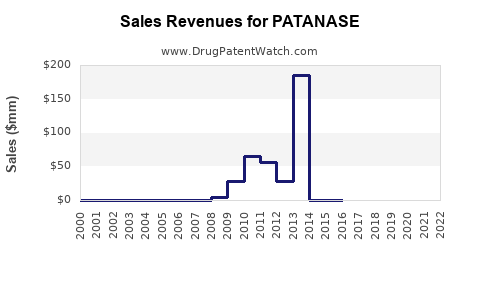
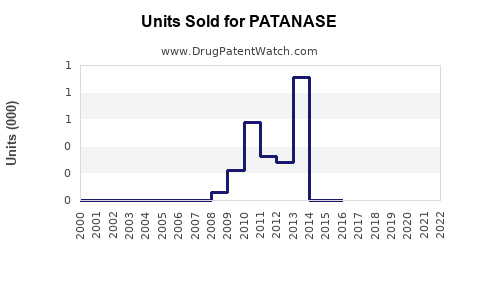
Annual Sales Revenues and Units Sold for PATANASE
| Drug Name | Revenues (USD) | Units | Year |
|---|---|---|---|
| PATANASE | ⤷ Start Trial | ⤷ Start Trial | 2022 |
| PATANASE | ⤷ Start Trial | ⤷ Start Trial | 2021 |
| PATANASE | ⤷ Start Trial | ⤷ Start Trial | 2020 |
| PATANASE | ⤷ Start Trial | ⤷ Start Trial | 2019 |
| >Drug Name | >Revenues (USD) | >Units | >Year |
Executive summary: Patanase, the olopatadine hydrochloride 0.6% nasal spray, is a mature allergy product with limited branded revenue potential and a larger opportunity in generic and over-the-counter channels. The U.S. market is structurally exposed to low-cost competitors, including generic olopatadine, azelastine, fluticasone, triamcinolone and budesonide nasal sprays. A reasonable base-case forecast places U.S. retail-equivalent sales for the olopatadine nasal-spray category at approximately $18 million to $40 million annually through 2030, with manufacturer net sales materially lower. Growth depends on OTC distribution, pharmacy shelf placement and seasonal allergy demand rather than patent exclusivity.
Patanase Market Analysis and Sales Projections Through 2030
What is Patanase and how does it compete?
Patanase is a nasal spray containing olopatadine hydrochloride, a topical antihistamine approved for allergic rhinitis. The U.S. product is supplied at a 0.6% concentration and delivers 665 micrograms of olopatadine hydrochloride per spray. The original prescription product was approved for seasonal allergic rhinitis and later expanded through regulatory changes affecting age groups and nonprescription access.[1]
Olopatadine blocks histamine activity at the nasal mucosa. Its principal commercial advantages are rapid antihistamine activity and direct nasal delivery. Its disadvantages are twice-daily administration for the original prescription regimen, competition from cheaper generic sprays and lower consumer awareness than major corticosteroid brands.
| Product | Active ingredient | Class | Main commercial position |
|---|---|---|---|
| Patanase | Olopatadine | Intranasal antihistamine | Brand and generic olopatadine opportunity |
| Astepro | Azelastine | Intranasal antihistamine | Major OTC antihistamine competitor |
| Flonase | Fluticasone propionate | Intranasal corticosteroid | Large OTC allergy brand |
| Nasacort | Triamcinolone acetonide | Intranasal corticosteroid | Large OTC competitor |
| Rhinocort | Budesonide | Intranasal corticosteroid | OTC corticosteroid competitor |
| Dymista | Fluticasone propionate/azelastine | Combination spray | Prescription combination product |
| Generic azelastine | Azelastine | Intranasal antihistamine | Low-cost prescription and OTC pressure |
What is the FDA regulatory status of Patanase?
Patanase was approved by the FDA under NDA 022196. The product was initially commercialized as a prescription treatment for seasonal allergic rhinitis. An OTC version of olopatadine nasal spray later expanded the addressable consumer market and reduced dependence on physician prescribing.[1][2]
The regulatory position has three commercial effects:
- OTC access expands volume through mass retail, drugstores, supermarkets and e-commerce.
- OTC competition increases price transparency and accelerates private-label substitution.
- Prescription and OTC channels can create different pricing, branding and reimbursement dynamics.
Patanase is not a biologic. Biosimilar competition is therefore irrelevant. The relevant competitors are generic drug products, authorized OTC products and branded allergy sprays.
How large is the Patanase and olopatadine nasal-spray market?
Public filings do not provide a consistently reported standalone revenue figure for Patanase. Manufacturers generally report allergy products within broader respiratory, consumer-health or ophthalmic portfolios. Market estimates therefore require a channel-based model rather than a direct company-reported sales series.
The addressable U.S. market includes:
- Prescription olopatadine nasal spray.
- OTC olopatadine nasal spray.
- Store-brand and private-label versions.
- E-commerce allergy products.
- Seasonal purchases by patients who switch among antihistamine and corticosteroid sprays.
A practical 2024 estimate for U.S. retail-equivalent sales of olopatadine nasal spray is approximately $15 million to $30 million. This is a category estimate, not a reported Patanase brand figure. The range reflects differences in retail price, generic penetration, pack size, distribution and seasonal demand.
The broader U.S. nasal-allergy product market is substantially larger. Intranasal corticosteroids hold the largest share because of broad efficacy, established consumer recognition and extensive OTC distribution. Intranasal antihistamines have a smaller position but can gain share when consumers prioritize rapid symptom relief or prefer antihistamine therapy.[3][4]
What are the main growth drivers for Patanase?
OTC distribution
OTC availability is the strongest potential growth driver. Consumers can purchase the product without a physician visit, and retailers can place it beside Flonase, Astepro and competing allergy products. OTC distribution also supports online sales and seasonal promotional campaigns.
The commercial benefit is limited by price competition. Once a product is available without a prescription, consumers can compare active ingredients and substitute based on price, package size and retailer promotion.
Seasonal allergy prevalence
Allergic rhinitis affects a large U.S. population, and pollen seasons can extend demand beyond the traditional spring period. Weather variation, geographic pollen exposure and climate-related changes in seasonal duration can affect annual volumes.[5]
Seasonality creates a concentrated revenue pattern. A disproportionate share of annual sales can occur before and during peak pollen periods. Inventory planning and retail execution are therefore more important than for continuously used chronic medicines.
Consumer preference for rapid relief
Intranasal antihistamines can provide faster symptom relief than intranasal corticosteroids for certain patients. This positioning gives olopatadine a defensible clinical niche, particularly for patients who want an as-needed product or who do not prefer steroid-based therapy.
E-commerce and private label
Online pharmacies and retailer websites improve product discoverability but increase comparison shopping. Private-label products can capture demand when the active ingredient and concentration are clearly displayed.
What limits Patanase sales growth?
Patanase faces four structural constraints.
First, the product competes in a highly substitutable category. Patients can switch among antihistamine sprays, corticosteroid sprays, oral antihistamines and combination products.
Second, generic olopatadine limits the attainable price. Once multiple suppliers are present, pharmacy and retail buyers typically prioritize acquisition cost, supply reliability and contract terms.
Third, brand awareness is weaker than for Flonase and other mass-market products. A smaller brand must spend more per incremental consumer or rely on retailer placement and search advertising.
Fourth, the product has limited exclusivity leverage. Patanase is a mature small-molecule product, and its commercial value is driven primarily by distribution, formulation quality, packaging and brand execution.
What are the Patanase sales projections through 2030?
The following forecast covers U.S. retail-equivalent sales for the olopatadine nasal-spray category, including branded, generic and OTC products. It is not a forecast of manufacturer net revenue for a single Patanase owner.
| Year | Bear case | Base case | Bull case |
|---|---|---|---|
| 2024 | $12 million | $22 million | $32 million |
| 2025 | $12 million | $24 million | $35 million |
| 2026 | $12 million | $26 million | $38 million |
| 2027 | $13 million | $28 million | $41 million |
| 2028 | $13 million | $30 million | $44 million |
| 2029 | $14 million | $32 million | $47 million |
| 2030 | $14 million | $34 million | $50 million |
The base case implies an approximately 7% compound annual growth rate from 2024 to 2030. The forecast assumes:
- Low-single-digit growth in the overall nasal-allergy category.
- Continued OTC access.
- Stable consumer demand for intranasal antihistamines.
- Gradual unit growth offset by lower prices.
- No major supply disruption.
- Continued substitution toward generic and retailer-branded products.
The bull case requires stronger OTC execution, expanded retailer distribution and increased consumer adoption of antihistamine sprays. The bear case reflects accelerated generic substitution, weak brand investment and continued consumer preference for corticosteroid products.
Manufacturer net sales could be 25% to 60% below retail-equivalent sales, depending on channel mix, wholesaler discounts, rebates, retailer margins and private-label participation.
What is the revenue exposure for a Patanase commercial program?
A branded Patanase program has limited absolute revenue exposure compared with leading allergy brands. The principal economic risk is margin compression rather than a sudden loss of a large protected revenue stream.
| Commercial model | Revenue potential | Margin outlook | Risk profile |
|---|---|---|---|
| Branded prescription Patanase | Low | Moderate to high initially | Prescribing and reimbursement pressure |
| Branded OTC Patanase | Moderate | Moderate | Retail placement and advertising costs |
| Generic olopatadine | Moderate volume | Low to moderate | Price erosion and supplier competition |
| Private-label olopatadine | Moderate volume | Low | Retailer bargaining power |
| Combination or differentiated formulation | Higher potential | Higher if differentiated | Clinical and regulatory execution risk |
A company entering through a generic strategy would likely pursue volume and supply reliability. A brand owner would need to justify pricing through packaging, dosing convenience, consumer recognition or retail marketing.
What patents protect Patanase and when does exclusivity end?
Patanase is a mature small-molecule product. The principal commercial protection associated with the original product has expired or no longer provides the type of market exclusivity available to a newly approved medicine. Current competition is therefore governed mainly by generic approvals, manufacturing economics and brand positioning.
The FDA Orange Book remains the controlling source for active U.S. patents and regulatory exclusivity associated with approved drug products.[6] For Patanase, the practical market conclusion is that patent protection is not the principal barrier to entry. A competitor’s more relevant barriers are:
- FDA approval of an equivalent nasal-spray product.
- Access to olopatadine hydrochloride active pharmaceutical ingredient.
- Spray-pump performance and container-closure compatibility.
- Stability and microbial-control validation.
- Manufacturing scale and retail distribution.
- Ability to meet seasonal demand without shortages.
No material biosimilar risk exists because Patanase is a chemically synthesized small molecule.
Are there Paragraph IV challenges or Patanase patent lawsuits?
Paragraph IV risk is relevant to generic olopatadine products when an applicant certifies that listed patents are invalid, unenforceable or will not be infringed. Because the product is mature and its original patent estate is aged, the principal Paragraph IV opportunity would have been during the earlier generic-entry period rather than at the current commercial stage.
There is no widely reported active, market-defining U.S. patent litigation campaign currently associated with Patanase comparable to litigation surrounding high-value specialty medicines. The absence of major current litigation reinforces the view that the commercial market is largely post-exclusivity.
Settlement agreements would matter if they imposed a delayed generic entry date, supply restrictions or authorized-generic terms. Publicly available information does not establish a current settlement structure that materially limits generic olopatadine access.
How strong is the Patanase patent estate?
The patent estate is weak as a current revenue-protection tool and moderate as a historical product-development asset.
| Patent-estate factor | Assessment |
|---|---|
| Composition-of-matter protection | Largely exhausted for current commercial planning |
| Core nasal-spray protection | Limited current exclusivity value |
| Formulation protection | Potentially relevant only if a specific improvement remains enforceable |
| Method-of-use protection | Narrow value in an OTC, symptom-driven market |
| Manufacturing know-how | More commercially relevant than legacy patents |
| Regulatory exclusivity | Not a current primary barrier |
| Freedom to operate | Manageable for standard generic development, subject to claim review |
Formulation patents can still matter where a company has developed a distinct preservative system, suspension technology, dosing regimen, device or combination product. They do not automatically block standard olopatadine nasal-spray entry.
What generic launch scenarios exist for Patanase?
Standard generic launch
A standard generic entrant competes on price and pharmacy availability. This is the most likely scenario in a mature market. The entrant gains volume but faces low margins and seasonal inventory risk.
Authorized or retailer-branded launch
A retailer-branded product can gain shelf space quickly if it offers a lower consumer price. This model can shift revenue away from the Patanase brand without materially expanding total category demand.
OTC private-label expansion
Private-label expansion is the most significant long-term threat to branded sales. Retailers can use olopatadine as part of a broader allergy assortment and rely on active-ingredient recognition rather than brand loyalty.
Differentiated device or dosing product
A company could seek differentiation through a more convenient spray pump, lower-drip formulation, improved packaging or a modified dosing schedule. The commercial value would depend on FDA requirements, clinical support and the ability to secure meaningful retail placement.
How does Patanase compare with competing allergy drugs?
Patanase has a stronger rapid-relief positioning than many intranasal corticosteroids but a weaker mass-market position. Flonase, Nasacort and Rhinocort benefit from broad consumer familiarity and extensive retail distribution. Astepro is the closest branded OTC comparator because it is also an intranasal antihistamine.
| Attribute | Patanase | Intranasal corticosteroids | Astepro and generic azelastine |
|---|---|---|---|
| Mechanism | Antihistamine | Anti-inflammatory corticosteroid | Antihistamine |
| Typical consumer message | Fast antihistamine relief | Broad allergy control | Fast antihistamine relief |
| Generic pressure | High | High | High |
| OTC retail competition | High | Very high | High |
| Patent-based pricing power | Low | Low | Low |
| Brand-growth potential | Moderate | Higher for major brands | Moderate |
Patanase is best positioned as a targeted antihistamine spray, not as the category leader in overall allergic-rhinitis treatment.
What is the investment outlook for Patanase?
The investment case is volume-driven and operational rather than patent-driven. Attractive opportunities may exist in:
- Generic manufacturing with reliable seasonal supply.
- Retailer or pharmacy private-label agreements.
- Low-cost OTC distribution.
- Combination products with differentiated clinical positioning.
- Contract manufacturing for nasal-spray products.
- International markets where olopatadine nasal spray has lower generic penetration.
The main risks are price erosion, low brand loyalty, retailer concentration, manufacturing complexity and demand volatility during weak allergy seasons.
Key Takeaways
- Patanase is olopatadine hydrochloride 0.6% nasal spray for allergic rhinitis.
- The product is mature and largely post-exclusivity.
- Generic and OTC competition is more important than current patent protection.
- Estimated U.S. retail-equivalent category sales are approximately $15 million to $30 million in 2024.
- Base-case category sales reach approximately $34 million by 2030.
- Manufacturer net sales are lower than retail-equivalent sales because of discounts, retailer margins and generic pricing.
- Astepro is the closest branded antihistamine competitor.
- Flonase, Nasacort and Rhinocort create stronger mass-market pressure through broad OTC distribution.
- Biosimilar risk does not apply.
- The strongest commercial barriers are manufacturing quality, supply reliability and retail access.
FAQs About Patanase Market Size and Commercial Outlook
Is Patanase still commercially relevant?
Yes, but primarily as part of the broader olopatadine nasal-spray category. Its relevance depends on OTC availability, generic supply and retail distribution rather than exclusivity.
Is olopatadine nasal spray a generic drug?
Generic olopatadine nasal spray products can compete with the Patanase brand. The active ingredient is the same, but suppliers can differ in device design, packaging, labeling and manufacturing source.
What is the closest alternative to Patanase?
Astepro and generic azelastine are the closest antihistamine alternatives. Flonase, Nasacort and Rhinocort are major alternatives from the intranasal corticosteroid class.
Can a new company still enter the Patanase market?
Yes. Entry is technically feasible through an FDA-approved generic or OTC pathway. The main challenges are bioequivalence or applicable regulatory requirements, spray-device performance, manufacturing scale and retail access.
Does Patanase have biosimilar competition?
No. Patanase contains a chemically synthesized small-molecule active ingredient. Its competition comes from generics and other nasal-allergy products, not biosimilars.
References
- U.S. Food and Drug Administration. (2008). Patanase nasal spray, olopatadine hydrochloride: Prescribing information.
- U.S. Food and Drug Administration. (2021). FDA approves over-the-counter olopatadine hydrochloride nasal spray for allergic rhinitis.
- U.S. Food and Drug Administration. (2024). Drugs@FDA: FDA-approved drug products.
- IQVIA. (2024). U.S. pharmaceutical market and allergy category data.
- Centers for Disease Control and Prevention. (2023). Allergic conditions and allergic rhinitis in the United States.
- U.S. Food and Drug Administration. (2024). Approved drug products with therapeutic equivalence evaluations, Orange Book.
More… ↓
