Drug Sales Trends for OLANZAPINE
Payment Methods and Pharmacy Types for OLANZAPINE (2016)
Revenues by Pharmacy Type
Units Sold by Pharmacy Type
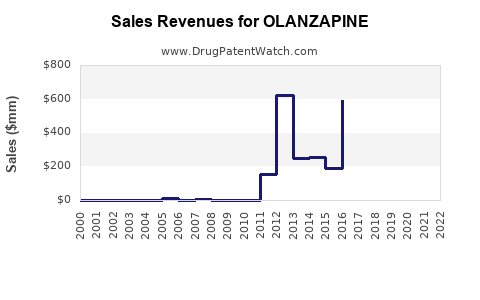
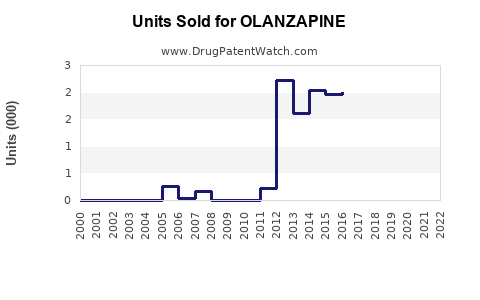
Annual Sales Revenues and Units Sold for OLANZAPINE
| Drug Name | Revenues (USD) | Units | Year |
|---|---|---|---|
| OLANZAPINE | ⤷ Start Trial | ⤷ Start Trial | 2022 |
| OLANZAPINE | ⤷ Start Trial | ⤷ Start Trial | 2021 |
| OLANZAPINE | ⤷ Start Trial | ⤷ Start Trial | 2020 |
| >Drug Name | >Revenues (USD) | >Units | >Year |
Olanzapine Market Analysis, Patent Expiration, Competitive Landscape, and Sales Projections
Olanzapine is a mature, high-volume generic antipsychotic with substantial global demand but limited branded pricing power. The market is driven by schizophrenia, bipolar disorder, oral tablets, orally disintegrating tablets, and long-acting injectable formulations. Generic competition eliminated most U.S. branded revenue after 2011, while long-acting injectable olanzapine retains higher commercial value because of manufacturing complexity, administration requirements, and post-injection monitoring.
The base-case market outlook is stable to modestly growing in volume, with declining prices for immediate-release tablets and stronger value retention in depot formulations. A reasonable five-year scenario range is 1% to 4% annual global volume growth, offset by 2% to 6% annual price erosion in conventional oral products. Long-acting injectable products should grow faster than tablets but remain constrained by administration infrastructure and safety-monitoring requirements.
What is olanzapine and where is it used?
Olanzapine is an atypical antipsychotic approved for schizophrenia and bipolar disorder. In the United States, the FDA-approved product categories include:
| Product category | Typical use | Commercial status |
|---|---|---|
| Immediate-release tablets | Schizophrenia and bipolar disorder | Widely generic |
| Orally disintegrating tablets | Patients with swallowing or adherence challenges | Generic competition |
| Intramuscular injection | Acute agitation associated with schizophrenia or bipolar mania | Generic and hospital use |
| Long-acting injectable olanzapine pamoate | Maintenance treatment of schizophrenia | Limited competition |
| Branded Zyprexa products | Original Eli Lilly products | Mature or discontinued in many markets |
The original brand was Zyprexa, developed and commercialized by Eli Lilly. The active ingredient is olanzapine, a thienobenzodiazepine antipsychotic with activity at dopamine and serotonin receptors. The product became one of Lilly’s largest revenue contributors before patent expiry.
How large is the olanzapine market?
The market is large in patient volume but fragmented by geography, formulation, reimbursement channel, and supplier. Oral olanzapine is a commodity generic in the United States and other developed markets. Value remains higher in countries with slower generic substitution, branded-generic markets, or restricted access to competing atypical antipsychotics.
Market structure by formulation
| Segment | Relative volume | Relative price | Growth outlook |
|---|---|---|---|
| Generic tablets | Very high | Low | Stable volume, continuing price pressure |
| Orally disintegrating tablets | Moderate | Low to medium | Stable to modest growth |
| Acute injectable | Low to moderate | Medium | Hospital-driven demand |
| Long-acting injectable | Low | High | Faster growth from adherence programs |
| Branded Zyprexa | Small | High where available | Continuing decline |
Olanzapine competes with risperidone, quetiapine, aripiprazole, ziprasidone, lurasidone, clozapine, and long-acting injectable products such as paliperidone palmitate and aripiprazole lauroxil. Prescribing decisions depend on efficacy, metabolic risk, sedation, route of administration, formulary restrictions, and adherence requirements.
What were peak Zyprexa sales and what happened after generic entry?
Zyprexa reached multibillion-dollar annual sales before loss of U.S. exclusivity. Eli Lilly reported Zyprexa revenue of approximately $4.6 billion in 2009 and approximately $5.0 billion in 2010. Revenue fell sharply after U.S. generic olanzapine launched in 2011. Lilly reported Zyprexa revenue of approximately $2.4 billion in 2011, reflecting the partial-year impact of generic competition, followed by further erosion in subsequent years (Eli Lilly and Company, 2010, 2011).
The decline followed the standard small-molecule generic pattern:
- Generic tablets entered rapidly after patent expiry.
- Pharmacy benefit managers substituted generic products.
- Net prices fell sharply.
- Lilly retained limited value through residual brand demand, selected international markets, and differentiated formulations.
- Long-acting injectable olanzapine remained more defensible than oral tablets.
The historical revenue profile shows that olanzapine is commercially important as a class product but no longer a major branded asset in the United States.
When did olanzapine lose exclusivity?
The core U.S. composition patent for olanzapine was U.S. Patent No. 5,229,382, assigned to Eli Lilly. The patent covered the active compound and expired in 2011 after applicable patent-term adjustments and pediatric exclusivity. FDA records show that generic olanzapine tablets and orally disintegrating tablets were approved beginning in 2011.
| Milestone | Approximate date | Commercial impact |
|---|---|---|
| FDA approval of Zyprexa | 1996 | Launch of branded olanzapine |
| Core composition patent expiry | 2011 | U.S. generic entry |
| Generic tablet approvals | 2011 onward | Rapid oral price erosion |
| Long-acting injectable approval | 2009 | Creation of a differentiated depot segment |
| Generic oral market maturity | 2012 onward | Commodity pricing and supplier competition |
The core oral product has no meaningful remaining U.S. patent barrier. Current commercial protection depends on formulation, manufacturing, regulatory approvals, contracts, and supply reliability rather than the original composition patent.
What patents protect olanzapine products today?
The main patent estate for oral olanzapine has expired. Patent protection is more relevant for specific delivery systems, manufacturing processes, formulations, and injectable products.
Oral formulation patents
Historically, patents and exclusivity claims covered:
- The olanzapine active compound.
- Orally disintegrating tablets.
- Taste-masking technologies.
- Rapid-dissolution formulations.
- Excipients and tablet manufacturing processes.
- Specific dosage forms and stability profiles.
Most commercially important oral claims have expired or become weak because multiple generic manufacturers have obtained approval for standard tablets and orally disintegrating tablets.
Long-acting injectable patents
Olanzapine pamoate depot products are more difficult to replicate because they require:
- A specific salt or depot-forming system.
- Particle-size and suspension controls.
- Sterile manufacturing.
- Extended-release performance.
- Product-specific stability data.
- Administration protocols linked to post-injection monitoring.
The regulatory and technical barrier is more important than the expired composition patent. A competitor must demonstrate equivalent product performance and satisfy manufacturing requirements that are more demanding than those for standard oral tablets.
What is the FDA regulatory status of olanzapine?
Olanzapine is an FDA-approved prescription drug. Immediate-release tablets, orally disintegrating tablets, and injectable products have generic competition. Long-acting injectable olanzapine pamoate remains a specialized product category.
The long-acting formulation is associated with post-injection delirium/sedation syndrome, a serious adverse event that can occur after administration. The U.S. product requires a risk-management system that includes administration by a qualified healthcare professional and patient observation after injection. This monitoring requirement increases provider burden and limits use in settings without sufficient staff and observation capacity (U.S. Food and Drug Administration, 2009).
The safety-monitoring requirement has two commercial effects:
- It protects the depot segment from purely price-based substitution.
- It restricts adoption relative to simpler long-acting injectable products.
What is the Orange Book status of olanzapine?
The FDA Orange Book lists approved olanzapine products and associated patent and exclusivity information where applicable. The original Zyprexa oral products no longer have meaningful market exclusivity in the United States. Standard generic tablets and orally disintegrating tablets are approved through abbreviated new drug applications.
Orange Book relevance is now highest for:
- Specific long-acting injectable products.
- Product-specific patents.
- Formulation claims.
- Method-of-use claims.
- Regulatory exclusivity associated with later-approved formulations.
For generic developers, the main opportunity is not a conventional Paragraph IV challenge to the expired oral compound patent. It is development of differentiated injectable products, alternative dosage forms, or products with manufacturing advantages.
Which companies compete in the olanzapine market?
The competitive field includes large generic manufacturers, specialty injectable companies, regional branded-generic suppliers, and hospital-focused manufacturers. Suppliers vary by jurisdiction and may change as contracts, shortages, and regulatory approvals shift.
Competitive groups
| Competitor type | Primary opportunity |
|---|---|
| Large generic manufacturers | Tablets, orally disintegrating tablets, injectable products |
| Regional branded-generic companies | Retail and institutional markets outside the U.S. |
| Specialty pharmaceutical companies | Long-acting injectable or differentiated formulations |
| Contract manufacturers | Sterile injectable production |
| Originator-linked companies | Residual branded and depot-product economics |
The strongest oral competition comes from scale manufacturers able to supply multiple strengths and dosage forms at low cost. The strongest depot competition comes from companies with sterile manufacturing, suspension-processing capability, and access to psychiatric treatment networks.
What generic entry risks exist for olanzapine?
Generic entry risk is high for conventional oral products and moderate for long-acting injectable formulations.
Oral tablets
The principal risks are:
- Additional approved suppliers.
- Aggressive wholesaler and pharmacy benefit manager contracting.
- Price compression.
- Product discontinuation if margins fall below manufacturing costs.
- Shortages caused by concentrated supply.
A generic company can gain share rapidly if it offers reliable supply across common strengths, including 2.5 mg, 5 mg, 7.5 mg, 10 mg, 15 mg, and 20 mg tablets.
Orally disintegrating tablets
The ODT segment has somewhat greater technical complexity than standard tablets because of taste, dissolution, friability, packaging, and stability requirements. That complexity does not create a durable monopoly, but it can reduce the number of commercially viable suppliers.
Long-acting injectable products
The principal barriers are:
- Sterile manufacturing validation.
- Depot particle engineering.
- Product equivalence.
- Post-injection safety procedures.
- Provider training.
- Restricted distribution or monitoring obligations.
- Commercial access to psychiatric clinics.
These barriers make a rapid multi-entrant price collapse less likely than in the tablet segment.
What are olanzapine sales projections through 2030?
A practical forecast should separate unit demand from revenue. Olanzapine volume can grow even while revenue declines because oral prices continue to fall.
Base-case global scenario
| Year | Oral volume index | Depot volume index | Oral revenue index | Depot revenue index |
|---|---|---|---|---|
| 2025 | 100 | 100 | 100 | 100 |
| 2026 | 102 | 106 | 96 | 104 |
| 2027 | 104 | 112 | 92 | 108 |
| 2028 | 106 | 119 | 88 | 112 |
| 2029 | 108 | 126 | 84 | 116 |
| 2030 | 110 | 134 | 80 | 120 |
This scenario assumes:
- Oral unit demand grows about 2% annually.
- Oral net prices decline about 4% annually.
- Depot unit demand grows about 6% annually.
- Depot pricing declines slowly because of manufacturing and service requirements.
- No major safety signal removes a formulation from the market.
- No large-scale supply disruption affects the principal manufacturers.
Under this model, oral olanzapine revenue declines by approximately 20% from 2025 to 2030 despite modest volume growth. Depot revenue grows approximately 20% over the same period. Total market revenue is broadly stable if injectable products represent a meaningful share of value.
Bull case
The bull case includes:
- Greater use of long-acting treatment for adherence management.
- Expansion in emerging markets.
- Increased use of ODT products in community psychiatry.
- Stable reimbursement for depot administration.
- Limited new competition in long-acting injectable products.
Under that case, global revenue could grow 3% to 5% annually through 2030, led by depot products.
Bear case
The bear case includes:
- More aggressive oral price competition.
- New depot entrants.
- Reduced reimbursement for administration and monitoring.
- Continued concerns about metabolic adverse effects.
- Greater use of competing long-acting injectable antipsychotics.
Under that case, total market revenue could decline 3% to 6% annually, even if prescription volume remains stable.
How does olanzapine compare with competing antipsychotics?
| Drug | Patent position | Key commercial strength | Main limitation |
|---|---|---|---|
| Olanzapine | Mature generic | Efficacy, broad clinical familiarity, low cost | Weight gain and metabolic risk |
| Risperidone | Mature generic | Low cost and multiple formulations | Prolactin and movement-related effects |
| Quetiapine | Mature generic | Broad use across psychiatric indications | Sedation and metabolic effects |
| Aripiprazole | Generic oral; depot products retain value | Lower metabolic burden for some patients | Depot competition and cost |
| Paliperidone palmitate | Depot-focused branded/generic competition | Established monthly and extended intervals | Higher price and administration cost |
| Lurasidone | Generic in many markets | Bipolar depression positioning | Narrower commercial base |
| Clozapine | Generic | Treatment-resistant schizophrenia | Monitoring and safety burden |
Olanzapine’s strongest competitive position is the combination of clinical familiarity and low oral cost. Its weakest position is metabolic tolerability. In the depot segment, the product’s value depends on whether providers accept the monitoring burden in exchange for adherence benefits.
What manufacturing and intellectual-property barriers affect olanzapine?
Manufacturing risk is more material than composition-patent risk. Oral olanzapine is relatively accessible to qualified generic manufacturers, but reliable commercial supply requires control of:
- Active pharmaceutical ingredient quality.
- Particle size and polymorphic form.
- Tablet dissolution.
- ODT taste and mechanical strength.
- Packaging moisture protection.
- Sterile injectable processing.
- Depot suspension uniformity.
- Batch-to-batch release testing.
The injectable segment has the strongest entry barriers. A company with no sterile facility may need a contract manufacturing partner, increasing cost, lead time, and supply-chain dependence.
What is the outlook for olanzapine licensing and partnerships?
Licensing value is limited for standard oral olanzapine because the active ingredient is generic and competition is extensive. Potentially attractive transactions involve:
- Long-acting injectable technology.
- Depot manufacturing platforms.
- Emerging-market commercialization rights.
- Hospital supply contracts.
- ODT delivery technology.
- Combination products or adherence services.
A licensing transaction based solely on standard oral olanzapine would likely face weak pricing power. A transaction involving differentiated injectable technology can command greater value if it includes regulatory approvals, manufacturing capacity, or established psychiatric distribution.
Key Takeaways
- Olanzapine is a mature, high-volume generic antipsychotic.
- U.S. oral exclusivity ended in 2011, following expiration of Eli Lilly’s core composition patent.
- Conventional tablet revenue is exposed to continued generic price erosion.
- Orally disintegrating tablets retain modest technical differentiation but no durable compound-level exclusivity.
- Long-acting injectable olanzapine has the strongest commercial and manufacturing barriers.
- Post-injection monitoring limits depot adoption but also reduces immediate price competition.
- Base-case global volume growth is approximately 1% to 4% annually through 2030.
- Oral revenue is likely to decline while depot revenue grows.
- The principal investment opportunity is differentiated delivery, sterile manufacturing, and emerging-market distribution rather than standard tablets.
- The principal market risks are price compression, metabolic-risk competition, new depot entrants, and reimbursement pressure.
FAQs About Olanzapine Market and Sales
Is olanzapine still profitable for generic manufacturers?
Yes, but profitability depends on scale, supply reliability, and formulation. Standard tablets are low-margin products in competitive markets. Orally disintegrating and injectable products generally offer better economics.
Does olanzapine have biosimilar competition?
No. Olanzapine is a chemically synthesized small molecule, not a biologic. Competitors enter through generic-drug pathways rather than biosimilar applications.
Can a company still challenge Zyprexa patents under Paragraph IV?
Paragraph IV litigation is unlikely to create meaningful value for the expired core oral patent. It may remain relevant to later-issued formulation or injectable patents if enforceable claims remain listed or asserted.
Which olanzapine formulation has the best commercial outlook?
Long-acting injectable olanzapine has the strongest revenue outlook because it is differentiated and harder to manufacture. Its growth is limited by required observation and clinical administration procedures.
What is the largest commercial threat to olanzapine?
For oral products, the largest threat is further generic price compression. For long-acting injectable products, the largest threat is substitution by competing depot antipsychotics with simpler administration or longer dosing intervals.
References
-
Eli Lilly and Company. (2010). 2010 annual report. Indianapolis, IN: Author.
-
Eli Lilly and Company. (2011). 2011 annual report. Indianapolis, IN: Author.
-
U.S. Food and Drug Administration. (2009). FDA approves Zyprexa Relprevv for schizophrenia. Silver Spring, MD: U.S. Department of Health and Human Services.
-
U.S. Food and Drug Administration. (2024). Orange Book: Approved drug products with therapeutic equivalence evaluations. Silver Spring, MD: U.S. Department of Health and Human Services.
-
U.S. Patent No. 5,229,382. (1993). Thienobenzodiazepine derivatives. United States Patent and Trademark Office.
More… ↓
