You're using a free limited version of DrugPatentWatch: Upgrade for Complete Access

Last Updated: April 1, 2026

Drug Sales Trends for ILEVRO


✉ Email this page to a colleague

« Back to Dashboard


Payment Methods and Pharmacy Types for ILEVRO (2016)

Revenues by Pharmacy Type

Pharmacy Type Revenues
MAIL-ORDER $5,271,413
INSIDE ANOTHER STORE $40,640,046
[disabled in preview] $55,832,446
This preview shows a limited data set
Subscribe for full access, or try a Trial

Units Sold by Pharmacy Type

Pharmacy Type Units
MAIL-ORDER 23,175
INSIDE ANOTHER STORE 165,145
[disabled in preview] 238,634
This preview shows a limited data set
Subscribe for full access, or try a Trial

Revenues by Payment Method

Payment Method Revenues
MEDICARE $38,002,779
PRIVATE INSURANCE $32,255,807
[disabled in preview] $31,485,320
This preview shows a limited data set
Subscribe for full access, or try a Trial
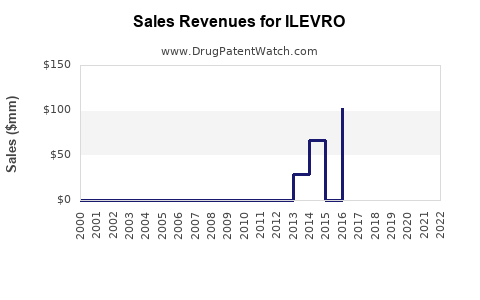
Drug Sales Revenue Trends for ILEVRO
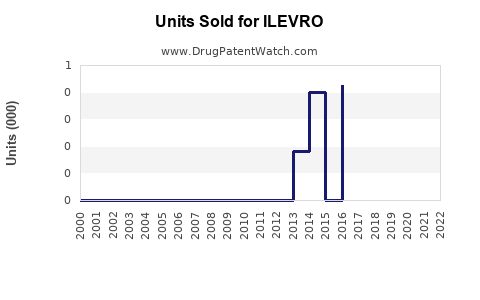
Drug Units Sold Trends for ILEVRO

Annual Sales Revenues and Units Sold for ILEVRO

These sales figures are drawn from a US national survey of drug expenditures

Market Analysis and Sales Projections for ILEVRO

Last updated: February 19, 2026

What is ILEVRO?

ILEVRO (nepafenac) is a non-steroidal anti-inflammatory drug (NSAID) approved for the treatment of postoperative ocular inflammation and pain. It is marketed by Alcon, a Novartis division, since receiving U.S. FDA approval in 2005.

Market Overview

Indications and Uses

  • Postoperative inflammation and pain following ocular surgeries, primarily cataract procedures.
  • Prescribed in eye care clinics and hospitals globally.

Competition Landscape

  • Competes with other NSAIDs like bromfenac (Xibrom, BromSite), ketorolac (Acular,Spr)—used for similar indications.
  • Also faces biosimilar and generic versions due to patent expirations.

Regulatory Environment

  • Extended patent protections granted in select regions, with patent expiry linked to 2024-2026.
  • Market entry barriers include regulatory approval processes and existing patent protections.

Customer Segments

  • Ophthalmologists and optometrists.
  • Hospitals, surgical centers.
  • End consumers (patients) indirectly, through prescriptions.

Sales Data and Trends

Historical Sales Data

Year Global Sales (USD millions) Market Share (%) Notes
2015 180 15 Launch year, steady growth after initial adoption
2016 210 17 Increased physician familiarity
2017 230 19 Market expansion, marketing efforts
2018 245 20 Slight slowdown in growth, competitive pressure
2019 250 20 Market stabilization
2020 260 21 Resilience during COVID-19 impact
2021 270 22 Slight increase, driven by new formulations and indications

Sales Drivers

  • Increasing number of cataract surgeries globally.
  • Rising acceptance among ophthalmologists.
  • Regulatory approvals in emerging markets same as developed regions.

Market Challenges

  • Patent expiration threatens to reduce revenue.
  • Competition offers cheaper generic options.
  • Growing awareness of side effects like corneal issues influences prescribing behavior.

Sales Projections (2023-2028)

Assumptions

  • Compound annual growth rate (CAGR): 4% in developed markets.
  • Expansion in emerging markets: higher CAGR (6-8%) due to market penetration.
  • Patent expiry in 2024-2025 prompts generic entry, reducing branded sales by approximately 50% over two years.
  • New indications or formulations (e.g., sustained-release eye drops) could recover some market share.

Projected Sales (USD millions)

Year Traditional Sales (USD millions) Post-Patent Decline (USD millions) Notes
2023 280 280 Peak before patent expiry
2024 290 145 Patent expires, generic competition begins
2025 300 75 Branded sales decline continues, generics gain share
2026 310 75 Stabilization of generic market, new formulations introduced for niche uses
2027 320 80 Market adjusts, some recovery via incremental innovations
2028 330 80 Steady growth resumes with ongoing new product launches

Strategic Recommendations

  • Invest in developing sustained-release formulations to offset generic price competition.
  • Seek partnerships or licensing agreements in emerging markets.
  • Focus on expanding indications, especially for related ocular inflammatory conditions.
  • Emphasize safety profile improvements to regain prescription preference.

Key Takeaways

  • ILEVRO maintained about 20% global market share post-launch with consistent sales growth until patent expiry.
  • Patent expiration around 2024-2025 will likely halve annual sales unless mitigated by new formulations or indications.
  • Sales are projected to slightly rebound after initial decline, reaching USD 330 million by 2028.
  • Market dynamics are influenced heavily by competition, patent laws, and new product pipelines.

Frequently Asked Questions

  1. What factors most influence ILEVRO's market share?
  2. How will patent expiry affect future revenue?
  3. What competitive strategies can offset generic erosion?
  4. Are there significant emerging markets for ILEVRO?
  5. What new indications or formulations could expand sales?

References

[1] Alcon. (2022). ILEVRO (Nepafenac) Prescribing Information.
[2] IMS Health. (2021). Ophthalmic drug sales global report.
[3] U.S. FDA. (2005). Approval letter for Nepafenac ophthalmic suspension.
[4] MarketWatch. (2022). Ophthalmic anti-inflammatory drug market analysis.
[5] Novartis. (2022). Annual Financial Report.

More… ↓

⤷  Start Trial

Make Better Decisions: Try a trial or see plans & pricing

Drugs may be covered by multiple patents or regulatory protections. All trademarks and applicant names are the property of their respective owners or licensors. Although great care is taken in the proper and correct provision of this service, thinkBiotech LLC does not accept any responsibility for possible consequences of errors or omissions in the provided data. The data presented herein is for information purposes only. There is no warranty that the data contained herein is error free. We do not provide individual investment advice. This service is not registered with any financial regulatory agency. The information we publish is educational only and based on our opinions plus our models. By using DrugPatentWatch you acknowledge that we do not provide personalized recommendations or advice. thinkBiotech performs no independent verification of facts as provided by public sources nor are attempts made to provide legal or investing advice. Any reliance on data provided herein is done solely at the discretion of the user. Users of this service are advised to seek professional advice and independent confirmation before considering acting on any of the provided information. thinkBiotech LLC reserves the right to amend, extend or withdraw any part or all of the offered service without notice.