You're using a free limited version of DrugPatentWatch: Upgrade for Complete Access

Last Updated: March 27, 2026

Drug Sales Trends for CARBAMAZEPINE


✉ Email this page to a colleague

« Back to Dashboard


Payment Methods and Pharmacy Types for CARBAMAZEPINE (2016)

Revenues by Pharmacy Type

Pharmacy Type Revenues
INSIDE ANOTHER STORE $1,526,770
INSIDE HMO/CLINIC/HOSPITAL $1,467,354
[disabled in preview] $216,165
This preview shows a limited data set
Subscribe for full access, or try a Trial

Units Sold by Pharmacy Type

Pharmacy Type Units
INSIDE ANOTHER STORE 54,748
INSIDE HMO/CLINIC/HOSPITAL 72,752
[disabled in preview] 16,919
This preview shows a limited data set
Subscribe for full access, or try a Trial

Revenues by Payment Method

Payment Method Revenues
MEDICAID $216,165
PRIVATE INSURANCE $1,362,525
[disabled in preview] $1,615,334
This preview shows a limited data set
Subscribe for full access, or try a Trial
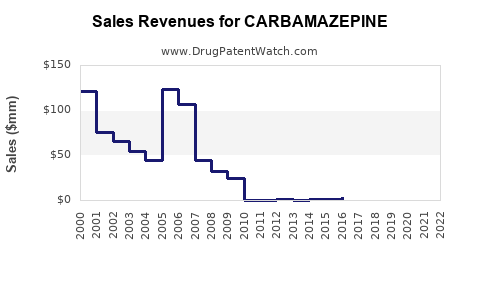
Drug Sales Revenue Trends for CARBAMAZEPINE
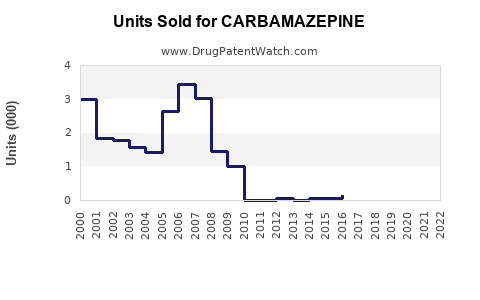
Drug Units Sold Trends for CARBAMAZEPINE

Annual Sales Revenues and Units Sold for CARBAMAZEPINE

These sales figures are drawn from a US national survey of drug expenditures
Drug Name Revenues (USD) Units Year
CARBAMAZEPINE ⤷  Start Trial ⤷  Start Trial 2022
CARBAMAZEPINE ⤷  Start Trial ⤷  Start Trial 2021
CARBAMAZEPINE ⤷  Start Trial ⤷  Start Trial 2020
CARBAMAZEPINE ⤷  Start Trial ⤷  Start Trial 2019
CARBAMAZEPINE ⤷  Start Trial ⤷  Start Trial 2018
>Drug Name >Revenues (USD) >Units >Year

Market Analysis and Sales Projections for Carbamazepine

Last updated: February 19, 2026

Market Overview

Carbamazepine is an anticonvulsant and mood-stabilizing drug primarily used to treat epilepsy, trigeminal neuralgia, and bipolar disorder. It was first approved by the FDA in 1968. The drug remains a cornerstone in neurological and psychiatric treatment, with an estimated global market size driven by its formulary presence and longstanding clinical utility.

Global sales of carbamazepine were approximately $600 million in 2022. The compound is available in generic and branded formulations, with generics accounting for roughly 85% of sales. The drug's low cost, established efficacy, and FDA approval sustain its market share despite newer anticonvulsants.

Market Drivers

  • Prevalence of Epilepsy and Neuralgia: Approximately 50 million people worldwide have epilepsy, with trigeminal neuralgia affecting 4-5 per 100,000 annually.
  • Longstanding Generic Availability: Market penetration is high due to low-cost generics, impacting branded drug sales.
  • Physician Preference: Carbamazepine remains preferred in settings with limited access to newer, more expensive medications.
  • Regulatory Approvals: Approvals in emerging markets expand the geographic footprint.
  • Adverse Effect Profile: Risk of hematologic and dermatologic side effects influences prescribing patterns.

Competitive Landscape

Patent Status Market Share Key Players Formulations Pricing Dynamics
Patent expired 15% Teva, Mylan, Sandoz Tablets, suspension Low-cost generics dominate market
Patent-held 85% UCB (brand: Tegretol) Tablets, XR formulations Higher pricing for branded products

Geographic Market Breakdown

Region Market Share (%) Key Trends Average Annual Growth (2020–2022)
North America 35% Stable, high penetration 1.5%
Europe 30% Slight decline in branded sales 1.2%
Asia-Pacific 20% Rapid generic adoption; emerging markets 4.5%
Latin America, Africa 15% Growing access, limited regulation 3.8%

Sales Projections (2023–2028)

Year Global Market Size (USD millions) Compound Annual Growth Rate (CAGR) Major Growth Drivers
2023 620 1.8% Increasing epilepsy diagnosis; expanding access abroad
2024 640 1.8% Entry into new markets; use in bipolar disorder
2025 660 1.8% Continued generic penetration; unmet needs in epilepsy
2026 680 1.8% New formulations; improved tolerability
2027 700 2.0% Adoption of narrow-spectrum formulations
2028 720 2.1% Aging populations with chronic seizure conditions

Barriers and Risks

  • Drug Interactions: Carbamazepine induces hepatic enzymes, affecting metabolism of other drugs.
  • Safety Concerns: Risks of agranulocytosis, Stevens-Johnson syndrome.
  • Regulatory Changes: Stricter safety monitoring may mitigate use.
  • Emerging Therapies: Newer anticonvulsants (e.g., levetiracetam, lamotrigine) gaining market share.

Revenue Impact of Patent and Formulary Changes

  • Patent expiry in most regions led to a significant decline in premium-branded sales by 50% since 2015.
  • Increased prescribing of generics has decreased per-unit revenue but expanded volume.
  • Manufacturers' investment in controlled-release formulations aims to improve adherence and reduce side effects.

Future Opportunities

  • Developing safer, more selective formulations.
  • Expanding to pediatric populations.
  • Integrating into combination therapies for complex seizure syndromes.
  • Growing use in low- and middle-income countries as healthcare infrastructure improves.

Key Takeaways

  • The carbamazepine market is mature with slow growth, driven mostly by expanding access in emerging markets.
  • Generic competition limits revenue potential; branded sales are declining.
  • New formulations targeting improved safety and tolerability could renew growth.
  • Market growth remains modest at approximately 1.8–2.1% CAGR through 2028.
  • A significant share of future revenues depends on regulatory landscape shifts and competitive responses.

Frequently Asked Questions

  1. What is the primary indication for carbamazepine?
    Treatment of epilepsy, trigeminal neuralgia, and bipolar disorder.

  2. How does patent expiration affect market dynamics?
    It causes branded sales decline, increases generic market share, and reduces per-unit pricing.

  3. What are the main barriers to growth?
    Safety concerns, drug interactions, and competition from newer agents.

  4. Which regions exhibit the highest growth potential?
    Asia-Pacific and Latin America, driven by increased access and healthcare infrastructure development.

  5. Are there upcoming formulations or combinations anticipated to impact sales?
    Yes, controlled-release formulations and combination therapies for complex seizure syndromes.

References

[1] U.S. Food and Drug Administration. (2021). Tegretol (carbamazepine) tablet, chewable tablet, suspension, extended-release capsule. FDA.
[2] MarketsandMarkets. (2022). Anticonvulsant drugs market by type, application, and region — Global forecast to 2027.
[3] IQVIA. (2022). Global prescription drug sales data.
[4] World Health Organization. (2019). Epilepsy fact sheet.
[5] European Medicines Agency. (2018). Safety communication on carbamazepine and adverse drug reactions.

More… ↓

⤷  Start Trial

Make Better Decisions: Try a trial or see plans & pricing

Drugs may be covered by multiple patents or regulatory protections. All trademarks and applicant names are the property of their respective owners or licensors. Although great care is taken in the proper and correct provision of this service, thinkBiotech LLC does not accept any responsibility for possible consequences of errors or omissions in the provided data. The data presented herein is for information purposes only. There is no warranty that the data contained herein is error free. We do not provide individual investment advice. This service is not registered with any financial regulatory agency. The information we publish is educational only and based on our opinions plus our models. By using DrugPatentWatch you acknowledge that we do not provide personalized recommendations or advice. thinkBiotech performs no independent verification of facts as provided by public sources nor are attempts made to provide legal or investing advice. Any reliance on data provided herein is done solely at the discretion of the user. Users of this service are advised to seek professional advice and independent confirmation before considering acting on any of the provided information. thinkBiotech LLC reserves the right to amend, extend or withdraw any part or all of the offered service without notice.