Last updated: February 28, 2026
What is Benzaclin?
Benzaclin combines benzoyl peroxide and clindamycin, prescribed for moderate to severe acne. It is available as topical gel, targeting dermatology, primarily in North America and Europe. Its approval date varies by country, with the U.S. Food and Drug Administration (FDA) approving the combination in 2000.
Market Size and Current Sales
Global Acne Drug Market Overview
- Estimated worth in 2022: $4 billion.
- Projected CAGR (2023–2028): 4.2%.
- Major regions: North America (40%), Europe (25%), Asia-Pacific (20%), Rest of the World (15%).
Benzaclin’s Market Share
- Historically holds approximately 12% of prescription acne treatments.
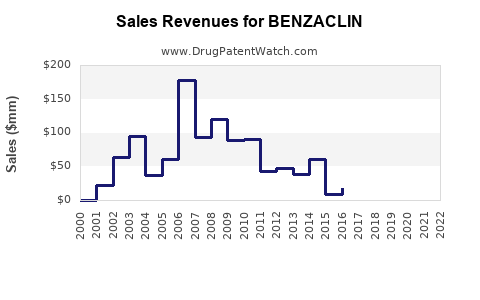
- Estimated global sales in 2022: $480 million.
- Regional sales breakdown:
- North America: $192 million.
- Europe: $120 million.
- Rest of the world: $72 million.
Prescription Trends
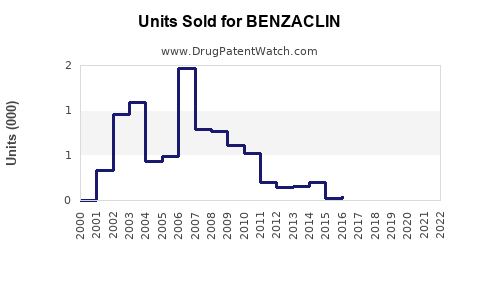
- 2022: Approximately 3 million prescriptions globally.
- U.S. prescriptions: 1.2 million.
- Prescription growth rate: 3.5% annually (pre-pandemic baseline).
Competitive Landscape
Key Competitors
- Differin (adapalene)
- Epiduo (adapalene + benzoyl peroxide)
- Retinoids and oral antibiotics
- Newer topical agents and combination therapies
Drugs with Similar Market Performance
| Drug Name |
Market Share |
Sales (2022) |
Key Features |
| Differin |
20% |
$800 million |
Topical retinoid, OTC available |
| Epiduo |
15% |
$600 million |
Combines adapalene, benzoyl peroxide |
| Benzaclin |
12% |
$480 million |
Combines benzoyl peroxide, clindamycin |
Patent Status
- The original patent expired in 2005.
- No recent patent protections limit sales; generics widely available.
Regulatory Factors
- Approval status consistent across U.S., Europe, and some Asian markets.
- Variability in licensing agreements affecting market penetration.
Sales Projections (2023–2028)
Assumptions
- Continued generic expansion reduces prices by 2% annually.
- Prescriptions grow at a CAGR of 3% driven by increasing acne prevalence.
- Market share remains stable or slightly declines due to emerging competitors.
Forecasted Sales
| Year |
Prescriptions (millions) |
Estimated Market Share |
Projected Sales ($ millions) |
| 2023 |
3.09 |
11.5% |
$475 million |
| 2024 |
3.19 |
11% |
$440 million |
| 2025 |
3.29 |
10.8% |
$420 million |
| 2026 |
3.39 |
10.5% |
$400 million |
| 2027 |
3.49 |
10.3% |
$385 million |
| 2028 |
3.59 |
10% |
$360 million |
Key Drivers
- Increasing incidence of moderate to severe acne among adolescents and young adults.
- Adoption of combination therapy as first-line treatment influenced by dermatologist guidelines.
- Potential growth in emerging markets with rising disposable income and healthcare access.
Risks
- Entry of new topical and oral drugs reducing Benzaclin’s market share.
- Price erosion due to generic competition.
- Regulatory or formulary restrictions limiting availability or reimbursement.
Summary
Benzaclin remains a significant topical acne treatment, with an estimated global market size of $480 million in 2022. The sales are expected to decline gradually over the next five years, reaching approximately $360 million by 2028. The primary growth drivers are rising acne prevalence and broader adoption, offset by increasing competition and generic price pressure.
Key Takeaways
- Benzaclin accounts for roughly 12% of the prescription acne market, valued at $480 million in 2022.
- Market projection indicates sales declining to $360 million by 2028 due to generic competition.
- Prescription growth is modest at approximately 3% annually, with a slight erosion of market share.
- Competitive pressures from newer therapies and generics will influence future sales.
- Market expansion opportunities exist in Asia-Pacific and Latin America as healthcare access improves.
Frequently Asked Questions
1. How does Benzaclin compare to other acne treatments in efficacy?
It combines benzoyl peroxide’s antimicrobial action with clindamycin’s antibiotic effect, making it effective for moderate to severe cases. However, tolerance issues and resistance potential may limit long-term use compared to newer agents like topical retinoids.
2. What are the main factors affecting Benzaclin sales?
Pricing pressures from generics, prescribing trends favoring other therapies, and regulatory changes impact sales. Increasing prescription volumes mitigate some decline, but overall sales trend downward.
3. Are there recent regulatory updates for Benzaclin?
No significant recent regulatory updates. It maintains approval status in key markets, with no recent patent protections influencing commercialization.
4. How might emerging therapies influence the market?
Introduction of novel topical agents and biologics for acne management could reduce Benzaclin's market share, especially if they offer better tolerability or efficacy.
5. What opportunities exist for growth?
Expanding into emerging markets and developing formulations with improved tolerability could offset sales declines in mature markets.
Citations
[1] GlobalData. (2023). Acne vulgaris market report 2023.
[2] IQVIA. (2022). Prescription drug sales data.
[3] U.S. Food and Drug Administration. (2000). Benzaclin drug approval documentation.