Share This Page
Drug Sales Trends for BENICAR
✉ Email this page to a colleague
Payment Methods and Pharmacy Types for BENICAR (2016)
Revenues by Pharmacy Type
Units Sold by Pharmacy Type
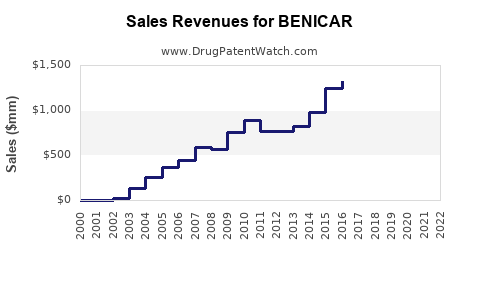
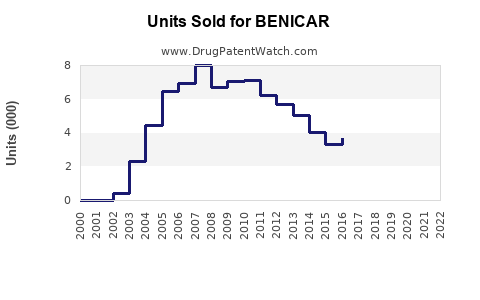
Annual Sales Revenues and Units Sold for BENICAR
| Drug Name | Revenues (USD) | Units | Year |
|---|---|---|---|
| BENICAR | ⤷ Start Trial | ⤷ Start Trial | 2022 |
| BENICAR | ⤷ Start Trial | ⤷ Start Trial | 2021 |
| BENICAR | ⤷ Start Trial | ⤷ Start Trial | 2020 |
| BENICAR | ⤷ Start Trial | ⤷ Start Trial | 2019 |
| BENICAR | ⤷ Start Trial | ⤷ Start Trial | 2018 |
| BENICAR | ⤷ Start Trial | ⤷ Start Trial | 2017 |
| BENICAR | ⤷ Start Trial | ⤷ Start Trial | 2016 |
| >Drug Name | >Revenues (USD) | >Units | >Year |
Benicar Market Analysis and Sales Projections: Olmesartan Patent, Generic Competition, and Commercial Outlook
Benicar, the branded formulation of olmesartan medoxomil, is a mature antihypertensive product with limited remaining branded revenue potential. Daiichi Sankyo’s principal commercial exposure shifted from branded Benicar to generic olmesartan after U.S. patent protection ended in 2016. Future market value is concentrated in low-cost generic tablets, combination products such as Benicar HCT and Azor, and international markets where generic penetration and reimbursement differ.
The base-case outlook is for continued unit demand but declining nominal sales, driven by generic price erosion, formulary substitution, and therapeutic competition from other angiotensin II receptor blockers, including losartan, valsartan, irbesartan, telmisartan, and candesartan.
What is Benicar and how large is the olmesartan market?
Benicar is the U.S. brand name for olmesartan medoxomil, an angiotensin II receptor blocker used to treat hypertension. The product is administered as an oral tablet, generally once daily. Benicar is also marketed in combination products:
| Product | Active ingredients | Principal use | Commercial status |
|---|---|---|---|
| Benicar | Olmesartan medoxomil | Hypertension | Mature brand; generic competition |
| Benicar HCT | Olmesartan medoxomil and hydrochlorothiazide | Hypertension | Mature combination product; generic competition |
| Azor | Olmesartan medoxomil and amlodipine | Hypertension | Mature combination product; generic competition |
| Tribenzor | Olmesartan medoxomil, amlodipine and hydrochlorothiazide | Hypertension | Mature triple-combination product; generic competition |
The addressable market is the global oral antihypertensive market, but Benicar competes within the narrower ARB segment. The market has high prescription volume, low product differentiation, and substantial generic substitution. Treatment guidelines generally permit physicians to choose among several ARBs based on price, tolerability, comorbidities, and formulary placement.
Benicar’s strongest commercial period occurred before generic entry, when branded pricing and combination-product prescriptions supported high revenue. The product no longer has the characteristics of a growth pharmaceutical asset. Its value is primarily in residual prescriptions, authorized generic arrangements, supply contracts, and regional markets with slower substitution.
When did Benicar lose patent protection and exclusivity?
Benicar’s U.S. market exclusivity ended in stages. Regulatory exclusivity ended well before the principal patent barriers, while generic competition became commercially meaningful after the core patent term expired.
| Milestone | Date or period | Commercial effect |
|---|---|---|
| U.S. FDA approval of Benicar NDA 021286 | April 2002 | Established U.S. branded market |
| U.S. FDA approval of Benicar HCT | 2003 | Expanded into fixed-dose combination therapy |
| U.S. FDA approval of Azor | 2006 | Added amlodipine combination product |
| New chemical entity exclusivity | Expired approximately 2007 | Removed the first major regulatory barrier to ANDA filing |
| Core U.S. patent term | Expired in 2016 | Opened the principal pathway for commercial generic entry |
| Generic olmesartan launches | From 2016 onward | Accelerated price and share erosion |
The principal U.S. patent estate was associated with olmesartan compounds, compositions, and related pharmaceutical formulations. Patent expiry dates varied by product, jurisdiction, and patent listing. U.S. generic approvals were governed by the FDA Orange Book and applicable listed patents, including patents covering the active ingredient, combinations, and methods of use where relevant. [1]
Benicar did not retain a commercially meaningful period of post-patent branded exclusivity. The product is now exposed to standard generic competition rather than a protected specialty or biologic market.
What patents protect Benicar and its combination products?
The Benicar patent estate historically covered several technical layers:
- Olmesartan and related angiotensin II receptor antagonist compounds.
- Pharmaceutical compositions containing olmesartan medoxomil.
- Combination products containing olmesartan with hydrochlorothiazide or amlodipine.
- Dosage forms and treatment methods.
- Manufacturing and formulation processes in certain jurisdictions.
The most commercially important protection was the composition and product patent coverage that delayed ANDA commercialization. Formulation and combination patents provided additional barriers, but those protections were narrower than the principal active-ingredient protection and were vulnerable to design-around strategies.
What formulations are protected by Benicar patents?
The principal formulation categories were:
- Olmesartan medoxomil immediate-release tablets.
- Olmesartan medoxomil plus hydrochlorothiazide tablets.
- Olmesartan medoxomil plus amlodipine tablets.
- Triple-combination tablets containing olmesartan, amlodipine, and hydrochlorothiazide.
Generic manufacturers can enter through separate ANDAs for each strength and combination. A generic competitor that receives approval for olmesartan alone does not automatically obtain approval for every combination product. Each product requires its own regulatory showing, including bioequivalence and labeling compliance.
Manufacturing patents have less commercial leverage after product patent expiry unless they cover a process that is difficult to avoid or is linked to a required quality attribute. For a mature oral tablet, manufacturing patents generally create a lower barrier than active-ingredient or formulation patents.
What is the Orange Book status of Benicar?
Benicar, Benicar HCT, and Azor were approved under separate FDA new drug applications. Their Orange Book treatment depends on whether each NDA remains actively marketed and whether listed patents remain eligible for inclusion.
The FDA identifies discontinued products separately from actively marketed products. A product can remain relevant to generic approval history even after the original brand is discontinued, because the reference listed drug establishes the regulatory basis for ANDA approval. [1]
The practical Orange Book position is:
- Benicar is an established reference product for olmesartan medoxomil tablets.
- Generic olmesartan products have been approved in multiple strengths.
- Combination products have separate reference-product and patent histories.
- Historical listed patents are no longer an effective broad barrier to ordinary generic entry after expiration.
- Current commercial disputes are more likely to concern supply, manufacturing, labeling, or market access than basic patent exclusivity.
Which companies challenged Benicar patents through Paragraph IV filings?
Generic companies seeking early entry would typically use an ANDA with a Paragraph IV certification when asserting that a listed patent was invalid, unenforceable, or not infringed. Innovator patent holders commonly respond by filing infringement litigation within the 45-day statutory period, which can trigger a 30-month stay of ANDA approval under the Hatch-Waxman Act. [2]
Historical generic competition around olmesartan involved major suppliers of oral antihypertensives, including companies such as Teva, Mylan, Apotex, and other ANDA sponsors. The commercial result was a broad generic market rather than a single first entrant retaining durable pricing power.
The importance of the Paragraph IV disputes has declined because the relevant U.S. patent barriers have expired. Any current challenge would have limited strategic value unless it concerned a later-issued formulation, a combination product, or a manufacturing process with separate enforceable rights.
What FDA regulatory issues affect Benicar sales?
The principal regulatory issue associated with Benicar was olmesartan-linked sprue-like enteropathy. In 2013, the FDA required label changes after reports of severe chronic diarrhea and substantial weight loss in some patients using olmesartan. The FDA noted that symptoms could improve after discontinuation of the medicine. [3]
The labeling action affected risk perception and may have influenced prescribing in some patient populations. It did not remove Benicar from the market, and olmesartan remained an approved treatment for hypertension.
The regulatory impact is commercially relevant in three ways:
- Physicians may choose another ARB for patients with gastrointestinal symptoms or relevant clinical histories.
- Generic labels remain subject to FDA-approved safety information.
- A mature brand cannot generally offset a safety-related demand effect through premium pricing or promotional expansion.
The event also produced product-liability and consumer litigation exposure. That exposure is distinct from patent risk and is more relevant to reserve requirements, settlement costs, and brand reputation than to future exclusivity.
How strong is the Benicar patent estate?
The current Benicar patent estate is weak as a barrier to ordinary generic entry because the principal U.S. exclusivity period has ended.
| Patent-estate factor | Assessment | Commercial implication |
|---|---|---|
| Active-ingredient protection | Expired in the U.S. | No broad blocking position |
| Regulatory exclusivity | Expired | ANDA pathway available |
| Combination-product protection | Largely expired or commercially limited | Some product-specific entry timing differences |
| Formulation protection | Narrow and jurisdiction-dependent | Potential design-around risk |
| Manufacturing protection | Process-specific | Limited leverage unless difficult to avoid |
| Method-of-use protection | Limited value in a broad hypertension market | Label carve-outs may reduce impact |
| International coverage | Uneven by country | Local opportunity remains in selected markets |
The estate is therefore weak for U.S. lifecycle defense but may retain residual value in countries where patent terms, generic registration, reimbursement, and enforcement differ.
How does Benicar compare with competing ARB drugs?
Benicar’s clinical and commercial profile differs from competing ARBs mainly through price, tolerability, combination availability, and prescribing familiarity.
| Drug | Generic availability | Competitive position |
|---|---|---|
| Olmesartan | Broadly available | Lower-cost mature ARB; residual brand demand |
| Losartan | Broadly available | High-volume first-line generic competitor |
| Valsartan | Broadly available | Strong combination and cardiovascular franchise |
| Irbesartan | Broadly available | Established hypertension and diabetic nephropathy use |
| Telmisartan | Broadly available | Long half-life and combination positioning |
| Candesartan | Broadly available | Strong heart-failure and hypertension positioning |
Benicar’s commercial disadvantage is the absence of a meaningful brand premium. Its advantage is continued physician familiarity and the availability of fixed-dose combinations. Those advantages support prescription persistence but do not prevent price erosion.
No biosimilar risk applies because olmesartan medoxomil is a small-molecule chemical drug, not a biologic. Competition proceeds through the ANDA generic pathway rather than the biosimilar pathway under the Public Health Service Act. [4]
What are Benicar’s current sales and revenue drivers?
Standalone current Benicar sales are difficult to separate from broader olmesartan and combination-product reporting because originator companies commonly report products at franchise or regional level after generic entry. The principal revenue drivers are:
- Generic or authorized-generic volume.
- Residual branded prescriptions in less price-sensitive channels.
- Fixed-dose combination demand.
- International markets with slower generic substitution.
- Supply and distribution arrangements.
- Reimbursement status and formulary tier placement.
The principal revenue detractors are:
- Multiple approved generic suppliers.
- Pharmacy benefit manager substitution.
- Annual price reductions.
- Therapeutic substitution to other ARBs.
- Generic combination products.
- Reduced promotional spending on a mature brand.
- Safety-related prescribing concerns.
Daiichi Sankyo’s later growth strategy has centered on oncology, cardiovascular innovation, and specialty products rather than Benicar. That strategic shift reduces the likelihood of substantial new investment in Benicar promotion or lifecycle management. [5]
What are the Benicar sales projections through 2028?
Because Benicar is a mature, largely genericized product, a unit-based scenario is more reliable than a single nominal revenue forecast. The following index uses 2024 global olmesartan franchise revenue as 100. It is an analytical model, not company-reported guidance.
| Scenario | 2025 | 2026 | 2027 | 2028 | Assumption |
|---|---|---|---|---|---|
| Downside | 82 | 66 | 53 | 43 | Rapid price erosion and broad generic substitution |
| Base case | 88 | 77 | 68 | 60 | Stable volume with moderate annual price decline |
| Upside | 94 | 89 | 84 | 79 | Slower generic penetration and stronger combination-product demand |
The base case implies approximately 40% nominal revenue erosion from 2024 to 2028. Unit demand would decline more slowly than revenue because hypertension is a chronic condition with a large treated population. The product’s revenue elasticity is therefore driven more by price and mix than by complete loss of demand.
A reasonable commercial forecast is:
- Branded Benicar revenue: continuing decline and limited strategic relevance.
- Generic olmesartan revenue: stable to declining in units, with lower prices.
- Combination products: slower erosion than single-agent tablets where physicians and patients value convenience.
- International revenue: uneven, with some markets retaining higher average selling prices.
- U.S. revenue: most exposed to pharmacy substitution and purchasing consolidation.
What generic launch scenarios exist for Benicar?
Three scenarios define the remaining commercial outlook.
Continued generic commoditization
This is the base case. Multiple suppliers compete for pharmacy and payer contracts. Prices fall, but prescription volume remains substantial because hypertension therapy is chronic and generic ARBs remain clinically established.
Combination-product resilience
Fixed-dose olmesartan combinations may decline more slowly if they improve adherence or reduce pill burden. Their protection is not sufficient to restore the former Benicar franchise, but combinations can support a higher-value residual segment.
Regional branded persistence
In markets with slower generic adoption, physician prescribing habits, fragmented distribution, or brand-sensitive patients, Benicar may retain a small branded position. This is a regional opportunity rather than a global growth thesis.
What patent litigation and settlement agreements affect Benicar?
The material patent litigation period occurred before and around generic entry. Hatch-Waxman disputes, ANDA certifications, and possible settlements influenced the timing of generic launches. Once the core patents expired and multiple generic manufacturers entered, litigation ceased to be a meaningful barrier to market access.
Current investment analysis should focus on:
- Whether any later-listed patent remains enforceable.
- Whether a combination-product patent creates a separate launch date.
- Whether an authorized generic agreement changes channel economics.
- Whether product-liability settlements affect cash flow.
- Whether manufacturing or supply litigation disrupts availability.
There is no current basis for treating Benicar as an actively litigated, patent-protected growth asset.
What generic entry risks exist for Benicar investors?
The main risks are commercial rather than exclusivity-based:
- Further U.S. price compression.
- Loss of branded formulary placement.
- Consolidation among generic suppliers and wholesalers.
- Substitution toward lower-cost ARBs.
- Safety-related prescribing restrictions.
- Supply interruptions or manufacturing observations.
- Declining relevance of the legacy brand to the originator.
- Combination-product erosion from separate generic components.
The principal upside is limited to volume durability, international pricing, and combination-product retention. Patent-based upside is minimal in the United States.
Key Takeaways
- Benicar is olmesartan medoxomil, an established ARB for hypertension.
- U.S. regulatory exclusivity ended years before the core patent expired.
- The principal U.S. patent barrier ended in 2016, enabling broad generic competition.
- Benicar, Benicar HCT, and Azor have separate regulatory and patent histories.
- No biosimilar risk applies; competition is through the generic ANDA pathway.
- Olmesartan demand should remain durable because hypertension treatment is chronic.
- Revenue should decline faster than prescription volume because of generic price erosion.
- The base-case model projects a 40% decline in franchise revenue from 2024 to 2028.
- Combination products and international markets offer the strongest residual value.
- Benicar is no longer a credible U.S. patent-protected growth asset.
FAQs About Benicar Market Size, Patents, and Generic Competition
Is Benicar still sold in the United States?
Generic olmesartan products are widely available. Branded Benicar’s commercial presence is substantially smaller than before generic entry, and product availability can vary by channel and manufacturer.
What is the generic name for Benicar?
The generic name is olmesartan medoxomil. Generic tablets are available in multiple strengths and may be marketed by several manufacturers.
Does Benicar have patent protection in 2025?
The principal U.S. patent protection that delayed generic entry has expired. Any remaining rights would need to be assessed at the specific product, patent, and jurisdiction level.
Are Benicar HCT and Azor exposed to the same generic risks?
Yes, but each combination product has its own ANDA approvals, patent history, and launch timing. Generic competition can enter the single-agent and combination markets on different schedules.
Is olmesartan a growth opportunity for pharmaceutical investors?
Olmesartan is more consistent with a mature generic-volume opportunity than a branded growth opportunity. Potential returns depend on manufacturing cost, procurement scale, geographic pricing, and combination-product share rather than patent exclusivity.
References
-
U.S. Food and Drug Administration. (n.d.). Approved drug products with therapeutic equivalence evaluations: Orange Book. https://www.accessdata.fda.gov/scripts/cder/ob/
-
U.S. Food and Drug Administration. (n.d.). Abbreviated new drug application approvals and patent certifications. https://www.fda.gov/drugs
-
U.S. Food and Drug Administration. (2013). FDA approves label changes to include intestinal problems associated with Benicar. https://www.fda.gov/drugs
-
U.S. Food and Drug Administration. (n.d.). Generic drugs and biosimilar biological products. https://www.fda.gov/drugs
-
Daiichi Sankyo Co., Ltd. (n.d.). Annual reports and financial results. https://www.daiichisankyo.com/investors/financial-results/
More… ↓
