You're using a free limited version of DrugPatentWatch: Upgrade for Complete Access

Last Updated: January 1, 2026

Drug Sales Trends for AMLOD/VALSAR


✉ Email this page to a colleague

« Back to Dashboard


Payment Methods and Pharmacy Types for AMLOD/VALSAR (2016)

Revenues by Pharmacy Type

Pharmacy Type Revenues
MAIL-ORDER $7,338,526
INSIDE ANOTHER STORE $2,611,729
[disabled in preview] $39,336,364
This preview shows a limited data set
Subscribe for full access, or try a Trial

Units Sold by Pharmacy Type

Pharmacy Type Units
MAIL-ORDER 121,786
INSIDE ANOTHER STORE 69,539
[disabled in preview] 719,674
This preview shows a limited data set
Subscribe for full access, or try a Trial

Revenues by Payment Method

Payment Method Revenues
MEDICARE $13,621,255
PRIVATE INSURANCE $16,396,615
[disabled in preview] $18,767,461
This preview shows a limited data set
Subscribe for full access, or try a Trial
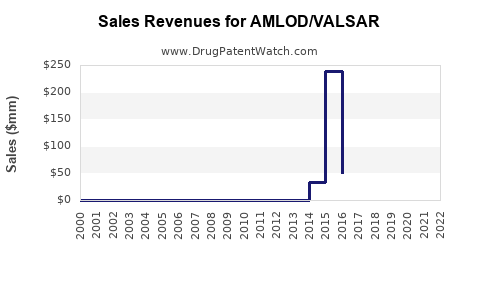
Drug Sales Revenue Trends for AMLOD/VALSAR
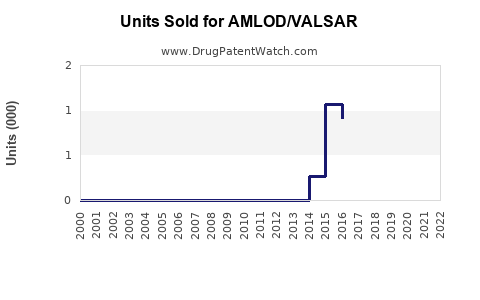
Drug Units Sold Trends for AMLOD/VALSAR

Annual Sales Revenues and Units Sold for AMLOD/VALSAR

These sales figures are drawn from a US national survey of drug expenditures
Drug Name Revenues (USD) Units Year
AMLOD/VALSAR ⤷  Get Started Free ⤷  Get Started Free 2022
AMLOD/VALSAR ⤷  Get Started Free ⤷  Get Started Free 2021
AMLOD/VALSAR ⤷  Get Started Free ⤷  Get Started Free 2020
AMLOD/VALSAR ⤷  Get Started Free ⤷  Get Started Free 2019
>Drug Name >Revenues (USD) >Units >Year

Market Analysis and Sales Projections for Amlod/Valsar

Last updated: July 29, 2025


Overview

Amlod/Valsar is a fixed-dose combination (FDC) drug that integrates amlodipine besylate, a calcium channel blocker, and valsartan, an angiotensin II receptor blocker (ARB). Designed primarily to treat hypertension and manage heart failure, this combination offers the dual benefits of vascular relaxation and blood pressure control. As cardiovascular diseases remain a leading global health concern, the market potential for Amlod/Valsar is substantial, contingent upon competitive positioning, regulatory approval, and clinical efficacy.


Market Context and Rationale

Hypertension affects over 1 billion individuals worldwide and is a primary risk factor for stroke, heart attack, and chronic kidney disease [1]. The therapeutic landscape favors combination therapies for better adherence, especially in patients requiring multiple medications. Fixed-dose combinations (FDCs) enhance compliance, reduce pill burden, and improve cardiovascular outcomes. Amlod/Valsar leverages this clinical strategy, aligning with current treatment guidelines promoting multifaceted antihypertensive regimens.

The global antihypertensive drugs market was valued at approximately USD 24 billion in 2022 and is projected to grow at a CAGR of 4% through 2030 [2]. The increasing prevalence of hypertension, aging populations, and the shift toward personalized medicine further contribute to its expansion. Amlod/Valsar, also positioned under the broader ARB and calcium channel blocker categories, taps into a therapeutic niche with steady demand.


Market Segmentation and Target Demographics

  1. Geographic Markets

    • North America: Established healthcare infrastructure, high awareness for combination therapy, and favorable reimbursement policies support strong sales. The U.S. dominates this region, with an estimated antihypertensive market share of over USD 10 billion [3].
    • Europe: Similar to North America but with varying reimbursement policies; the European market is expected to grow as hypertension diagnosis and management improve.
    • Asia-Pacific: The fastest-growing segment, driven by rising prevalence of hypertension, economic development, and expanding healthcare access. Countries like China and India exhibit annual growth rates exceeding 7% in antihypertensive sales [4].
  2. Patient Demographics

    • Adults aged 45 and above, with higher prevalence in older populations.
    • Patients with comorbidities such as diabetes or chronic kidney disease—groups aligned with the benefits of combined therapy.
    • Adherence-focused population seeking simplified medication regimens.
  3. Physician Segments

    • Cardiology and primary care physicians prescribing antihypertensive monotherapies and FDCs.
    • Clinical guidelines strongly recommend combination therapy when target blood pressure is not achieved with monotherapy, favoring products like Amlod/Valsar.

Competitive Landscape

Several branded and generic formulations of amlodipine and valsartan exist, but fixed-dose combinations featuring both agents are comparatively less prevalent, especially in certain markets. Key competitors include:

  • Brand Name Combinations:

    • Exforge (amlodipine/valsartan) by Novartis—approved globally and a market leader.
    • Valmox (amlodipine/valsartan)—marketed in select regions.
  • Generic/Branded Variants: Numerous generics for each component, with some offering their own FDCs.

The strategic differentiation for Amlod/Valsar hinges on formulation advantages, price competitiveness, patent status, and regional approval.


Sales Projections and Market Penetration

Baseline Scenario (Conservative)

  • Year 1–2: Launch phase with limited penetration in key markets. Expecting 0.5%–1% of hypertension treated population adopting Amlod/Valsar.
  • Year 3–5: Increased adoption as physicians become familiar, regulatory approvals expand, and brand awareness grows. Projected cumulative sales reach USD 150–250 million globally by year 5.
  • Market Share Assumptions: Within a competitive landscape, capturing 2%–3% of the fixed-dose combination antihypertensive market in mature regions and 1%–2% in emerging markets.

High-Scenario (Aggressive Adoption)

  • Early regulatory approvals and aggressive marketing may accelerate growth, capturing 5% market share globally by year 5.
  • Projected sales could surpass USD 500 million, particularly if combined with strategic alliances and favorable formulary placements.

Key Factors Influencing Sales

  • Regulatory Approvals: Fast-trackizations or orphan drug statuses could expedite market entry.
  • Pricing Strategy: Competitive pricing in line with generics could facilitate adoption in cost-sensitive markets.
  • Clinical Evidence: Supporting data demonstrating superior efficacy or safety enhances prescriber confidence.
  • Reimbursement Policies: Favorable coverage significantly impacts product uptake.

Revenue Drivers

  • Patent status and exclusivity rights directly influence sales potential.
  • Manufacturing scalability to meet demand while maintaining quality.
  • Strategic partnerships with regional distributors and healthcare providers.

Regulatory and Market Entry Challenges

  • Patent Expirations: Patents on key components or formulations may allow generic competition, impacting pricing and market share.
  • Regional Approvals: Navigating diverse regulatory pathways (FDA, EMA, etc.) requires tailored dossiers and can delay launches.
  • Clinician Acceptance: Convincing prescribers to switch or adopt new formulations hinges on demonstrated clinical benefits and safety profile.
  • Pricing Pressure: Governments and insurers increasingly scrutinize drug prices, especially in markets heavily influenced by generics.

Conclusion

Amlod/Valsar presents a promising opportunity within the hypertensive therapeutic landscape, leveraging the growing demand for combination therapies. Success hinges on strategic regulatory navigation, competitive pricing, robust clinical data, and effective penetration strategies. The market could generate between USD 150 million to over USD 500 million in sales within five years, contingent upon multiple factors.


Key Takeaways

  • The global antihypertensive market is expanding, driven by aging populations and increasing hypertension prevalence.
  • Amlod/Valsar’s strong clinical positioning as a fixed-dose combination aligns with current treatment guidelines and patient adherence needs.
  • Competitive landscape favors established products like Exforge; differentiation will depend on formulation, price, and regulatory success.
  • Conservative sales projections indicate USD 150–250 million in five years; aggressive strategies could push figures beyond USD 500 million.
  • Success strategies include rapid regulatory approval, establishing reimbursement pathways, and building prescriber confidence through clinical data.

FAQs

1. What are the primary advantages of Amlod/Valsar over existing antihypertensive therapies?
Amlod/Valsar offers a convenient fixed-dose combination that improves patient adherence, reduces pill burden, and potentially enhances blood pressure control compared to monotherapy.

2. How does the competitive landscape impact the sales potential of Amlod/Valsar?
Existing branded combinations like Exforge dominate the market; entering requires competitive pricing, clinical differentiation, and regulatory approval to achieve significant share.

3. Which markets offer the greatest growth opportunity for Amlod/Valsar?
Emerging markets like China and India show the highest growth potential due to rising hypertension prevalence and expanding healthcare infrastructure. Mature markets like North America and Europe provide stable revenue streams.

4. What are the main regulatory considerations for launching Amlod/Valsar?
Regulatory approvals depend on regional agencies' requirements, patent status, and clinical trial data sufficiency. Life-cycle management strategies must address patent expiries and post-marketing surveillance.

5. How can market entry be optimized to maximize sales?
Accelerating approvals, establishing reimbursement, engaging key opinion leaders, offering competitive pricing, and investing in clinical evidence are critical success factors.


Sources
[1] World Health Organization. Hypertension Fact Sheet. 2022.
[2] Grand View Research. Antihypertensive Drugs Market Size & Trends. 2022.
[3] IQVIA. Global Pharmaceutical Market Overview. 2022.
[4] Asia-Pacific Market Analysis Report. Cardiovascular Drugs. 2022.

More… ↓

⤷  Get Started Free

Make Better Decisions: Try a trial or see plans & pricing

Drugs may be covered by multiple patents or regulatory protections. All trademarks and applicant names are the property of their respective owners or licensors. Although great care is taken in the proper and correct provision of this service, thinkBiotech LLC does not accept any responsibility for possible consequences of errors or omissions in the provided data. The data presented herein is for information purposes only. There is no warranty that the data contained herein is error free. We do not provide individual investment advice. This service is not registered with any financial regulatory agency. The information we publish is educational only and based on our opinions plus our models. By using DrugPatentWatch you acknowledge that we do not provide personalized recommendations or advice. thinkBiotech performs no independent verification of facts as provided by public sources nor are attempts made to provide legal or investing advice. Any reliance on data provided herein is done solely at the discretion of the user. Users of this service are advised to seek professional advice and independent confirmation before considering acting on any of the provided information. thinkBiotech LLC reserves the right to amend, extend or withdraw any part or all of the offered service without notice.