Share This Page
Drug Sales Trends for ACANYA
✉ Email this page to a colleague
Payment Methods and Pharmacy Types for ACANYA (2016)
Revenues by Pharmacy Type
Units Sold by Pharmacy Type
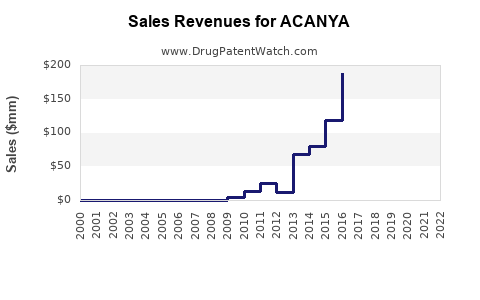
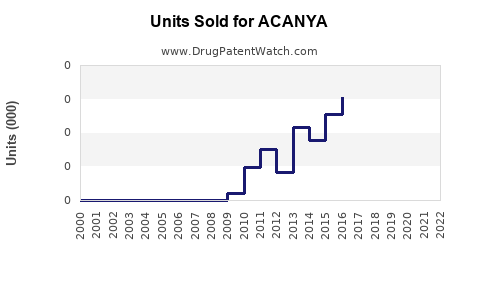
Annual Sales Revenues and Units Sold for ACANYA
| Drug Name | Revenues (USD) | Units | Year |
|---|---|---|---|
| ACANYA | ⤷ Start Trial | ⤷ Start Trial | 2022 |
| ACANYA | ⤷ Start Trial | ⤷ Start Trial | 2021 |
| ACANYA | ⤷ Start Trial | ⤷ Start Trial | 2020 |
| ACANYA | ⤷ Start Trial | ⤷ Start Trial | 2019 |
| ACANYA | ⤷ Start Trial | ⤷ Start Trial | 2018 |
| ACANYA | ⤷ Start Trial | ⤷ Start Trial | 2017 |
| ACANYA | ⤷ Start Trial | ⤷ Start Trial | 2016 |
| >Drug Name | >Revenues (USD) | >Units | >Year |
ACANYA Market Analysis and Sales Projections
ACANYA, a topical combination of clindamycin phosphate 1.2% and benzoyl peroxide 2.5%, is a mature acne product with limited current commercial value as a branded medicine. Its principal market was created by the convenience of combining an antibiotic and benzoyl peroxide in one gel. That advantage has weakened because generic clindamycin/benzoyl peroxide products are available and physicians have shifted toward non-antibiotic acne therapies, including adapalene, tretinoin, dapsone, azelaic acid, and newer retinoid products.
A reasonable base-case estimate for current U.S. annual sales attributable to the ACANYA molecule and equivalent combination products is approximately $25 million to $50 million at pharmacy acquisition value. Brand ACANYA sales alone are likely substantially lower. Under current market conditions, a durable branded-sales recovery is unlikely without a new formulation, pricing strategy, or licensing transaction.
What is ACANYA and what is it used for?
ACANYA Gel is a prescription topical treatment for acne vulgaris in patients age 12 and older. Each gram contains:
| Component | Concentration | Pharmacologic role |
|---|---|---|
| Clindamycin phosphate | 1.2% | Topical lincosamide antibiotic |
| Benzoyl peroxide | 2.5% | Antimicrobial and keratolytic agent |
The product is applied once daily to affected areas. Clindamycin reduces Cutibacterium acnes and inflammatory lesions, while benzoyl peroxide has antimicrobial activity and reduces the risk of antibiotic resistance associated with topical clindamycin monotherapy.
The U.S. Food and Drug Administration approved ACANYA under NDA 022111 in 2008. The product was commercialized by subsidiaries associated with Medicis Pharmaceutical Corporation and later Valeant Pharmaceuticals, which became Bausch Health Companies. The FDA prescribing information identifies acne vulgaris as the approved indication and includes warnings for antibiotic-associated colitis and irritation. [1]
What is the current market status of ACANYA?
ACANYA is a mature, low-growth product. Its commercial position has been affected by four factors:
- Generic versions of clindamycin phosphate and benzoyl peroxide gel are available.
- Topical antibiotic stewardship has reduced long-term use of antibiotic-containing acne products.
- Generic dispensing has sharply compressed reimbursement and net pricing.
- The brand has limited differentiation from other combination products.
ACANYA remains clinically relevant where prescribers want a single product containing benzoyl peroxide and clindamycin. Its commercial relevance is narrower because generic products provide substantially similar active ingredients at lower cost.
Product positioning
ACANYA competes in the prescription topical acne segment with:
- Generic clindamycin phosphate/benzoyl peroxide gel
- Duac and equivalent products
- Benzaclin and equivalent products
- Epiduo and generic adapalene/benzoyl peroxide
- Tactupump and generic adapalene/benzoyl peroxide
- Ziana and generic clindamycin/tretinoin
- Onexton and generic clindamycin phosphate/benzoyl peroxide
- Aczone and generic dapsone gel
- Arazlo, Altreno, and other topical retinoid products
The most direct competition is from other fixed-dose clindamycin/benzoyl peroxide formulations. The wider competitive threat comes from retinoid-based regimens, which are often preferred for maintenance therapy because antibiotic exposure is generally limited.
How large is the ACANYA addressable market?
The addressable market is the U.S. prescription topical acne market, not the entire acne-treatment market. Acne is highly prevalent, but most patients use over-the-counter benzoyl peroxide, salicylic acid, adapalene, or lower-cost generic prescriptions.
A practical market segmentation is:
| Segment | Relevance to ACANYA | Commercial outlook |
|---|---|---|
| Mild inflammatory acne | Moderate | Often treated with OTC products or topical retinoids |
| Moderate inflammatory acne | High | Core prescriber target for combination topical therapy |
| Severe acne | Low | Often treated with oral antibiotics, hormonal therapy, or isotretinoin |
| Maintenance therapy | Low | Long-term topical antibiotics are generally avoided |
| Pediatric and adolescent acne | Moderate to high | Important historical prescribing segment |
| Adult female acne | Moderate | Often overlaps with hormonal or retinoid therapies |
The product’s practical market is therefore a subset of moderate inflammatory acne cases requiring prescription treatment. Its use is usually front-loaded during active inflammatory disease rather than maintained indefinitely.
What are ACANYA sales projections?
No public company filing provides a reliable, standalone current revenue figure for ACANYA. The product has been part of broader dermatology portfolios, and public disclosures have generally aggregated products by business unit rather than reporting ACANYA separately.
The following projection is a market model for ACANYA and therapeutically equivalent clindamycin/benzoyl peroxide products in the United States. It is not a reported company forecast.
U.S. sales projection
| Year | Bear case | Base case | Upside case |
|---|---|---|---|
| 2024 | $15 million | $35 million | $60 million |
| 2025 | $13 million | $33 million | $58 million |
| 2026 | $11 million | $31 million | $55 million |
| 2027 | $9 million | $29 million | $52 million |
| 2028 | $8 million | $27 million | $49 million |
| 2029 | $7 million | $25 million | $46 million |
The model assumes declining prescription volume, generic price pressure, and continued substitution toward retinoid-based products. The base case implies a compound annual decline of roughly 6% from 2024 through 2029.
Projection assumptions
The base case assumes:
- U.S. combination-product prescriptions remain stable to modestly down.
- Generic products capture most volume.
- Average net revenue per prescription declines by 3% to 6% annually.
- No major new indication is approved.
- No material supply disruption affects generic competitors.
- Antibiotic stewardship limits chronic use.
- Brand ACANYA does not regain broad formulary preference.
The upside case requires a commercial event such as a branded relaunch, a materially improved vehicle, a lower-cost authorized generic, or a licensing arrangement that expands distribution. The bear case reflects further generic substitution and erosion of the fixed-dose topical antibiotic market.
How does ACANYA compare with competing acne drugs?
ACANYA versus generic clindamycin/benzoyl peroxide
This is the closest competitive comparison. Both products deliver the same active ingredients at similar concentrations. ACANYA can retain value through vehicle characteristics, packaging, tolerability, or prescriber familiarity, but those advantages are difficult to monetize after generic entry.
ACANYA versus adapalene/benzoyl peroxide
Adapalene/benzoyl peroxide products have a stronger maintenance position because adapalene is a retinoid rather than an antibiotic. They compete for many of the same moderate-acne patients but have different treatment logic. ACANYA is more directly positioned for inflammatory lesions, while adapalene/benzoyl peroxide is often used for broader lesion prevention and maintenance.
ACANYA versus clindamycin/tretinoin
Clindamycin/tretinoin combinations offer antibiotic treatment with a retinoid. They may be preferred where comedonal acne is prominent. Their commercial performance is also exposed to generic pricing and antibiotic stewardship.
ACANYA versus oral isotretinoin
Oral isotretinoin is used for severe or refractory acne and is not a direct substitute for ACANYA in most cases. It is relevant to market sizing because patients with more severe disease may bypass topical combination therapy entirely.
What patents protect ACANYA?
ACANYA’s original commercial protection centered on the composition, formulation, and delivery of clindamycin phosphate with benzoyl peroxide in a topical gel. The relevant intellectual-property categories include:
- Fixed-dose clindamycin and benzoyl peroxide compositions
- Stabilized topical formulations
- Gel vehicles and compatibility systems
- Manufacturing methods for combining the active ingredients
- Packaging systems designed to preserve formulation stability
- Treatment methods for acne vulgaris
The principal commercial patent barrier has expired or lost practical exclusivity in the United States. Generic competition confirms that the product no longer depends on a blocking U.S. patent estate for market access.
What formulations are protected by ACANYA patents?
The commercially relevant protection was directed to the combination and formulation rather than to new chemical entities. That distinction matters because:
- Clindamycin is an established antibiotic.
- Benzoyl peroxide is an established topical antimicrobial.
- The formulation challenge involved stability, compatibility, and delivery.
- Later competitors could design around formulation claims or wait for expiration.
- Generic approval could proceed once applicable patents and exclusivities no longer blocked approval.
A new formulation using a different vehicle, delivery system, concentration, or stability profile could support new patent filings. Such patents would protect only the newly claimed features and would not restore broad exclusivity for the original ACANYA concept.
When did ACANYA lose exclusivity?
ACANYA lost meaningful market exclusivity after expiration or removal of the patents and regulatory protections that had supported generic entry. The FDA Orange Book identifies patents and exclusivity information associated with approved products, but the commercial significance of those listings changes after patent expiration and generic approval. [2]
ACANYA’s regulatory exclusivity was short relative to its commercial life. The product received standard new-drug approval rather than biologic exclusivity. It did not receive orphan-drug exclusivity, pediatric exclusivity sufficient to create a major long-term barrier, or other specialized protection that would materially extend the product’s market life.
What is the Orange Book status of ACANYA?
ACANYA is an approved prescription drug listed under the FDA’s drug-product databases. Its original approval was under NDA 022111. Generic clindamycin phosphate and benzoyl peroxide products have entered the U.S. market through abbreviated new drug applications.
The key Orange Book implications are:
| Issue | ACANYA position |
|---|---|
| Reference listed drug | ACANYA |
| FDA pathway | NDA |
| Generic pathway | ANDA |
| Therapeutic category | Topical acne treatment |
| Active ingredients | Clindamycin phosphate and benzoyl peroxide |
| Current barrier | Limited patent-based barrier |
| Market effect | Generic substitution and price erosion |
An Orange Book listing does not guarantee continuing commercial exclusivity. The relevant questions are whether listed patents remain unexpired, whether generic approvals are active, and whether state substitution rules favor the generic equivalent.
Which companies compete with or challenge ACANYA?
The competitive field includes generic manufacturers and branded dermatology companies. Depending on the product and time period, relevant participants have included:
- Bausch Health and affiliated dermatology businesses
- Perrigo
- Teva Pharmaceuticals
- Mylan and its successor operations
- Taro Pharmaceuticals
- Actavis and its successor operations
- Glenmark Pharmaceuticals
- Prasco Laboratories
- Other ANDA sponsors of clindamycin/benzoyl peroxide products
Generic competition is more important than Paragraph IV litigation in the current commercial assessment. The major value transfer occurred through generic entry and reimbursement substitution rather than through a continuing, high-value patent dispute.
What Paragraph IV challenges affected ACANYA?
Paragraph IV certifications may have been filed against patents listed for ACANYA or related clindamycin/benzoyl peroxide products. Publicly available litigation records should be reviewed by NDA, patent number, and ANDA sponsor before relying on any specific historical litigation conclusion.
The current commercial issue is not whether an early generic challenge once existed. It is whether any enforceable patent, settlement restriction, pediatric extension, or regulatory block still limits generic supply. The presence of multiple generic equivalents indicates that any historical Paragraph IV barrier no longer supports a durable branded monopoly.
What patent litigation and settlements affect ACANYA?
ACANYA’s litigation value is limited today because the product is mature and generic competition is established. Historical disputes involving topical clindamycin/benzoyl peroxide products generally focused on:
- Formulation similarity
- Patent validity
- Patent infringement
- Paragraph IV certification
- Generic launch timing
- Settlement rights and launch dates
Settlement agreements could have affected the timing of generic entry, but they are unlikely to support material current revenue unless a settlement included unusual market-allocation or manufacturing restrictions. The Federal Trade Commission has scrutinized pharmaceutical settlements for potential anticompetitive effects, particularly where payment or delayed entry is alleged. [3]
Does ACANYA face biosimilar risk?
No. ACANYA is a small-molecule topical drug, not a biologic. Biosimilar law under the Public Health Service Act does not apply. Its competitive exposure is generic-drug risk under the Federal Food, Drug, and Cosmetic Act.
The relevant competitors are ANDA-approved generics, authorized generics, and therapeutically substitutable topical acne products.
What manufacturing and intellectual-property barriers remain?
The active ingredients are inexpensive and widely available. Manufacturing barriers are therefore modest. The most important technical issues are:
- Uniform dispersion of benzoyl peroxide
- Stability of clindamycin phosphate
- Control of particle size and viscosity
- Preservation and microbial control
- Packaging compatibility
- Batch-to-batch consistency
- Demonstration of pharmaceutical equivalence
These requirements can delay a generic launch or cause quality problems, but they do not create the same barrier as a complex injectable, inhaled product, or biologic. A manufacturer with dermatology production capability can compete if it achieves acceptable stability, scale, and regulatory compliance.
What licensing deals could increase ACANYA value?
ACANYA is more likely to be involved in a portfolio transaction than a standalone high-value licensing deal. Potential transaction structures include:
- Acquisition of a dermatology product portfolio
- Regional distribution rights
- Authorized-generic commercialization
- Contract manufacturing and supply
- Bundling with other topical acne products
- Licensing of an improved vehicle or delivery system
A standalone license would need a clear commercial advantage, such as access to a high-volume payer channel, a low-cost manufacturing platform, or a differentiated formulation. Rights to the original brand alone are unlikely to command significant upfront consideration.
What generic launch scenarios exist for ACANYA?
Scenario 1: Continued generic erosion
This is the most likely scenario. Generic products gain prescription share, net prices decline, and brand ACANYA becomes a low-volume product used by prescribers with product-specific preferences.
Scenario 2: Authorized-generic recovery
An authorized generic marketed by the brand owner or a partner could preserve some volume while reducing price. This would protect manufacturing economics but would not restore premium brand pricing.
Scenario 3: Reformulated product
A new formulation with improved tolerability, reduced irritation, enhanced stability, or a more convenient delivery system could obtain new patents and potentially support a relaunch. The commercial opportunity would depend on demonstrated clinical or adherence benefits.
Scenario 4: Category contraction
If antibiotic stewardship accelerates and retinoid-based therapies gain share, the entire fixed-dose topical antibiotic segment could contract faster than generic substitution alone would indicate.
What revenue exposure exists for the manufacturer?
ACANYA’s revenue exposure is likely small relative to the broader revenues of a diversified pharmaceutical company. Its value lies mainly in:
- Residual cash flow from brand prescriptions
- Portfolio-level cross-selling
- Dermatology sales-force utilization
- Manufacturing-network efficiency
- Potential authorized-generic economics
- Historical brand recognition among dermatologists
The product is unlikely to influence enterprise valuation unless it is part of a larger dermatology portfolio or litigation damages calculation.
Key Takeaways
- ACANYA is a mature topical acne product containing clindamycin phosphate 1.2% and benzoyl peroxide 2.5%.
- The FDA approved ACANYA under NDA 022111 in 2008.
- Generic competition has removed most of the product’s historical exclusivity value.
- The current U.S. market for ACANYA and equivalent products is reasonably modeled at $25 million to $50 million annually.
- Base-case sales are projected to decline from approximately $35 million in 2024 to $25 million in 2029.
- Brand-only revenue is likely materially below total category sales.
- ACANYA faces generic, not biosimilar, competition.
- The strongest commercial risks are generic price erosion, antibiotic stewardship, and substitution by retinoid-based therapies.
- A differentiated reformulation or authorized-generic strategy would be required to create a meaningful growth opportunity.
- Patent and litigation value is limited unless a new formulation generates enforceable claims.
FAQs
Is ACANYA still prescribed?
Yes, but prescribing is limited by generic availability and competition from retinoid-based acne treatments. Use is concentrated in patients with inflammatory acne who are appropriate for short-term topical antibiotic therapy.
Is generic ACANYA available?
Generic clindamycin phosphate and benzoyl peroxide topical products are available in the United States. Availability and pharmacy substitution may vary by manufacturer, product presentation, and payer.
Is ACANYA better than benzoyl peroxide alone?
ACANYA adds topical clindamycin to benzoyl peroxide and may provide greater treatment activity for inflammatory acne. Benzoyl peroxide alone avoids topical antibiotic exposure and is often used for maintenance or in combination with a topical retinoid.
Can ACANYA be used long term?
Long-term antibiotic use is generally limited because of resistance and tolerability concerns. Treatment duration is determined by the prescriber and the patient’s response.
Could a new ACANYA formulation receive patent protection?
Yes. A reformulated product could receive patents directed to a novel vehicle, stability system, delivery mechanism, concentration, packaging configuration, or method of treatment. Those patents would not automatically restore protection for the original ACANYA formulation.
References
-
U.S. Food and Drug Administration. (2008). ACANYA (clindamycin phosphate and benzoyl peroxide) gel prescribing information. FDA.
-
U.S. Food and Drug Administration. (n.d.). Approved drug products with therapeutic equivalence evaluations. FDA.
-
Federal Trade Commission. (2013). Authorized generic drugs: Short-term effects and long-term impact. Federal Trade Commission.
More… ↓
