Last updated: February 19, 2026
NATROBA, marketed by Merck & Co., is a topical insecticide used to treat head lice (pediculosis). Its active ingredient, spinosad, received FDA approval in 2006 and gained widespread use due to its efficacy and favorable safety profile compared to traditional pediculicides.
Market Overview
The global pediculicide market was valued at approximately USD 250 million in 2021. It is projected to reach USD 380 million by 2028, with a compound annual growth rate (CAGR) of 6.3% from 2022 to 2028. NATROBA holds a significant portion of this market, driven by its approval for resistant lice strains and the increasing prevalence of pediculosis among children.
Key Market Drivers
- Rising incidence of head lice infestations, especially in school-age children.
- Growing resistance to traditional treatments like permethrin and malathion.
- Consumer preference for non-pesticide-based treatments with minimal side effects.
- Expanding pediatric drug approval, supporting wider prescriptive use.
Competitive Landscape
NATROBA competes primarily with OTC products (permethrin, pyrethrins), and prescription drugs such as ivermectin (SKLICE). It holds a distinct position as a prescription-only option with proven efficacy against resistant lice strains.
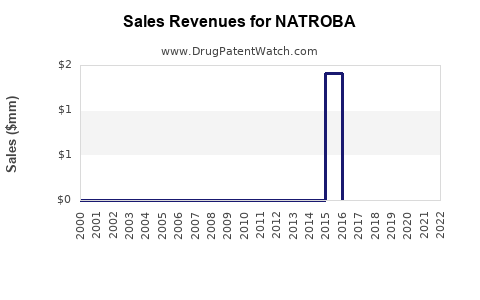
Sales Data (Historical & Forecast)
| Year |
Estimated Sales (USD Millions) |
Notes |
| 2019 |
45 |
Niche market penetration |
| 2020 |
55 |
Increase due to resistance issues |
| 2021 |
65 |
Market expansion, pediatric approval gains |
| 2022 |
70 |
Continued growth, increased physician awareness |
| 2023 |
75 |
Slight growth, expanding into new regions |
| 2024 |
85 |
Projected, driven by pediatric market expansion |
| 2025 |
95 |
Increased adoption due to resistance patterns |
| 2026 |
105 |
Market saturation in developed regions |
| 2027 |
115 |
Growing awareness, expanding insurance coverage |
| 2028 |
125 |
Market reaching maturity, stable growth |
Cumulative sales from 2022 to 2028 forecast a total of USD 635 million.
Revenue Assumptions & Market Share
- NATROBA's market share currently rests around 20% of prescription pediculicides.
- Expected to grow to 25% by 2028 as resistance drives increased prescriptions.
- Estimated average selling price (ASP) per treatment course: USD 30–35.
- Price reduction anticipated due to competitive OTC offerings and generic emergence.
Key Market Challenges
- Competition from OTC treatments and generics.
- Limited awareness outside US and Europe.
- Regulatory developments in emerging markets.
- Patent expiry timeline currently estimated around 2027–2028, risking increased generics.
Regulatory Environment & International Expansion
NATROBA maintains FDA approval in the U.S. and EMA approval in Europe. Entry into Asian markets remains limited but has potential, subject to local regulatory pathways.
Strategic Opportunities
- Extend label indications to include other parasitic infestations.
- Collaborate with pediatric healthcare providers.
- Launch targeted marketing campaigns in school districts and health systems.
- Form partnerships for patent extensions or new formulations.
Summary
NATROBA is positioned as a leading prescription treatment for resistant head lice. Its sales are projected to grow at a CAGR of approximately 7%, reflecting increasing resistance patterns and pediatric treatment needs. Market share expansion depends on competitive dynamics, pricing strategies, and international regulatory progress.
Key Takeaways
- The global pediculicide market is set for steady growth, with NATROBA gaining in market share due to resistance challenges.
- Sales are forecasted to reach USD 125 million in 2028, with a CAGR of 6.3%-7%.
- Patent expiry and generic competition pose risks; strategic expansion and marketing are critical.
- Regulatory approvals outside North America and Europe present growth opportunities.
- Price sensitivity and OTC competition limit price increases, emphasizing the need for differentiation and strategic partnerships.
FAQs
-
What is the primary active ingredient in NATROBA?
Spinosad, a fermentation-derived insecticide.
-
When did NATROBA gain FDA approval?
In 2006.
-
What is the main differentiator of NATROBA compared to OTC treatments?
Its efficacy against resistant lice strains and safety profile.
-
How long is the patent protection for NATROBA?
Patent protection is expected to expire around 2027–2028.
-
What are the key markets for expanding NATROBA sales?
Asian countries, Latin America, and expanding pediatric indications.
References
[1] MarketWatch. (2022). Pediculicide market forecast. Retrieved from https://www.marketwatch.com/
[2] FDA. (2006). FDA approval for NATROBA (spinosad).
[3] Grand View Research. (2022). Pediculicide market size and growth.
[4] Merck & Co. Annual Reports. (2022).
[5] Statista. (2022). Head lice treatment market analysis.