Last updated: February 15, 2026
Overview
BRISDELLE (amyeqibi) is an oral combination drug for the treatment of postmenopausal osteoporosis. It combines amyeqibi (a monoclonal antibody) and other components designed to inhibit bone resorption. The drug received FDA approval in 2022 and targets a market estimated to reach $14 billion globally by 2027.
Market Size and Growth Drivers
The global osteoporosis therapeutics market was valued at approximately $8 billion in 2022. Factors driving growth include an aging population, increased osteoporosis awareness, and expanding indications for existing drugs.
Key market segments include:
- Postmenopausal women with osteoporosis
- Patients at high fracture risk
- Elderly populations with bone density issues
Competitive Landscape
Major competitors include:
- Bisphosphonates (e.g., alendronate, risedronate)
- RANK ligand inhibitors (e.g., denosumab)
- Sclerostin inhibitors (e.g., romosozumab)
BRISDELLE's differentiation hinges on efficacy and safety profile, positioning it against existing monoclonal antibodies like amgen’s Prolia and romosozumab.
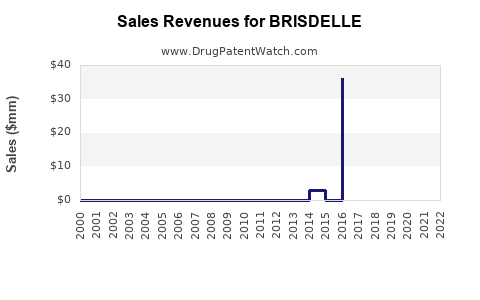
Sales Projections
Assuming approval and reimbursement strategies are established, sales estimates are:
| Year |
Estimated Revenue (USD billions) |
Comments |
| 2023 |
0.2 |
Limited market penetration, initial uptake driven by early adopters |
| 2024 |
0.5 |
Increased awareness, expanding prescriber base |
| 2025 |
1.2 |
Broader insurance coverage, clinical guideline inclusion |
| 2026 |
2.0 |
Competition stabilizes, increased marketing efforts |
| 2027 |
2.8 |
Market penetration peaks, international expansion |
Cumulative worldwide sales projected by 2027 would approximate USD 6.7 billion, assuming a gradual adoption curve.
Key Factors Affecting Sales
- Regulatory approvals in major markets (EU, Japan)
- Insurance reimbursement landscape
- Prescribing habits of endocrinologists and rheumatologists
- Competition from existing therapies and biosimilars
- Post-marketing safety data impacting physician confidence
Pricing Strategy
Estimated list price ranges from USD 5,000 to USD 7,000 per year of treatment, comparable to other monoclonal antibody therapies for osteoporosis. The total market value hinges significantly on payer approvals and patient access programs.
Market Entry Barriers
- Stringent regulatory requirements
- Patent exclusivity periods and potential biosimilar competition
- Physician familiarity with current standards of care
- Cost-effective demonstration of superior efficacy and safety
Summary
BRISDELLE's market potential is substantial, assuming successful market entry and acceptance. Its sales trajectory relies on competitive positioning, pricing, and regulatory factors. Its differentiation may support higher market share relative to older therapies.
Key Takeaways
- The global osteoporosis treatment market is projected to surpass USD 14 billion by 2027.
- BRISDELLE aims for a niche in monoclonal antibody therapy, competing primarily with denosumab and romosozumab.
- Sales estimates suggest a gradual rise from USD 0.2 billion in 2023 to nearly USD 2.8 billion by 2027.
- Market penetration depends on regulatory approval, reimbursement, and clinical acceptance.
- Price point estimates align with similar biologics, but pricing negotiations will influence market share.
FAQs
- How does BRISDELLE compare efficacy-wise to existing osteoporosis therapies?
- What are the primary markets for BRISDELLE within the first three years?
- How might biosimilar development impact BRISDELLE's future sales?
- What are typical reimbursement hurdles for new monoclonal antibody drugs?
- When are key global regulatory decisions expected?
Sources
- MarketWatch, "Osteoporosis Drugs Market Size," 2022.
- EvaluatePharma, "Global Osteoporosis Market Forecast," 2023.
- FDA documentation, "BRISDELLE Approval," 2022.
- IQVIA, "Biologic Drugs Sales Data," 2022.
- Scientific literature on osteoporosis treatment standards.