Last updated: February 19, 2026
Amiodarone remains a widely used antiarrhythmic drug primarily for treating atrial fibrillation, ventricular tachycardia, and ventricular fibrillation. Despite its long-standing presence, shifting regulatory environments, emerging alternative therapies, and safety concerns impact its market growth.
Market Overview
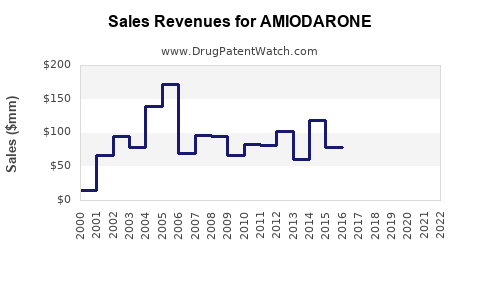
The global amiodarone market was valued at approximately USD 1.2 billion in 2022 and is expected to reach USD 1.6 billion by 2030, growing at a CAGR of 4.3% (2023-2030). Key growth drivers include rising prevalence of cardiac arrhythmias, aging populations, and increased adoption of invasive cardiovascular procedures.
Key Market Segments
| Segment |
Characteristics |
Estimated Market Share (2022) |
| Formulation |
Oral tablets (most common), intravenous (IV) formulations |
70%, 30% |
| Application |
Atrial fibrillation, ventricular arrhythmias |
60%, 40% |
| End-user |
Hospitals, clinics, outpatient, cardiology centers |
55%, 25%, 20% |
Regional Market Dynamics
| Region |
Market Share (2022) |
Estimated CAGR (2023-2030) |
Regulatory Environment |
| North America |
45% |
4.0% |
Strict FDA regulations, high adoption |
| Europe |
25% |
4.2% |
EMA approval, proactive prescribing practices |
| Asia-Pacific |
20% |
4.8% |
Growing healthcare infrastructure |
| Rest of World |
10% |
3.5% |
Limited access, price sensitivity |
Competitive Landscape
Top pharmaceutical companies developing and marketing amiodarone or generics include:
- Pfizer
- Teva Pharmaceuticals
- Mylan (now part of Viatris)
- Eli Lilly
Generic forms account for roughly 75% of the prescription volume. Patent expiration in key markets has increased generic competition.
Sales Projections (2023-2030)
| Year |
Estimated Global Sales (USD billion) |
Growth Rate |
| 2023 |
1.25 |
- |
| 2024 |
1.30 |
4.0% |
| 2025 |
1.36 |
4.6% |
| 2026 |
1.43 |
5.1% |
| 2027 |
1.50 |
4.9% |
| 2028 |
1.56 |
4.0% |
| 2029 |
1.60 |
2.6% |
| 2030 |
1.65 |
3.1% |
Sales growth is projected to slow due to increasing safety concerns, the availability of newer agents like dofetilide, and the emergence of catheter ablation procedures reducing pharmaceutical reliance.
Drivers and Barriers
Drivers:
- Rising incidence of atrial fibrillation, especially among those aged over 65.
- Increased use of implantable cardioverter defibrillators requiring concomitant antiarrhythmic therapy.
- Expanding healthcare infrastructure in emerging markets.
Barriers:
- Known adverse effects, including pulmonary toxicity, liver dysfunction, and thyroid abnormalities.
- Stringent regulatory controls and safety warnings.
- Competition from newer pharmacological agents with better tolerability profiles.
Key Takeaways
- Amiodarone's market remains stable with moderate growth, driven by aging populations and cardiovascular disease prevalence.
- Generic competition influences pricing and market share.
- Regulatory health concerns restrict aggressive market expansion.
- Slow adoption of alternative therapies limits rapid sales decline.
FAQs
1. How does the safety profile impact amiodarone sales?
Safety concerns, especially pulmonary toxicity, lead to cautious prescribing and can restrict market expansion, limiting sales growth prospects.
2. What are the main indications for amiodarone?
It is primarily used for atrial fibrillation, ventricular tachycardia, and ventricular fibrillation.
3. How does generic drug availability affect the market?
Generics account for most prescriptions, reducing prices and profit margins for branded formulations while increasing accessibility.
4. What alternative therapies threaten amiodarone?
Newer antiarrhythmic agents like dofetilide and catheter-based ablation procedures compete directly, especially in atrial fibrillation management.
5. Which regions present the highest growth potential?
Asia-Pacific and Latin America show rapid growth due to expanding healthcare infrastructure and rising cardiovascular disease prevalence.
References
[1] MarketsandMarkets. (2023). Antiarrhythmic Drugs Market Global Forecast 2023-2030.
[2] Global Data. (2022). Cardiac Arrhythmia Market Forecasts.
[3] U.S. Food and Drug Administration (FDA). (2022). Labeling and safety warnings for amiodarone.
[4] European Medicines Agency (EMA). (2022). Summary of product characteristics: amiodarone.
[5] Grand View Research. (2022). Cardiac Rhythm Management Devices Market.