Drug Sales Trends for ABILIBY
Payment Methods and Pharmacy Types for ABILIBY (2015)
Revenues by Pharmacy Type
Units Sold by Pharmacy Type
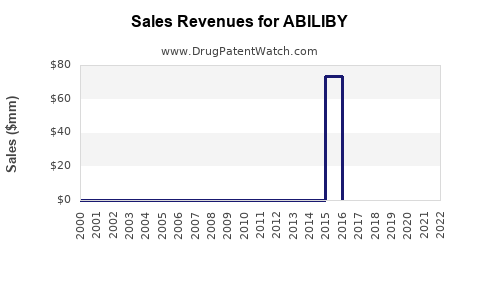
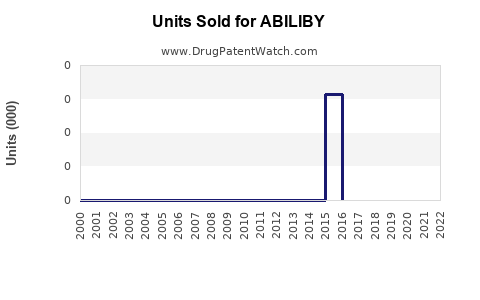
Annual Sales Revenues and Units Sold for ABILIBY
| Drug Name | Revenues (USD) | Units | Year |
|---|---|---|---|
| ABILIBY | ⤷ Start Trial | ⤷ Start Trial | 2022 |
| ABILIBY | ⤷ Start Trial | ⤷ Start Trial | 2021 |
| ABILIBY | ⤷ Start Trial | ⤷ Start Trial | 2020 |
| >Drug Name | >Revenues (USD) | >Units | >Year |
Abilify Market Analysis and Sales Projections: Aripiprazole, Abilify Maintena and Asimtufii
Abilify is the brand name for aripiprazole, an atypical antipsychotic developed by Otsuka Pharmaceutical and commercialized in several markets with Lundbeck. The immediate-release tablet and oral-solution products have lost U.S. exclusivity and face extensive generic competition. Commercial value has shifted to long-acting injectable products, primarily Abilify Maintena and the two-month formulation Abilify Asimtufii.
The base-case outlook is for global aripiprazole franchise sales of approximately $2.0 billion in 2024, rising to about $2.8 billion by 2030. Growth is expected to come from long-acting injectable adoption, higher treatment persistence, expanded use in bipolar disorder and schizophrenia, and conversion from monthly Abilify Maintena to twice-yearly Asimtufii where clinically appropriate. Generic erosion will continue to suppress oral Abilify revenue.
What is Abilify and how is the aripiprazole market segmented?
Abilify contains aripiprazole, a dopamine D2 and D3 partial agonist and serotonin 5-HT1A partial agonist with 5-HT2A antagonist activity. The product is used in schizophrenia, bipolar I disorder, major depressive disorder as adjunctive treatment, irritability associated with autistic disorder, and Tourette's disorder, depending on the formulation and jurisdiction. (U.S. Food and Drug Administration [FDA], 2024a)
The franchise has three commercial segments:
| Product | Formulation | Main indications | Commercial status |
|---|---|---|---|
| Abilify tablets and oral solution | Daily oral aripiprazole | Schizophrenia, bipolar disorder, adjunctive major depressive disorder and other approved uses | Generic competition |
| Abilify Maintena | Monthly aripiprazole extended-release injection | Schizophrenia and maintenance treatment of bipolar I disorder | Branded long-acting injectable |
| Abilify Asimtufii | Aripiprazole extended-release injection administered every two months | Schizophrenia and maintenance treatment of bipolar I disorder | Newer branded long-acting injectable |
The oral market is mature and price-sensitive. The long-acting injectable market has higher net pricing, stronger prescriber control and greater barriers to generic substitution.
How much revenue does Abilify generate?
Public companies generally report long-acting aripiprazole sales separately from the older oral product, while global market databases track the products by country and formulation. Reported company figures indicate that Abilify Maintena and Asimtufii together generate roughly $1.7 billion to $2.0 billion annually, depending on currency conversion and reporting period. Oral branded Abilify contributes a much smaller amount because U.S. and European generic versions are widely available. (Otsuka Pharmaceutical Co., Ltd., 2024; Lundbeck A/S, 2024)
Estimated 2024 franchise revenue
| Segment | Estimated 2024 global sales | Revenue direction |
|---|---|---|
| Oral branded Abilify | $100 million-$250 million | Declining |
| Generic oral aripiprazole | $500 million-$900 million at market level | Stable to declining in value |
| Abilify Maintena | $1.4 billion-$1.7 billion | Growing |
| Abilify Asimtufii | $150 million-$300 million | Rapid growth from a small base |
| Total branded and generic aripiprazole market | $2.2 billion-$3.1 billion | Mixed |
The range reflects differences in whether estimates include hospital purchasing, generic sales, royalties, and all geographic markets. The economically relevant branded franchise is the long-acting injectable business.
What are the sales projections for Abilify through 2030?
The following forecast is an analyst model based on reported company growth, long-acting injectable penetration, generic oral erosion and the competitive environment. It is not a company-issued forecast.
Base-case global sales projection
| Year | Oral branded Abilify | Abilify Maintena | Abilify Asimtufii | Total branded franchise |
|---|---|---|---|---|
| 2024 | $0.15 billion | $1.55 billion | $0.20 billion | $1.90 billion |
| 2025 | $0.13 billion | $1.66 billion | $0.32 billion | $2.11 billion |
| 2026 | $0.11 billion | $1.76 billion | $0.46 billion | $2.33 billion |
| 2027 | $0.09 billion | $1.84 billion | $0.61 billion | $2.54 billion |
| 2028 | $0.08 billion | $1.91 billion | $0.77 billion | $2.76 billion |
| 2029 | $0.07 billion | $1.96 billion | $0.91 billion | $2.94 billion |
| 2030 | $0.06 billion | $2.00 billion | $1.05 billion | $3.11 billion |
The model implies a 2024-2030 compound annual growth rate of approximately 8.5% for the branded franchise. Asimtufii is expected to account for roughly one-third of branded aripiprazole injectable revenue by 2030.
Scenario analysis
| Scenario | 2030 branded sales | Implied 2024-2030 CAGR | Principal assumptions |
|---|---|---|---|
| Downside | $2.2 billion | 2%-3% | Faster price compression, weak Asimtufii conversion, new injectable competition |
| Base case | $3.1 billion | 8%-9% | Continued LAI adoption and gradual Asimtufii conversion |
| Upside | $3.8 billion | 12%-13% | Strong bipolar maintenance uptake, superior persistence and limited direct competition |
The most important variable is not new oral prescriptions. It is the rate at which patients move from oral therapy or monthly injection to branded long-acting injectable treatment.
When did Abilify lose exclusivity in the United States?
Generic aripiprazole entered the U.S. market in 2015 after patent litigation and settlement activity involving Bristol-Myers Squibb, Otsuka and generic manufacturers. The launch ended broad exclusivity for the oral Abilify tablet franchise. FDA-approved generic products include aripiprazole tablets from multiple manufacturers. (FDA, 2024b)
| Product | U.S. exclusivity position | Commercial consequence |
|---|---|---|
| Abilify tablets | Lost; generic entry began in 2015 | Severe price and volume erosion for branded tablets |
| Abilify oral solution | Generic competition | Limited branded pricing power |
| Abilify Maintena | Separate long-acting injectable estate | More durable branded position |
| Abilify Asimtufii | Newer long-acting injectable product | Longer growth runway, subject to patent and regulatory challenges |
The branded oral product is no longer a meaningful source of growth. Its strategic value is mainly as a funnel into long-acting injectable therapy.
What patents protect Abilify Maintena and Asimtufii?
The relevant intellectual-property protection differs from the original oral Abilify estate. Long-acting injectable products depend on formulation, dosing interval, manufacturing, device and method-of-use claims. The applicable patent position must be assessed through current FDA Orange Book entries, patent assignments and litigation records because listed patents and expiration calculations can change.
Formulation and delivery-system protection
Long-acting aripiprazole products may be protected by claims covering:
- Aripiprazole crystal or particle characteristics.
- Extended-release injectable compositions.
- Depot administration and drug-release profiles.
- Dosage regimens for monthly or two-month administration.
- Reconstitution and injection procedures.
- Treatment of schizophrenia and bipolar I disorder.
- Manufacturing processes that produce consistent injectable particles.
The principal commercial barrier is the difficulty of reproducing a long-acting injectable with equivalent pharmacokinetics, particle properties, sterility and injection performance. This creates a higher entry threshold than for generic oral tablets.
Orange Book and paragraph IV risk
Abilify Maintena and Asimtufii are FDA-approved new drug applications with Orange Book-listed patents where applicable. A generic or follow-on injectable applicant can file an Abbreviated New Drug Application with a Paragraph IV certification against listed patents. The filing may trigger patent litigation and a potential 30-month stay of approval under the Hatch-Waxman Act. (FDA, 2024c)
The practical risk profile is:
| Risk area | Oral Abilify | Abilify Maintena | Abilify Asimtufii |
|---|---|---|---|
| Formulation complexity | Low | High | High |
| Existing generic competition | Extensive | Limited relative to oral product | Limited |
| Price erosion risk | High | Moderate | Moderate |
| Paragraph IV exposure | Historical and mature | Material as patents approach expiry | Increasing over time |
| Substitution risk | Immediate | Gradual | Dependent on follow-on injectable development |
A formulation patent with a later expiry does not guarantee full market protection. Generic applicants can challenge validity, non-infringement and patent listing eligibility. The strongest protection normally comes from the combined effect of formulation patents, clinical dosing data, manufacturing know-how and regulatory complexity.
What patent litigation and settlement agreements affect Abilify?
The major commercial patent event for oral Abilify was the resolution of litigation that permitted generic aripiprazole launches beginning in 2015. The resulting entry demonstrates the difference between the oral and injectable estates: oral aripiprazole became heavily commoditized, while the long-acting products retained branded pricing.
For Abilify Maintena and Asimtufii, the key litigation indicators are:
- Paragraph IV notices against Orange Book-listed patents.
- District court complaints filed by Otsuka or its partners.
- Inter partes review petitions before the Patent Trial and Appeal Board.
- ANDA approval dates and tentative approvals.
- Settlement terms governing launch dates, licenses and authorized generic rights.
No biosimilar pathway applies to aripiprazole because it is a chemically synthesized small molecule. Competitive products would generally enter through the generic drug pathway, although complex long-acting injectables can require substantial comparative development work.
Which companies compete with Abilify in long-acting psychiatric treatment?
Abilify competes in two distinct markets: oral atypical antipsychotics and long-acting injectable antipsychotics.
Long-acting injectable competitors
| Product | Active ingredient | Manufacturer | Administration interval |
|---|---|---|---|
| Abilify Maintena | Aripiprazole | Otsuka/Lundbeck | Monthly |
| Abilify Asimtufii | Aripiprazole | Otsuka/Lundbeck | Every two months |
| Invega Sustenna | Paliperidone palmitate | Johnson & Johnson | Monthly |
| Invega Trinza | Paliperidone palmitate | Johnson & Johnson | Every three months |
| Invega Hafyera | Paliperidone palmitate | Johnson & Johnson | Every six months |
| Perseris | Risperidone | Teva | Monthly |
| Uzedy | Risperidone | Teva/MedinCell | Monthly or every two months |
| Aristada | Aripiprazole lauroxil | Alkermes | Monthly to every six months, depending on regimen |
Aristada is the closest pharmacologic competitor because it also uses an aripiprazole-based long-acting injectable. Invega products remain major competitors because they offer longer dosing intervals and established use in schizophrenia. Uzedy has gained attention through its subcutaneous delivery system and flexible dosing intervals. (Alkermes plc, 2024; Johnson & Johnson, 2024; Teva Pharmaceutical Industries Ltd., 2024)
How does Abilify compare with competing antipsychotics?
Abilify's principal advantages are its established clinical history, aripiprazole's partial dopamine agonism, monthly and two-month injectable options, and broad prescriber familiarity. Its main limitations are injection-site administration, oral overlap or initiation requirements for some regimens, akathisia risk and competition from products with longer dosing intervals.
| Attribute | Abilify Maintena/Asimtufii | Paliperidone LAIs | Aristada |
|---|---|---|---|
| Active ingredient | Aripiprazole | Paliperidone | Aripiprazole lauroxil |
| Core market | Schizophrenia; bipolar maintenance | Primarily schizophrenia | Primarily schizophrenia |
| Dosing flexibility | Monthly or every two months | Monthly to every six months | Multiple intervals |
| Bipolar maintenance positioning | Important | Less central | Limited |
| Generic erosion | Low relative to oral aripiprazole | Low for major LAI products | Low |
| Commercial risk | Direct aripiprazole competition | Longer-interval products | Same-mechanism competition |
Abilify Asimtufii's bipolar I maintenance indication creates a differentiation opportunity because it extends the aripiprazole franchise beyond schizophrenia-focused injectable prescribing.
What is the FDA regulatory status of Abilify?
The FDA approved oral Abilify in 2002. Abilify Maintena was approved in 2013 for schizophrenia and later received an indication for maintenance treatment of bipolar I disorder. Abilify Asimtufii was approved in 2023 as a longer-interval aripiprazole injectable for schizophrenia and bipolar I maintenance treatment. (FDA, 2002, 2013, 2023)
The regulatory strategy has been commercially effective because each new formulation extends the franchise without relying on a new molecular entity. The two-month product increases treatment convenience and creates a branded migration path from the monthly product.
What generic launch risks exist for Abilify?
Generic oral aripiprazole will continue to exert pressure on branded oral revenue. The principal future risk is generic or follow-on entry into long-acting injectable aripiprazole.
Near-term risk
The near-term threat is commercial substitution rather than immediate patent expiry. Payers may prefer oral generic aripiprazole for cost reasons, while providers may favor long-acting injections for adherence, relapse prevention and reduced administration burden.
Medium-term risk
The medium-term risk is a Paragraph IV challenge to Maintena or Asimtufii patents. A successful challenge could produce an accelerated launch before the expected patent term ends. The impact would depend on whether the entrant reaches a monthly, two-month or alternative dosing regimen.
Long-term risk
By the end of the decade, the franchise could face:
- Direct generic or follow-on injectable competition.
- Net-price reductions in government and managed-care channels.
- Switching to longer-interval paliperidone products.
- Competition from digital adherence programs combined with oral generics.
- Reduced incremental benefit from converting Maintena patients to Asimtufii.
How much revenue is exposed to patent and competitive risk?
Approximately 85%-95% of current branded aripiprazole revenue is concentrated in long-acting injectable products. That concentration makes the franchise less exposed to ordinary oral generic erosion but more sensitive to a single major injectable patent event.
| Revenue pool | Risk level | Primary exposure |
|---|---|---|
| Branded oral Abilify | Very high | Generic substitution and price compression |
| Generic oral aripiprazole | Low for originator | Commodity pricing |
| Abilify Maintena | Moderate | Injectable patent challenges and competing LAIs |
| Abilify Asimtufii | Moderate to high over the long term | New product adoption and later patent challenges |
The franchise has a favorable near-term mix, but its value increasingly depends on maintaining clinical and reimbursement differentiation for the injectable products.
What licensing deals support Abilify commercialization?
Otsuka and Lundbeck have a long-standing collaboration covering the development and commercialization of aripiprazole and related products in multiple territories. The arrangement combines Otsuka's discovery and development role with Lundbeck's commercial infrastructure in selected markets. (Lundbeck A/S, 2024)
The partnership has strategic value because long-acting injectable products require specialized sales, payer and clinical-support capabilities. The deal also spreads regional commercialization risk, although reported revenue and profit attribution can differ between the companies.
How strong is the Abilify patent estate?
The estate is weak for oral aripiprazole and materially stronger for the long-acting injectable franchise.
Relative patent-strength assessment
| Dimension | Assessment |
|---|---|
| Oral active ingredient protection | Exhausted |
| Oral formulation protection | Largely exhausted or commercially ineffective |
| Injectable formulation claims | Stronger, subject to validity and scope |
| Dosing-regimen claims | Potentially valuable but vulnerable to obviousness challenges |
| Manufacturing know-how | Important practical barrier |
| Regulatory exclusivity | Limited compared with patent protection |
| Biosimilar protection | Not applicable |
| Geographic coverage | Strongest in the U.S., Europe and Japan, but country-specific |
The estate's commercial strength comes from layered protection rather than a single composition-of-matter patent. Manufacturing scale, sterile production, particle engineering and clinical evidence may delay entry even when individual patents are challenged.
What geographic markets offer the greatest growth?
The United States remains the largest profit pool because of high injectable pricing and established use of long-acting antipsychotics. Europe offers substantial volume but generally lower net prices. Japan and other Asian markets have growth potential from broader use of maintenance therapy, although reimbursement controls can limit revenue per patient.
| Region | Growth outlook | Main driver |
|---|---|---|
| United States | Strong | LAI conversion, bipolar maintenance and Asimtufii adoption |
| Western Europe | Moderate | Stable LAI use and reimbursement expansion |
| Japan | Moderate | Aging population and adherence-focused treatment |
| China | Moderate to strong from a low base | Urban psychiatric care and injectable adoption |
| Latin America | Moderate | Access expansion, with pricing constraints |
| Emerging markets | Variable | Hospital procurement and reimbursement availability |
The United States is likely to produce most of the incremental branded revenue through 2030.
What are the most likely Abilify launch scenarios?
Base case
Otsuka and Lundbeck continue converting eligible Maintena patients to Asimtufii while defending injectable reimbursement. Oral generic aripiprazole declines, but injectable revenue grows at a mid-single-digit rate. Branded franchise sales reach approximately $3.1 billion by 2030.
Downside case
Asimtufii adoption remains concentrated in a narrow patient population. Payers increase utilization controls, Aristada and paliperidone products gain share, and an early injectable patent challenge accelerates price erosion. Sales reach approximately $2.2 billion by 2030.
Upside case
Two-month dosing improves adherence and persistence, bipolar maintenance adoption expands, and no direct follow-on injectable achieves rapid scale. The franchise reaches approximately $3.8 billion by 2030.
Key Takeaways
- Abilify oral revenue is structurally mature because generic aripiprazole has been available in the U.S. since 2015.
- The commercial franchise now depends on Abilify Maintena and Abilify Asimtufii.
- The base-case branded sales forecast is approximately $1.9 billion in 2024 and $3.1 billion in 2030.
- Asimtufii is the principal growth product and could generate about $1 billion annually by 2030 in the base case.
- Long-acting injectable patents, formulation know-how and sterile manufacturing provide stronger barriers than oral-product patents.
- The main competitors are Aristada, Invega Sustenna, Invega Trinza, Invega Hafyera and Uzedy.
- No biosimilar pathway applies because aripiprazole is a small-molecule drug.
- The main investment risk is accelerated competition against the long-acting injectable franchise, not further erosion of oral Abilify.
FAQs
Is Abilify still a blockbuster drug?
The branded oral product no longer has blockbuster economics because of generic competition. The combined Abilify Maintena and Asimtufii injectable franchise remains a multibillion-dollar global business.
What is the difference between Abilify Maintena and Asimtufii?
Abilify Maintena is generally administered monthly, while Asimtufii is administered every two months for eligible patients. Both contain aripiprazole in extended-release injectable formulations.
Does Abilify have biosimilar competition?
No. Aripiprazole is a chemically synthesized small molecule. Competitive products enter through generic or complex injectable regulatory pathways rather than the biosimilar pathway.
Which drug is the closest competitor to Abilify Maintena?
Aristada is the closest pharmacologic competitor because it is also an aripiprazole-based long-acting injectable. Paliperidone products are major commercial competitors because of their longer dosing intervals and established use.
Will generic versions of Abilify Maintena reduce sales?
Generic or follow-on injectable entry would likely reduce net prices and could reduce branded volume. The timing and magnitude depend on patent outcomes, FDA approval, manufacturing capacity and payer substitution policies.
References
- Alkermes plc. (2024). Annual report 2023.
- Johnson & Johnson. (2024). Annual report 2023.
- Lundbeck A/S. (2024). Annual report 2023.
- Otsuka Pharmaceutical Co., Ltd. (2024). Integrated report 2024.
- Teva Pharmaceutical Industries Ltd. (2024). Annual report 2023.
- U.S. Food and Drug Administration. (2002). Abilify approval history and prescribing information.
- U.S. Food and Drug Administration. (2013). Abilify Maintena approval announcement and prescribing information.
- U.S. Food and Drug Administration. (2023). Abilify Asimtufii approval announcement and prescribing information.
- U.S. Food and Drug Administration. (2024a). Aripiprazole prescribing information.
- U.S. Food and Drug Administration. (2024b). Drugs@FDA: Abilify and aripiprazole products.
- U.S. Food and Drug Administration. (2024c). Orange Book: Approved drug products with therapeutic equivalence evaluations.
More… ↓
