Share This Page
Drug Sales Trends for VYTORIN
✉ Email this page to a colleague
Payment Methods and Pharmacy Types for VYTORIN (2014)
Revenues by Pharmacy Type
Units Sold by Pharmacy Type
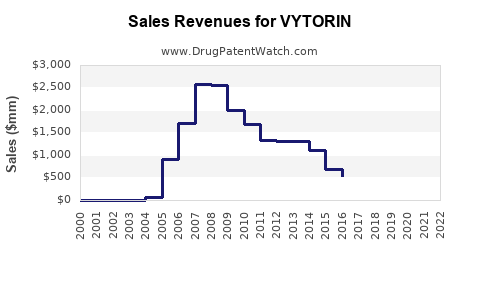
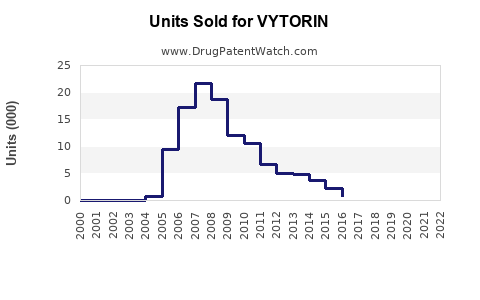
Annual Sales Revenues and Units Sold for VYTORIN
| Drug Name | Revenues (USD) | Units | Year |
|---|---|---|---|
| VYTORIN | ⤷ Start Trial | ⤷ Start Trial | 2022 |
| VYTORIN | ⤷ Start Trial | ⤷ Start Trial | 2021 |
| VYTORIN | ⤷ Start Trial | ⤷ Start Trial | 2020 |
| VYTORIN | ⤷ Start Trial | ⤷ Start Trial | 2019 |
| VYTORIN | ⤷ Start Trial | ⤷ Start Trial | 2018 |
| VYTORIN | ⤷ Start Trial | ⤷ Start Trial | 2017 |
| >Drug Name | >Revenues (USD) | >Units | >Year |
Vytorin Market Analysis, Sales History, Patent Expiration, and Revenue Projections
Vytorin, the fixed-dose combination of ezetimibe and simvastatin, is a mature cardiovascular product with limited branded commercial value and substantial generic substitution. Its commercial decline began after U.S. generic entry and accelerated as prescribers shifted to standalone statins, generic ezetimibe, and high-intensity atorvastatin and rosuvastatin. Vytorin retains clinical utility for patients who need combined LDL-cholesterol reduction, but its future market is primarily a low-price generic market rather than a branded growth opportunity.
What is Vytorin and how does it work?
Vytorin combines two lipid-lowering agents:
- Ezetimibe inhibits intestinal cholesterol absorption.
- Simvastatin inhibits HMG-CoA reductase and reduces hepatic cholesterol synthesis.
The product was approved by the U.S. Food and Drug Administration in July 2004 for primary hypercholesterolemia and mixed hyperlipidemia. Its approved strengths are:
| Vytorin strength | Ezetimibe | Simvastatin |
|---|---|---|
| 10/10 mg | 10 mg | 10 mg |
| 10/20 mg | 10 mg | 20 mg |
| 10/40 mg | 10 mg | 40 mg |
| 10/80 mg | 10 mg | 80 mg |
The 10/80 mg strength carries important safety limitations because of simvastatin-associated myopathy and rhabdomyolysis risk. The FDA restricted initiation at the 80 mg simvastatin dose and recommended continuation only in patients who had taken it for at least 12 months without evidence of muscle toxicity (FDA, 2011).
Vytorin was developed and commercialized through the Merck and Schering-Plough organizations. After the 2009 Merck-Schering-Plough merger, Merck controlled the product in the United States. Organon became the successor company for portions of Merck's former established-products portfolio after the 2021 spinoff.
What were Vytorin's historical sales?
Vytorin generated more than $1 billion in annual global sales during its commercial peak, although reported figures varied by year, geography, currency, and whether the product was reported together with Zetia.
Merck's public reporting historically grouped certain cardiovascular products or reported geographic sales in ways that limit direct comparison across years. The commercial peak occurred before widespread generic substitution for ezetimibe and before the broad adoption of generic high-intensity statins.
| Period | Commercial position | Market interpretation |
|---|---|---|
| 2004-2007 | Initial launch and formulary expansion | Rapid adoption of fixed-dose lipid therapy |
| 2008-2012 | Peak branded period | Strong sales supported by ezetimibe differentiation and the Vytorin brand |
| 2013-2015 | Mature branded product | Clinical debate and payer pressure constrained growth |
| 2016-2018 | Generic erosion | Generic ezetimibe and ezetimibe/simvastatin reduced branded demand |
| 2019-present | Mature generic market | Brand economics materially weakened |
Vytorin's sales were also affected by the ENHANCE trial, which compared simvastatin monotherapy with the ezetimibe/simvastatin combination in patients with familial hypercholesterolemia. The trial did not show a significant difference in carotid intima-media thickness, which led to negative publicity and delayed uptake even though the study was not designed to establish cardiovascular event reduction (Kastelein et al., 2008).
The later IMPROVE-IT cardiovascular outcomes trial demonstrated that adding ezetimibe to simvastatin reduced cardiovascular events after acute coronary syndrome compared with simvastatin alone. The result strengthened the clinical rationale for ezetimibe but did not reverse the long-term pricing and generic-substitution trend (Cannon et al., 2015).
What is the current Vytorin market?
The current Vytorin market is fragmented among:
- Generic ezetimibe/simvastatin fixed-dose combinations.
- Separate generic ezetimibe and simvastatin prescriptions.
- Generic atorvastatin and rosuvastatin.
- Other branded or specialty LDL-lowering products for patients with inadequate response or statin intolerance.
Vytorin competes against stronger and often cheaper treatment alternatives. Atorvastatin and rosuvastatin are generally preferred when high-intensity statin therapy is clinically appropriate. Ezetimibe is often prescribed as a separate generic tablet because it allows physicians to adjust the statin and ezetimibe components independently.
Competitive product comparison
| Product | Active ingredients | Main competitive advantage | Main limitation |
|---|---|---|---|
| Vytorin | Ezetimibe/simvastatin | Single-tablet combination | Older statin; limited brand value |
| Generic ezetimibe | Ezetimibe | Low cost and flexible combination use | Requires a separate statin |
| Atorvastatin | Atorvastatin | High-intensity efficacy and broad use | Does not contain ezetimibe |
| Rosuvastatin | Rosuvastatin | High potency and favorable LDL reduction | Separate ezetimibe may be needed |
| Ezetimibe/rosuvastatin combinations | Ezetimibe/rosuvastatin | Fixed-dose combination with a more potent statin | Smaller market and higher price than basic generics |
| PCSK9 inhibitors | Evolocumab, alirocumab | Large LDL reductions for high-risk patients | Injectable and significantly more expensive |
| Bempedoic acid combinations | Bempedoic acid/ezetimibe | Option for statin-intolerant patients | Smaller eligible population and higher cost |
Vytorin's principal remaining advantages are adherence convenience, established clinical familiarity, and availability in a low-cost generic form. These advantages do not support premium pricing.
When did Vytorin lose exclusivity?
Vytorin's commercial exclusivity ended in stages rather than on one date.
The underlying active ingredients had separate patent histories. Simvastatin was already a mature generic molecule when Vytorin launched. Ezetimibe and combination-product claims provided the more important exclusivity protection. Generic versions of ezetimibe became available in the United States after the relevant exclusivity and patent barriers expired, followed by generic ezetimibe/simvastatin products.
The relevant commercial conclusion is clear: Vytorin no longer has meaningful U.S. market exclusivity.
U.S. exclusivity timeline
| Event | Approximate timing | Commercial effect |
|---|---|---|
| FDA approval of Vytorin | 2004 | Branded combination launched |
| Pediatric exclusivity period | Historical, limited duration | Temporary extension of regulatory protection |
| Ezetimibe patent and regulatory barriers | Through the mid-to-late 2010s | Delayed broad generic competition |
| Generic ezetimibe entry | 2016-2017 period | Reduced value of the ezetimibe franchise |
| Generic ezetimibe/simvastatin entry | Late 2010s | Direct substitution for Vytorin |
| Current position | 2025 | No meaningful brand exclusivity |
The exact patent position differs by strength, jurisdiction, and whether the claim covers ezetimibe, the combination, formulation, or a method of treatment. FDA Orange Book listings should be reviewed by product strength and application number for litigation-grade diligence (FDA, Approved Drug Products with Therapeutic Equivalence Evaluations).
What is the Orange Book status of Vytorin?
Vytorin was approved under NDA 021687. The product's Orange Book position is commercially important because the listed patents historically supported the reference product's regulatory exclusivity and created potential barriers to abbreviated new drug applications.
Today, Orange Book-listed protection does not create a meaningful barrier to generic entry for Vytorin. The relevant U.S. market has already experienced generic entry, and generic substitution is established.
The key regulatory points are:
- Vytorin is an approved fixed-dose combination product.
- Generic applicants can rely on the reference product through the ANDA pathway.
- Therapeutic-equivalence ratings and state substitution rules determine practical substitution.
- Any residual patent listings do not restore a commercially significant monopoly after generic launch.
- Method-of-use claims are less relevant where generic labels omit protected indications or where the claims have expired.
Which companies challenged Vytorin patents?
Generic manufacturers historically pursued ezetimibe and ezetimibe/simvastatin through ANDA filings and Paragraph IV certification strategies. The relevant competitive group included large generic manufacturers such as Teva, Mylan, Dr. Reddy's Laboratories, Sandoz, and other ANDA sponsors.
The commercial importance of these challenges was greater for Zetia and the ezetimibe franchise than for Vytorin alone. Patent disputes focused on whether claims covering ezetimibe, the combination, pharmaceutical compositions, or treatment methods remained valid and enforceable.
A Paragraph IV certification is not itself proof of patent invalidity. It is an ANDA applicant's assertion that a listed patent is invalid, unenforceable, or will not be infringed. The sponsor may then file an infringement action within the statutory period, potentially triggering a 30-month stay of ANDA approval under the Hatch-Waxman framework (21 U.S.C. § 355).
What patent litigation affects Vytorin?
Vytorin's major litigation risk was historical and centered on generic entry into the ezetimibe franchise. Once the relevant patents expired or were defeated, settled, or bypassed through approved generic products, the litigation ceased to provide durable commercial protection.
For current business planning, the relevant litigation assessment is:
| Issue | Current impact |
|---|---|
| Core composition patents | Expired or no longer commercially blocking |
| Combination-product claims | No material barrier to generic substitution |
| Method-of-use claims | Limited value unless a live, enforceable indication-specific claim applies |
| Formulation claims | Low strategic value for a conventional tablet with established generic products |
| ANDA litigation | Primarily a historical entry issue |
| Biosimilar litigation | Not applicable |
No biosimilar pathway applies to Vytorin because it is a chemically synthesized small-molecule drug, not a biologic. Competition occurs through the ANDA generic pathway rather than the biosimilar pathway.
What formulations are protected by Vytorin patents?
Vytorin is an immediate-release oral tablet containing ezetimibe and simvastatin. Its historical intellectual-property protection included claims directed to:
- The combination of ezetimibe and simvastatin.
- Pharmaceutical compositions containing both active ingredients.
- Dosing and treatment of hypercholesterolemia.
- Solid oral dosage forms and related manufacturing subject matter.
The formulation estate is weak as a current commercial defense because generic products have already entered the market. A new formulation could theoretically obtain patent protection if it delivered a non-obvious pharmacokinetic, stability, or adherence benefit, but a conventional reformulation would face substantial obviousness and freedom-to-operate risks.
How strong is the Vytorin patent estate?
Vytorin's current patent estate is weak from a revenue-protection perspective.
| Patent-estate factor | Assessment |
|---|---|
| Core molecule protection | Expired or exhausted |
| Combination protection | No longer blocks generic market participation |
| Formulation protection | Limited practical value |
| Method-of-use protection | Narrow and commercially constrained |
| Manufacturing protection | Potentially relevant only for specific processes |
| Geographic coverage | U.S. protection is exhausted; foreign status varies |
| Litigation leverage | Low |
| Pricing protection | None of commercial significance |
The product's residual intellectual property may still matter for manufacturing know-how, regulatory documentation, or country-specific launch timing. It does not support a premium branded franchise.
What are Vytorin's sales projections for 2025-2029?
Vytorin sales should be modeled separately for the branded product and the total ezetimibe/simvastatin market.
The branded Vytorin product is likely to generate minimal revenue in the United States. Generic versions will capture most prescriptions, while the fixed-dose combination will remain a small portion of the broader LDL-lowering market.
Base-case sales projection
The following projection estimates worldwide net sales attributable to the Vytorin brand and authorized branded equivalents. It excludes total generic-market revenue.
| Year | Estimated branded sales | Annual change | Base-case assumptions |
|---|---|---|---|
| 2024A | $25 million-$50 million | N/A | Residual brand demand and non-U.S. sales |
| 2025E | $20 million-$40 million | -15% to -25% | Continued generic substitution |
| 2026E | $15 million-$32 million | -15% to -25% | Further formulary migration |
| 2027E | $11 million-$26 million | -15% to -25% | Brand becomes commercially marginal |
| 2028E | $8 million-$21 million | -15% to -25% | Primarily legacy and selected international demand |
| 2029E | $6 million-$17 million | -15% to -25% | Residual sales only |
These are analytical estimates rather than company-reported guidance. A reasonable base case places cumulative branded Vytorin sales for 2025-2029 at approximately $60 million to $136 million.
Total generic fixed-dose combination market
The generic ezetimibe/simvastatin market should remain larger than the branded Vytorin market but should experience modest volume erosion as physicians favor separate ezetimibe plus atorvastatin or rosuvastatin.
| Scenario | 2025 estimated global market | 2029 estimated global market | CAGR |
|---|---|---|---|
| Bear case | $120 million | $75 million | -11% |
| Base case | $180 million | $135 million | -7% |
| Bull case | $260 million | $230 million | -3% |
These estimates refer to the fixed-dose ezetimibe/simvastatin category, not all ezetimibe sales. The principal downside risk is therapeutic substitution by separate tablets and more potent statins. The principal upside factor is demand for low-cost combination therapy in markets where adherence and pill burden strongly influence prescribing.
What drives Vytorin's future market?
Positive demand drivers
- Low-cost access to dual-mechanism LDL reduction.
- Use in patients who require ezetimibe but prefer one tablet.
- Increased diagnosis and treatment of hypercholesterolemia.
- Secondary prevention after acute coronary syndrome.
- Expansion of generic cardiovascular treatment in emerging markets.
- Continued clinical use of ezetimibe after the IMPROVE-IT outcomes data.
Negative demand drivers
- Generic pricing compression.
- Use of atorvastatin and rosuvastatin as preferred statins.
- Separate-tablet prescribing, which gives physicians greater dose flexibility.
- Limited value of the simvastatin component compared with newer high-intensity statins.
- Safety concerns surrounding simvastatin 80 mg.
- Payer preference for the lowest-cost generic alternative.
- Reduced commercial investment in a mature, off-patent product.
What generic launch scenarios exist for Vytorin?
The U.S. market is already in the post-launch phase. Future scenarios concern market share, pricing, and manufacturer participation rather than first generic entry.
Base scenario
Generic manufacturers maintain broad availability. Net prices continue to decline gradually, and fixed-dose combination volume falls as separate ezetimibe and high-intensity statins gain share.
Downside scenario
Manufacturers exit because of low margins, shortages, or limited reimbursement. Reduced supplier participation could temporarily raise generic prices, but it would not restore Vytorin's brand power.
Upside scenario
Combination prescribing increases in value-oriented health systems, particularly outside the United States. This would support generic unit growth but would have limited effect on branded Vytorin revenue.
How does Vytorin compare with Zetia, atorvastatin, and rosuvastatin?
Vytorin has a weaker commercial outlook than standalone ezetimibe because its simvastatin component limits prescribing flexibility. It also has a weaker clinical positioning than atorvastatin and rosuvastatin for patients requiring high-intensity statin therapy.
| Product | Commercial outlook | Patent position | Main use |
|---|---|---|---|
| Vytorin | Declining, low-value generic | Expired | Fixed-dose ezetimibe plus simvastatin |
| Zetia | Genericized but broader demand | Expired | Add-on ezetimibe therapy |
| Atorvastatin | Large generic market | Expired | First-line and high-intensity statin therapy |
| Rosuvastatin | Large generic market | Expired | High-intensity and potency-driven therapy |
| PCSK9 inhibitors | Growing specialty segment | Active branded estates | Severe hypercholesterolemia and high-risk patients |
What is Vytorin's revenue exposure for manufacturers and investors?
Vytorin has low revenue-at-risk for the original innovator but can have meaningful volume exposure for generic manufacturers with cardiovascular portfolios.
For the innovator, the product is unlikely to affect overall valuation materially unless it is part of a larger established-products portfolio. The more relevant assets are:
- Generic ezetimibe supply contracts.
- Manufacturing scale and cost position.
- Regulatory approvals in emerging markets.
- Hospital and payer contracts.
- Ability to bundle Vytorin with other cardiovascular generics.
For generic manufacturers, the category offers recurring demand but limited pricing power. Profitability depends on manufacturing cost, market share, supply reliability, and the number of active suppliers.
Is Vytorin commercially attractive for licensing or acquisition?
A Vytorin brand acquisition is generally unattractive unless the buyer has a low-cost supply chain and access to markets where branded or semi-branded generic products retain pricing power.
A licensing or acquisition thesis would require one or more of the following:
- Rights in a market with delayed generic penetration.
- An approved or patent-protected formulation.
- Manufacturing advantages.
- A bundled cardiovascular portfolio.
- Hospital or government procurement access.
- A differentiated adherence or combination product.
Without those factors, Vytorin is a low-growth generic asset with limited intellectual-property protection and weak pricing leverage.
Key Takeaways
- Vytorin combines ezetimibe and simvastatin in a fixed-dose oral tablet.
- U.S. market exclusivity has ended, and generic competition is established.
- Vytorin is not a biologic and has no biosimilar pathway.
- Its patent estate no longer provides meaningful commercial protection.
- Generic ezetimibe/simvastatin sales should remain material but decline as separate ezetimibe, atorvastatin, and rosuvastatin gain share.
- Estimated branded Vytorin sales for 2025-2029 are approximately $60 million to $136 million cumulatively.
- The commercial opportunity is primarily generic supply, not branded innovation.
- Simvastatin's lower potency and dose-related safety concerns weaken Vytorin against newer statin-based regimens.
- The strongest remaining commercial markets are cost-sensitive jurisdictions with demand for fixed-dose combination therapy.
FAQs About Vytorin Market Size and Patent Expiration
Is Vytorin still sold in the United States?
Generic ezetimibe/simvastatin products are available in the United States. Branded Vytorin has little remaining commercial presence compared with its pre-generic period.
Can a generic manufacturer still challenge Vytorin patents?
A Paragraph IV challenge may be filed only against a relevant unexpired and enforceable listed patent. Because Vytorin's principal commercial patent barriers have expired or ceased to block entry, current competition is primarily post-exclusivity market competition.
Does Vytorin have a protected combination formulation?
Historical patents covered combination and pharmaceutical-composition subject matter. Those protections no longer prevent approved generic ezetimibe/simvastatin products from competing in the United States.
What is the most important substitute for Vytorin?
The most important substitutes are generic ezetimibe combined with atorvastatin or rosuvastatin, followed by generic high-intensity statin monotherapy where ezetimibe is not required.
Could Vytorin sales increase outside the United States?
Unit demand could increase in selected emerging markets, but international growth is unlikely to produce a material global branded-sales recovery because generic competition and price controls limit revenue capture.
References
-
Cannon, C. P., Blazing, M. A., Giugliano, R. P., McCagg, A., White, J. A., Theroux, P., Darius, H., Lewis, B. S., Ophuis, T. O., Jukema, J. W., De Ferrari, G. M., Ruzyllo, W., De Lucca, C., Im, K., Bohula, E. A., Reist, C., Wiviott, S. D., Tershakovec, A. M., Musliner, T. A., ... Califf, R. M. (2015). Ezetimibe added to statin therapy after acute coronary syndromes. New England Journal of Medicine, 372(25), 2387-2397.
-
Kastelein, J. J. P., Akdim, F., Stroes, E. S. G., Zwinderman, A. H., Bots, M. L., Stalenhoef, A. F. H., Visseren, F. L. J., Sijbrands, E. J. G., Trip, M. D., Stein, E. A., Gaudet, D., Duivenvoorden, R., Veltri, E. P., Marais, A. D., de Groot, E., & ENHANCE Investigators. (2008). Simvastatin with or without ezetimibe in familial hypercholesterolemia. New England Journal of Medicine, 358(14), 1431-1443.
-
Merck & Co., Inc. (Various years). Annual report and Form 10-K. Merck & Co.
-
U.S. Food and Drug Administration. (2011). FDA drug safety communication: New restrictions, contraindications, and dose limitations for Zocor and generic simvastatin. FDA.
-
U.S. Food and Drug Administration. (2024). Approved drug products with therapeutic equivalence evaluations. FDA Orange Book.
-
U.S. Food and Drug Administration. (2024). Drugs@FDA: Vytorin application and labeling information. FDA.
-
U.S. Congress. (2024). Federal Food, Drug, and Cosmetic Act, 21 U.S.C. § 355.
More… ↓
