Last Updated: May 10, 2026

Drug Sales Trends for SULFASALAZINE


✉ Email this page to a colleague

« Back to Dashboard


Payment Methods and Pharmacy Types for SULFASALAZINE (2014)

Revenues by Pharmacy Type

Pharmacy Type Revenues
INSIDE HMO/CLINIC/HOSPITAL $3,888,978
DRUG STORE $2,592,652
[disabled in preview] $0
This preview shows a limited data set
Subscribe for full access, or try a Trial

Units Sold by Pharmacy Type

Pharmacy Type Units
INSIDE HMO/CLINIC/HOSPITAL 67,179
DRUG STORE 44,786
[disabled in preview] 0
This preview shows a limited data set
Subscribe for full access, or try a Trial

Revenues by Payment Method

Payment Method Revenues
VETERANS/CHAMPVA $6,481,631
[disabled in preview] $0
This preview shows a limited data set
Subscribe for full access, or try a Trial
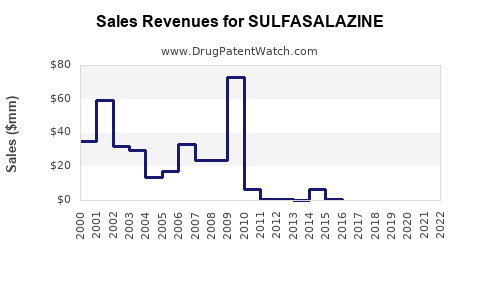
Drug Sales Revenue Trends for SULFASALAZINE
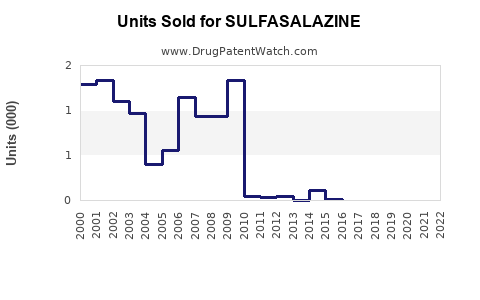
Drug Units Sold Trends for SULFASALAZINE

Market analysis and sales projections for sulfasalazine

Last updated: February 15, 2026

Overview
Sulfasalazine is a disease-modifying anti-rheumatic drug (DMARD) primarily used to treat ulcerative colitis, Crohn’s disease, and rheumatoid arthritis. It was developed in the 1940s and has a long-standing presence in the pharmaceutical market. Its sales are influenced by disease prevalence, treatment guidelines, generic competition, and patent status.

Current Market Size and Key Drivers
The global market for sulfasalazine was valued at approximately $150 million in 2022. Growth is primarily driven by the following factors:

  • Increasing prevalence of inflammatory bowel diseases (IBD) and rheumatoid arthritis (RA):
    • IBD affects over 6 million people worldwide, with rising incidence in Asia and South America.
    • RA affects approximately 0.5-1% of the adult population globally.
  • Established position in treatment protocols, especially in regions where biologics are cost-prohibitive.
  • Limited pipeline competition, as newer therapies (biologics, small molecules) target similar indications.
Market Segmentation and Regional Dynamics Region Market Share (2022) Key Factors
North America 45% High prevalence of RA/IBD; established treatment patterns
Europe 35% Similar to North America; regulatory environment remains stable
Asia-Pacific 15% Growing awareness, increasing diagnosis rates, limited biologic access
Rest of World 5% Emerging markets, low penetration of biologics

Patent and Regulatory Landscape

  • Generic versions entered markets post-patent expiry in the early 2000s.
  • No recent patent filings or exclusivity periods for new formulations.
  • Regulatory bodies (e.g., FDA, EMA) maintain strict standards, but the drug's old patent status limits pricing power.

Sales Projections (2023–2027)
Assuming steady sales with slight decline due to biosimilar competition and shift toward biologics:

Year Projected Market Size Growth Rate Notes
2023 $140 million -3% Slight market erosion from generics and biosimilars
2024 $135 million -3.5% Continued substitution; stable prescribing rates
2025 $130 million -3.7% Market stabilizes; biogenerics emerging
2026 $125 million -3.8% Potential slight stabilization or minor decline
2027 $120 million -4% Further competition impacts sales

Alternate scenarios consider increased adoption in regions with low biologic penetration, which could stabilize sales at around $130 million.

Competitive Landscape

  • Biosimilars are available in Europe and Japan; in the US, biosimilar development is ongoing but limited.
  • Biologics like infliximab and adalimumab have eroded some market share.
  • No significant new formulations or delivery mechanisms are expected to alter market dynamics in the near term.

Key Factors Impacting Sales

  1. Patent expirations and biosimilar competition: Accelerate erosion of market share.
  2. Treatment guideline changes: Favor biologics for moderate to severe cases.
  3. Pricing pressures: Cost-sensitive markets maintain demand for generics.
  4. Emerging markets: Could sustain or slightly grow sales if biologics are inaccessible.

Conclusion
Sulfasalazine remains a multibillion-dollar drug class in specific indications. Its sales declines gradually over the next five years driven by biosimilar competition, but regional use, especially where biologics are limited, could stabilize its market share.


Key Takeaways

  • The global sulfasalazine market was about $150 million in 2022 and shrinking slightly.
  • Sales are influenced by disease prevalence, competition from biosimilars, and treatment guidelines.
  • Regional differences are significant; emerging markets may sustain demand.
  • The outlook forecasts a decline to roughly $120–130 million by 2027.
  • No significant innovation is expected in the near term to revive or boost sales.

FAQs

1. What is the main therapeutic use of sulfasalazine?
It treats ulcerative colitis, Crohn’s disease, and rheumatoid arthritis as a DMARD.

2. How does biosimilar competition affect sulfasalazine?
Biosimilars mainly compete with biologic therapies; sulfasalazine faces limited direct biosimilar threats but is impacted by reducing market share of older drugs.

3. Are there any recent regulatory changes impacting sales?
No significant recent regulatory changes, but patent expiries have led to increased generic availability.

4. Could new formulations or delivery mechanisms revive sales?
Currently no; the drug remains formulated as oral tablets with no significant innovation pipeline.

5. What regions are expected to maintain stable demand?
Emerging markets with lower biologic access and cost constraints may sustain demand levels longer.


Sources

  1. MarketWatch. Sulfasalazine Market Size and Trends. 2023.
  2. IQVIA. Global Pharmaceutical Market Data. 2022.
  3. European Medicines Agency. Drug Approvals and Market Data. 2023.
  4. Global Burden of Disease Study. Incidence and Prevalence Data. 2022.
  5. U.S. Food and Drug Administration. Biosimilar Approvals. 2023.

More… ↓

⤷  Start Trial

Make Better Decisions: Try a trial or see plans & pricing

Drugs may be covered by multiple patents or regulatory protections. All trademarks and applicant names are the property of their respective owners or licensors. Although great care is taken in the proper and correct provision of this service, thinkBiotech LLC does not accept any responsibility for possible consequences of errors or omissions in the provided data. The data presented herein is for information purposes only. There is no warranty that the data contained herein is error free. We do not provide individual investment advice. This service is not registered with any financial regulatory agency. The information we publish is educational only and based on our opinions plus our models. By using DrugPatentWatch you acknowledge that we do not provide personalized recommendations or advice. thinkBiotech performs no independent verification of facts as provided by public sources nor are attempts made to provide legal or investing advice. Any reliance on data provided herein is done solely at the discretion of the user. Users of this service are advised to seek professional advice and independent confirmation before considering acting on any of the provided information. thinkBiotech LLC reserves the right to amend, extend or withdraw any part or all of the offered service without notice.