Drug Sales Trends for PROPECIA
Payment Methods and Pharmacy Types for PROPECIA (2014)
Revenues by Pharmacy Type
Units Sold by Pharmacy Type
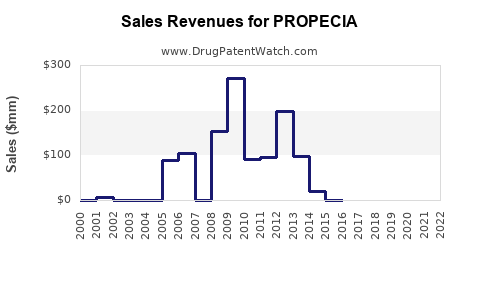
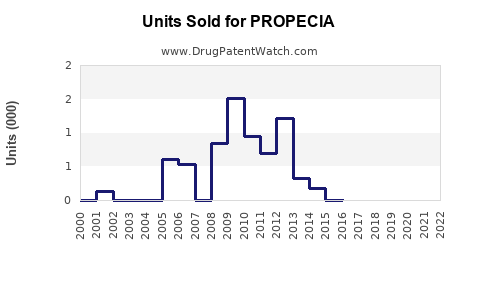
Annual Sales Revenues and Units Sold for PROPECIA
| Drug Name | Revenues (USD) | Units | Year |
|---|---|---|---|
| PROPECIA | ⤷ Start Trial | ⤷ Start Trial | 2022 |
| PROPECIA | ⤷ Start Trial | ⤷ Start Trial | 2021 |
| PROPECIA | ⤷ Start Trial | ⤷ Start Trial | 2020 |
| PROPECIA | ⤷ Start Trial | ⤷ Start Trial | 2019 |
| PROPECIA | ⤷ Start Trial | ⤷ Start Trial | 2018 |
| >Drug Name | >Revenues (USD) | >Units | >Year |
Propecia Market Analysis and Sales Projections: Finasteride 1 mg, Patent Status, Competition, and Generic Risk
Propecia is the branded 1 mg finasteride product for male androgenetic alopecia. Its U.S. composition and use patents have expired, and generic finasteride has held the market for more than a decade. The commercial opportunity is now concentrated in low-cost generic prescriptions, telehealth distribution, subscription programs, and international markets. Standalone current Propecia sales are not publicly reported, so projections are best made for the total finasteride 1 mg market rather than the discontinued or low-visibility branded product.
What is Propecia and how large is its market?
Propecia contains finasteride 1 mg and is approved for the treatment of male pattern hair loss, also called androgenetic alopecia. Merck received U.S. Food and Drug Administration approval for Propecia in December 1997 under NDA 020788.[1]
Finasteride inhibits type II 5-alpha-reductase and reduces conversion of testosterone to dihydrotestosterone. The product competes with oral and topical minoxidil, dutasteride, hair-transplant procedures, platelet-rich plasma, low-level light therapy, and newer telehealth-prescribed regimens.
The addressable market has two distinct components:
| Market segment | Commercial status | Main products |
|---|---|---|
| Branded Propecia | Mature or limited availability | Propecia 1 mg |
| Generic oral finasteride | Largest prescription segment | Finasteride 1 mg tablets |
| Topical finasteride | Growing, jurisdiction-dependent | Compounded or approved topical products |
| Oral minoxidil | Off-label in many markets | Generic minoxidil |
| Hair-restoration procedures | High-value elective segment | Transplantation and related services |
Global market reports often combine hair-loss drugs, supplements, devices, procedures, and cosmetics. Those figures should not be treated as Propecia or finasteride sales. Public company filings generally do not disclose a separate Propecia revenue line.
What are the current Propecia sales and revenue trends?
Current standalone Propecia revenue is not publicly available in a sufficiently reliable form. Merck’s public reporting does not provide a current, separately reported Propecia sales line, and generic substitution has materially reduced the economic value of the brand.
The commercial trend is clear:
- Branded Propecia lost U.S. exclusivity after generic finasteride entered the market.
- Reimbursement and cash-pay channels shifted toward low-cost generic tablets.
- Telehealth companies increased prescription access and recurring fulfillment.
- Brand value moved from product differentiation to consumer recognition, adherence support, and distribution.
- Price compression limited revenue growth even when prescription volume remained stable or increased.
Finasteride 1 mg is generally available at a fraction of the historical branded price. A retail cash prescription may cost approximately $5 to $30 per month depending on quantity, pharmacy, discount program, and market. Telehealth subscriptions can be substantially higher because they include consultation, fulfillment, platform fees, and ancillary products.
Revenue exposure by channel
| Channel | Volume outlook | Price outlook | Revenue implication |
|---|---|---|---|
| Traditional generic pharmacy | Stable to growing | Low and declining | High volume, low value |
| Telehealth subscription | Growing | Higher than pharmacy generic | Stronger revenue per patient |
| Branded Propecia | Limited | Variable | Low strategic importance |
| Compounded topical finasteride | Growing from small base | Premium pricing | Regulatory and quality risk |
| International branded markets | Mixed | Market-specific | Residual brand opportunity |
When did Propecia lose exclusivity?
Propecia’s principal U.S. patent protection expired in the early 2010s. FDA-approved generic finasteride 1 mg products subsequently entered the market. The key historical patent is U.S. Patent No. 5,547,957, covering treatment of androgenetic alopecia with finasteride.[2]
| Milestone | Date or status |
|---|---|
| Propecia U.S. approval | December 1997 |
| Principal alopecia patent | U.S. Patent No. 5,547,957 |
| Principal U.S. patent expiration | 2013, including applicable patent-term calculations |
| Generic finasteride availability | Began after loss of relevant exclusivity |
| Current U.S. status | Mature generic market |
The exact commercial impact of patent expiry was greater than the loss of a single patent. Prescribers and pharmacies gained access to multiple manufacturers, while patients could receive finasteride under the generic name at materially lower prices.
What patents protect Propecia today?
No active U.S. patent estate appears to provide meaningful exclusivity for the original Propecia 1 mg product. The historical protection centered on:
- The finasteride active ingredient and related compounds.
- Use of finasteride for male pattern hair loss.
- Oral tablet formulations and manufacturing processes.
Those rights do not create a current barrier to ordinary generic finasteride 1 mg tablets. Any later patents covering topical delivery, specific formulations, combination products, digital adherence systems, or alternative dosing would need separate claim and jurisdiction analysis.
Formulation patents and method-of-use patents
The original commercial product is a conventional oral tablet. It does not depend on a complex delivery device, long-acting formulation, biologic manufacturing process, or specialized administration system.
Potentially relevant newer IP may cover:
- Topical finasteride vehicles.
- Spray, foam, gel, or liposomal delivery.
- Finasteride combined with minoxidil.
- Lower-dose or alternate dosing schedules.
- Specific treatment populations.
- Reduced systemic exposure.
- Compounded formulation processes.
These rights generally do not restore exclusivity to oral Propecia. Their value depends on claim scope, enablement, written-description support, enforceability, regulatory approval, and whether physicians can legally substitute an unclaimed generic tablet.
What is the FDA and Orange Book status of Propecia?
Propecia was approved through the FDA’s New Drug Application pathway. Finasteride 1 mg generic products use the Abbreviated New Drug Application pathway and must demonstrate bioequivalence to the reference product.
The Orange Book historically identified Propecia as the reference listed drug and included relevant patent information during the protected period.[3] With the principal patent estate expired, generic applicants no longer face the same patent-based delay risk that applied during the protected period.
The FDA-approved indication is male pattern hair loss in men. Finasteride 1 mg is not approved for use in women or children for this indication. The label includes reproductive and handling warnings, including precautions concerning crushed or broken tablets and exposure during pregnancy.[1]
Which companies are challenging Propecia, and what is the Paragraph IV status?
Generic competition has already occurred. The relevant Paragraph IV period was the litigation and approval phase before or around the initial generic launches, rather than an active present-day challenge to a commercially protected Propecia patent.
For mature finasteride 1 mg products:
- Multiple generic manufacturers have entered the U.S. market.
- Paragraph IV litigation is not the primary current market risk.
- ANDA competition has shifted pricing power away from the brand.
- New entrants face manufacturing, bioequivalence, supply, and pharmacy-access issues rather than a material Propecia patent barrier.
Typical competitive participants have included large generic manufacturers such as Teva, Mylan, Dr. Reddy’s, Cipla, Aurobindo, and others, subject to product-specific FDA approval status and market availability.
What patent litigation affects Propecia?
The principal litigation risk associated with Propecia is historical product-liability litigation, not current patent enforcement. Lawsuits have alleged sexual dysfunction and related adverse effects after discontinuation. Those cases can affect brand reputation, regulatory communications, insurance exposure, and demand, but they do not recreate patent exclusivity.
Patent litigation concerning newer topical finasteride products, combination products, or proprietary delivery systems would be separate from legacy Propecia litigation. A company commercializing a new product must analyze freedom to operate around formulation claims, method-of-use claims, manufacturing claims, and trademarks.
How strong is the Propecia patent estate?
The current Propecia patent estate is weak as a source of exclusivity because the core U.S. patents have expired and generic substitution is established.
| Estate characteristic | Assessment |
|---|---|
| Core active ingredient protection | Expired |
| Original alopecia use protection | Expired |
| Oral tablet exclusivity | Expired or commercially ineffective |
| Device or delivery-system protection | Not central to Propecia |
| Biologic manufacturing protection | Not applicable |
| Trademark value | Residual consumer recognition |
| Generic substitution barrier | Low |
| Litigation leverage | Low for legacy oral product |
Propecia’s remaining commercial assets are brand awareness, historical clinical familiarity, and consumer search demand. Those assets are weaker than patent exclusivity but can support premium telehealth packaging or international brand sales.
What are the sales projections for finasteride and Propecia?
A precise brand forecast cannot be supported by public data because Propecia revenue is not separately disclosed. The following scenario model applies to the U.S. oral finasteride 1 mg market, including generic dispensing and branded or telehealth channels.
Base-case five-year forecast
Assumptions:
- Mature prescription volume grows 2% annually.
- Average net revenue per monthly patient declines 1% annually in pharmacy channels.
- Telehealth and subscription channels increase their share of total economic value.
- No new FDA-approved oral competitor displaces finasteride.
- No major safety action removes finasteride from the market.
| Year | Prescription-volume index | Net market-value index | Main driver |
|---|---|---|---|
| 2025 | 100 | 100 | Mature generic base |
| 2026 | 102 | 101 | Telehealth expansion offsets price pressure |
| 2027 | 104 | 102 | Stable diagnosis and treatment uptake |
| 2028 | 106 | 103 | More direct-to-consumer distribution |
| 2029 | 108 | 104 | Volume growth, low unit pricing |
Scenario range
| Scenario | Annual volume growth | Annual value growth | 2029 value versus 2025 |
|---|---|---|---|
| Downside | -3% | -8% | About 66% |
| Base | 2% | 1% | About 104% |
| Upside | 6% | 7% | About 131% |
The downside case reflects stronger adoption of topical products, adverse publicity, tighter prescribing practices, or lower-cost generic competition. The upside case requires sustained telehealth growth, increased diagnosis, international expansion, and successful retention of patients on recurring treatment.
Propecia-branded revenue is likely to remain flat or decline unless a company invests in premium positioning, differentiated packaging, physician support, or a regulated topical or combination extension. Generic finasteride can grow in prescriptions while total drug revenue remains flat because unit prices continue to fall.
What generic entry risks exist for Propecia?
Generic entry risk is already realized rather than prospective. The key risks now affect any branded or reformulated finasteride product:
- Rapid pharmacy substitution.
- Low barriers to switching between generic manufacturers.
- Limited willingness to pay for the Propecia name.
- Online price comparison.
- Telehealth churn.
- Regulatory scrutiny of compounded topical products.
- Product-liability exposure related to sexual and psychiatric adverse events.
- Supply interruptions caused by active pharmaceutical ingredient concentration.
- Trademark confusion between approved products and compounded products.
For a new entrant, the principal barrier is commercial differentiation, not patent protection.
How does Propecia compare with competing hair-loss drugs?
| Product | Active ingredient | FDA status for male pattern hair loss | Patent position | Commercial position |
|---|---|---|---|---|
| Propecia | Finasteride 1 mg | Approved | Core patents expired | Legacy brand |
| Generic finasteride | Finasteride 1 mg | Approved through ANDA pathway | No meaningful core barrier | Dominant low-cost option |
| Rogaine | Minoxidil | Approved topical treatment | Mature generic market | Major OTC competitor |
| Oral minoxidil | Minoxidil | Often off-label for hair loss | Mature compound | Growing but safety-limited |
| Dutasteride | Dutasteride | Hair-loss use varies by jurisdiction | Mature compound | Off-label or jurisdiction-specific |
| Topical finasteride | Finasteride | Product-specific | Formulation-dependent | Emerging segment |
Finasteride’s main advantage is established efficacy, low manufacturing cost, and physician familiarity. Its main disadvantages are the need for continuous use, adverse-effect concerns, and limited differentiation among manufacturers.
What licensing deals and commercial partnerships affect Propecia?
No current licensing transaction is necessary to explain the economics of generic finasteride. The original Propecia rights were associated with Merck. Current market expansion is more likely to occur through:
- Telehealth prescribing agreements.
- Pharmacy and fulfillment contracts.
- Private-label generic supply.
- Topical formulation licensing.
- Combination-product development.
- International distributor arrangements.
Commercial diligence should distinguish a license to the finasteride active ingredient from a license to a protected delivery system, brand, formulation, or digital service. A generic finasteride supply agreement usually has limited IP value unless it includes manufacturing capacity, regulatory approvals, geographic exclusivity, or a differentiated formulation.
What are the geographic opportunities for finasteride?
The United States is a mature generic market. Growth opportunities are more likely in:
- Markets with increasing diagnosis of male pattern hair loss.
- Countries where prescription access is expanding.
- Regions with lower generic penetration.
- Markets where branded finasteride retains physician or consumer preference.
- Online channels that can bundle consultation, medication, and adherence services.
Geographic freedom to operate must be assessed separately. Patent expiry, product approval, pharmacy substitution, advertising restrictions, prescription rules, and local trademark rights vary by country.
Key Takeaways
- Propecia is the original branded finasteride 1 mg product for male pattern hair loss.
- Its principal U.S. patent protection expired in the early 2010s.
- Generic finasteride is the primary commercial product in the United States.
- Current standalone Propecia sales are not publicly disclosed.
- The U.S. market can grow in prescription volume while declining in unit value.
- Telehealth subscriptions and topical formulations offer the main routes to higher revenue per patient.
- Legacy oral Propecia has little remaining patent strength.
- Current competitive risk is driven by generic pricing, product liability, topical alternatives, and patient acquisition costs.
- A reasonable base case is low-single-digit market-value growth through 2029, with substantial downside if price erosion accelerates.
FAQs
Is Propecia still sold in the United States?
Propecia has had limited commercial visibility relative to generic finasteride. Patients commonly receive FDA-approved finasteride 1 mg tablets from generic manufacturers.
Is finasteride 1 mg still patent-protected?
The core U.S. patents covering the original oral finasteride hair-loss product have expired. New topical or combination formulations may have separate patent rights.
Can generic finasteride replace Propecia?
FDA-approved generic finasteride 1 mg is therapeutically equivalent to the reference product for the approved indication, subject to physician prescribing and pharmacy-substitution rules.
Does Propecia have biosimilar risk?
No. Propecia is a small-molecule drug, not a biologic. Its relevant competitive threat is generic substitution, not biosimilar competition.
Is topical finasteride a material threat to oral Propecia?
Topical finasteride is a potential growth competitor, particularly where it is approved or legally marketed. Its commercial impact depends on regulatory status, clinical adoption, price, systemic exposure, and patient preference.
References
-
U.S. Food and Drug Administration. (2014). Propecia (finasteride) tablets, 1 mg: Prescribing information. FDA.
-
U.S. Patent and Trademark Office. (1996). U.S. Patent No. 5,547,957: Treatment of androgenetic alopecia with finasteride. USPTO.
-
U.S. Food and Drug Administration. (n.d.). Approved drug products with therapeutic equivalence evaluations, Orange Book. FDA.
More… ↓
