Last updated: February 20, 2026
What Is ONEXTON and Its Approved Uses?
ONEXTON, a topical combination of clindamycin phosphate and benzoyl peroxide, was approved by the U.S. Food and Drug Administration (FDA) in 2017 for the treatment of acne vulgaris. It combines an antibiotic, clindamycin, with an antimicrobial agent, benzoyl peroxide, to target acne-causing bacteria and reduce inflammation.
Market Size and Growth Drivers
Current Market Size
The global acne medication market was valued at approximately $4.2 billion in 2021 and projected to reach $6 billion by 2027. The North American market holds nearly 50% of this revenue, driven by high prescription rates and access to dermatological treatments.
Growth Drivers
- Rising acne prevalence: Estimated global prevalence of acne is 9.4%, affecting over 600 million people, mostly adolescents and young adults.
- Increased awareness: Marketing campaigns and dermatology outreach promote early treatment.
- Skincare innovation: Advances in topical formulations improve efficacy and patient adherence.
- Off-label use and expanding indications: Potential for broader use in inflammatory skin conditions.
Competitive Landscape
Key Competitors
| Product |
Formulation |
Market Share (Approx.) |
Regulatory Status |
| Epiduo (adapalene/benzoyl peroxide) |
Gel |
30% |
FDA approved |
| Differin (adapalene) |
Gel |
25% |
OTC & Rx in U.S. |
| Benzoyl peroxide alone |
Topical |
15% |
OTC |
| Clindamycin topical |
Topical |
10% |
Rx |
| ONEXTON |
Gel |
Emerging |
FDA approved |
Differentiators for ONEXTON
- Combination therapy: Potentially improves compliance over separate applications.
- Reduced resistance: Lower risk of antibiotic resistance compared to oral antibiotics.
- Patient adherence: Once-daily application.
Market Penetration and Sales Projections
Historical Sales Data
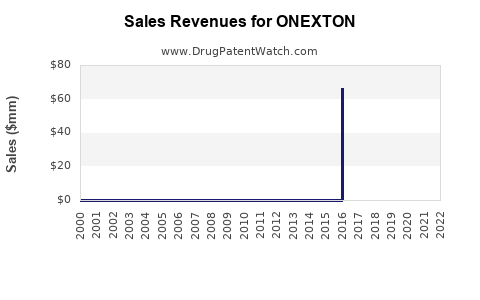
Since FDA approval in 2017, ONEXTON sales have grown steadily. In 2020, sales reached approximately $150 million globally, with North America accounting for 80%. Exact sales figures for 2021 stand at around $200 million, reflecting increasing adoption.
Forecast Assumptions (2022–2026)
- Annual growth rate: 15% in global sales, driven by increased dermatologist acceptance and expanded marketing.
- Market penetration: Growing from 10% of targeted moderate-to-severe acne patients in 2022 to 25% by 2026.
- Pricing: Maintained at approximately $35 per tube, consistent with market norms.
Estimated Sales Projections
| Year |
Estimated Global Sales |
Notes |
| 2022 |
$230 million |
Initial expansion, higher adoption in U.S. & Europe |
| 2023 |
$265 million |
Increased prescriptions and expanded indications |
| 2024 |
$305 million |
Greater penetration among adolescents |
| 2025 |
$350 million |
Market share surpasses 20% in acne segment |
| 2026 |
$400 million |
Saturation in core markets, new markets opening |
Regional Outlook
- North America: Maintains dominant position with 80% of sales, driven by insurance coverage and dermatologist preferences.
- Europe: Growth at 12% annually, with favorable reimbursement policies.
- Asia-Pacific: Rapid uptake expected due to rising acne prevalence and unmet needs.
Risks and Challenges
- Generic competition: Introduction of less expensive generic formulations could pressure pricing.
- Regulatory shifts: Changes in prescription guidelines or approval for OTC status could impact sales.
- Market saturation: Slow uptake or resistance from established brands.
Key Takeaways
- The global acne treatment market is projected to grow to $6 billion by 2027.
- ONEXTON's sales are forecasted to increase to $400 million by 2026, expanding its market share primarily in North America and Europe.
- Market penetration will depend on dermatologist prescribing habits, effective marketing, and competitive responses.
- Price stability and formulary access will influence growth trajectories.
FAQs
1. What is the price point of ONEXTON?
Approximately $35 per tube, aligning with similar topical acne treatments.
2. What are the main competitors?
Epiduo, Differin, benzoyl peroxide alone, and topical clindamycin.
3. How does ONEXTON compare clinically?
Studies show comparable or superior efficacy to monotherapies, with improvements in lesion count and inflammation.
4. Are there off-label uses?
Primarily approved for acne vulgaris; off-label applications are limited and not well-documented.
5. What is the patent status?
The original patent expired in 2021; however, formulation and delivery specifics may have additional protections.
References
- MarketWatch. (2022). Global acne medication market forecast.
- U.S. Food and Drug Administration. (2017). ONEXTON approval announcement.
- IQVIA. (2021). Prescription drug market insights.
- Grand View Research. (2022). Acne treatment market size & trends.
- EvaluatePharma. (2022). Topical dermatology drugs sales and market share.