Drug Sales Trends for OFLOXACIN
Payment Methods and Pharmacy Types for OFLOXACIN (2014)
Revenues by Pharmacy Type
Units Sold by Pharmacy Type
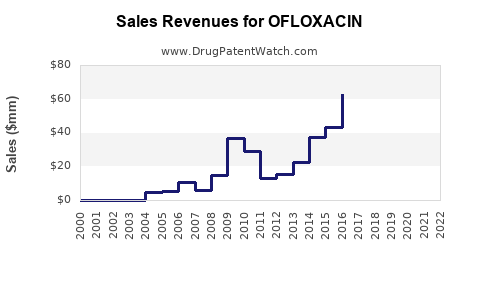
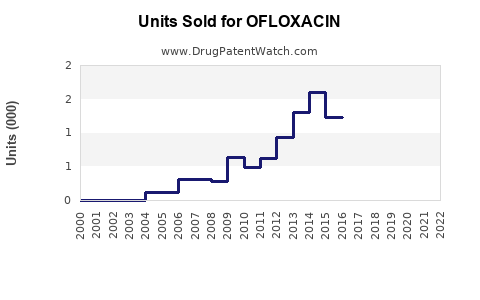
Annual Sales Revenues and Units Sold for OFLOXACIN
| Drug Name | Revenues (USD) | Units | Year |
|---|---|---|---|
| OFLOXACIN | ⤷ Start Trial | ⤷ Start Trial | 2022 |
| OFLOXACIN | ⤷ Start Trial | ⤷ Start Trial | 2021 |
| OFLOXACIN | ⤷ Start Trial | ⤷ Start Trial | 2020 |
| OFLOXACIN | ⤷ Start Trial | ⤷ Start Trial | 2019 |
| OFLOXACIN | ⤷ Start Trial | ⤷ Start Trial | 2018 |
| OFLOXACIN | ⤷ Start Trial | ⤷ Start Trial | 2017 |
| >Drug Name | >Revenues (USD) | >Units | >Year |
Ofloxacin Market Analysis, Sales Projections, Patent Status, and Generic Competition
Ofloxacin is a mature fluoroquinolone antibiotic with no meaningful U.S. patent or regulatory exclusivity remaining. The commercial market is almost entirely generic and is concentrated in low-cost oral, ophthalmic, and otic products. Sales are declining structurally because of antimicrobial-stewardship policies, substitution by newer therapies, and limited pricing power. Growth opportunities are concentrated in emerging markets, ophthalmic and otic formulations, hospital tenders, and contract manufacturing rather than branded innovation.
Standalone global sales for ofloxacin are not publicly reported in a reliable, drug-specific format. The projections below are analytical estimates based on generic-market dynamics, formulation mix, and expected price erosion.
What is the current market position of ofloxacin?
Ofloxacin is a second-generation fluoroquinolone marketed in several dosage forms:
| Formulation | Main commercial uses | Market position |
|---|---|---|
| Oral tablets | Selected urinary, respiratory, skin, gastrointestinal and reproductive-tract infections | Mature generic market with declining use |
| Ophthalmic solution | Bacterial conjunctivitis and corneal ulcer | More resilient than oral products |
| Otic solution | Otitis externa and otitis media with tympanic-membrane perforation | Stable niche market |
| Injectable products | Hospital use in some jurisdictions | Limited commercial significance in the U.S. |
The U.S. Food and Drug Administration approved oral ofloxacin under the Floxin brand in the late 1980s. Generic oral and topical versions have been available for many years. FDA labeling warns about serious fluoroquinolone adverse reactions, including tendinitis and tendon rupture, peripheral neuropathy, central nervous-system effects, and exacerbation of myasthenia gravis. These warnings restrict use when alternative antibiotics are appropriate. (FDA, 2018; FDA, 2024a)
The strongest remaining commercial segment is topical ofloxacin. Ophthalmic and otic products have lower systemic exposure, established physician familiarity, and recurring demand from primary-care, ophthalmology, otolaryngology, and urgent-care channels.
How large is the ofloxacin market?
No authoritative public source reports a consolidated global market value for ofloxacin across oral, ophthalmic, otic, hospital, and retail channels. Market-research reports often combine ofloxacin with broader fluoroquinolone categories or report products by therapeutic class rather than active ingredient.
A practical market view is:
| Segment | Relative demand | Pricing | Five-year outlook |
|---|---|---|---|
| U.S. oral ofloxacin | Low | Very low generic pricing | Declining |
| U.S. ophthalmic ofloxacin | Moderate | Low to moderate | Stable to slightly declining |
| U.S. otic ofloxacin | Moderate | Moderate relative to oral | Stable |
| Emerging-market oral products | High unit volume in some countries | Low | Flat to declining value |
| Emerging-market ophthalmic and otic products | Moderate | Low to moderate | Low-single-digit growth in value |
| Hospital and tender supply | Variable | Highly compressed | Stable volume, weak margins |
The commercial value of ofloxacin is driven more by manufacturing scale and distribution than by innovation. A supplier with low-cost API access, validated sterile manufacturing, and broad registration coverage can remain competitive even in markets where headline prices are low.
What are the sales projections for ofloxacin?
The following projections are modeled estimates, not reported manufacturer sales. They assume continued generic substitution, annual price erosion of 3% to 7% in developed markets, stable-to-growing unit demand in selected emerging markets, and a gradual shift from oral toward topical formulations.
Base-case global manufacturer-sales projection
| Year | Estimated global sales pool | Year-over-year change | Primary driver |
|---|---|---|---|
| 2024 | $120 million-$210 million | Baseline | Generic oral and topical demand |
| 2025 | $116 million-$205 million | -2% to -4% | Oral price erosion |
| 2026 | $111 million-$201 million | -2% to -4% | Continued generic substitution |
| 2027 | $107 million-$198 million | -1% to -4% | Topical products offset oral decline |
| 2028 | $103 million-$195 million | -1% to -4% | Emerging-market volume support |
| 2029 | $99 million-$192 million | -1% to -4% | Mature generic-market contraction |
The projected range reflects the lack of public product-level reporting and the wide variation in local prices. It represents manufacturer and distributor sales rather than total patient spending.
Scenario analysis
| Scenario | 2029 estimated sales | Assumptions |
|---|---|---|
| Downside | $65 million-$105 million | Faster stewardship-driven decline, aggressive tender pricing, reduced oral use |
| Base case | $99 million-$192 million | Stable topical demand and moderate emerging-market volume |
| Upside | $190 million-$285 million | Higher emerging-market adoption, expanded otic registrations, supply disruptions affecting competitors |
The upside case does not depend on new intellectual property. It depends on execution, regulatory registrations, supply reliability, and access to low-cost manufacturing.
Which formulations of ofloxacin have the strongest commercial potential?
Ophthalmic ofloxacin
Ophthalmic ofloxacin has the most defensible commercial profile. It is used as a generic antibacterial eye drop, commonly in 0.3% solution. The segment benefits from:
- Established clinical familiarity.
- Relatively simple dosing.
- Demand from conjunctivitis and corneal-infection treatment.
- Lower systemic safety concerns than oral fluoroquinolones.
- Distribution through retail pharmacies, hospitals, clinics, and ophthalmology practices.
The principal competitive threats are newer fluoroquinolone eye drops, including moxifloxacin and besifloxacin, as well as non-fluoroquinolone agents used for uncomplicated conjunctivitis.
Otic ofloxacin
Otic ofloxacin is commercially attractive because it is used where the tympanic membrane is perforated or where ototoxicity concerns affect product selection. The product is typically supplied as a sterile otic solution and competes with ciprofloxacin-based products and combination antibiotic-steroid products.
Otic products can achieve higher unit prices than oral tablets, but the market is smaller. Sterile manufacturing capability and validated filling operations are more important than tablet-scale economics.
Oral ofloxacin
Oral ofloxacin has the weakest long-term outlook in developed markets. FDA safety communications advise reserving systemic fluoroquinolones for certain infections when alternative treatments are unavailable or inappropriate. (FDA, 2016)
Generic oral products remain commercially relevant in countries where:
- Antibiotic stewardship enforcement is limited.
- Physicians continue to prescribe fluoroquinolones broadly.
- Ofloxacin is included in public tenders.
- Lower-cost oral therapy is prioritized.
- Local guidelines retain ofloxacin for selected infections.
The oral segment is vulnerable to both volume decline and severe price competition.
What is the FDA regulatory status of ofloxacin?
Ofloxacin is an FDA-approved small-molecule antibiotic available through abbreviated new drug applications and legacy new drug applications. It is not a biologic and does not create a biosimilar opportunity.
| Regulatory issue | Status |
|---|---|
| U.S. active ingredient | Approved |
| Generic pathway | ANDA pathway available |
| New chemical entity exclusivity | Expired |
| Orphan-drug exclusivity | Not applicable |
| Pediatric exclusivity | Not commercially relevant |
| U.S. biosimilar pathway | Not applicable |
| Prescription status | Prescription drug |
| Current regulatory barrier | Safety labeling and product-quality compliance |
FDA-approved labeling differs by dosage form. Oral ofloxacin labeling contains systemic fluoroquinolone warnings, while ophthalmic and otic labels contain formulation-specific dosing and safety information. Generic manufacturers must demonstrate pharmaceutical equivalence and bioequivalence or satisfy the applicable topical-product requirements under FDA review. (FDA, 2024a; FDA, 2024b)
What is the Orange Book status of ofloxacin?
Ofloxacin is a mature generic active ingredient with no commercially significant U.S. Orange Book exclusivity remaining. Original listed-drug patents and regulatory exclusivities expired long ago. Current generic competition is therefore based on approval status, product quality, availability, channel access, and price.
The Orange Book remains relevant for:
- Identifying reference-listed drugs.
- Reviewing approved dosage forms and strengths.
- Checking current therapeutic-equivalence codes.
- Reviewing any residual patent or exclusivity entries.
- Comparing approved generic suppliers.
The commercial risk from the Orange Book is low compared with newer branded antibiotics. A new generic applicant is unlikely to face a meaningful patent barrier for standard oral, ophthalmic, or otic ofloxacin products, although FDA application-specific requirements still apply. (FDA, 2024c)
What patents protect ofloxacin?
No active U.S. composition-of-matter patent is expected to protect standard commercial ofloxacin products. The original compound and brand-product patent positions expired decades ago.
Potential patent categories include:
| Patent category | Current commercial relevance |
|---|---|
| Ofloxacin composition patents | Expired |
| Original oral formulation patents | Expired |
| Ophthalmic formulation patents | Generally expired or commercially immaterial |
| Otic formulation patents | No broad blocking position identified for standard products |
| Manufacturing-process patents | Possible at supplier level but usually nonblocking |
| Method-of-use patents | Limited relevance for generic label use |
| Device or packaging patents | Product-specific and narrow |
A generic applicant still must avoid infringing any valid, unlisted process, formulation, device, or manufacturing patent. Those patents are unlikely to recreate the market exclusivity once provided by the original compound patent.
When does ofloxacin lose exclusivity?
Ofloxacin lost meaningful U.S. exclusivity many years ago. The product is now in the post-exclusivity generic phase.
| Exclusivity type | Status |
|---|---|
| Composition-of-matter protection | Expired |
| Original branded exclusivity | Expired |
| Generic entry rights | Long established |
| Current market protection | None of material commercial scope |
| Expected generic launch barrier | Regulatory and manufacturing execution |
There is no credible basis for a future U.S. patent-cliff event involving standard ofloxacin. The market is already beyond the cliff. Future changes will result from supplier exits, shortages, tender awards, manufacturing inspections, and clinical prescribing trends.
Are there Paragraph IV challenges involving ofloxacin?
Paragraph IV litigation is generally associated with a new generic applicant challenging an unexpired listed patent. Because standard ofloxacin products have been generic for decades and lack meaningful current patent exclusivity, new Paragraph IV activity is unlikely to be a major market event.
A new applicant could still make a Paragraph IV certification against an application-specific patent if a listed patent were present for a particular formulation or delivery system. That would be product-specific rather than evidence of broad protection for ofloxacin.
The more relevant generic risks are:
- FDA deficiencies during review.
- Sterility failures for ophthalmic or otic products.
- API supply interruptions.
- Manufacturing-site warning letters.
- State substitution rules.
- Contract losses in hospital and public tenders.
Which companies compete in the ofloxacin market?
Competition varies by country and dosage form. The market includes:
- Multinational generic manufacturers.
- Regional pharmaceutical companies.
- Sterile ophthalmic specialists.
- Contract development and manufacturing organizations.
- API suppliers in India and China.
- Hospital-tender suppliers.
The original branded franchise was associated with Daiichi and regional commercial partners, but branded ownership is no longer the primary competitive variable. Generic manufacturers compete through:
- Regulatory registrations.
- Product availability.
- Low-cost API procurement.
- Sterile-product quality.
- Distributor relationships.
- Tender participation.
- Multi-country packaging and labeling capability.
A supplier with both oral solid-dose and sterile topical capabilities can sell across more channels than a tablet-only manufacturer.
What licensing deals and partnerships affect ofloxacin?
No major current licensing structure is required to commercialize standard generic ofloxacin in the U.S. The original branded rights and historical commercialization arrangements have little bearing on current generic supply.
Commercial partnerships remain relevant in emerging markets. Typical arrangements include:
- Local marketing authorization holders.
- Territory-based distribution agreements.
- Private-label supply contracts.
- Government-tender partnerships.
- API supply agreements.
- Contract sterile-fill arrangements.
The value of a licensing deal depends on registration ownership and channel access, not on patent exclusivity. An arrangement that grants access to a large public-health tender can be more valuable than a traditional brand license.
What litigation affects the ofloxacin market?
No broad, current patent-litigation issue is expected to restrict standard ofloxacin generic entry. Litigation exposure is more likely to arise from:
- Product-liability claims involving systemic fluoroquinolone risks.
- Manufacturing and sterility disputes.
- ANDA-related disputes involving a specific formulation.
- Trademark or trade-dress disputes.
- Distribution and supply-contract disagreements.
Systemic fluoroquinolone warnings create liability and compliance exposure for manufacturers and prescribers. FDA updated fluoroquinolone safety communications in response to reports of disabling and potentially permanent adverse effects. (FDA, 2016)
How strong is the patent estate for ofloxacin?
The patent estate is weak from an exclusivity perspective.
| Patent-strength factor | Assessment |
|---|---|
| Composition-of-matter patent | No remaining commercial protection |
| Standard oral product | Very weak |
| Standard ophthalmic solution | Weak |
| Standard otic solution | Weak to moderate for narrow product claims |
| Manufacturing know-how | Moderate operational value |
| Sterile-filling capability | Moderate commercial barrier |
| Label differentiation | Limited |
| Freedom to operate | Generally favorable for standard products |
The principal barriers are operational rather than legal. Sterility assurance, extractables and leachables control, container-closure integrity, stability data, and supply-chain qualification can delay entry even when patent risk is low.
What generic launch scenarios exist for ofloxacin?
Base case
Existing suppliers maintain availability while prices decline gradually. Oral volume contracts, while ophthalmic and otic products remain stable. No major branded relaunch occurs.
Downside case
Stewardship programs reduce oral prescribing faster than emerging-market growth offsets the decline. One or more suppliers exit because margins no longer cover compliance and pharmacovigilance costs.
Upside case
A manufacturer captures public tenders, secures registrations in high-volume emerging markets, or benefits from competitor shortages. Growth occurs through unit share rather than price increases.
Disruption case
A major sterile manufacturer experiences a warning letter, recall, or supply interruption. Competitors temporarily increase volume and prices, particularly in ophthalmic and otic products.
How does ofloxacin compare with competing fluoroquinolones?
| Drug | Commercial position | Relative strengths | Main risks |
|---|---|---|---|
| Ofloxacin | Mature generic | Low cost, broad legacy familiarity, ophthalmic and otic availability | Older molecule, systemic safety concerns |
| Ciprofloxacin | Larger generic franchise | Broad global use, extensive dosage-form presence | Heavy price competition and stewardship limits |
| Levofloxacin | Strong generic presence | Once-daily dosing and broad use | Systemic fluoroquinolone warnings |
| Moxifloxacin | Higher-value topical and systemic segments | Strong ophthalmic positioning, newer clinical profile | Higher price and stewardship pressure |
| Besifloxacin | Ophthalmic niche | Dedicated ophthalmic positioning | Smaller market and higher unit cost |
Ofloxacin is unlikely to regain share in systemic treatment without a major change in prescribing guidelines. Its most defensible position is in established topical applications where clinicians value availability and low cost.
What geographic markets offer the greatest opportunity?
The strongest commercial opportunities are in countries with:
- Large outpatient populations.
- High rates of bacterial eye and ear infections.
- Established generic substitution.
- Public procurement systems.
- Local registration pathways that recognize mature reference products.
- Lower levels of fluoroquinolone restriction.
North America and Western Europe offer regulatory credibility but limited growth. Latin America, South Asia, Southeast Asia, the Middle East, and parts of Africa can offer higher unit growth, although pricing and collection risk are greater.
Geographic expansion should prioritize ophthalmic and otic products. Oral expansion faces greater stewardship and reimbursement risk.
Key Takeaways
- Ofloxacin is a mature, fully generic antibiotic with no meaningful U.S. exclusivity remaining.
- The global market is likely worth tens to low hundreds of millions of dollars annually, but no authoritative standalone sales dataset is publicly available.
- A modeled global manufacturer-sales pool is approximately $99 million to $192 million by 2029 in the base case.
- Ophthalmic and otic products have stronger commercial prospects than oral tablets.
- Generic competition, API cost, sterile manufacturing, and tender access matter more than patents.
- Paragraph IV challenges and patent litigation are unlikely to drive market outcomes.
- Systemic safety warnings and antimicrobial stewardship will continue to pressure oral ofloxacin demand.
- The best commercial strategy is a low-cost, multi-country generic platform supported by sterile-product capability and reliable supply.
FAQs
Is ofloxacin still profitable for pharmaceutical manufacturers?
It can be profitable at scale, particularly in ophthalmic and otic products. Profitability is limited for low-volume oral tablets sold through highly competitive tenders.
Can a company launch a new ofloxacin eye drop without a patent license?
In general, standard ofloxacin ophthalmic products do not require a license to an active composition patent. The applicant must still satisfy FDA approval requirements and avoid any valid product-specific patents.
Is ofloxacin eligible for over-the-counter sale in the United States?
No. U.S. ofloxacin products are prescription drugs. A switch to over-the-counter status would require FDA review and approval.
Does ofloxacin have biosimilar competition?
No. Ofloxacin is a synthetic small-molecule drug, not a biologic. Competition occurs through generic-drug applications rather than biosimilar applications.
What is the most attractive ofloxacin product to develop?
A sterile ophthalmic or otic product with reliable supply, competitive packaging, and registrations in multiple emerging markets is generally more attractive than another low-price oral tablet.
References
- U.S. Food and Drug Administration. (2016). FDA updates warnings for oral and injectable fluoroquinolone antibiotics due to disabling side effects. https://www.fda.gov
- U.S. Food and Drug Administration. (2018). Fluoroquinolone antibacterial drugs: Drug safety communication. https://www.fda.gov
- U.S. Food and Drug Administration. (2024a). Ofloxacin tablet prescribing information. DailyMed. https://dailymed.nlm.nih.gov
- U.S. Food and Drug Administration. (2024b). Ofloxacin ophthalmic solution prescribing information. DailyMed. https://dailymed.nlm.nih.gov
- U.S. Food and Drug Administration. (2024c). Approved drug products with therapeutic equivalence evaluations, 44th edition. https://www.fda.gov
More… ↓
