Drug Sales Trends for LOVENOX
Payment Methods and Pharmacy Types for LOVENOX (2014)
Revenues by Pharmacy Type
Units Sold by Pharmacy Type
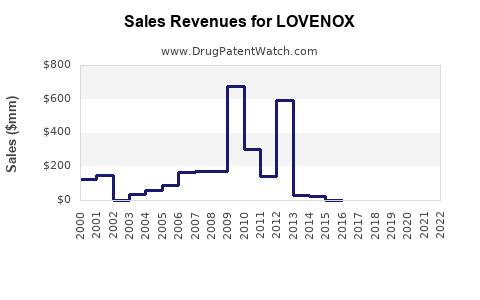
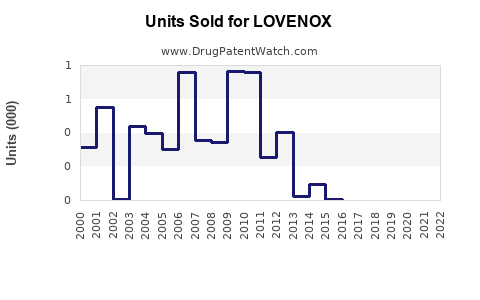
Annual Sales Revenues and Units Sold for LOVENOX
| Drug Name | Revenues (USD) | Units | Year |
|---|---|---|---|
| LOVENOX | ⤷ Start Trial | ⤷ Start Trial | 2022 |
| LOVENOX | ⤷ Start Trial | ⤷ Start Trial | 2021 |
| LOVENOX | ⤷ Start Trial | ⤷ Start Trial | 2020 |
| >Drug Name | >Revenues (USD) | >Units | >Year |
Lovenox Market Analysis, Sales Projections, Patent Status, and Generic Competition
Lovenox, Sanofi’s brand of enoxaparin sodium, is a mature low-molecular-weight heparin with broad use in venous thromboembolism prevention and treatment, acute coronary syndromes, and perioperative anticoagulation. Its commercial profile is driven by molecule-level demand rather than brand exclusivity. U.S. patent and regulatory protections have expired, generic enoxaparin is widely available, and Sanofi does not separately disclose current Lovenox revenue in its public financial reporting. The global enoxaparin market is likely to grow at a low- to mid-single-digit rate through 2030, while branded Lovenox sales should remain flat to declining.
What is Lovenox and how large is its addressable market?
Lovenox is the U.S. brand name for enoxaparin sodium, an injectable anticoagulant derived from unfractionated heparin. It is administered subcutaneously and is commonly used for:
- Prevention of deep-vein thrombosis after hip, knee, or abdominal surgery
- Treatment of deep-vein thrombosis and pulmonary embolism
- Prevention of ischemic complications in unstable angina and non-Q-wave myocardial infarction
- Prevention of thromboembolic complications in selected hospitalized patients
The product is marketed primarily in prefilled syringes and multiple dosage strengths. Enoxaparin competes with unfractionated heparin, dalteparin, fondaparinux, direct oral anticoagulants, and hospital-administered anticoagulation protocols.
The addressable market has two distinct segments:
| Segment | Commercial relevance |
|---|---|
| Lovenox brand | Declining, largely concentrated in brand-loyal or institutionally contracted accounts |
| Enoxaparin molecule | Stable to growing, supported by generic and multisource hospital demand |
| Low-molecular-weight heparins | Mature market with modest volume growth |
| Injectable anticoagulants overall | Under pressure from oral anticoagulants in selected outpatient indications |
The molecule remains important in hospitals because of its predictable dosing, extensive clinical history, established reversal and monitoring practices, and use in settings where oral therapy is unsuitable.
How much does Lovenox generate in annual sales?
Sanofi does not currently provide a separately reported Lovenox revenue line in its principal public financial disclosures. The company reports larger business units and product groupings, making current brand-specific revenue difficult to verify from company filings alone.
Historical Lovenox revenue was materially higher before generic competition. The product generated approximately $1 billion or more annually at its commercial peak, depending on the reporting year and currency conversion. Following U.S. generic entry and additional international competition, brand revenue declined sharply.
Estimated current sales profile
The following estimates separate Lovenox brand sales from total enoxaparin market sales.
| Metric | 2024 estimated range | 2030 base-case estimate |
|---|---|---|
| Global enoxaparin market | $1.5 billion-$2.2 billion | $1.9 billion-$2.9 billion |
| Lovenox branded sales globally | $250 million-$500 million | $150 million-$350 million |
| U.S. Lovenox branded sales | $75 million-$175 million | $40 million-$120 million |
| Generic and non-Sanofi enoxaparin sales | $1.1 billion-$1.7 billion | $1.5 billion-$2.5 billion |
These figures are analytical estimates rather than Sanofi-reported product sales. Public market research reports use different definitions, currencies, geographic scopes, and inclusion criteria. Some count only injectable enoxaparin; others include hospital anticoagulant products more broadly.
What are the sales projections for Lovenox through 2030?
The base case assumes low growth for the total enoxaparin market and continued share erosion for the Lovenox brand.
Base-case projection
| Year | Global enoxaparin market | Lovenox brand sales | Core market assumption |
|---|---|---|---|
| 2024 | $1.5B-$2.2B | $250M-$500M | Mature molecule; generic dominance |
| 2025 | $1.6B-$2.3B | $240M-$480M | Stable hospital demand |
| 2026 | $1.6B-$2.4B | $225M-$460M | Continued price competition |
| 2027 | $1.7B-$2.5B | $215M-$440M | Volume growth offset by lower prices |
| 2028 | $1.8B-$2.6B | $200M-$410M | Generic and regional manufacturer expansion |
| 2029 | $1.8B-$2.8B | $185M-$380M | Brand contraction continues |
| 2030 | $1.9B-$2.9B | $150M-$350M | Molecule growth with declining branded share |
The implied global market compound annual growth rate is approximately 3% to 5%. Lovenox brand sales are expected to decline at roughly 3% to 8% annually, depending on geography and contracting conditions.
The molecule can grow while the brand declines because volume increases in hospitals, emerging markets, and perioperative care do not necessarily translate into higher Sanofi sales.
What factors will drive enoxaparin market growth?
Hospital utilization remains the primary demand driver
Enoxaparin demand is linked to surgical volume, hospital admissions, orthopedic procedures, cancer-associated thrombosis, trauma care, and acute coronary syndrome treatment. Aging populations and higher rates of obesity and cancer support long-term anticoagulation demand.
The COVID-19 pandemic created a temporary increase in hospital anticoagulant use, but that demand spike did not establish a permanent equivalent increase in Lovenox brand sales.
Generic competition limits price growth
Generic enoxaparin products compete primarily through hospital tenders, group purchasing organizations, distributor contracts, and public procurement systems. Price competition is strongest in the United States and major European markets.
The product is more complex than a conventional small-molecule tablet because enoxaparin is a heterogeneous mixture of oligosaccharides produced through heparin depolymerization. Manufacturing consistency, molecular-weight distribution, anti-Xa and anti-IIa activity, impurity control, and source-material quality create technical barriers. Those barriers can restrict the number of qualified suppliers, but they do not preserve brand-level exclusivity.
Oral anticoagulants substitute in selected indications
Direct oral anticoagulants such as apixaban, rivaroxaban, edoxaban, and dabigatran have displaced injectable anticoagulants in some long-term outpatient settings. Their impact is lower in immediate postoperative prophylaxis, pregnancy-related anticoagulation, critical care, severe renal impairment, and situations requiring short-acting injectable therapy.
What is the FDA regulatory status of Lovenox?
Lovenox was approved by the FDA as an injectable enoxaparin product. The FDA label covers prophylaxis and treatment indications, including postoperative thrombosis prevention and acute coronary syndromes. The product carries boxed-warning language addressing spinal or epidural hematomas in patients receiving neuraxial anesthesia or spinal puncture while treated with enoxaparin [1].
Lovenox is not a biologic requiring biosimilar substitution analysis. Enoxaparin is regulated as a drug product, and competing products have entered through abbreviated drug approval pathways and product-specific FDA standards.
FDA market status
| Regulatory issue | Status |
|---|---|
| Active ingredient | Enoxaparin sodium |
| Dosage form | Injectable solution |
| Main route | Subcutaneous injection |
| Original sponsor | Sanofi and predecessor entities |
| Regulatory pathway for generics | Abbreviated New Drug Application pathway |
| Biosimilar designation | Not applicable |
| Current brand exclusivity | Expired |
| Current market access barrier | Manufacturing, quality, supply, contracting, and clinical substitution |
What patents protect Lovenox and when did exclusivity expire?
Lovenox’s foundational U.S. patent estate has expired. U.S. Patent No. 5,389,618, associated with enoxaparin and its use, was among the principal patents connected to the product’s original protection. Its effective patent term ended in the early 2010s after statutory adjustments and regulatory exclusivity considerations.
The key U.S. milestones were:
| Event | Approximate timing |
|---|---|
| FDA approval of Lovenox | 1993 |
| Five-year new chemical entity exclusivity | Expired in the late 1990s |
| First major U.S. generic competition | 2010 |
| Foundational U.S. patent protection | Expired by the early 2010s |
| Current patent-based brand exclusivity | None of commercial significance |
Lovenox patent risk is now different from the risk profile of a recently launched drug. The relevant questions are not whether a generic can enter under a Paragraph IV challenge, but whether a supplier can manufacture consistently, obtain regulatory approval, qualify for hospital contracts, and maintain supply reliability.
What is the Orange Book status of Lovenox?
The FDA Orange Book lists approved drug products and certain patent and exclusivity information. Lovenox’s historic Orange Book listings do not provide a current barrier comparable to an unexpired composition-of-matter patent or active regulatory exclusivity period.
The commercial implication is direct:
- A generic manufacturer does not face a meaningful remaining Lovenox patent wall.
- Paragraph IV litigation is not the central current risk.
- Any residual listed patent issue would need to be assessed by product, indication, and listing status.
- Market entry depends more heavily on FDA approval, manufacturing readiness, and procurement access.
Lovenox also lacks a current biosimilar interchangeability question because enoxaparin is not marketed as a biologic under the biosimilar framework.
Which companies compete with Lovenox?
Competition comes from both branded and generic enoxaparin manufacturers.
Direct enoxaparin competitors
Depending on jurisdiction, the competitive field has included products from:
- Sandoz
- Teva Pharmaceutical Industries
- Amphastar Pharmaceuticals
- Fresenius Kabi
- Viatris and legacy Mylan operations
- Regional injectable-drug manufacturers
- Hospital and government procurement suppliers
The exact competitor set varies by country because approval, tender participation, supply qualification, and distributor relationships differ across markets.
Therapeutic competitors
| Product class | Examples | Competitive effect |
|---|---|---|
| Unfractionated heparin | Heparin sodium | Lower-cost inpatient substitute; requires more monitoring |
| Other LMWHs | Dalteparin, tinzaparin | Indication-specific substitution |
| Factor Xa inhibitor | Fondaparinux | Alternative injectable anticoagulant |
| Direct oral anticoagulants | Apixaban, rivaroxaban, edoxaban | Strongest substitution in outpatient treatment |
| Warfarin | Warfarin | Low-cost alternative with monitoring burden |
How strong is the Lovenox patent estate?
The current patent strength of Lovenox is low from a market-exclusivity perspective. The product’s historical technical and manufacturing know-how remains valuable, but those assets do not function as a conventional patent moat.
Remaining competitive advantages
- Long clinical history
- Physician and hospital familiarity
- Established dosing protocols
- Global regulatory record
- Broad distribution
- Existing procurement relationships
- Manufacturing know-how for a heterogeneous heparin-derived product
Weaknesses
- No meaningful composition-of-matter exclusivity
- Generic price competition
- Substitution by oral anticoagulants
- Limited ability to raise prices
- Lack of a separately disclosed growth franchise
- Dependence on hospital contracts and supply reliability
The strongest barriers are manufacturing and quality controls. Enoxaparin production requires control over source heparin, depolymerization, molecular-weight distribution, potency testing, and impurity profiles. These barriers can slow entry and create supply disruptions, but they do not prevent competition indefinitely.
Are there Paragraph IV challenges or Lovenox patent lawsuits?
Paragraph IV litigation was relevant during the U.S. generic-entry period, particularly when generic manufacturers sought approval before the expiry of listed patents. That litigation period is largely historical.
Current Lovenox commercial risk is not centered on a new Paragraph IV wave. The principal legal and commercial issues are more likely to involve:
- Product quality and manufacturing compliance
- Procurement disputes
- Supply interruptions
- Patent disputes over manufacturing processes in selected jurisdictions
- Contracting and substitution rules
- Product-liability claims involving anticoagulation and bleeding
No current, broad-based Lovenox litigation campaign creates a new U.S. market-exclusivity period comparable to the original brand launch.
What generic launch scenarios exist for Lovenox?
Because generic enoxaparin is already established, future launch scenarios involve additional suppliers and regional expansion rather than first generic entry.
Base case
Existing suppliers retain most institutional contracts. New entrants gain share gradually through price discounts or regional tenders. Total market volume grows modestly, while average selling prices decline.
Downside case for Sanofi
A new supplier receives approval, demonstrates reliable production, and wins major group purchasing or government contracts. Lovenox brand share declines faster, particularly in the United States and Europe.
Upside case for Lovenox
Sanofi preserves a premium position through supply reliability, hospital preference, quality reputation, and selected branded contracting. Brand sales stabilize but do not return to historical peak levels.
How does Lovenox compare with direct oral anticoagulants?
| Factor | Lovenox | Direct oral anticoagulants |
|---|---|---|
| Administration | Injection | Oral |
| Hospital use | Strong | Increasing but less universal |
| Outpatient convenience | Lower | Higher |
| Pregnancy use | Established role | More limited or contraindicated in selected settings |
| Renal impairment | Requires careful dosing | Drug-specific limitations |
| Onset | Rapid | Rapid |
| Generic competition | Mature | Increasing as patents expire |
| Long-term adherence | Injection burden | Generally easier |
| Surgical and acute-care use | Strong | More selective |
Lovenox retains defensible demand where injectable therapy is clinically preferred or operationally necessary. It is less competitive in chronic outpatient anticoagulation where oral agents offer greater convenience.
What are the revenue and investment implications?
Lovenox should be treated as a mature cash-generating product rather than a growth asset. Revenue exposure remains meaningful at the molecule level but limited at the branded-product level.
For Sanofi, the main value drivers are:
- Retention of premium hospital contracts.
- Reliable supply and quality performance.
- Geographic markets with slower generic penetration.
- Continued use in surgery, oncology, pregnancy, and acute care.
- Cost control in manufacturing and distribution.
The principal risks are price erosion, institutional substitution, generic tender wins, and further migration to oral anticoagulants. No major patent expiry event is required for additional decline because the principal exclusivity loss has already occurred.
Key Takeaways
- Lovenox is a mature enoxaparin brand with expired U.S. exclusivity.
- Current brand sales are not separately disclosed by Sanofi.
- Estimated global enoxaparin market sales are approximately $1.5 billion to $2.2 billion in 2024.
- The global molecule market could reach approximately $1.9 billion to $2.9 billion by 2030.
- Lovenox brand sales are estimated at $250 million to $500 million globally in 2024 and may decline to $150 million to $350 million by 2030.
- Generic competition, hospital tenders, and oral anticoagulants are the main commercial pressures.
- Biosimilar risk is not applicable because enoxaparin is regulated as a drug rather than a biologic.
- Manufacturing quality, supply reliability, and procurement access are more important than patent litigation for future market share.
- Lovenox remains clinically relevant but has limited capacity for branded revenue growth.
FAQs About Lovenox Sales, Patents, and Competition
When did Lovenox lose U.S. market exclusivity?
Lovenox lost effective U.S. exclusivity during the period surrounding generic entry in 2010 and expiration of foundational patent protection in the early 2010s.
Does Lovenox have biosimilar competition?
No. Enoxaparin is not subject to the FDA biosimilar pathway. Competition comes from generic and follow-on enoxaparin drug products.
What is the largest threat to Lovenox revenue?
The largest threat is cumulative price and volume erosion from generic enoxaparin, reinforced by hospital contracting and substitution with oral anticoagulants.
Can Lovenox sales grow after patent expiry?
Molecule-level enoxaparin sales can grow after patent expiry because hospital demand may increase. Sanofi’s branded Lovenox sales are unlikely to grow materially without a differentiated formulation, new indication, or significant market-share gain.
Is Lovenox still commercially important to hospitals?
Yes. Hospitals continue to use enoxaparin for postoperative prophylaxis, acute venous thromboembolism, selected cardiac indications, pregnancy-related anticoagulation, and other settings where injectable treatment is preferred.
References
-
U.S. Food and Drug Administration. (2023). Lovenox (enoxaparin sodium injection) prescribing information. FDA.
-
U.S. Food and Drug Administration. (2024). Approved drug products with therapeutic equivalence evaluations: Orange Book. FDA.
-
U.S. Food and Drug Administration. (2010). FDA approves first generic version of Lovenox. FDA.
-
Sanofi. (2024). Universal registration document and annual financial report. Sanofi.
-
U.S. Patent No. 5,389,618. (1995). Low molecular weight heparin fractions and process for their preparation. United States Patent and Trademark Office.
More… ↓
