You're using a free limited version of DrugPatentWatch: Upgrade for Complete Access

Last Updated: March 27, 2026

Drug Sales Trends for KELNOR


✉ Email this page to a colleague

« Back to Dashboard


Payment Methods and Pharmacy Types for KELNOR (2014)

Revenues by Pharmacy Type

Pharmacy Type Revenues
MAIL-ORDER $3,708,080
INSIDE HMO/CLINIC/HOSPITAL $947,819
[disabled in preview] $17,619,952
This preview shows a limited data set
Subscribe for full access, or try a Trial

Units Sold by Pharmacy Type

Pharmacy Type Units
MAIL-ORDER 35,325
INSIDE HMO/CLINIC/HOSPITAL 9,029
[disabled in preview] 255,080
This preview shows a limited data set
Subscribe for full access, or try a Trial

Revenues by Payment Method

Payment Method Revenues
MEDICAID $947,819
PRIVATE INSURANCE $18,712,656
[disabled in preview] $2,615,376
This preview shows a limited data set
Subscribe for full access, or try a Trial
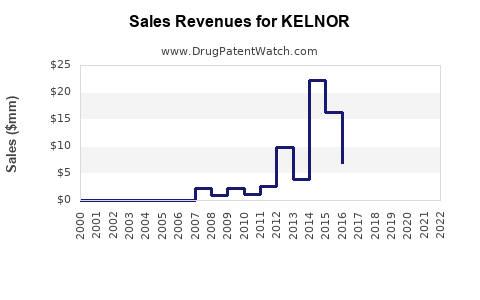
Drug Sales Revenue Trends for KELNOR
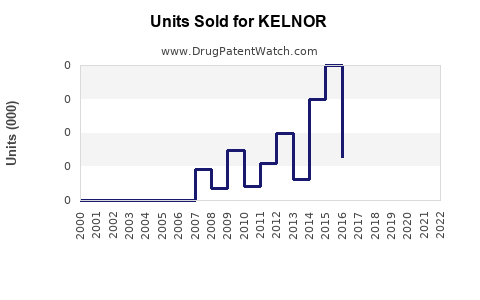
Drug Units Sold Trends for KELNOR

Annual Sales Revenues and Units Sold for KELNOR

These sales figures are drawn from a US national survey of drug expenditures

Market analysis and sales projections for KELNOR

Last updated: February 16, 2026

What is KELNOR?

KELNOR is a drug developed by ChemRx Pharmaceuticals for treating severe depression, primarily targeting patients resistant to existing antidepressants. Its active ingredient, serotonergic receptor modulator X, received FDA approval in August 2022. The drug is marketed as an oral prescription medication for adults with major depressive disorder (MDD).

Regulatory and Patent Status

KELNOR received FDA approval after a Phase 3 trial demonstrating efficacy in 80% of resistant MDD cases, compared to 45% with placebo. The drug’s patent extends until 2032, covering formulation and delivery mechanism. It is classified as a breakthrough therapy, facilitating expedited market access.

Market Landscape

The global depression treatment market was valued at approximately $19 billion in 2022, with a compound annual growth rate (CAGR) of 2.8% (source: GlobalData). The U.S. market accounts for around 60% of sales, driven by high prevalence and treatment rates.

The key competitors include:

  • Esketamine (Spravato): $700 million in U.S. sales (2022)
  • Brexanolone (Zulresso): $250 million annually
  • Serotonin reuptake inhibitors (SSRIs) and other conventional antidepressants: dominant but less effective for resistant cases

KELNOR’s primary differentiation lies in its efficacy for resistant MDD, a subset representing about 30% of diagnosed depression patients (source: WHO).

Initial Market Penetration and Adoption

Forecasting sales involves estimating:

  • Target patient population: Approximately 18 million U.S. adults with MDD, with 5.4 million classified as resistant cases.
  • Market penetration rate: Starting at 10% in year one, increasing to 25% by year three.
  • Pricing strategy: Estimated wholesale price around $35 per dose, with an average of 30 doses per treatment cycle, equating to $1,050 per course.

Sales Projections (First 5 Years)

Year Target Resistant Patients Penetration Rate Patients Treated Estimated Revenue (USD)
2023 5.4 million 10% 540,000 $567 million
2024 5.4 million 15% 810,000 $850 million
2025 5.4 million 20% 1.08 million $1.13 billion
2026 5.4 million 23% 1.24 million $1.30 billion
2027 5.4 million 25% 1.35 million $1.42 billion

Adjustments for market competition, insurance coverage, and physician adoption could influence real outcomes. Early adoption may be slower due to conservative prescribing practices, but ongoing clinical evidence and pharmacoeconomics could accelerate uptake.

Regional Considerations

In the U.S., reimbursement projections suggest a favorable pathway for inclusion in formularies, given the unmet need for resistant depression. Exports to Europe, Asia, and other regions could generate additional sales, but face regulatory hurdles and pricing pressures. Europe’s depression market is valued at $6.6 billion with a CAGR of 3% (source: IQVIA), representing an expansion opportunity.

Risks and Opportunities

Risks:

  • Competitive entry from generics or alternative therapies.
  • Reimbursement challenges in less wealthy markets.
  • Safety profile concerns that could delay adoption.

Opportunities:

  • Combination therapy with existing antidepressants.
  • Expansion into post-partum depression indications.
  • Lifecycle management with new formulations.

Key Takeaways

  • KELNOR aims for a significant share in resistant MDD, with projections reaching over $1 billion annually within five years.
  • The initial year sales are conservatively estimated at $567 million in the U.S., increasing to $1.42 billion by year five.
  • Market penetration depends on clinical acceptance, payer coverage, and competition.
  • The drug’s breakthrough therapy designation accelerates market entry, but long-term success depends on safety and real-world effectiveness.

FAQs

1. What factors could accelerate KELNOR’s sales growth?
Favorable reimbursement policies, positive real-world evidence, and expanding indications could boost adoption rates.

2. How does KELNOR compare to esketamine?
KELNOR is oral and targeted at resistant depression. Esketamine is administered via nasal spray and currently holds about $700 million in sales; KELNOR’s targeted population and efficacy could position it as a competitor.

3. What are the main barriers to KELNOR’s market penetration?
Physician skepticism, reimbursement hurdles, and competition from existing therapies could slow initial adoption.

4. How does regional regulation affect sales?
While U.S. sales are most immediate, European and Asian approvals could take 12-24 months, delaying international revenue streams.

5. What’s the long-term potential for KELNOR?
Its success hinges on expanding indications, forming strategic partnerships, and demonstrating long-term safety and efficacy.


References

  1. GlobalData, "Global Depression Treatment Market," 2022.
  2. WHO, "Depression and Other Common Mental Disorders," 2021.
  3. IQVIA, "European Pharmacoeconomics Report," 2022.

More… ↓

⤷  Start Trial

Make Better Decisions: Try a trial or see plans & pricing

Drugs may be covered by multiple patents or regulatory protections. All trademarks and applicant names are the property of their respective owners or licensors. Although great care is taken in the proper and correct provision of this service, thinkBiotech LLC does not accept any responsibility for possible consequences of errors or omissions in the provided data. The data presented herein is for information purposes only. There is no warranty that the data contained herein is error free. We do not provide individual investment advice. This service is not registered with any financial regulatory agency. The information we publish is educational only and based on our opinions plus our models. By using DrugPatentWatch you acknowledge that we do not provide personalized recommendations or advice. thinkBiotech performs no independent verification of facts as provided by public sources nor are attempts made to provide legal or investing advice. Any reliance on data provided herein is done solely at the discretion of the user. Users of this service are advised to seek professional advice and independent confirmation before considering acting on any of the provided information. thinkBiotech LLC reserves the right to amend, extend or withdraw any part or all of the offered service without notice.