Drug Sales Trends for GUANFACINE
Payment Methods and Pharmacy Types for GUANFACINE (2014)
Revenues by Pharmacy Type
Units Sold by Pharmacy Type
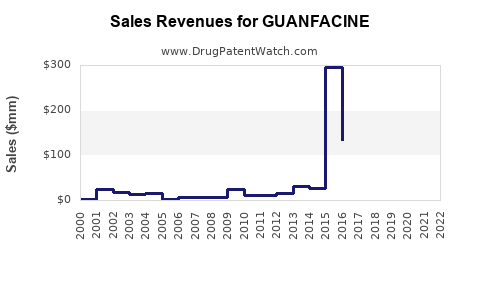
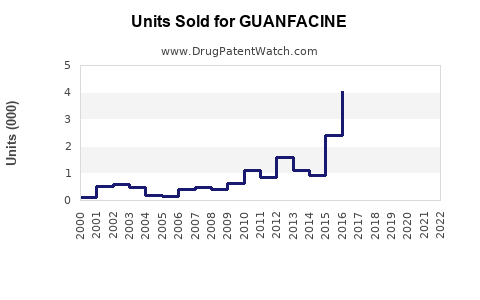
Annual Sales Revenues and Units Sold for GUANFACINE
| Drug Name | Revenues (USD) | Units | Year |
|---|---|---|---|
| GUANFACINE | ⤷ Start Trial | ⤷ Start Trial | 2022 |
| GUANFACINE | ⤷ Start Trial | ⤷ Start Trial | 2021 |
| GUANFACINE | ⤷ Start Trial | ⤷ Start Trial | 2020 |
| GUANFACINE | ⤷ Start Trial | ⤷ Start Trial | 2019 |
| >Drug Name | >Revenues (USD) | >Units | >Year |
Guanfacine Market Analysis and Sales Projections: Intuniv, Tenex, Generics, and ADHD Demand
Guanfacine is a mature, largely genericized alpha-2A adrenergic receptor agonist used in hypertension and attention-deficit/hyperactivity disorder. The commercial market is divided between immediate-release guanfacine, historically sold as Tenex, and extended-release guanfacine, marketed as Intuniv. U.S. revenue has shifted from branded pharmaceutical sales to low-priced generic prescriptions.
The base-case outlook is for stable to modestly growing prescription volume through 2030, with declining average selling prices and limited manufacturer pricing power. A reasonable U.S. market estimate is approximately $120 million to $220 million in annual gross sales across immediate-release and extended-release guanfacine products in 2025, rising to roughly $140 million to $260 million by 2030 under a volume-growth scenario. Net manufacturer revenue is materially lower after rebates, wholesaler discounts, and pharmacy concessions.
What is guanfacine and which products contain it?
Guanfacine is a selective alpha-2A adrenergic receptor agonist. Its principal commercial uses are:
| Product | Active ingredient | Formulation | Primary indication | Commercial status |
|---|---|---|---|---|
| Tenex | Guanfacine hydrochloride | Immediate-release tablet | Hypertension | Genericized |
| Intuniv | Guanfacine hydrochloride | Extended-release tablet | ADHD | Brand plus generics |
| Generic guanfacine IR | Guanfacine hydrochloride | Immediate-release tablet | Hypertension, off-label ADHD use | Multiple manufacturers |
| Generic guanfacine ER | Guanfacine hydrochloride | Extended-release tablet | ADHD | Multiple manufacturers |
The FDA approved Intuniv in 2009 for ADHD in children and adolescents aged 6 to 17 years. The product can be used alone or as an adjunct to stimulant therapy. Immediate-release guanfacine was approved earlier for hypertension and is not interchangeable with the extended-release product on a milligram-for-milligram basis.[1]
The extended-release formulation is the commercially important segment in ADHD. The immediate-release market is older, lower priced, and more dependent on generic prescription volume.
How large is the guanfacine market?
The guanfacine market is difficult to measure because manufacturers do not consistently report sales by active ingredient, formulation, or indication. Public company filings generally combine guanfacine with broader ADHD, cardiovascular, or generic portfolios.
A practical market estimate separates the market into three revenue pools:
| Segment | Estimated 2025 U.S. gross market | Growth outlook through 2030 | Main driver |
|---|---|---|---|
| Guanfacine ER, branded and generic | $90 million-$170 million | 2%-6% annual prescription growth; declining price | ADHD diagnosis and adjunctive treatment |
| Guanfacine IR | $25 million-$45 million | Flat to 2% annual prescription growth | Hypertension and off-label use |
| Non-U.S. markets | $30 million-$80 million | 1%-4% annual growth | Local reimbursement and ADHD treatment access |
| Total estimated market | $145 million-$295 million | Low-single-digit value growth at most | Volume growth offset by generic pricing |
These figures are market estimates rather than reported manufacturer sales. They include pharmacy-channel gross sales and exclude hospital purchasing, rebates, and confidential contracting terms.
Demand is supported by the size of the ADHD treatment population. The Centers for Disease Control and Prevention estimates that approximately 7 million U.S. children and adolescents aged 3 to 17 years have received an ADHD diagnosis, representing about 11% of the age group in recent survey data.[2] Guanfacine is not a first-line treatment for most patients, but it has a defined role in patients with stimulant-related adverse effects, sleep problems, tics, inadequate stimulant response, or a need for adjunctive therapy.
What are the main guanfacine sales drivers?
ADHD diagnosis and treatment expansion
The largest demand driver is the continued treatment of pediatric and adolescent ADHD. Guanfacine ER is prescribed as monotherapy or with stimulants. Prescribing is influenced by:
- Growth in diagnosed ADHD prevalence.
- Greater use of non-stimulant therapy.
- Shortages and supply disruptions affecting stimulant products.
- Increased clinical attention to sleep, appetite, blood pressure, and behavioral adverse effects.
- Use in patients who do not tolerate atomoxetine or stimulant medicines.
The market does not convert every new ADHD diagnosis into guanfacine demand. Stimulants remain the dominant pharmacologic treatment class, while atomoxetine, viloxazine, clonidine ER, and behavioral interventions compete with guanfacine.
Generic substitution
Generic substitution has increased prescription access but reduced revenue per prescription. Extended-release guanfacine is particularly exposed because the active ingredient is chemically simple and multiple manufacturers can compete after regulatory and patent barriers are cleared.
The commercial effect is a widening gap between volume and value:
| Metric | Expected direction |
|---|---|
| Total prescriptions | Stable to modestly increasing |
| Generic share | Increasing |
| Average selling price | Declining |
| Brand Intuniv share | Decreasing |
| Gross market value | Flat to low-single-digit growth |
| Net manufacturer revenue | Flat or declining without differentiated products |
Adjunctive use with stimulants
Intuniv and generic guanfacine ER benefit from adjunctive use. Physicians may add guanfacine to a stimulant when residual impulsivity, hyperactivity, tics, sleep issues, or evening symptom control remains a concern.
This creates a more resilient demand base than a monotherapy-only product. It also limits substitution by atomoxetine because clinicians may use guanfacine for a different clinical purpose.
Immediate-release hypertension use
Immediate-release guanfacine has a smaller commercial opportunity. Hypertension treatment has shifted toward ACE inhibitors, angiotensin receptor blockers, calcium-channel blockers, thiazide diuretics, and beta blockers. Guanfacine remains a low-cost option but does not have a strong growth profile in the cardiovascular market.
What are the guanfacine sales projections through 2030?
The following projection uses a volume-price framework rather than a reported manufacturer forecast. It assumes continued generic competition, modest ADHD prescription growth, and annual price erosion in the extended-release segment.
Base-case U.S. market projection
| Year | Estimated U.S. gross sales | Estimated prescription trend | Key assumption |
|---|---|---|---|
| 2025 | $120 million-$220 million | Baseline | Generic ER dominates volume |
| 2026 | $122 million-$225 million | 1%-3% volume growth | Price decline offsets most growth |
| 2027 | $125 million-$232 million | 1%-3% volume growth | Continued ADHD treatment demand |
| 2028 | $128 million-$240 million | 1%-3% volume growth | Stable generic supply |
| 2029 | $132 million-$250 million | 1%-3% volume growth | Higher non-stimulant utilization |
| 2030 | $136 million-$260 million | 1%-3% volume growth | Low-single-digit value expansion |
Scenario analysis
| Scenario | 2030 U.S. gross sales | Prescription growth | Price trend | Commercial interpretation |
|---|---|---|---|---|
| Downside | $90 million-$145 million | Flat to negative | 6%-10% annual erosion | More generic entrants and weaker brand retention |
| Base case | $136 million-$260 million | 1%-3% annually | 2%-5% annual erosion | Volume growth broadly offsets pricing |
| Upside | $220 million-$360 million | 4%-7% annually | Stable to modest erosion | More non-stimulant prescribing and persistent stimulant shortages |
The upside case requires a meaningful increase in guanfacine's share of the ADHD treatment market. It would likely depend on sustained stimulant supply constraints, expanded use in adolescents and adults, or new clinical evidence supporting additional neuropsychiatric indications.
What is the Orange Book status of Intuniv and guanfacine ER?
Intuniv's primary commercial protection came from formulation and regulatory exclusivity rather than a new chemical entity patent. The product contains an established active ingredient but uses an extended-release delivery system for ADHD treatment.
The principal historic U.S. patent estate included formulation and extended-release technology patents associated with guanfacine hydrochloride tablets. U.S. Patent No. 6,287,599 was commonly identified with the Intuniv formulation estate and had an expiration date in 2022, including applicable patent-term adjustments or extensions reflected in public patent records.[3]
By the time generic guanfacine ER products entered the U.S. market, the central patent barriers had largely expired or been resolved through litigation and regulatory proceedings. Current commercial risk is therefore driven more by generic competition, FDA approval status, manufacturing reliability, and payer contracting than by a new Orange Book patent cliff.
The relevant regulatory distinction is:
- Guanfacine IR has long been genericized.
- Intuniv's original brand protection has expired or been substantially neutralized.
- Generic ER products can compete if they satisfy FDA bioequivalence and extended-release performance requirements.
- Any later-listed formulation or method-of-use patent must be evaluated separately from the original Intuniv estate.
When did guanfacine lose exclusivity?
The original Intuniv product received FDA approval in September 2009. Its commercial exclusivity ended through a combination of statutory exclusivity expiration, patent expiry, and the subsequent entry of approved generic extended-release products.
The key timeline is:
| Date | Event |
|---|---|
| 1986 | FDA approval of immediate-release guanfacine for hypertension as Tenex |
| September 2009 | FDA approval of Intuniv for ADHD |
| 2013 | Pediatric exclusivity period associated with Intuniv-related regulatory protection ended, based on public FDA exclusivity records |
| 2015 | FDA approval of generic extended-release guanfacine products began to broaden competition |
| 2022 | Major historic Intuniv formulation patent protection reached expiration |
| 2025 onward | Market primarily characterized by generic competition and brand-value erosion |
The precise launch timing of a particular generic depended on the applicant's approval date, litigation position, settlement terms, manufacturing readiness, and pharmacy contracting.
Which companies compete in the guanfacine market?
The competitive field includes branded and generic pharmaceutical companies. The participant list changes as suppliers enter or leave the market.
Brand and originator companies
Shire developed and commercialized Intuniv. Takeda acquired Shire in 2019 and assumed responsibility for the product portfolio. Intuniv has remained a branded reference product, but its competitive position has weakened after generic entry.
The brand can retain limited demand through:
- Physician familiarity.
- Patient response to a specific formulation.
- Insurance coverage differences.
- Authorized-generic arrangements.
- Prescriber preference for the reference product.
- Commercial programs that reduce patient out-of-pocket costs.
Generic manufacturers
Generic guanfacine suppliers have included major U.S. and international generic companies such as Teva, Actavis, Par Pharmaceutical, and other FDA-approved manufacturers. The exact active supplier group varies by strength, formulation, wholesaler contract, and shortage status.
Competition is strongest in immediate-release tablets. Extended-release tablets retain greater technical complexity because the applicant must demonstrate comparable release characteristics and bioequivalence.
What formulations are protected by guanfacine patents?
The main historical IP value was in the extended-release tablet rather than the guanfacine molecule. Relevant protection categories include:
| Protection category | Commercial relevance |
|---|---|
| Extended-release matrix or delivery system | Controls drug release over time |
| Tablet composition | Defines excipients and manufacturing composition |
| Dosage strength and release profile | Supports differentiated dosing |
| Method of treating ADHD | May protect selected patient populations or dosing regimens |
| Manufacturing process | Can create regulatory or supply barriers |
| Trade secrets | May protect process controls and scale-up parameters |
Formulation patents have limited remaining value when the basic active ingredient is old, the primary patents have expired, and generic applicants have established alternative formulations. Process patents can still create operational barriers, but they rarely support durable product-level pricing unless they are difficult to design around.
Are there paragraph IV challenges and guanfacine patent litigation?
Generic extended-release guanfacine applicants historically had incentives to file Abbreviated New Drug Applications with paragraph IV certifications against listed Intuniv patents. Such certifications assert that a listed patent is invalid, unenforceable, or not infringed.
The commercial significance of paragraph IV litigation was greatest before generic approval and launch. After the main formulation patents expired, the litigation risk shifted away from a single high-value patent event. Public FDA Orange Book records and federal court filings should be used to confirm the status of any specific applicant, patent, or settlement.[3,4]
The current risk profile is:
| Risk | Current assessment |
|---|---|
| Blocking composition-of-matter patent | Low; guanfacine is an old active ingredient |
| Blocking core ER formulation patent | Low after historic expiration |
| Later formulation patent | Product-specific and requires claim analysis |
| Method-of-use patent | Limited unless tied to a narrow, commercially important population |
| Generic litigation | Possible but less likely to affect the whole market |
| Supply and manufacturing dispute | More relevant than molecule-level patent litigation |
Settlement agreements can delay entry, permit an authorized generic, or establish a licensed launch date. Their impact must be assessed against the actual patent term and the number of competing ANDA applicants.
What is the FDA regulatory status of guanfacine?
Immediate-release guanfacine is FDA-approved for hypertension. Extended-release guanfacine is FDA-approved for ADHD in pediatric patients aged 6 to 17 years, as monotherapy or adjunctive therapy to stimulant medication.[1]
Important regulatory points include:
- Immediate-release and extended-release products are not automatically interchangeable.
- The extended-release tablet should not be substituted for the immediate-release product on an equivalent milligram basis.
- Abrupt discontinuation can cause rebound increases in blood pressure.
- Pediatric ADHD is the core approved market.
- Adult use is generally outside the original pediatric label and may be off-label depending on jurisdiction and product labeling.
- Generic ER products must meet FDA requirements for pharmaceutical equivalence and bioequivalence.
The most material regulatory opportunity would be label expansion into adults or additional neuropsychiatric indications. The commercial benefit would depend on clinical evidence, reimbursement, and competition from atomoxetine, viloxazine, clonidine ER, and stimulants.
How strong is the guanfacine patent estate?
The guanfacine patent estate is weak for long-term exclusivity and moderate for formulation complexity.
| Factor | Assessment |
|---|---|
| Active ingredient age | Very old; no meaningful molecule-level exclusivity |
| Brand formulation | Historically important but largely expired |
| Generic entry barriers | Moderate for ER; low for IR |
| Method-of-use protection | Potentially narrow |
| Manufacturing know-how | Moderate operational value |
| Litigation leverage | Limited compared with newer ADHD products |
| Long-term pricing power | Low |
| Risk of additional generic entry | High |
The estate can still support short-term commercial differentiation where a company owns a specific extended-release technology or has a reliable supply chain. It is unlikely to support premium pricing across the entire market.
What generic launch scenarios exist for guanfacine?
Scenario one: Broad generic competition
Several manufacturers supply each strength and formulation. Prices fall, pharmacies substitute automatically, and Intuniv becomes a small branded niche. This is the most likely long-term outcome.
Scenario two: Limited supplier market
Manufacturing exits, quality actions, or supply shortages reduce the number of active suppliers. Prices stabilize or rise temporarily, particularly for specific ER strengths. This scenario increases short-term revenue opportunity but creates regulatory and supply-chain risk.
Scenario three: Brand-retention niche
Takeda or another commercial partner retains a narrow brand segment through patient support, payer agreements, or authorized-generic distribution. Brand sales remain meaningful but do not reverse the broader generic trend.
Scenario four: Non-stimulant expansion
Clinical practice shifts toward non-stimulant therapy because of stimulant shortages, misuse concerns, or increased diagnosis in populations less suited to stimulant treatment. Guanfacine volume grows faster than the ADHD market, but generic competition captures most of the value.
How does guanfacine compare with competing ADHD drugs?
| Product class | Examples | Market position | Pricing power | Competitive threat to guanfacine |
|---|---|---|---|---|
| Stimulants | Methylphenidate, amphetamine products | First-line, largest segment | Moderate for branded products | High |
| Atomoxetine | Strattera and generics | Established non-stimulant | Low after generic entry | High |
| Viloxazine ER | Qelbree | Newer non-stimulant | Higher branded pricing | Moderate to high |
| Clonidine ER | Kapvay and generics | Alpha-2 agonist competitor | Low to moderate | Moderate |
| Guanfacine ER | Intuniv and generics | Adjunctive and non-stimulant option | Low after generic entry | N/A |
Guanfacine's advantages are its established pediatric use, non-stimulant mechanism, adjunctive role, and generic affordability. Its disadvantages are sedation, hypotension, limited adult labeling, and competition from both stimulants and other non-stimulants.
What revenue exposure exists for manufacturers?
For a generic manufacturer, guanfacine is unlikely to be a major portfolio driver unless the company has a large ADHD or pediatric generic franchise. Revenue exposure is more likely to be meaningful at the product-family level than at the corporate level.
A simplified revenue sensitivity model is:
| Variable | Impact on revenue |
|---|---|
| 5% prescription growth | Adds volume but may be offset by generic price erosion |
| 5% annual price decline | Materially reduces market value |
| One major supplier exit | Can increase price and share for remaining suppliers |
| New ER entrant | Usually reduces price and share |
| Brand-to-generic substitution | Reduces originator revenue |
| Label expansion | Increases volume only if payer coverage follows |
| Stimulant shortage | Can temporarily increase guanfacine demand |
For investors, guanfacine is better viewed as a stable generic cash-flow product than as a high-growth branded asset. For licensors, differentiation would need to come from delivery technology, combination therapy, adult clinical data, or a new indication.
Key Takeaways
- Guanfacine is a mature generic market with two distinct products: immediate-release guanfacine for hypertension and extended-release guanfacine for ADHD.
- Intuniv's historic formulation and exclusivity protections have largely expired or lost their ability to block generic competition.
- Estimated 2025 U.S. gross sales are approximately $120 million to $220 million, with substantial uncertainty because molecule-level sales are not publicly reported.
- Base-case 2030 U.S. gross sales are approximately $136 million to $260 million.
- Prescription volume should grow modestly, but generic price erosion will limit revenue growth.
- The strongest commercial demand driver is ADHD treatment, particularly adjunctive use with stimulants.
- The main competitive threats are generic atomoxetine, viloxazine ER, clonidine ER, and stimulant therapies.
- Current commercial risk is more closely tied to generic entry, supply reliability, payer contracting, and formulation performance than to core patent litigation.
- Guanfacine has limited long-term premium pricing power without a new indication or differentiated delivery system.
FAQs
What is the expected market growth rate for guanfacine?
Prescription volume is likely to grow at approximately 1% to 3% annually through 2030 in the base case. Market value may grow more slowly because generic pricing continues to decline.
Is Intuniv still commercially relevant after generic guanfacine ER entry?
Yes, but mainly as a reference product, brand-prescribing option, and potential source of limited premium revenue. Generic extended-release guanfacine should account for most U.S. prescription volume.
Does guanfacine have biosimilar competition?
No. Guanfacine is a small-molecule drug, so competition proceeds through generic-drug pathways rather than the FDA biosimilar pathway.
Which guanfacine formulation has the greater commercial opportunity?
Extended-release guanfacine has the greater opportunity because of its ADHD indication and adjunctive use. Immediate-release guanfacine is a lower-value, mature hypertension product.
Could guanfacine sales accelerate if stimulant shortages continue?
Yes. Persistent stimulant shortages could increase prescribing of non-stimulants, including guanfacine. The financial benefit would be limited if additional generic suppliers enter and rapidly reduce prices.
References
-
U.S. Food and Drug Administration. (2009). Intuniv (guanfacine hydrochloride) extended-release tablets prescribing information. FDA.
-
Centers for Disease Control and Prevention. (2024). Data and statistics on ADHD. U.S. Department of Health and Human Services.
-
U.S. Food and Drug Administration. (2025). Approved drug products with therapeutic equivalence evaluations: Orange Book. FDA.
-
U.S. Courts. (2025). PACER federal court records and patent litigation filings involving guanfacine extended-release products. Administrative Office of the U.S. Courts.
More… ↓
