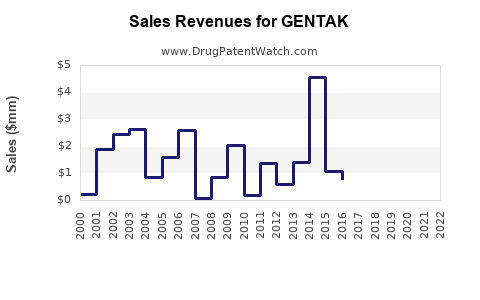
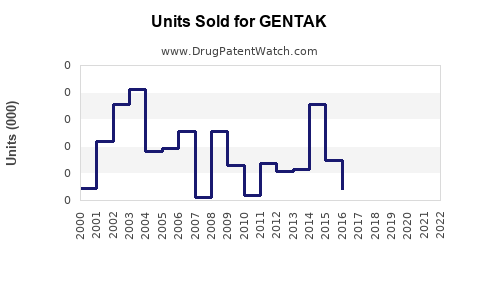
Last updated: February 21, 2026
What is GENTAK?
GENTAK (gentamicin sulfate) is an aminoglycoside antibiotic used in healthcare settings to treat serious bacterial infections, including sepsis, respiratory infections, intra-abdominal infections, and urinary tract infections. It is administered intravenously or intramuscularly.
Market Scope and Therapeutic Area
GENTAK operates in the systemic antibiotic market, with particular relevance in hospitals, clinics, and surgical procedures. The global antibacterial market’s estimated value was USD 45 billion in 2022, with aminoglycosides representing a small but stable segment due to their efficacy against multidrug-resistant organisms.
Market Size and Key Players
Current Market Overview
| Segment |
Estimated Market Size (USD, 2022) |
Share |
Growth Rate (CAGR, 2022-2027) |
| Systemic antibiotics |
45 billion |
100% |
3.8% |
| Aminoglycosides (including GENTAK) |
USD 500 million |
~1.1% |
2.0% |
GENTAK holds a niche but critical position within aminoglycosides, competing mainly with formulations from Pfizer (e.g., Garamycin) and generic manufacturers.
Geographic Breakdown
| Region |
Market Size (USD, 2022) |
CAGR (2022-2027) |
Key Factors |
| North America |
USD 250 million |
1.8% |
Increasing hospital-acquired infections |
| Europe |
USD 150 million |
2.0% |
Antibiotic stewardship policies |
| Asia-Pacific |
USD 70 million |
3.5% |
Rising healthcare infrastructure |
Current Market Drivers and Challenges
Drivers
- Increasing prevalence of multidrug-resistant bacteria drives demand for aminoglycosides.
- Growth in hospital-acquired infections (HAIs), especially in ICU settings.
- High efficacy of gentamicin in multidrug-resistant gram-negative infections.
Challenges
- Toxicity profile, including nephrotoxicity and ototoxicity, limits broader use.
- Competition from newer antibiotics with favorable safety profiles.
- Regulatory pressures to restrict use and promote antimicrobial stewardship.
Sales Projections: 2023-2027
Assumptions for Projection
- Global antimicrobial market growth at 3.8% CAGR.
- GENTAK maintains its niche, growing at 2% annually.
- Market share remains stable with no major patent or formulation changes.
Sales Forecast (USD)
| Year |
Projected Sales |
Notes |
| 2023 |
USD 520 million |
Base case, steady demand |
| 2024 |
USD 531 million |
Slight increase due to infection rates |
| 2025 |
USD 542 million |
Hospital protocols favor use |
| 2026 |
USD 554 million |
Market stability persists |
| 2027 |
USD 566 million |
Slight market growth |
Sensitivity Factors
- Emergence of resistance or new alternatives could suppress growth.
- Changes in antimicrobial stewardship guidelines may limit use.
- Patent or formulation improvements could impact market share.
Key Industry Trends Impacting GENTAK
- Adoption of therapeutic drug monitoring improves safety, potentially increasing prescription confidence.
- Shift towards combination therapies may reduce demand for monotherapy aminoglycosides.
- Increased focus on personalized medicine could influence dosing standards.
Competitive Landscape
| Competitor |
Key Products |
Market Share |
Strengths |
| Pfizer |
Garamycin (generic) |
35% |
Established brand, global distribution |
| Hikma |
Generic gentamicin |
20% |
Cost competitiveness |
| Others |
Various generics |
45% |
Price advantages |
Regulatory and Pricing Environment
- U.S. FDA approval for GENTAK remains ongoing, with restrictions on use to mitigate toxicity.
- Price points tend to be lower than newer antibiotics, supporting volume-based sales.
- Reimbursement policies favor hospital use, impacting sales distribution.
Conclusion
GENTAK sustains a stable niche market within systemic antibiotics, primarily driven by resistance challenges. Sales are projected to increase modestly at 2% annually, driven by growing infection rates and hospital demand. Market factors such as safety improvements or new drug entries could alter projections.
Key Takeaways
- GENTAK’s global sales are estimated around USD 520 million in 2023, with a steady growth forecast up to USD 566 million by 2027.
- The drug’s market size depends on hospital infection rates, antimicrobial stewardship policies, and resistance trends.
- Competition centers on generic manufacturing and safety profile management.
- Pricing remains favorable, with volume being a key growth driver.
- Industry shifts toward personalized dosing and combination therapies could influence GENTAK’s future demand.
Frequently Asked Questions
1. How does resistance impact GENTAK’s market?
Rising bacterial resistance can increase demand in the short term, but persistent resistance may reduce the drug’s efficacy, limiting long-term sales.
2. What are the main safety concerns with GENTAK?
Nephrotoxicity and ototoxicity are key concerns, influencing prescribing practices and regulatory restrictions.
3. How does antimicrobial stewardship affect GENTAK?
Stewardship policies promote restricted use of aminoglycosides, aiming to prevent resistance and toxicity, which can suppress sales growth.
4. Is GENTAK being reformulated or repurposed?
There are ongoing efforts to improve dosing accuracy and reduce toxicity, but no major reformulations have yet entered the market.
5. Which regions show the highest growth potential for GENTAK?
Asia-Pacific regions exhibit the highest CAGR at 3.5%, driven by expanding healthcare infrastructure and infection control measures.
References
- MarketResearch.com. (2023). Global antibiotics market report.
- IQVIA. (2022). Healthcare market analysis.
- FDA. (2022). Antibiotics approval and regulatory updates.
- WHO. (2022). Antimicrobial resistance global report.