Share This Page
Drug Sales Trends for DAYTRANA
✉ Email this page to a colleague
Payment Methods and Pharmacy Types for DAYTRANA (2014)
Revenues by Pharmacy Type
Units Sold by Pharmacy Type
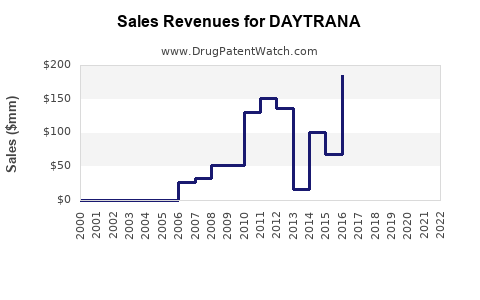
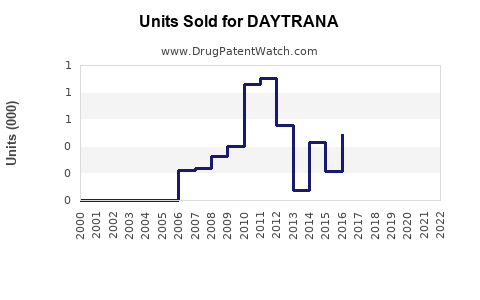
Annual Sales Revenues and Units Sold for DAYTRANA
| Drug Name | Revenues (USD) | Units | Year |
|---|---|---|---|
| DAYTRANA | ⤷ Start Trial | ⤷ Start Trial | 2022 |
| DAYTRANA | ⤷ Start Trial | ⤷ Start Trial | 2021 |
| DAYTRANA | ⤷ Start Trial | ⤷ Start Trial | 2020 |
| DAYTRANA | ⤷ Start Trial | ⤷ Start Trial | 2019 |
| DAYTRANA | ⤷ Start Trial | ⤷ Start Trial | 2018 |
| DAYTRANA | ⤷ Start Trial | ⤷ Start Trial | 2017 |
| >Drug Name | >Revenues (USD) | >Units | >Year |
DAYTRANA Market Analysis, Sales Projections, Patent Position, and Generic Entry Risk
DAYTRANA is a niche ADHD treatment based on transdermal methylphenidate. Its commercial value is limited by the dominance of low-cost oral stimulants, pediatric-only labeling, supply and reimbursement friction, and the availability of competing delivery systems. Standalone current sales are not publicly disclosed by Takeda, and a reliable audited forecast is unavailable. A scenario model indicates that U.S. annual net sales are likely in the low-single-digit millions unless a manufacturer restores broad supply, secures favorable reimbursement, and expands prescriber use.
What is DAYTRANA and how does it compete in ADHD treatment?
DAYTRANA is a methylphenidate transdermal system approved by the FDA for attention-deficit/hyperactivity disorder in patients aged 6 to 17 years. The patch is applied to the hip and worn for up to nine hours. Its delivery profile allows parents or caregivers to control dosing by removing the patch, which differentiates it from once-daily oral products.[1]
The product competes in the U.S. ADHD market against:
- Generic immediate-release and extended-release methylphenidate tablets and capsules
- Concerta and authorized or generic extended-release methylphenidate products
- Vyvanse and generic lisdexamfetamine
- Quillivant XR, Quillichew ER, and other liquid or chewable formulations
- Adzenys XR-ODT and other orally disintegrating stimulants
- Nonstimulants such as atomoxetine, viloxazine, and extended-release guanfacine
- Competing transdermal products, including XELSTRYM, an amphetamine patch
DAYTRANA’s primary commercial advantage is non-oral administration. Its main disadvantages are higher acquisition cost, skin irritation, visible application, limited age labeling, and weaker payer coverage than generic oral stimulants.
What is the FDA regulatory status of DAYTRANA?
The FDA approved DAYTRANA in 2006. The product contains methylphenidate, a Schedule II controlled substance. Its approved indication is ADHD treatment in pediatric patients aged 6 to 17 years.[1]
The product label includes several commercially relevant limitations:
- The patch is intended for external use only.
- Application time controls exposure and can be shortened by removing the patch.
- Skin reactions can lead to discontinuation.
- Methylphenidate carries stimulant-class warnings involving abuse, misuse, cardiovascular effects, psychiatric reactions, and growth suppression.
- The product is not approved for adults.
DAYTRANA is therefore positioned as a specialty delivery option within the pediatric stimulant market rather than as a broad ADHD product.
How large is the market for transdermal methylphenidate?
The addressable market is materially smaller than the overall U.S. ADHD market. The CDC reported that approximately 7.1 million U.S. children and adolescents aged 3 to 17 years had ever received an ADHD diagnosis in 2022.[2] Most diagnosed patients do not require a transdermal product. The practical DAYTRANA market consists of patients who have one or more of the following characteristics:
- Difficulty swallowing tablets or capsules
- Poor adherence to morning oral dosing
- Need for caregiver-controlled exposure
- Sensitivity to oral stimulant duration or peak effects
- Need for a non-oral option after failure of other formulations
The market is constrained by the fact that physicians can often address these needs with lower-cost liquids, chewables, orally disintegrating tablets, or long-acting capsules.
Market-size framework
A reasonable commercial framework is:
| Market layer | Commercial relevance to DAYTRANA |
|---|---|
| U.S. children with ADHD diagnosis | Large epidemiologic pool |
| Children receiving prescription ADHD medication | Smaller treated population |
| Patients requiring non-oral or caregiver-controlled dosing | Narrow segment |
| Patients with access to DAYTRANA | Reduced by coverage and supply |
| Patients retained after skin reactions or inadequate efficacy | Core recurring market |
DAYTRANA’s opportunity is therefore driven more by market share within a specialized segment than by overall ADHD prevalence.
What were DAYTRANA’s historical sales?
Public company filings have not consistently reported DAYTRANA as a standalone material revenue line. Shire commercialized the product before Takeda acquired Shire in 2019. Takeda has reported revenue by broader product categories and geographic regions rather than providing a continuous standalone DAYTRANA sales series.[3]
The absence of a separate revenue line creates three analytical limitations:
- Historical revenue cannot be reconstructed reliably from Takeda’s consolidated filings.
- Current brand demand cannot be inferred from total ADHD prescription volume.
- Distributor purchases may differ materially from end-patient utilization because of inventory changes.
DAYTRANA should be treated as a low-revenue, mature product unless audited company disclosures show a material commercial recovery.
What are the DAYTRANA sales projections?
Because current net sales are not publicly disclosed, the most defensible forecast is a scenario model rather than a single-point estimate.
U.S. annual net-sales scenarios
| Scenario | Commercial assumptions | Estimated annual net sales |
|---|---|---|
| Downside | Intermittent supply, limited payer coverage, continued substitution by oral products | $0-$2 million |
| Base case | Stable niche availability, modest specialist prescribing, limited generic pressure | $2-$7 million |
| Upside | Broad supply restoration, improved reimbursement, stronger non-oral adherence positioning | $8-$15 million |
| Expansion case | New commercial owner, broader contracting, label or market expansion | More than $15 million |
These are analytical estimates, not reported company guidance. They assume U.S. sales only and exclude licensing income, international sales, and one-time inventory movements.
Five-year base-case projection
| Year | Estimated net sales | Main assumption |
|---|---|---|
| Year 1 | $3 million | Niche demand with limited access |
| Year 2 | $3.5 million | Stable prescriber base |
| Year 3 | $4 million | Modest adherence-driven uptake |
| Year 4 | $4.5 million | No major generic displacement |
| Year 5 | $5 million | Mature specialty product |
The implied compound annual growth rate is approximately 13%, but the low starting base makes the percentage growth less meaningful than the absolute revenue level. In the base case, DAYTRANA remains commercially small despite potential growth.
What factors could increase DAYTRANA sales?
The strongest growth drivers are operational and commercial rather than epidemiologic.
Non-oral dosing demand
Some families prefer a patch because it avoids swallowing pills and permits dose reduction by early removal. This benefit can support use in selected pediatric patients who have difficulty with oral administration.
Adherence and caregiver control
The patch provides a visible administration event and reduces the risk that a child will cheek or discard an oral dose. These attributes can support use in school-age children with inconsistent morning routines.
Differentiation from oral stimulants
DAYTRANA may attract patients who experience unacceptable duration, rebound, or tolerability issues with oral methylphenidate. The product’s value depends on whether clinicians view the transdermal route as clinically meaningful rather than merely convenient.
Commercial repositioning
A specialty pharmaceutical company could improve sales through:
- Pediatric psychiatry and developmental medicine targeting
- Prior-authorization support
- Pharmacy distribution improvements
- Patient assistance programs
- Contracting with Medicaid managed-care plans
- Education on patch removal and skin management
Without better access, clinical differentiation alone is unlikely to generate material revenue.
What factors could reduce DAYTRANA sales?
Generic oral methylphenidate remains the primary structural threat. Physicians and payers generally prefer lower-cost products when efficacy and safety are considered comparable.
Other risks include:
- Skin irritation and sensitization
- Application errors
- Patch adhesion problems
- Higher pharmacy copays
- Limited use outside the pediatric population
- Stimulant shortages that disrupt prescribing and pharmacy substitution
- Competition from XELSTRYM and other long-acting formulations
- Prescriber preference for oral products with established titration options
- Difficulty obtaining coverage for a branded transdermal product
DAYTRANA’s commercial ceiling is also limited by its delivery system. A patch cannot address patients who need flexible oral titration, adult treatment, or low-cost maintenance therapy.
What patents protect DAYTRANA?
DAYTRANA is a small-molecule drug-device combination involving methylphenidate and a transdermal delivery system. Its protection has historically depended on several categories:
- Transdermal composition patents
- Adhesive and skin-delivery technology
- Patch construction
- Methylphenidate release profiles
- Manufacturing and dosage-form claims
- Method-of-use and administration claims
The FDA Orange Book is the controlling public source for patents listed against an approved product. Patent protection should be reviewed at the product-strength level because listed patents, expiration dates, pediatric extensions, and delisting status can differ.[4]
The commercial importance of the remaining estate is limited by the age of the product and the availability of alternative methylphenidate dosage forms. Even where formulation patents remain enforceable, they may not prevent substitution by oral generics or competing transdermal products.
When does DAYTRANA lose exclusivity and what is the generic-entry risk?
DAYTRANA’s principal exclusivity risk is generic transdermal methylphenidate, not biosimilar competition. Methylphenidate is a chemically synthesized small molecule, so the relevant FDA pathway is an abbreviated new drug application, or ANDA. A biosimilar pathway does not apply.
Generic-entry analysis should focus on:
- Active Orange Book patent listings
- Paragraph IV certifications
- FDA approval status of competing ANDAs
- Substitution rules at the state level
- Whether the generic is therapeutically equivalent
- Manufacturer capacity for patch production
- Adhesive, liner, and transdermal manufacturing know-how
A generic patch may face more technical development barriers than an oral tablet because bioequivalence and delivery performance can be more complex. Those barriers can delay entry, but they do not provide durable protection if the brand’s core patents have expired or become vulnerable.
Are there DAYTRANA Paragraph IV challenges or patent lawsuits?
A complete current assessment of Paragraph IV certifications and active ANDA litigation requires a live review of FDA Orange Book records, FDA litigation notifications, and federal court dockets. Public company filings do not provide a reliable consolidated record of every historical or pending DAYTRANA challenge.
The principal litigation triggers would be:
- A Paragraph IV certification against an Orange Book-listed patent
- An ANDA filing alleging noninfringement or invalidity
- A dispute over patch composition or drug-release characteristics
- Claims involving adhesive technology or transdermal delivery
- Hatch-Waxman litigation following a notice letter
Because DAYTRANA is a mature product with limited disclosed revenue, litigation economics may discourage extensive patent enforcement unless a challenger expects meaningful market share or the brand has unusually strong pricing.
What licensing deals affect DAYTRANA?
DAYTRANA was associated with Noven Pharmaceuticals’ transdermal technology and was commercialized through larger pharmaceutical partners, including Shire before Takeda’s acquisition. The relevant commercial rights have therefore changed over time through corporate transactions rather than through a widely disclosed standalone licensing model.
Takeda’s acquisition of Shire transferred the broader Shire portfolio, including associated product rights and obligations, to Takeda.[3] Public disclosures have not established a major current licensing transaction that materially changes DAYTRANA’s revenue outlook.
How does DAYTRANA compare with XELSTRYM?
| Attribute | DAYTRANA | XELSTRYM |
|---|---|---|
| Active ingredient | Methylphenidate | Dextroamphetamine |
| Delivery | Transdermal patch | Transdermal patch |
| Core use | Pediatric ADHD | ADHD |
| Drug class | Methylphenidate stimulant | Amphetamine stimulant |
| Main differentiation | Non-oral methylphenidate dosing | Non-oral amphetamine dosing |
| Commercial risk | Mature product and generic substitution | Newer-product adoption and reimbursement |
| Prescriber role | Alternative for selected methylphenidate patients | Alternative for selected amphetamine patients |
The products compete for the same broad non-oral treatment segment but are not pharmacologic substitutes for every patient. Clinical response and prior stimulant history will determine which patch is selected.
What is the investment outlook for DAYTRANA?
DAYTRANA is more likely to be a niche cash-flow or portfolio product than a major growth asset. Its value depends on low operating costs, reliable manufacturing, and a focused specialty-sales strategy. A buyer would need to evaluate:
- Net realized price after rebates
- Current prescription and shipment volume
- Manufacturing cost per patch
- Product liability exposure
- Patch-related adverse-event rates
- Payer coverage
- Orange Book and ANDA status
- Remaining patent term
- Inventory and supply-chain reliability
- Cost of maintaining controlled-substance compliance
A transaction based on aggressive revenue growth would carry substantial execution risk. The most credible upside case involves operational repair and focused patient selection, not rapid penetration of the overall ADHD market.
Key Takeaways
- DAYTRANA is a pediatric transdermal methylphenidate product with a narrow but clinically identifiable market.
- Public filings do not provide a dependable current standalone sales figure.
- A reasonable U.S. base-case forecast is approximately $2 million to $7 million in annual net sales.
- Generic oral stimulants are the largest structural threat.
- Generic transdermal methylphenidate is the relevant exclusivity risk; biosimilars are not applicable.
- The commercial opportunity depends on supply reliability, reimbursement, skin tolerability, and non-oral adherence needs.
- DAYTRANA is better characterized as a mature specialty product than as a high-growth ADHD franchise.
- Patent value should be assessed through the current Orange Book record and live Hatch-Waxman litigation data.
FAQs
Is DAYTRANA still commercially available?
Availability has varied by manufacturer, distributor, and period. Commercial availability should be distinguished from FDA approval because an approved product may have limited or interrupted distribution.
Can adults use DAYTRANA?
The FDA-approved indication covers patients aged 6 to 17 years. Adult use would generally be outside the approved labeling.
Is there a generic DAYTRANA patch?
The relevant competitive pathway is a generic methylphenidate transdermal system approved through an ANDA. Generic availability and therapeutic-equivalence status should be verified in current FDA records.
What is the biggest obstacle to DAYTRANA growth?
The main obstacle is the combination of low-cost oral stimulant competition and limited payer willingness to reimburse a higher-cost patch.
Is DAYTRANA a strong acquisition target?
It may be attractive as a low-cost niche asset for a specialty company with controlled-substance distribution, pediatric sales capability, and reimbursement infrastructure. It is unlikely to justify a high valuation based solely on broad ADHD market growth.
References
- U.S. Food and Drug Administration. (2023). DAYTRANA (methylphenidate transdermal system) prescribing information.
- Centers for Disease Control and Prevention. (2024). Data and statistics on ADHD.
- Takeda Pharmaceutical Company Limited. (2019-2024). Annual reports and securities filings.
- U.S. Food and Drug Administration. (2024). Approved drug products with therapeutic equivalence evaluations, Orange Book.
More… ↓
