Share This Page
Drug Sales Trends for BUTRANS
✉ Email this page to a colleague
Payment Methods and Pharmacy Types for BUTRANS (2014)
Revenues by Pharmacy Type
Units Sold by Pharmacy Type
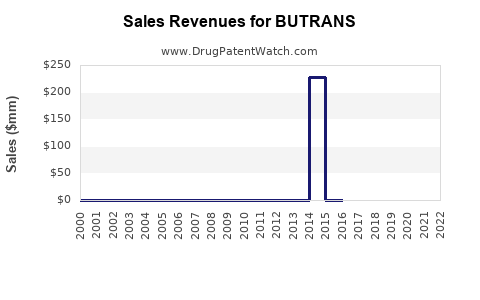
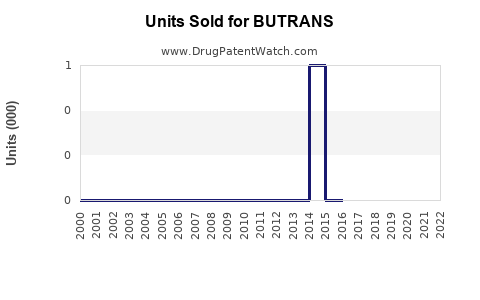
Annual Sales Revenues and Units Sold for BUTRANS
| Drug Name | Revenues (USD) | Units | Year |
|---|---|---|---|
| BUTRANS | ⤷ Start Trial | ⤷ Start Trial | 2022 |
| BUTRANS | ⤷ Start Trial | ⤷ Start Trial | 2021 |
| BUTRANS | ⤷ Start Trial | ⤷ Start Trial | 2020 |
| BUTRANS | ⤷ Start Trial | ⤷ Start Trial | 2019 |
| BUTRANS | ⤷ Start Trial | ⤷ Start Trial | 2018 |
| BUTRANS | ⤷ Start Trial | ⤷ Start Trial | 2017 |
| BUTRANS | ⤷ Start Trial | ⤷ Start Trial | 2016 |
| >Drug Name | >Revenues (USD) | >Units | >Year |
BUTRANS Market Analysis and Sales Projections: Buprenorphine Transdermal Patch
Butrans is a buprenorphine transdermal system approved in the United States for the management of chronic pain severe enough to require a continuous, around-the-clock opioid analgesic when alternatives are inadequate. The product has a narrow commercial position, substantial generic competition, and limited growth potential in the U.S. market. Brand sales are likely declining, while total buprenorphine transdermal volume should remain relatively stable because the product occupies a differentiated niche between oral analgesics and higher-potency opioid patches.
The base-case outlook is for a low-growth or declining U.S. market through 2030. Brand Butrans revenue is likely to fall as payers favor generic buprenorphine patches. Total market revenue should remain below the level achieved before generic entry unless manufacturers obtain broader reimbursement for chronic pain or expand use in additional patient populations.
What is Butrans and how does it compete in the pain market?
Butrans contains buprenorphine, a partial mu-opioid receptor agonist, delivered through a weekly transdermal patch. U.S. strengths include 5, 7.5, 10, 15, and 20 micrograms per hour. The product is marketed for chronic pain requiring continuous opioid treatment and is not indicated for acute or intermittent pain.[1]
| Product attribute | Butrans |
|---|---|
| Active ingredient | Buprenorphine |
| Dosage form | Weekly transdermal patch |
| U.S. approval | 2010 |
| U.S. NDA | 021306 |
| Primary indication | Chronic pain requiring continuous opioid analgesia |
| Available strengths | 5, 7.5, 10, 15, 20 mcg/hour |
| Administration | One patch applied every seven days |
| Original commercial owner | Purdue Pharma |
| Current competitive status | Brand plus generic buprenorphine transdermal systems |
Butrans competes against oral extended-release opioids, buprenorphine buccal products, buprenorphine sublingual products, fentanyl patches, and non-opioid therapies. Its principal commercial advantages are weekly dosing, relatively low systemic opioid exposure compared with full agonists, and a formulation that may be attractive for selected chronic-pain patients.
Its main disadvantages are slower titration, patch-related administration limits, heat exposure warnings, skin reactions, opioid-class safety risks, and reimbursement pressure. The product is also exposed to the continuing reduction in opioid prescribing for chronic non-cancer pain.
How large is the Butrans market?
The publicly disclosed market size for Butrans is limited because Purdue Pharma has not consistently reported standalone product revenue in recent public filings. Third-party prescription and sales databases are required for a precise estimate. Public FDA records confirm the product’s regulatory status, but they do not provide commercial sales data.[1]
A practical market assessment separates three measurements:
- Brand Butrans revenue.
- Total U.S. buprenorphine transdermal revenue, including authorized and generic products.
- Total buprenorphine revenue across transdermal, buccal, and sublingual formulations.
The third category is materially larger but is not a direct proxy for Butrans demand. Subutex, Suboxone, Belbuca, and generic sublingual buprenorphine serve different indications or delivery requirements.
Estimated U.S. market framework
The following estimates are analytical ranges rather than company-reported results.
| Metric | 2024 estimated range | 2030 base-case range |
|---|---|---|
| Total U.S. buprenorphine transdermal sales | $100 million-$180 million | $90 million-$170 million |
| Brand Butrans sales | $20 million-$60 million | $5 million-$20 million |
| Generic transdermal sales | $80 million-$120 million | $85 million-$150 million |
| Annual unit volume | 2.0 million-3.5 million patches | 2.0 million-3.8 million patches |
| Brand share by value | 15%-35% | 5%-15% |
The market range reflects the absence of a publicly reported, product-level sales series. Generic price erosion can reduce revenue even when prescription volume remains stable.
What are the Butrans sales projections through 2030?
The base case assumes stable or modestly rising prescription volume, continued generic substitution, declining average selling prices, and no major new indication.
| Year | Total U.S. market, base case | Brand Butrans, base case | Generic market, base case |
|---|---|---|---|
| 2024 | $135 million | $40 million | $95 million |
| 2025 | $130 million | $32 million | $98 million |
| 2026 | $126 million | $26 million | $100 million |
| 2027 | $123 million | $21 million | $102 million |
| 2028 | $121 million | $17 million | $104 million |
| 2029 | $120 million | $14 million | $106 million |
| 2030 | $119 million | $11 million | $108 million |
Scenario analysis
| Scenario | 2030 total market | Main assumptions |
|---|---|---|
| Downside | $70 million-$100 million | Faster opioid deprescribing, deeper generic discounts, formulary exclusion |
| Base case | $100 million-$140 million | Stable prescriptions, continued generic substitution, modest price erosion |
| Upside | $160 million-$220 million | Better coverage, increased use in older adults, reduced opioid-switching barriers |
The upside case requires improved access rather than a major clinical breakthrough. A new indication would materially alter the forecast, but no such approval is established in the current U.S. label.
When does Butrans lose exclusivity?
Butrans no longer has the commercial protection associated with a single-source branded product. Generic buprenorphine transdermal systems have entered the U.S. market, establishing that the principal regulatory barrier to substitution has been overcome.
| Exclusivity category | Butrans position |
|---|---|
| New chemical entity exclusivity | Expired |
| Original product exclusivity | Expired |
| Generic competition | Present |
| Brand-only market | No longer applicable |
| Remaining commercial protection | Brand recognition, supply reliability, prescriber familiarity, payer positioning |
FDA approval of generic buprenorphine transdermal systems has shifted the market from patent-protected brand sales to a multi-supplier commodity model.[2] Any remaining patent rights would have to be assessed against current Orange Book listings and the claims asserted in relevant litigation. Those rights do not prevent generic competition at the market level.
What patents protect Butrans?
The important distinction is between patents covering the active ingredient and patents covering the transdermal delivery system.
Buprenorphine itself is an established active pharmaceutical ingredient. The potential patent value has therefore centered on:
- Patch composition.
- Adhesive and drug-release layers.
- Dose delivery rates.
- Skin permeation.
- Manufacturing processes.
- Specific chronic-pain treatment methods.
Patent protection for a transdermal formulation generally has less market value after multiple generic approvals because an abbreviated new drug application can support commercial entry if the generic product does not infringe live claims or successfully challenges them.
Orange Book status
The FDA Orange Book remains the authoritative source for patents and regulatory exclusivities associated with NDA 021306.[3] Orange Book listings can change through patent expiration, delisting, litigation outcomes, or FDA administrative updates. A patent listed against the brand does not independently establish that the patent blocks every generic launch.
For commercial diligence, the relevant questions are:
- Whether a patent remains listed against NDA 021306.
- Whether the patent covers the generic product’s formulation or only a narrower embodiment.
- Whether a Paragraph IV notice was served.
- Whether the sponsor filed an infringement action within the statutory period.
- Whether litigation triggered a 30-month stay.
- Whether the parties reached a settlement with an authorized-generic or launch-date provision.
Which companies are challenging or competing with Butrans?
The competitive field includes generic manufacturers and branded buprenorphine developers.
Generic transdermal competitors
Generic supply has included major manufacturers such as Teva and other ANDA holders, depending on strength and market period. Generic entry can occur at different times by strength because each strength may have separate development, approval, manufacturing, or litigation status.
Generic competition is strongest in the 5, 10, and 20 microgram-per-hour strengths, which have broader prescribing utility. Lower-volume strengths may retain fewer suppliers and experience less price compression.
Branded alternatives
| Product | Ingredient | Delivery | Primary commercial distinction |
|---|---|---|---|
| Butrans | Buprenorphine | Weekly patch | Continuous chronic-pain delivery |
| Belbuca | Buprenorphine | Buccal film | Flexible transmucosal dosing |
| Fentanyl patch | Fentanyl | Transdermal patch | Higher-potency opioid for opioid-tolerant patients |
| Buprenorphine sublingual products | Buprenorphine, often with naloxone | Sublingual | Primarily opioid-use-disorder treatment |
| Oral extended-release opioids | Various | Oral | Broader but more exposed to opioid stewardship restrictions |
Belbuca is the closest branded formulation competitor by active ingredient, but its buccal route creates a different dosing and patient-use profile. Fentanyl patches are not direct substitutes for many Butrans patients because of potency and opioid-tolerance requirements.
What generic entry risks affect Butrans?
Generic entry is the central commercial risk. The main effects are:
- Rapid reduction in brand prescription share.
- Payer-mandated substitution.
- Lower average selling prices.
- Retail and specialty-pharmacy inventory competition.
- Reduced return on brand promotion.
- Greater sensitivity to manufacturing disruptions.
A generic manufacturer may also compete through limited distribution discounts, rebate contracting, or supply reliability rather than through list-price reductions alone. If two or more generic manufacturers remain active, price erosion is likely to be substantial. If supply consolidates to a small number of manufacturers, net prices may stabilize.
What manufacturing and intellectual-property barriers remain?
The manufacturing process is more complex than an immediate-release tablet because the product requires controlled drug loading, adhesive performance, release-rate consistency, patch adhesion, packaging, and stability control.
Key barriers include:
- Uniform delivery across the full seven-day wear period.
- Reliable adhesion during bathing and movement.
- Control of buprenorphine migration through the adhesive matrix.
- Prevention of dose dumping under heat exposure.
- Consistent release across multiple strengths.
- Management of residual drug in used patches.
- Compliance with opioid handling and diversion controls.
These barriers can limit the number of reliable suppliers even after patent barriers have weakened. They also create potential supply advantages for manufacturers with validated transdermal production capacity.
What is the litigation and Paragraph IV outlook?
Butrans’ litigation risk is lower than it was before generic entry. The existence of approved generic products demonstrates that regulatory and patent disputes did not preserve a single-source market.
Paragraph IV exposure historically centered on formulation and delivery-system patents rather than the basic buprenorphine molecule. Any future litigation would most likely involve:
- A newly listed formulation patent.
- A patent covering a specific release profile.
- A manufacturing patent.
- A method-of-use claim involving patient selection or dosing.
A Paragraph IV certification can produce litigation and a potential 30-month stay under the Hatch-Waxman framework, but a stay does not guarantee long-term market exclusivity. Settlement terms can permit an earlier generic launch, an authorized generic, or a negotiated entry date.[4]
How does Butrans compare with Belbuca?
| Factor | Butrans | Belbuca |
|---|---|---|
| Active ingredient | Buprenorphine | Buprenorphine |
| Delivery | Weekly transdermal patch | Buccal film, generally twice daily |
| Patient convenience | High for weekly dosing | Lower dosing convenience |
| Titration flexibility | Limited by patch strengths | More flexible |
| Skin-related issues | Present | Not applicable |
| Generic substitution pressure | High | Lower or formulation-dependent |
| Chronic-pain positioning | Established | Established |
| Manufacturing complexity | High | High, but different technology |
| Commercial vulnerability | Generic patch competition | Branded formulation and reimbursement pressure |
Butrans has a dosing-convenience advantage. Belbuca has greater titration flexibility and avoids transdermal adhesion problems. The products compete for some patients but are not interchangeable in clinical practice.
What regulatory risks affect future Butrans sales?
FDA and state opioid policies remain material. The product label includes warnings involving respiratory depression, misuse, abuse, addiction, neonatal opioid withdrawal, adrenal insufficiency, severe hypotension, and accidental exposure.[1]
Regulatory and reimbursement risks include:
- Continued scrutiny of chronic opioid prescribing.
- Prior authorization requirements.
- Step therapy through non-opioid analgesics.
- State limits on opioid duration and quantity.
- Restrictions on new chronic-pain opioid starts.
- Safety-related label changes.
- Payer preference for generic alternatives.
The product’s partial-agonist pharmacology may support continued use in selected patients, but it does not remove opioid-class restrictions.
What is the revenue exposure for manufacturers?
Brand revenue exposure is concentrated in the owner and commercial partners of Butrans. Generic revenue is distributed across manufacturers and wholesalers, with margins dependent on supplier count and purchasing contracts.
A reasonable exposure framework is:
| Stakeholder | Revenue exposure |
|---|---|
| Brand owner | Declining, concentrated, dependent on residual brand loyalty |
| Generic manufacturers | Volume-driven, vulnerable to price erosion |
| Contract manufacturers | Dependent on supply agreements and capacity utilization |
| Payers | Potential savings from substitution |
| Providers | Limited direct financial exposure; prescribing influenced by coverage |
| Patients | Out-of-pocket costs depend on formulary tier and deductible status |
The greatest near-term value is likely in efficient generic production rather than brand promotion. A manufacturer with dependable supply and several approved strengths may capture disproportionate share even without a premium price.
What generic launch scenarios should investors consider?
Scenario 1: Broad generic substitution
All major strengths have multiple suppliers. Brand share falls below 10% by value. Total market revenue declines because average prices fall faster than prescription volume grows.
Scenario 2: Limited supplier market
Only a small number of manufacturers maintain commercial supply. Generic pricing remains above commodity levels, and total market revenue stabilizes. Supply interruptions could temporarily improve pricing for active suppliers.
Scenario 3: Brand niche retention
Purdue or a successor retains a narrow prescriber base through patient familiarity, supply reliability, or contracting. Brand share remains above 15%, but the market remains too small to support major promotional investment.
What is the geographic outlook for Butrans?
The United States remains the most important market for commercial analysis because of the product’s U.S. approval, opioid-policy environment, and generic substitution framework.
International markets use different brand names, reimbursement systems, and regulatory classifications. Buprenorphine transdermal products are available in several countries, but market size varies with:
- National reimbursement.
- Opioid prescribing norms.
- Chronic-pain guidelines.
- Generic penetration.
- Local transdermal manufacturing.
- Rules governing controlled substances.
U.S. projections should not be extrapolated directly to Europe, Japan, or emerging markets.
Key Takeaways
- Butrans is a mature weekly buprenorphine patch with a stable clinical niche and declining brand economics.
- Generic competition is the dominant market factor.
- Base-case U.S. total market revenue is estimated at roughly $100 million to $140 million in 2030.
- Brand Butrans revenue could fall to approximately $5 million to $20 million by 2030.
- The strongest remaining commercial barriers are manufacturing reliability, patch performance, and supply continuity.
- Formulation, delivery-system, and method-of-use patents are more relevant than active-ingredient patents.
- The FDA Orange Book and individual ANDA records control current patent and regulatory analysis.
- Belbuca is the closest branded buprenorphine competitor, but its buccal delivery system gives it a different commercial profile.
- The most attractive opportunity is likely generic supply, not branded market expansion.
FAQs
Is Butrans still commercially available?
Yes. Butrans remains an FDA-approved buprenorphine transdermal product, with generic buprenorphine transdermal systems also available in the U.S. market.[1,2]
Is Butrans a generic drug?
No. Butrans is the branded product. Generic products are labeled as buprenorphine transdermal systems and may be substituted subject to state pharmacy law and payer rules.
Does Butrans have biosimilar competition?
No. Butrans is a chemically synthesized small-molecule drug, not a biologic. It faces generic competition under the abbreviated new drug application pathway, not biosimilar competition under the Biologics Price Competition and Innovation Act.
Can Butrans sales grow despite generic competition?
Total prescription volume can grow, but brand revenue is unlikely to grow without a new indication, improved reimbursement, or a major reduction in generic availability. Generic substitution limits brand price and share expansion.
What would most improve the Butrans forecast?
The strongest upside drivers would be broader reimbursement, increased use of buprenorphine for chronic pain, reduced payer restrictions, reliable supply, and evidence supporting use in patient groups currently treated with higher-risk full opioid agonists.
References
-
U.S. Food and Drug Administration. (2023). Butrans (buprenorphine) transdermal system: Prescribing information. FDA. https://www.accessdata.fda.gov/drugsatfda_docs/label/2023/021306s020lbl.pdf
-
U.S. Food and Drug Administration. (n.d.). Drugs@FDA: Butrans application 021306. FDA. https://www.accessdata.fda.gov/scripts/cder/daf/
-
U.S. Food and Drug Administration. (2024). Approved drug products with therapeutic equivalence evaluations, commonly known as the Orange Book. FDA. https://www.fda.gov/drugs/drug-approvals-and-databases/approved-drug-products-therapeutic-equivalence-evaluations-orange-book
-
U.S. Food and Drug Administration. (2017). Paragraph IV certification questions and answers. FDA. https://www.fda.gov/drugs/abbreviated-new-drug-application-anda/paragraph-iv-certifications-questions-and-answers
More… ↓
